

Cloud strategy has never been more top of mind for technology leaders around the world. The pandemic has fueled rapid acceleration of cloud adoption, but new trends in cloud usage are emerging in today’s world of economic uncertainty and budget constraints.
The twelfth annual Flexera 2023 State of the Cloud Report (previously known as the RightScale State of the Cloud Report) highlights the latest cloud computing trends and statistics, including strategies, challenges and initiatives from a broad cross-section of industries and organizations. The cloud computing report explores the thinking of 750 IT professionals and executive leaders from a survey conducted in late 2022 and highlights the year-over-year (YoY) changes to help identify trends. The respondents—global cloud decision makers and users—revealed their experiences with cloud migration, cloud computing and their thoughts about the public, private and multi-cloud market.
Select highlights of the report on cloud computing are included below.
Terminology used:
- Large enterprises are public- or private-sector organizations with 10,000 or more employees
- Enterprises are public- or private-sector organizations with 1,000 or more employees
- SMBs are small to midsized businesses with fewer than 1,000 employees
- Organizations refers to the combination of enterprises and SMBs participating in the survey
Managing cloud spend overtakes security as a top cloud challenge
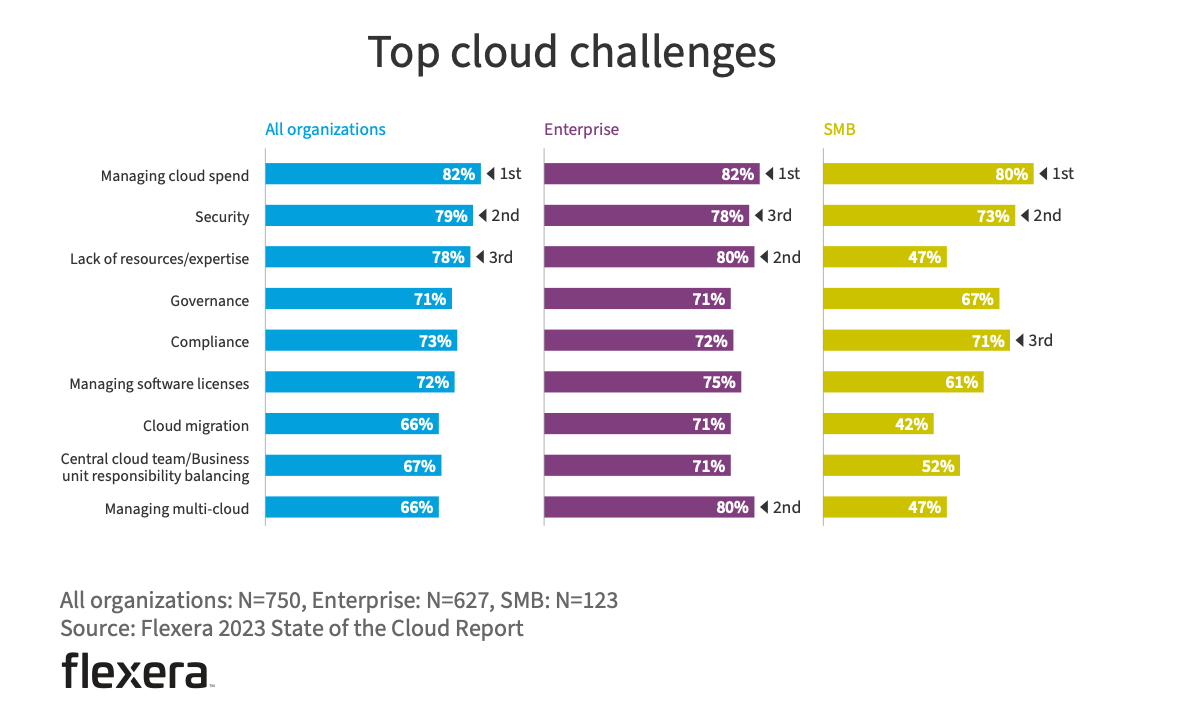
Managing cloud spend remains the #1 challenge across all organization sizes (82% overall), with security, skills gaps, and governance close behind—underscoring the growing need for FinOps, cost optimization, and cloud management discipline.
Given the current global economic volatility, 2023 marks the first time that managing cloud spend has overtaken security as the top challenge facing all organizations. This trend indicates it’s more critical than ever to get a handle on forecasting and cost optimization through FinOps practices. As we’ve seen in previous years, a lack of resources/expertise also continues to be a significant challenge.
Optimizing usage is the top cloud initiative for the seventh year running
It’s therefore not surprising that optimizing existing use of the cloud (cost savings) once again remains the top initiative for organizations, followed by migrating more workloads to the cloud. As organizations continue to embrace the cloud, they can retire the technical debt associated with maintaining and operating traditional data centers. Moving to SaaS solutions eliminates the resources required to manage equivalent on-premises software packages.
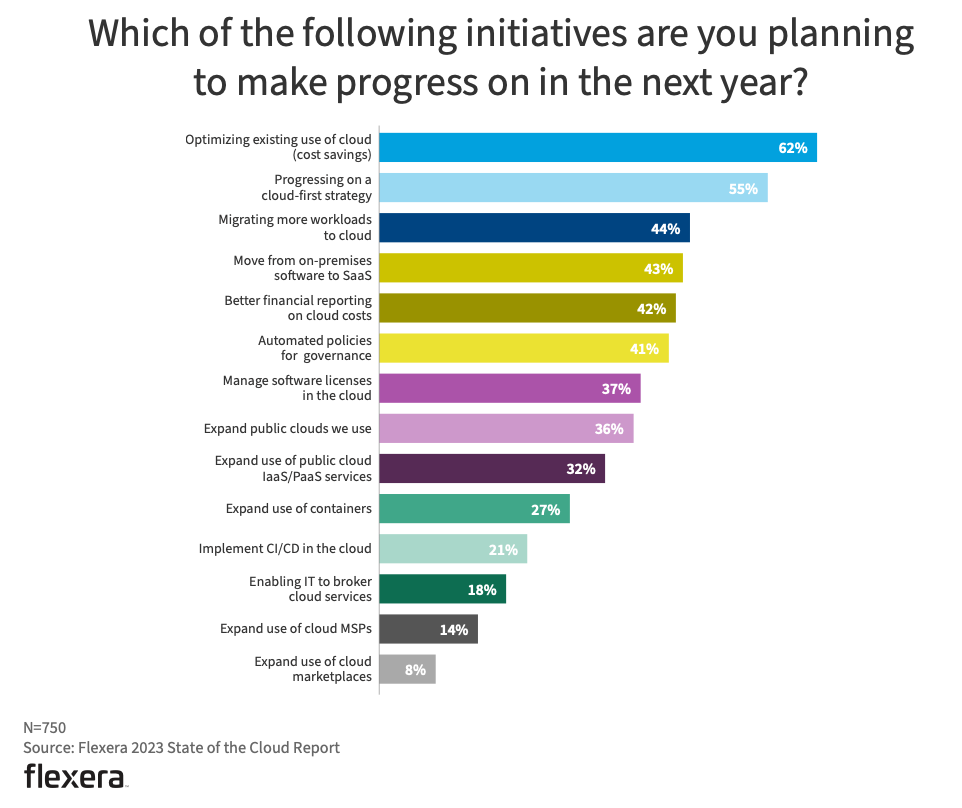
Cloud cost optimization is the top planned initiative for 62% of organizations, followed by advancing cloud-first strategies (55%) and accelerating cloud migration (44%)—signaling that FinOps maturity and cost governance are now leading cloud priorities.
Multi-cloud remains the standard
A hybrid, multi-cloud approach is still used among the majority of organizations, but there was a slight drift toward single public cloud usage from nine to eleven percent over the last year. Eighty-seven percent of respondents reported having a multi-cloud strategy, and 72 percent are taking a hybrid approach by combining the use of both public and private clouds.
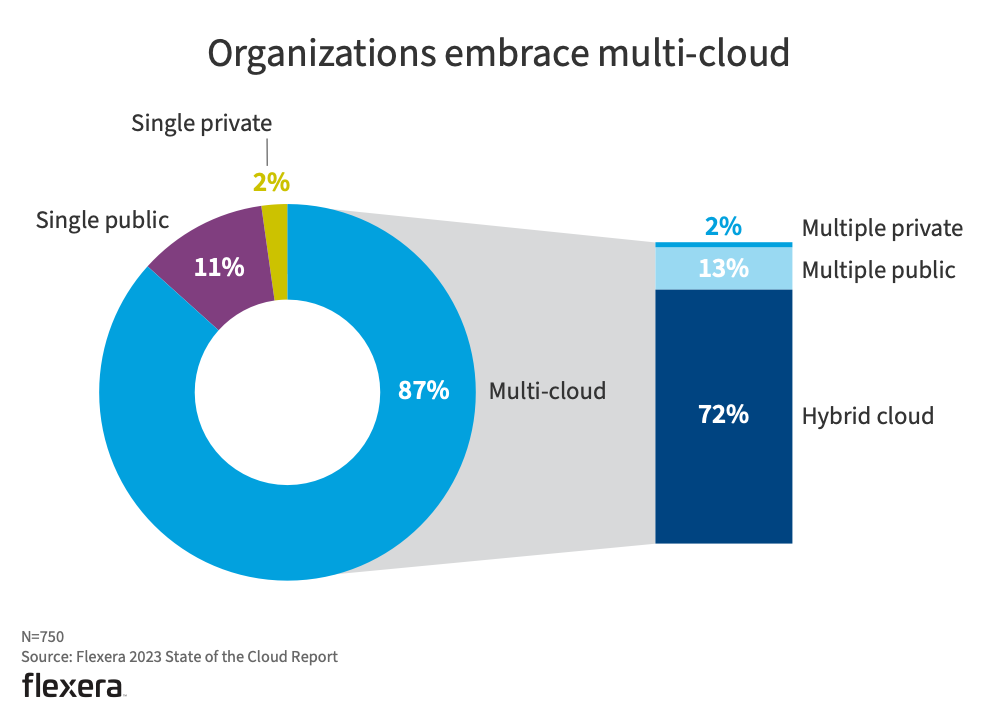
Nearly 9 in 10 organizations now run a multi-cloud strategy, with hybrid cloud leading at 72%—making multi-cloud management, governance, and cost optimization table stakes. Source: Flexera 2023 State of the Cloud Report.
Most large enterprises are using multi-cloud cost optimization tools
Across the board for all organizations, security tools continue to lead, followed closely by tools for cost optimization (FinOps). However, large enterprises reverse the order, with 68 percent using FinOps tools and 63 percent using security tools.
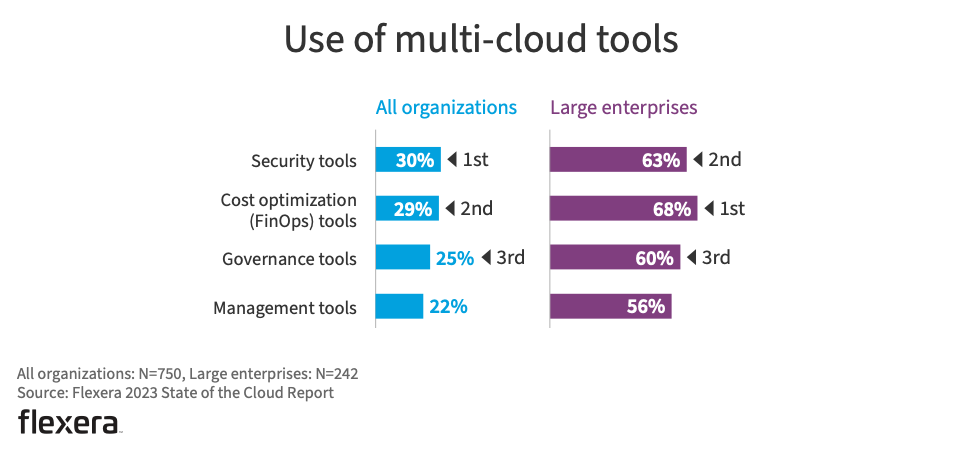
Large enterprises are doubling down on multi-cloud tooling: 68% use FinOps cost optimization tools (#1 priority), compared to just 29% across all organizations—highlighting a maturity gap in cloud cost management and governance adoption.
AWS and Azure still lead the pack of cloud providers
Last year was the first year Azure surpassed AWS in adoption rates, but the 2023 report indicates AWS is back on top, with 47 percent using the provider in significant workloads and 41 percent using Azure. Oracle, IBM and Alibaba cloud services remained relatively unchanged.
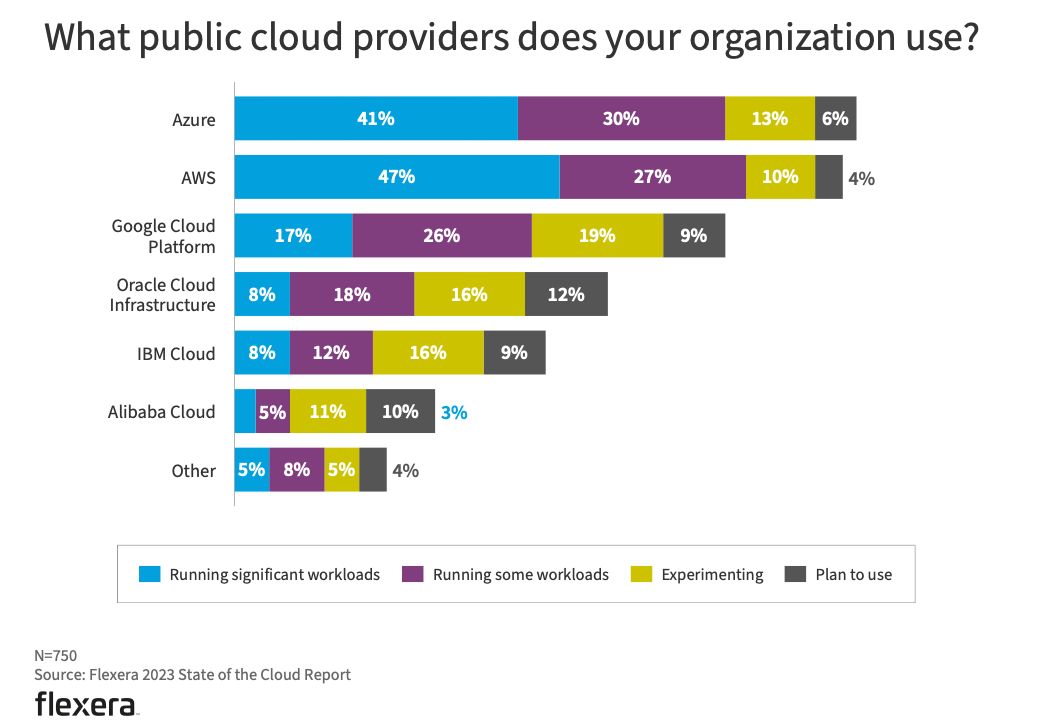
Azure and AWS dominate public cloud adoption, with 71% and 74% of organizations respectively running workloads on each platform—while Google Cloud, Oracle, and IBM trail behind, underscoring the continued two-horse race in enterprise cloud infrastructure.
Machine learning/artificial intelligence is gaining traction
Similar to last year, data warehouse is the most commonly used PaaS offering, followed by DBaaS (relational). Machine learning/artificial intelligence is being experimented with more than any other service; not surprisingly, it’s also the leading PaaS offering that organizations plan to use.
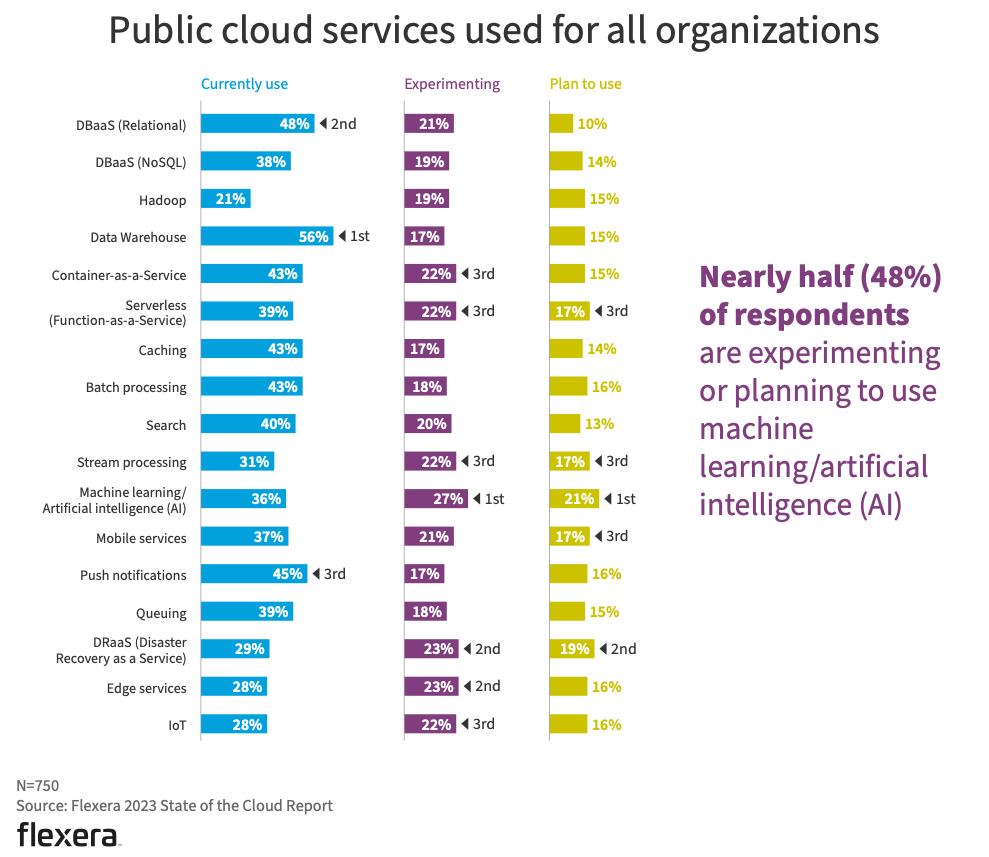
Data warehousing leads current public cloud service adoption at 56%, but AI and machine learning is the fastest-growing category—with 48% of organizations experimenting or planning to adopt it—signaling a major shift toward cloud-native AI workloads alongside established services like DBaaS, containers, and serverless.
Don’t let economic volatility slow innovation
The world has experienced extraordinary disruption in the past few years, fueled by the global pandemic, the Great Resignation and economic uncertainty. And while organizations of all sizes are prioritizing every dollar of spend, the cloud and technology will weather economic storms. Enterprises that remain focused on digital transformation, seizing new opportunities and evolving strategic initiatives through a cost-conscious lens will be better positioned for success than their competitors.
Get the latest insights in cloud computing trends and cloud migration statistics. View the report for the complete survey results.