


Key Takeaways
- FinOps has evolved from cost control to value optimization, offering a proven framework for managing AI investments
- Organizations can avoid AI cost surprises by applying FinOps practices such as accountability, governance and unit economics
- The companies that succeed with AI will focus on business outcomes, not just spending, while continuously optimizing and forecasting usage
A few years ago, cloud cost management was largely reactive. Organizations focused on understanding bills after they arrived, identifying waste and searching for savings. Today, that approach has evolved dramatically. More organizations are building dedicated teams, implementing governance frameworks and treating cloud financial management as an operational discipline rather than a one-time optimization project.
The numbers tell the story. Based on research from Flexera’s State of the Cloud reports, in 2021, optimizing cloud costs was the top cloud initiative for 61% of organizations. Cost efficiency and savings were also the primary metrics used to measure cloud success.
Fast forward to 2026, and 63% of organizations now have a dedicated FinOps team. At the same time, cloud goals have shifted beyond pure cost reduction toward delivering business value, improving financial accountability and aligning technology investments with outcomes.
Now organizations face a new challenge: AI.
GenAI adoption has moved quickly from experimentation to mainstream use. According to the Flexera 2026 State of the Cloud Report, every surveyed respondent uses GenAI in some capacity and nearly half use it extensively. Yet many organizations are still learning how to manage unpredictable AI costs, new consumption models and rapidly changing governance requirements.
The good news is you don’t need to start from scratch. Many of the same FinOps practices that transformed cloud cost management can help bring visibility, accountability and value to your AI spending.
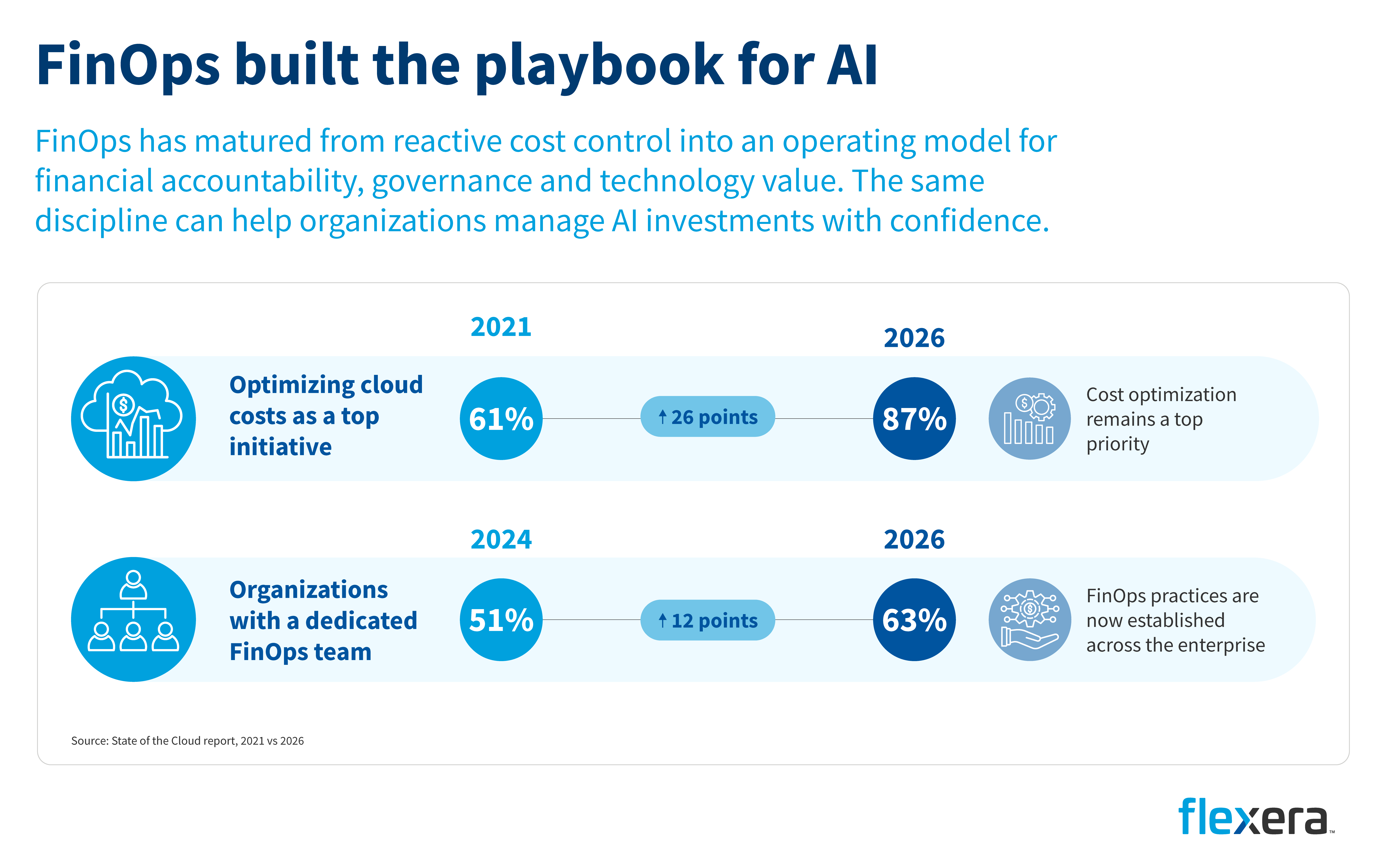
The same FinOps practices that helped organizations optimize cloud spending are now providing a blueprint for managing AI investments responsibly and efficiently
5 FinOps practices every organization should apply to AI
1. Focus on value, not just cost
One of the biggest shifts in FinOps maturity has been the move from cost savings to business value. The 2026 State of the Cloud Report found a significant increase in organizations measuring the value delivered to business units, while the importance of traditional cost-saving metrics declined. Enterprises are increasingly evaluating how technology investments contribute to business outcomes rather than simply how much they cost.
AI initiatives should follow the same approach. Instead of tracking only AI spending, consider asking:
- What business outcome did the AI initiative create?
- How much productivity did it generate?
- Did it help improve customer experiences?
- Did it accelerate decision-making?
An AI chatbot that reduces support costs may deliver value. But an AI assistant that helps service teams resolve issues faster may deliver even greater value if customer satisfaction improves at the same time.
Simply put, the most mature organizations don’t just measure what AI costs. They measure what it contributes.
2. Shift cost accountability left
One notable trend in FinOps maturity is that organizations are considering costs earlier in the planning process. Enterprises are increasingly evaluating costs before workloads are deployed rather than focusing exclusively on optimizing costs after migration. This reflects a broader shift toward proactive decision-making.
AI teams should adopt the same mindset. Before launching an AI application or selecting a model, make sure to evaluate:
- Expected usage patterns
- Data storage requirements
- Inference costs
- Training requirements
- Long-term scalability
Many AI cost challenges emerge because teams focus heavily on technical capabilities while overlooking consumption economics. By bringing financial accountability into architecture and planning discussions, you can avoid expensive surprises later.
3. Use unit economics to understand AI consumption
AI introduces pricing models that are very different from traditional infrastructure.
Cloud teams have spent years tracking compute, storage and networking costs. AI adds new dimensions such as tokens, prompts, training runs, GPU utilization and inference requests. This is where unit economics becomes essential.
The 2026 State of the Cloud Report found that 49% of enterprises now track unit metrics to improve unit economics, up significantly from last year. Organizations increasingly recognize that understanding cost in the context of business activity leads to better decision-making.
For AI, useful unit metrics might include:
- Cost per prompt
- Cost per generated image
- Cost per customer interaction
- Cost per document created
- Cost per transaction supported by AI
These measurements help teams move beyond broad spending totals and understand the actual efficiency of AI investments. They also help business leaders compare alternatives and determine where AI is creating the greatest return.
4. Establish governance before AI scales
As you mature your cloud operation, governance becomes increasingly important. Findings from this year’s report show that 71% of organizations now have a cloud center of excellence (CCOE) or similar governance function, while FinOps team adoption continues to rise. Enterprises are increasingly recognizing that financial accountability requires clear ownership, policies and oversight.
The same principle applies to AI. Without governance, you may experience:
- Duplicate AI initiatives
- Uncontrolled spending
- Shadow AI projects
- Inconsistent policies
- Limited visibility into usage
AI also introduces new challenges around security, compliance and risk management. In fact, security and compliance concerns rank as the top challenge organizations face when scaling AI workloads in the cloud.
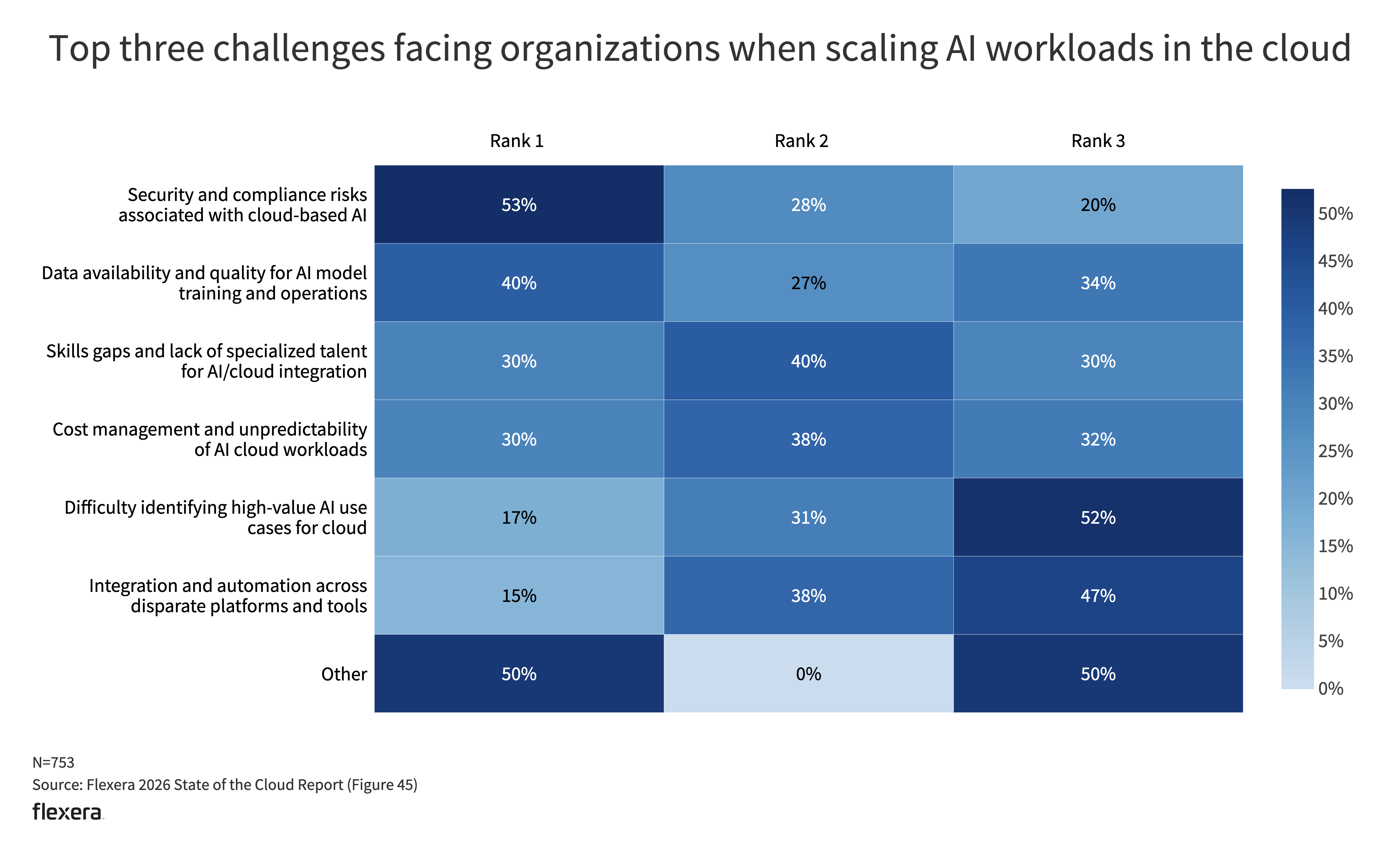
Security and compliance risks lead the list of challenges when scaling AI workloads in the cloud,
underscoring the importance of governance and risk management.
Strong governance doesn’t slow innovation. It creates the guardrails that allow you to scale AI responsibly while maintaining financial control. Make sure to define ownership, establish visibility requirements and create consistent processes for evaluating AI investments before adoption accelerates.
5. Continuously optimize and forecast AI spending
Cloud computing taught organizations an important lesson: Optimization isn’t a one-time exercise. The same is true for AI.
Managing AI workloads isn’t without its challenges, and it’s reminiscent of the top challenges faced in the early days of the cloud: Dynamic AI usage makes costs difficult to forecast. At the same time, estimated wasted cloud spend increased to 29% after years of decline, a change that may reflect the growing complexity introduced by AI and new cloud services.
Because AI workloads can fluctuate dramatically, you should continuously:
- Monitor usage patterns
- Evaluate cost trends
- Forecast future consumption
- Identify underutilized resources
- Compare model efficiency
- Review provider discount opportunities
This practice aligns closely with the FinOps Foundation’s principle of continuous optimization, where organizations balance cost, performance and business value rather than focusing on cost reduction alone.
Those who regularly review AI usage and spending are better positioned to scale successful initiatives while controlling unnecessary costs.
FinOps has evolved and AI should follow its lead
The FinOps story over the past five years is ultimately a story of maturity. In 2021, organizations were primarily focused on controlling cloud costs and improving savings. Today, FinOps teams are helping connect technology spending to business outcomes, improve governance and create greater financial accountability.
AI represents the next phase of that evolution.
The technologies may be different, but the underlying challenges are familiar: unpredictable spending, rapid innovation, growing complexity and increasing pressure to demonstrate value.
Organizations that apply proven FinOps principles to AI today won’t just gain better cost visibility. They’ll create a foundation for responsible growth, smarter investments and stronger business outcomes as AI adoption continues to accelerate.
Discover more about AI Cost Management
What is FinOps for AI?
FinOps for AI applies financial accountability, governance, and optimization practices to AI investments. It helps organizations manage AI costs, measure business value, improve forecasting, and align AI spending with business outcomes.
Why is FinOps important for AI?
AI workloads often have unpredictable consumption patterns and rapidly changing costs. FinOps helps organizations gain visibility into AIspending, establish accountability, optimize usage, and prevent unexpected cost overruns.
How can organizations control AI costs?
Organizations can control AI costs by forecasting usage, tracking consumption metrics, implementing governance policies, monitoringspending continuously, and measuring costs against business outcomes. FinOps practices provide a framework for managing AI investments efficiently.