
Key takeaways
- AI adoption is accelerating across public and private sector organizations, but public sector leaders face a different bar: governance, transparency, risk management and accountability are no longer optional considerations
- Enterprise AI programs show that visibility is the operational foundation for responsible governance, especially as organizations struggle to track AI usage, costs and software across complex environments
- Public sector leaders can apply lessons from enterprise FinOps, IT asset management and cloud governance models to build the inventories, oversight structures and financial discipline needed to scale AI responsibly
Public sector organizations are under pressure to accelerate artificial intelligence (AI) adoption while maintaining accountability, security, transparency and fiscal stewardship. Government agencies and public sector organizations are exploring AI to improve citizen services, streamline operations, strengthen data analysis and increase workforce productivity. But for public sector leaders, AI governance isn’t simply an emerging best practice. It’s becoming an operating requirement.
Federal agencies are already being pushed to establish stronger AI governance programs, maintain AI use case inventories and manage risks tied to AI systems. The White House’s archived Executive Order 14110 called for a coordinated federal approach to safe, secure and trustworthy AI, while Office of Management and Budget (OMB) memorandum M-24-10 directed agencies to advance AI governance, innovation and risk management, including through Chief AI Officers, expanded reporting and AI use case inventories. The National Institute of Standards and Technology (NIST) AI Risk Management Framework also provides a widely used foundation for managing AI risks across organizations. At the state level, AI policy activity continues to grow as legislatures evaluate how AI should be governed across public services, privacy, hiring, education and other sensitive areas.
That context changes the conversation. Public sector leaders don’t need to be convinced that AI visibility matters. They need practical ways to operationalize the visibility, oversight and accountability their organizations are already expected to deliver.
Private sectors aren’t immune to the challenges associated with AI. Investments are growing. Costs are difficult to predict. Governance structures are still maturing. Visibility into AI usage remains incomplete. he difference is that enterprise technology leaders have already spent years building governance disciplines for cloud, SaaS, ITAM and FinOps. Those lessons can help public sector organizations move from policy intent to repeatable execution.
A recent McKinsey & Company series on “rewiring” public sector organizations argues that government agencies must rethink how they operate to fully capture the value of emerging technologies. AI is a central part of that transformation, but being successful requires more than deploying new tools. It requires the governance, financial discipline and visibility needed to scale AI responsibly.
Enterprise organizations are already learning those lessons in real time. Public sector leaders can adapt them to meet a very different set of accountability expectations.
1. Rapid AI growth is creating new governance pressure
The race to adopt AI is well underway. In fact, according to the Flexera 2026 State of the Cloud Report, every surveyed respondent reports using generative AI (GenAI) in some capacity, with 81% using it either extensively or sparingly. Among public cloud services, GenAI usage increased to 58% and nearly half of respondents report extensive use.
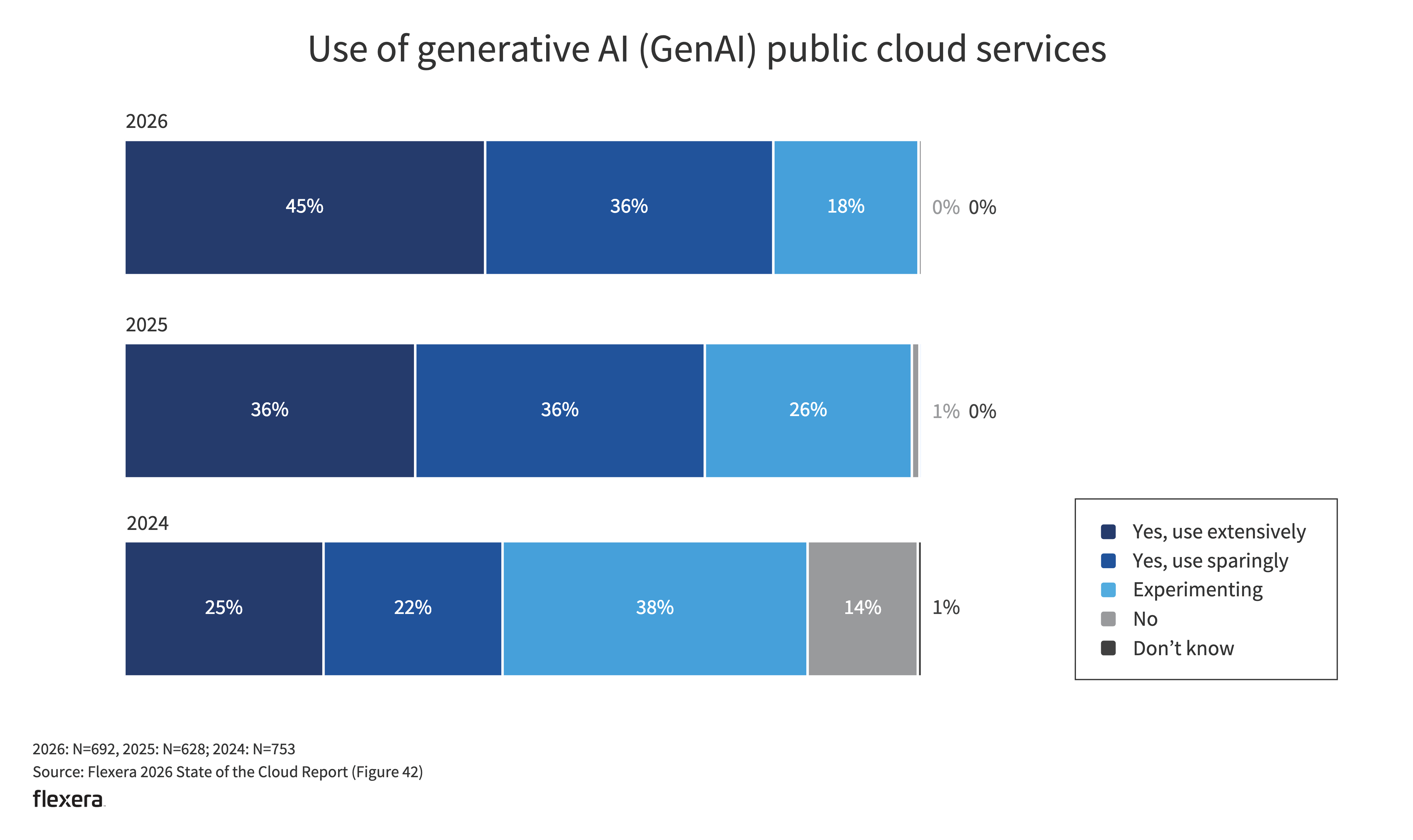
Organizations are rapidly moving from experimentation to adoption, with GenAI-enabled public cloud services now used by a majority of respondents. As AI initiatives mature, fewer organizations report having no plans to use these services
At the same time, enterprises acknowledge the need for oversight. Large enterprises are investing heavily in governance, with 85% reporting a dedicated team or senior leader responsible for AI oversight.
Public sector organizations are experiencing similar momentum, but with higher public accountability. Agencies are exploring AI-enabled citizen services, workforce productivity tools and data analysis capabilities. Yet the challenge isn’t simply deploying AI. It’s building the governance framework necessary to document AI use, understand risk, support transparency, manage costs and demonstrate value.
That’s where the public sector framing needs to shift. AI governance can’t trail adoption as a cleanup exercise. For agencies, governance must evolve alongside adoption because inventories, risk management practices and oversight structures are increasingly part of the job.
Organizations that wait to govern AI until after adoption accelerates will struggle to regain control. Public sector leaders need governance models that help them identify what AI exists, who owns it, what risks it introduces and how it supports mission outcomes from the start.
2. Visibility remains the foundation of accountability
One of the clearest lessons from enterprise organizations is that you can’t govern what you can’t see.
Flexera’s research reveals a striking gap between AI adoption and AI visibility. The 2026 State of ITAM Report finds that 84% of respondents say tracking and adopting new AI applications is now the top combined challenge, yet only 31% of organizations report having visibility into AI software across their environment.
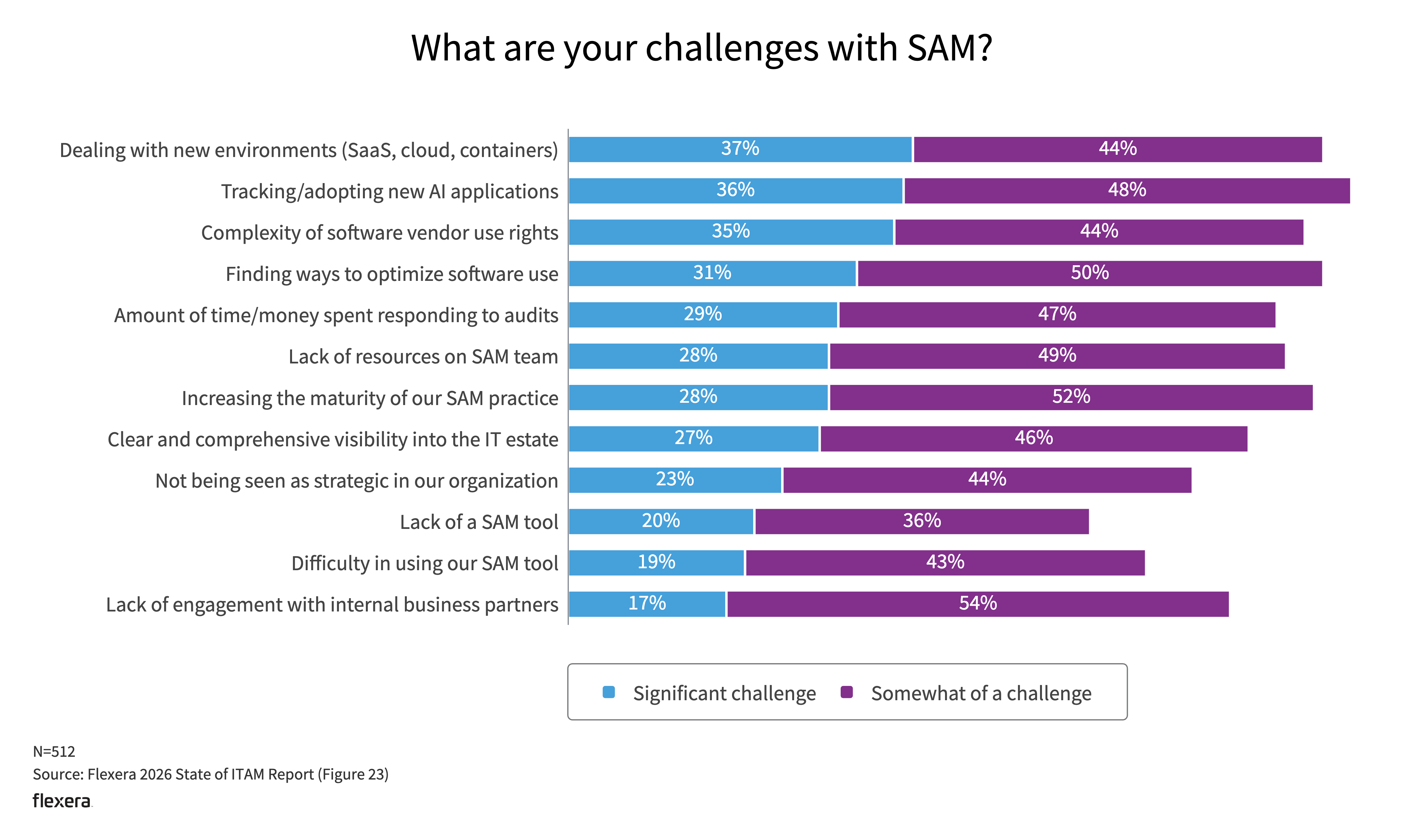
The rise of AI is creating new software management challenges. Overall, 84% of organizations report difficulty tracking and adopting new AI applications, making this the most commonly cited SAM challenge
Visibility challenges extend beyond AI applications. Complete IT visibility across organizational environments has declined to just 36%, reflecting the growing complexity introduced by SaaS, cloud services and AI tools.
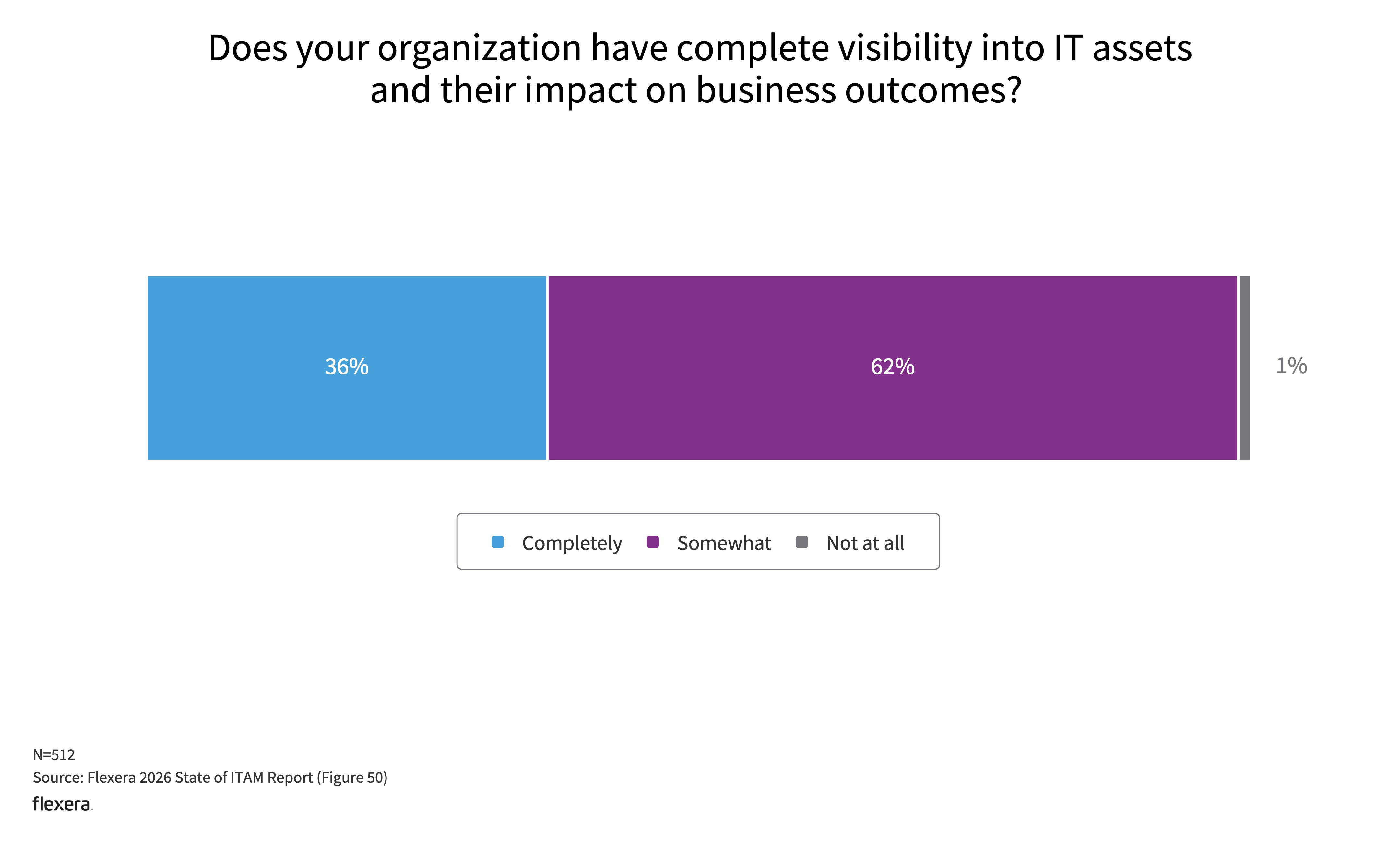
Despite growing investments in IT asset management, most organizations still lack complete visibility into their technology estate and its contribution to business outcomes
For public sector leaders, visibility has implications far beyond operational efficiency. It underpins:
- AI use case inventories
- Regulatory and policy compliance
- Responsible AI governance
- Budget accountability
- Security oversight
- Transparency to stakeholders and citizens
As agencies expand AI programs, maintaining a comprehensive inventory of AI systems, applications, models, owners, users and associated costs becomes a prerequisite for effective governance. OMB M-24-10 specifically requires agencies, with certain exceptions, to inventory AI use cases at least annually, submit inventories to OMB and post public versions on agency websites.
That requirement makes visibility a governance mechanism, not just an IT management goal. Agencies need to understand where AI is being used across formal systems, procured applications, cloud services, embedded software features and emerging productivity tools. Without that view, public sector leaders can’t consistently assess risks, answer oversight questions, control costs or show how AI supports mission delivery.
3. Cost uncertainty creates a new management challenge
Unlike traditional technology investments, AI doesn’t come with a predictable price tag. Costs can fluctuate based on usage, data volumes, cloud consumption, model interactions, licensing terms and the rapid introduction of new tools and services. As agencies move from pilots to broader deployment, many will find that AI spending can be difficult to forecast and even harder to control.
Enterprise organizations are learning this lesson firsthand. Flexera’s research shows that 59% of organizations report increased waste in AI software spending compared to last year. At the same time, overall wasted cloud spend has risen to 29%, reversing a 5-year trend of improvement as organizations grapple with the complexity introduced by AI services and evolving consumption-based pricing models.
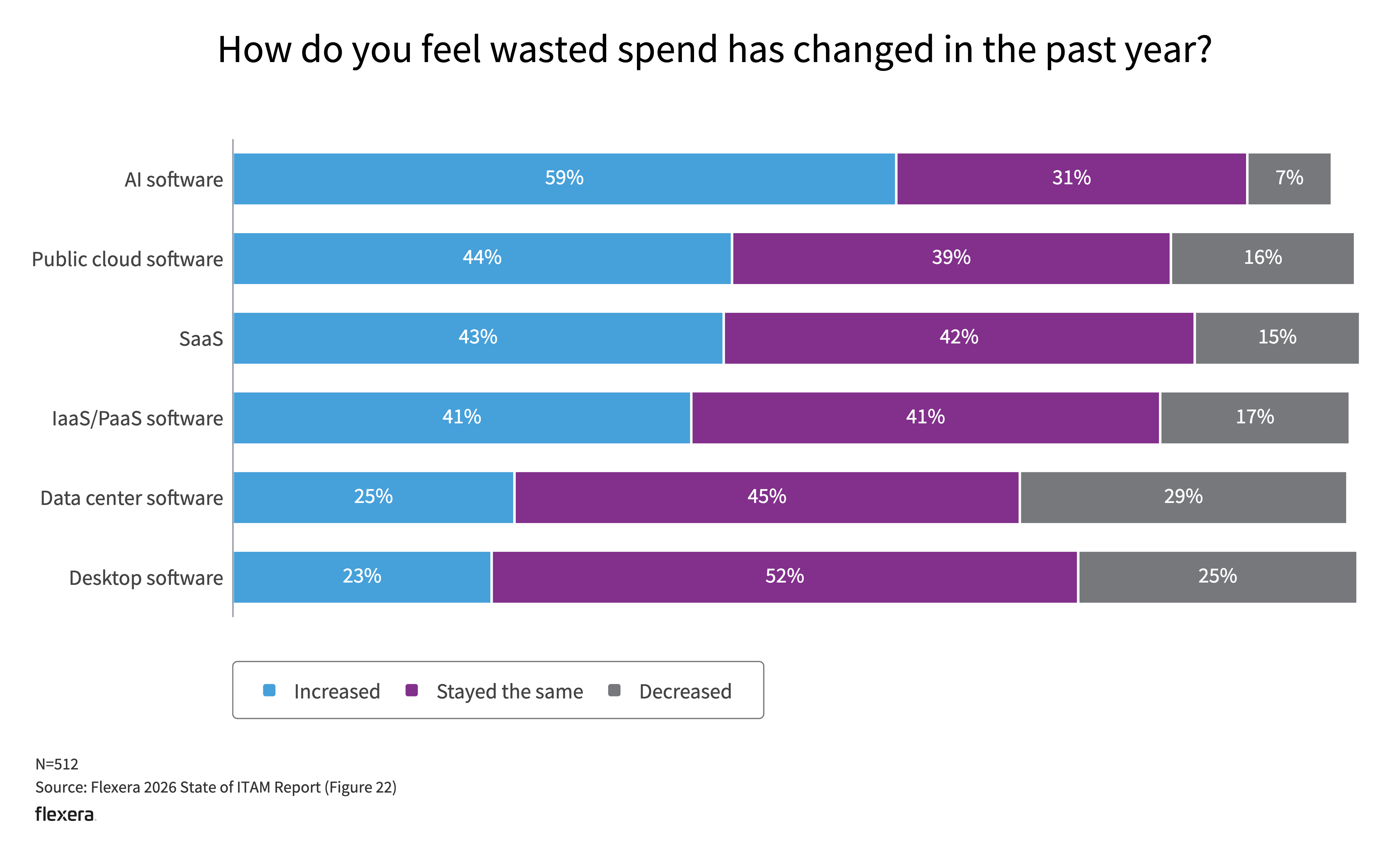
As organizations race to adopt AI, waste is becoming a growing concern. Nearly six in 10 organizations report increased waste in AI software spending, the highest of any software category measured
These findings point to a broader shift in how organizations must think about AI governance. The conversation can’t focus solely on security, compliance and risk management. Financial accountability has become equally important.
For public sector leaders, that means building governance models that can answer fundamental questions:
- Where is AI being used
- What is it costing
- Who owns those costs
- Which programs benefit
- What value is being delivered in return
Those questions matter because agencies must steward public funds while demonstrating measurable outcomes. AI experimentation can create mission value, but unmanaged growth can also create fragmented procurement, duplicate tools, underused licenses and inconsistent oversight.
As AI adoption accelerates, agencies that establish clear mechanisms for monitoring consumption, measuring outcomes and aligning spending to mission objectives will be better positioned to scale AI responsibly and sustainably.
4. FinOps offers a model for AI financial accountability
FinOps originally emerged to help organizations manage dynamic cloud spending, but its principles have since evolved to extend to other areas to maximize the business value of technology. Today, many enterprises are extending these same principles to AI, and the results are telling.
Seventy-eight percent of respondents from this year’s State of ITAM survey now have a dedicated FinOps team. Additionally, 75% of ITAM teams manage cloud software licenses, 64% manage SaaS licenses and 51% support AI spend visibility. Sixty-three percent of respondents from the 2026 State of the Cloud survey have a dedicated FinOps team, and 71% have established cloud governance teams such as a cloud center of excellence.
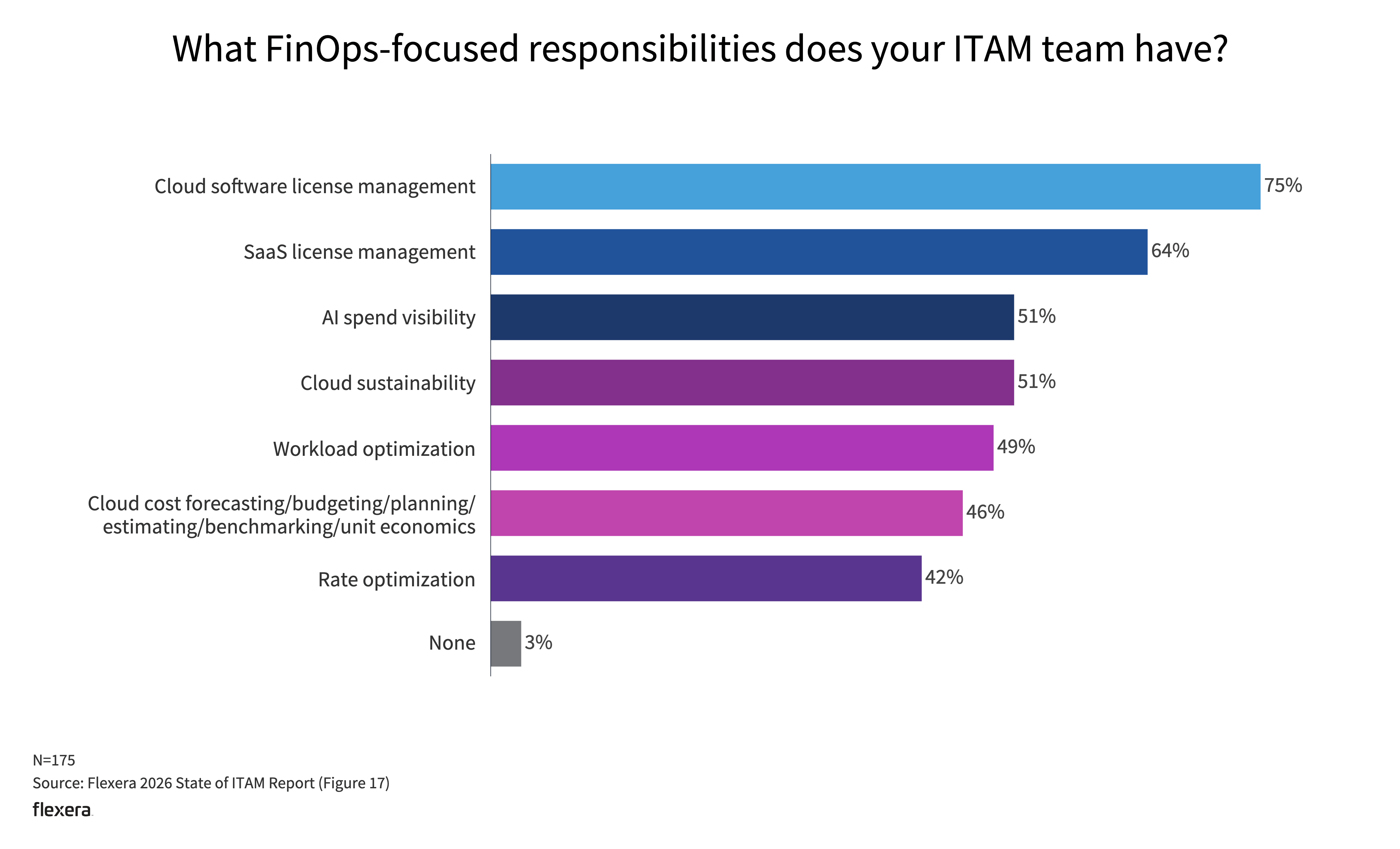
Today’s ITAM teams are helping organizations manage costs across cloud, SaaS and AI investments, making them key contributors to broader financial governance and optimization initiatives
These governance structures provide more than cost control. They create cross-functional accountability across technology, finance, procurement and business stakeholders. For public sector organizations, similar approaches can help agencies:
- Establish ownership for AI spending
- Improve budget forecasting
- Monitor AI utilization
- Track mission outcomes
- Create accountability across departments
FinOps principles are especially relevant for AI because many AI costs behave more like variable cloud consumption than fixed software purchases. Usage patterns matter. Ownership matters. Business value matters. Agencies need a way to connect spending to mission outcomes, especially when AI capabilities appear inside cloud platforms, SaaS applications and other technology investments.
As AI spending grows, financial governance will become just as important as model governance. Public sector leaders can use the lessons enterprises learned from cloud and SaaS to avoid repeating the same visibility, accountability and waste challenges with AI.
5. Centralized governance is becoming an operational advantage
Another lesson from enterprise organizations is that governance works best when responsibility is clearly defined. As technology environments become more distributed, organizations are moving toward centralized governance models that bring together finance, technology, compliance and business stakeholders.
The trend is evident across both Flexera reports. The Flexera 2026 State of the Cloud Report shows that cloud governance and FinOps teams continue to expand as enterprises attempt to manage increasing complexity. Governance responsibilities now extend beyond traditional cloud teams to include business units and software asset management teams. Similarly, the Flexera 2026 State of ITAM Report found that ITAM teams are increasingly aligned with cloud and FinOps organizations as responsibilities around software, cloud and AI converge.
Public sector agencies can benefit from a similar governance model, especially as AI oversight becomes more formally embedded in agency operations. Rather than treating AI as an isolated technology initiative, agencies can create governance frameworks that connect policy, procurement, cybersecurity, privacy, civil rights, financial management, data governance and mission delivery.
That cross-functional approach aligns with the direction of federal AI governance. OMB M-24-10 describes AI governance as deeply interconnected with data, information technology, security, privacy, civil rights and civil liberties, customer experience and workforce management. It also assigns Chief AI Officers responsibility for coordinating agency AI use, promoting innovation and managing risk.
Centralized governance doesn’t mean slowing innovation. It means creating the operating model needed to scale AI with confidence. Agencies need clear lines of ownership, consistent intake processes, repeatable risk reviews, cost visibility and inventory discipline. Without those structures, AI programs can grow faster than the organization’s ability to govern them.
At the end of the day, successful AI adoption depends on governance as much as innovation.
From experimentation to disciplined scale
The organizations making the greatest progress aren’t necessarily the ones deploying the most AI tools. They’re the ones creating repeatable processes to govern, measure and optimize those investments.
Enterprise data reveals a consistent pattern:
- AI adoption is accelerating rapidly
- Visibility remains limited
- Governance structures are expanding
- Financial accountability is becoming essential
- Cost pressures continue to grow
These same dynamics are emerging across public sector organizations, but agencies face additional pressures around mandate-driven oversight, transparency, public trust and responsible stewardship of taxpayer dollars. The goal isn’t just to decide whether AI should be used. It’s to understand where AI is already being used, how it is governed, what risks it creates, what it costs and whether it delivers measurable mission value.
Public sector organizations don’t have to start from scratch. The private sector has spent years developing governance practices for cloud, SaaS, IT asset management, FinOps and emerging AI technologies. While public sector missions differ from commercial objectives, the underlying operational challenges are remarkably similar.
The agencies that succeed will be those that treat AI governance not as a compliance checkbox, but as a strategic capability. Because in both the public and private sectors, the future of AI won’t be about who adopts it first. It will come down to who governs it best.
Ensure mission readiness with Flexera
Why is AI governance important in the public sector?
AI governance helps public sector organizations ensure transparency, accountability, security and responsible use of artificial intelligence (AI). As agencies adopt AI to improve services and operations, governance frameworks help manage risks, monitor costs, maintain compliance and build public trust in AI-driven decisions.
What can public sector organizations learn from enterprise AI governance?
Enterprise organizations have spent years developing governance practices for cloud, SaaS and AI technologies. Public sector leaders can apply lessons around visibility, cost management, financial accountability, centralized oversight and cross-functional governance to scale AI more responsibly and effectively.
What are the biggest challenges of AI adoption in government?
Many government agencies face challenges related to AI visibility, cost management, security, compliance and governance. As AI adoption accelerates, agencies must also address issues such as inventory management, usage tracking, budget forecasting and demonstrating measurable value from AI investments.
What should an AI governance framework include?
A comprehensive AI governance framework typically includes policies for responsible AI use, oversight and accountability structures, risk management processes, security and compliance controls, cost monitoring, usage visibility and performance measurement.
How can government agencies track AI applications?
Government organizations can improve AI visibility by creating centralized inventories of AI tools, implementing software asset management practices, monitoring AI usage and establishing governance processes that ensure new AI applications are identified and reviewed before deployment.
What is responsible AI governance?
Responsible AI governance is the practice of managing AI systems in a way that promotes transparency, accountability, security, fairness and compliance. It helps organizations balance innovation with risk management while ensuring AI supports organizational goals and stakeholder expectations.
How can agencies improve accountability for AI initiatives?
Organizations can improve accountability by establishing dedicated governance teams, assigning ownership for AI systems and spending, maintaining visibility into AI usage and regularly measuring performance, risk and business outcomes.