


AI has crossed the threshold from speculative R&D to the operational engine of the modern enterprise. Engineering teams deploy autonomous agents to handle complex customer workflows; product squads embed foundation model APIs directly into flagship software; and business units independently license AI-powered SaaS platforms to streamline daily work. What began as a series of isolated experiments has rapidly consolidated into one of the largest, most unpredictable line items on the corporate technology bill.
The speed of this transition has caught financial governance completely off guard. According to the Flexera AI Pulse Report, 99% of organizations are actively using or experimenting with generative AI. Yet that widespread adoption comes with immediate financial friction: 36% of organizations report overspending on AI applications, while 14% have already identified clear, unmanaged waste across their AI spend. Gartner projected that by 2026, more than 80% of enterprises will have used GenAI APIs, models, or GenAI-enabled applications in production environments.
The problem isn’t a lack of enthusiasm or executive buy-in for AI. It’s that AI introduces entirely new cost drivers that traditional governance models were never designed to manage.
For more than a decade, cloud teams built governance models around predictable infrastructure metrics: provisioned virtual machines, compute hours, gigabytes of object storage and reserved instances. AI introduces an entirely different, highly volatile set of cost drivers:
- Multi-tenant foundation model API pricing based on non-linear token consumption
- Inference costs that scale directly with user engagement rather than server capacity
- Specialized, highly constrained AI GPU infrastructure with volatile cloud pricing models
- Autonomous AI agent architectures capable of recursive, open-ended API calls
- Fragmented AI-enabled SaaS applications purchased quietly across disparate business units
- Shadow AI usage that completely bypasses central IT procurement and security filters
Enterprise leaders are discovering that while almost every department can boast an active AI initiative, few can answer fundamental financial questions: Who authorized this spend? Which foundation model requests deliver genuine business value? What is our unit cost per transaction? Where are our compute budgets leaking?
This governance vacuum has accelerated the rise of FinOps for AI. Data from the FinOps Foundation shows that 98% of FinOps teams now manage AI spend, up sharply from just 31% two years ago, making AI cost management the number-one skillset FinOps practitioners must master.
Controlling AI spend does not mean putting a brake on experimentation. Done right, FinOps for AI provides the structural guardrails that allow engineering teams to move fast without sending the organization off a financial cliff.
What is FinOps for AI?
FinOps for AI (often called AI FinOps) is the operational, cultural and technical practice of applying cloud financial management principles to the lifecycle of artificial intelligence. It establishes a shared responsibility model where cross-functional engineering, data science, product and finance teams collaborate to balance velocity, infrastructure performance and fiscal accountability.
Traditional FinOps ensures organizations get maximum business value out of public cloud platforms. FinOps for AI adapts that mission to the realities of artificial intelligence, providing a structured framework to discover, measure, allocate and optimize costs across foundation models, fine-tuning pipelines, AI infrastructure and autonomous agent systems.
At its core, FinOps for AI operates across three non-negotiable imperatives:
- Visibility: Achieving complete, unified observability into AI spend across public cloud providers, independent foundation model APIs, custom machine learning clusters and third-party AI-enabled SaaS applications.
- Accountability: Mapping AI consumption directly to the business units, applications and customer interactions that generate it, replacing vague cost pools with direct ownership through showback and chargeback mechanisms.
- Optimization: Continuously rightsizing infrastructure, refining prompt engineering architectures, leveraging prompt caching and choosing the most cost-effective models to drive down unit costs without degrading output quality.
FinOps for AI does not treat cost management as a post-quarterly audit. Instead, it embeds financial intelligence directly into the engineering workflow, turning cost into a first-class architectural metric alongside latency, throughput and model accuracy.
FinOps for AI
The shared operating discipline for AI value
| Visibility | Accountability | Optimization |
|---|---|---|
| Discover all API, GPU and SaaS spend | Direct cost ownership via show/chargeback | Rightsizing, caching and model tuning |
What is FinOps?
FinOps is an operational framework and cultural shift that brings financial accountability to the variable, consumption-based spend model of cloud computing. Historically developed by the FinOps Foundation, the methodology unites finance, technology, platform engineering and executive leadership under a single operating model.
Rather than relying on legacy, centralized IT procurement cycles where hardware was purchased upfront every three to five years, cloud FinOps enables distributed engineering teams to provision resources dynamically while maintaining clear financial control. FinOps operates on core principles:
- Teams need to collaborate continuously across organizational silos
- Technology decisions must be driven by business value rather than raw spend reductions
- Everyone shares responsibility for cloud usage and optimization
- Reports and dashboards must be accessible, normalized and delivered in near-real-time
- A centralized team enables, governs and evangelizes FinOps best practices across the organization
As modern technology estates have grown more complex, the remit of FinOps has expanded significantly. The FinOps Foundation’s State of FinOps research notes that modern teams manage SaaS applications (90%), software licensing (64%), private cloud estates (57%), and traditional data center infrastructure (48%) alongside public cloud workloads. AI represents the fastest-growing and most complex frontier within this expanded domain.
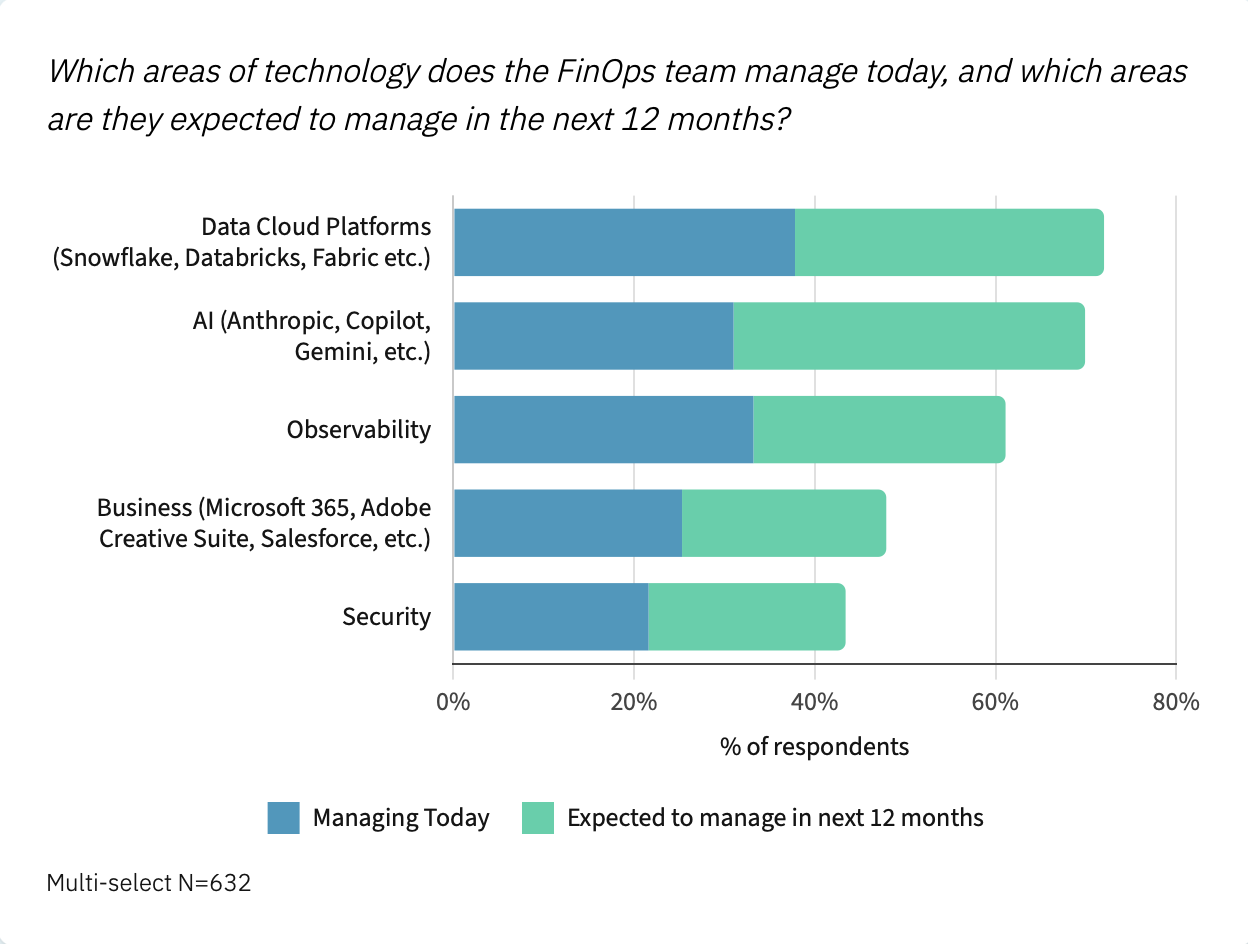
FinOps Foundation data showing areas of technology managed by FinOps teams
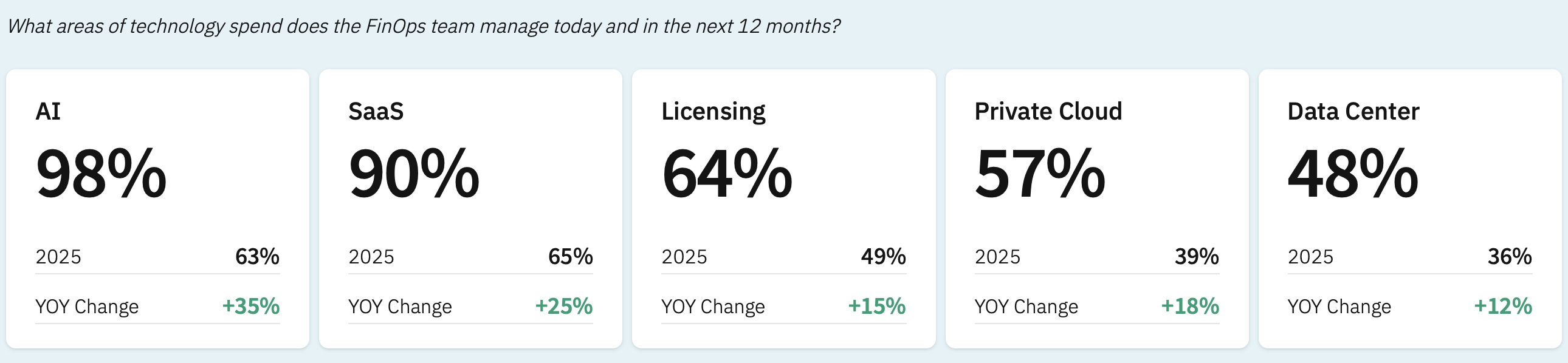
FinOps Foundation data showing areas of technology spend managed by FinOps teams
How is FinOps for AI different from traditional cloud FinOps?
While FinOps for AI inherits the cultural and organizational foundation of cloud FinOps, the underlying mechanics, unit economics and operational drivers are fundamentally distinct.
In traditional cloud environments, resource consumption is largely deterministic. If an engineering team spins up a cluster of Linux virtual machines to run a web application, the billing rate is tied to compute hours, provisioned storage volumes and network egress. The relationship between architectural decisions and cloud spend is linear and predictable.
AI environments overturn this predictability. Generative models charge by non-linear token throughput rather than uptime. An application’s cost profile can change by orders of magnitude based on the length of a system prompt, dynamic Retrieval-Augmented Generation (RAG) context injection or autonomous agent execution loops.
| Architectural Dimension | Traditional Cloud FinOps | FinOps for AI |
| Core Billing Metric | Compute hours, vCPUs, GBs provisioned | Input/output tokens, inference events, GPU hours |
| Primary Workload Unit | Virtual machines, containers, serverless instances | Foundation models, fine-tuned models, weights |
| Execution Paradigm | Static, deterministic web/backend services | Probabilistic pipelines, dynamic AI agents |
| Hardware Focus | Commodity x86/ARM CPU optimization | High-performance AI GPU clusters (H100, A100, L40S) |
| Utilization Metric | Average CPU/memory utilization percentages | GPU core saturation, Tensor Core utilization, VRAM |
| Financial Metric | Cost per VM hour, cost per gigabyte-month | Cost per token, cost per inference, cost per agent run |
| Optimization Levers | Reserved instances, savings plans, rightsizing | Prompt caching, model routing, quantization, distillation |
| Primary Value Metric | Infrastructure uptime, service availability | Unit business outcome, task completion rate, ROI |
Traditional cloud governance asks: “Is this virtual machine right-sized for our web traffic?”
FinOps for AI asks: “Are we using a $20-per-million-token reasoning model to perform a classification task that an open-weight, 8-billion-parameter model could execute for pennies?”
Why AI cloud costs are so difficult to manage
AI cloud spending behaves unlike any infrastructure expense technology leaders have previously encountered. The FinOps Foundation identifies token-based billing, specialized GPU infrastructure and volatile execution patterns as significant structural challenges.
Managing AI cloud costs requires unravelling several distinct economic variables.
Why AI cloud costs spiral out of control
| Tokenomics | Inference | AI GPUs | AI Agents |
|---|---|---|---|
| Asymmetric input/output pricing volatility |
Silent, compounding, operational scale |
Extreme cost volatility and idle waste |
Unbounded recursion and tool execution |
Token-based pricing changes everything
The primary shift in AI economics is the transition from hardware-based pricing to token-based pricing: a discipline broadly known as tokenomics.
Foundation model APIs (such as those from OpenAI, Anthropic and Google Cloud Vertex AI) do not bill based on server uptime. Instead, they bill based on inputs processed and outputs generated, measured in tokens (roughly four characters or 0.75 words of text).
The Token Cost Equation
Total Request Cost = (Input Tokens x Input Price per Token) + (Output Tokens x Output Price per Token)
This pricing model creates three significant operational hurdles:
- Asymmetric Pricing: Output tokens (generation) are typically 3x to 5x more expensive than input tokens (prompt processing) because generating tokens sequentially requires far more computational memory bandwidth and GPU time.
- Context Window Expansion: Modern models accept context windows ranging from 128,000 to over 1,000,000 tokens. While ingesting large PDFs, databases or entire codebases into a prompt makes applications smarter, it silently compounds input costs on every single query.
- Usage Unpredictability: In standard software engineering, a user clicking a button executes deterministic code with static computational cost. In generative AI, that same user interaction might trigger a 50-token response or a 3,000-token multi-page analysis, making cost per user wildly volatile.
Without real-time visibility into cost per token and price per token across environments, engineering teams can run through an entire quarter’s AI budget in a matter of weeks.
Inference costs add up fast
Early enterprise AI investments focused heavily on upfront training and fine-tuning. However, in production, AI inference costs dwarf initial training expenses over time.
Inference is the computational execution of generating an answer from a trained model in response to an input. Every user prompt submitted to an enterprise chatbot, every automated document summary processed in a background queue, every code completion accepted by an engineer and every autonomous step taken by an internal agent triggers an inference event.
At prototype scale, spending a fraction of a cent per inference feels negligible. At enterprise production scale, handling hundreds of thousands or millions of daily transactions, inference costs compound rapidly. If an enterprise supports 20,000 daily active employees, each averaging 25 model interactions a day, an unoptimized application costing $0.04 per inference generates:
Daily Inference Cost = 20,000×25×0.04 = 20,000/day
Annualized Run Rate = 20,000×365 = 7,300,000/year
Inference is an ongoing, operational tax on application scale. Unless organizations actively track cost per inference, business-critical applications can easily become victims of their own success, driving negative unit margins as user adoption increases.
GPU pricing varies widely across providers
For organizations hosting open-source foundation models (such as Llama 3, Mistral or DeepSeek) or training proprietary weights, infrastructure costs center on specialized AI compute: graphics processing units (GPUs).
Unlike commodity CPUs, AI GPUs (like NVIDIA H100s, A100s and specialized accelerators like Google TPUs or AWS Trainium) are expensive, power-hungry and historically constrained by global supply chains. As a result, GPU pricing exhibits extreme volatility across providers, geographic regions and commitment tiers:
- Pricing Discrepancies: The spot or on-demand price of an 8x NVIDIA H100 SXM5 node can vary significantly between hyperscalers (AWS, Azure, Google Cloud) and specialized GPU cloud platforms (such as CoreWeave, Lambda Labs or RunPod).
- Commitment Premiums: Reserved multi-year GPU contracts offer substantial discounts over on-demand rates, but lock organizations into hardware architectures that may become obsolete as newer chips and model optimizations emerge.
- The Idle Capacity Trap: Cloud providers bill for dedicated GPU instances by the wall-clock hour, whether the chip is processing matrix multiplications at 95% saturation or sitting completely idle waiting for an inference request. An unoptimized, underutilized H100 cluster can consume tens of thousands of dollars a month without serving a single prompt.
Did you know?
The FinOps Foundation specifically identifies GPU optimization as one of the emerging disciplines organizations must master as AI adoption grows.
The FinOps Foundation specifically identifies GPU optimization as one of the emerging disciplines organizations must master as AI adoption grows.
AI creates unpredictable consumption
The transition from single-prompt interactions to agentic AI introduces compounding financial unpredictability.
Unlike basic chatbots that execute a linear, single-turn request, AI agents operate autonomously to solve high-level business goals. To fulfill an objective (e.g., “Analyze customer support tickets, identify the top three billing bugs, open Jira tickets and draft communication to affected accounts”), an agent executes iterative planning, tool usage and reflection loops:
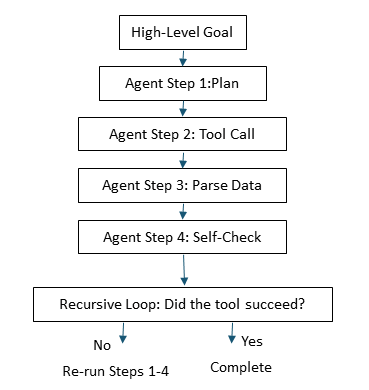
A single user-initiated task can prompt an autonomous agent to execute dozens or hundreds of downstream model calls. If an agent enters an infinite recursion loop due to an unhandled API error, a single task execution can burn through thousands of dollars of API tokens in minutes. Managing agentic workloads requires tracking cost per agent run and establishing strict execution budgets.
Shadow AI creates visibility gaps
Perhaps the most insidious driver of AI cloud costs is shadow AI: the unsanctioned deployment and consumption of artificial intelligence tools, APIs and services by individuals or departments without central IT or security approval.
Because generative AI capabilities are widely accessible, employees and development teams can spin up autonomous capabilities with a corporate credit card:
- Marketing teams subscribing to specialized content generation and image engines
- Software engineers utilizing unapproved AI coding assistants or provisioning external LLM API keys on personal cloud sandboxes
- Product groups embedding third-party AI APIs directly into microservices to meet aggressive delivery deadlines, completely bypassing enterprise procurement
According to Flexera research, IT teams are aware of only about one-third of the AI tools actually being used across their organizations.
This visibility gap creates fragmented spending, duplicate licensing, operational blind spots and significant security risks. When two-thirds of enterprise AI activity operates off the financial radar, establishing basic cost allocation or volume-based enterprise discount agreements becomes impossible.
The five pillars of FinOps for AI
Successfully governing AI cloud costs requires a structured operating framework that unites financial controls with engineering workflows.
| The Five Pillars of FinOps for AI | |
|---|---|
| Discover All AI Spending | Unified visibility across cloud, SaaS & shadow |
| Assign Ownership | Direct accountability via showback and chargeback |
| Measure AI Consumption | Track unit economics (Cost/Token, Cost/Inference) |
| Optimize AI Resources | Rightsizing models, prompt caching, & GPU packing |
| Connect Costs to Value | Measure revenue impact, productivity and ROI |
The FinOps Foundation emphasizes that an effective FinOps for AI operating model rests on five foundational pillars.
1. Discover all AI spend
You cannot optimize what you cannot see. The first pillar of FinOps for AI focuses on establishing an exhaustive, continuously updated inventory of all AI-related expenditures across the enterprise estate.
AI spend is heavily decentralized, often distributed across four distinct operational layers:
| Spending Category | Common Technologies/ Vendors | Visibility Challenge |
| AI-Enabled SaaS | Microsoft 365 Copilot, Salesforce Einstein, ServiceNow AI | Billed directly to departmental cost centers; hidden inside standard enterprise software licensing |
| Foundation Model APIs | OpenAI, Anthropic, Google Gemini, Mistral | Fragmented API keys tied to individual developer credit cards or discrete cloud projects |
| Cloud AI Services | Azure OpenAI, AWS Bedrock, GCP Vertex AI | Blended into massive, monolithic monthly cloud provider bills without standardized tagging |
| AI Infrastructure | Dedicated GPU clusters (AWS EC2 P5/G5, Azure NDv4), vector databases (Pinecone, Weaviate) | Unused, overprovisioned or orphaned compute nodes running unmonitored in development accounts |
Achieving visibility requires deploying comprehensive discovery mechanisms. Enterprise IT teams must ingest public cloud billing files, integrate API gateway telemetry, monitor single sign-on (SSO) authentication logs to catch shadow AI SaaS tools and leverage automated cloud discovery tools. Flexera research shows that up to 25% of AI applications and use-case-specific tooling are duplicated across different business units in the same company. Unified discovery identifies these overlapping tools so they can be eliminated or consolidated into master enterprise contracts.
2. Assign ownership and accountability
One of the most common reasons enterprise AI budgets spiral out of control is that no single party takes responsibility for AI consumption. Finance views AI spend as an infrastructure line item; platform engineering treats it as a developer productivity requirement; and business units treat foundation model queries as a free, limitless utility.
FinOps for AI establishes a culture of direct financial accountability. Every dollar spent on AI compute, APIs and software must map directly to an identified business owner, engineering team or product feature.
Organizations implement this accountability through two primary mechanisms:
- Showback: Finance and platform teams provide department managers and engineering leads with detailed, regular reports illustrating their exact AI consumption and associated costs. Showback creates awareness without financial penalty, encouraging teams to evaluate their consumption habits organically.
- Chargeback: AI costs are directly debited from the consuming business unit’s operational budget. If a customer service division launches an AI agent that consumes $40,000 a month in foundation model API tokens, that expense is charged directly against their department’s P&L.
When costs are allocated transparently, engineering teams naturally transition from passive consumers of AI into active participants in cost optimization.
3. Measure AI consumption
Traditional cloud management metrics such as average CPU utilization, memory consumption and disk I/O fail to capture the efficiency of AI systems. To manage AI economics effectively, organizations must introduce specialized, unit-level consumption metrics:
- Cost Per Token: Tracks the blended cost of input and output tokens across disparate foundation model providers
- Cost Per Inference: Calculates the fully loaded cost (compute, networking, model licensing) to generate an individual answer or complete a discrete AI transaction
- Cost Per User: Normalizes AI spending across an employee population or external customer base, identifying anomalous consumption patterns
- Cost Per Agent Run: Tracks the cumulative expense of multi-step autonomous workflows, surfacing runaway execution loops
- GPU Utilization: Measures whether provisioned AI compute is actively executing Tensor Core calculations or sitting idle while reserving expensive memory bandwidth
By tracking these metrics over time, organizations establish baseline operational efficiency, enabling engineers to project costs accurately as user adoption scales.
4. Optimize AI resources
Once complete visibility is established and consumption is mapped to accountable owners, teams can execute technical and architectural optimizations to eliminate waste.
Optimization in FinOps for AI spans multiple engineering layers:
- Right-Sizing Foundation Models: Moving away from the default practice of routing every prompt to the largest, most expensive reasoning model available. Simpler classification, data extraction and formatting tasks can be offloaded to smaller, highly efficient models at a fraction of the cost.
- Architecting for Prompt Efficiency: Pruning system prompts, eliminating conversational bloat and dynamically filtering context documents before sending requests to model APIs.
- Implementing Prompt Caching: Storing static prompt prefixes, system instructions and frequently queried reference documents in model memory, drastically reducing input token costs for repetitive queries.
- Maximizing GPU Utilization: Implementing dynamic batching, model quantization and autoscaling GPU clusters to zero when demand drops.
- Deprovisioning Orphaned Resources: Regularly auditing and deleting forgotten fine-tuning checkpoints, unattached persistent volumes and idle sandbox environments.
Optimization is not a one-time project. It is a continuous engineering discipline integrated directly into sprint planning and architectural reviews.
5. Connect AI costs to business value
The ultimate objective of FinOps for AI is not simply spending as little money as possible. The goal is maximizing the business return on AI investment.
A business unit spending $100,000 a month on foundation model APIs is not inherently inefficient. If that workload automates 80% of customer support inquiries, reduces ticket resolution times from hours to minutes and yields $500,000 in operational cost savings, the investment delivers an exceptional return. Conversely, an internal experimentation tool costing $2,000 a month that provides no clear utility to any team represents pure waste.
Leading organizations track value metrics such as:
- Revenue Influence: The percentage of closed sales pipeline accelerated by enterprise AI copilots
- Productivity Gains: Verified engineering hours saved via automated testing and code generation tools
- Operational Margin Improvement: The reduction in manual processing costs per customer transaction following the deployment of autonomous workflow agents
Connecting costs to value shifts the corporate conversation. AI changes from an alarming, unmanaged expense into a high-leverage business investment.
The most important FinOps for AI metrics
Managing AI economics effectively requires moving beyond high-level aggregate spend figures. Organizations need a balanced dashboard combining financial, operational and business performance metrics.
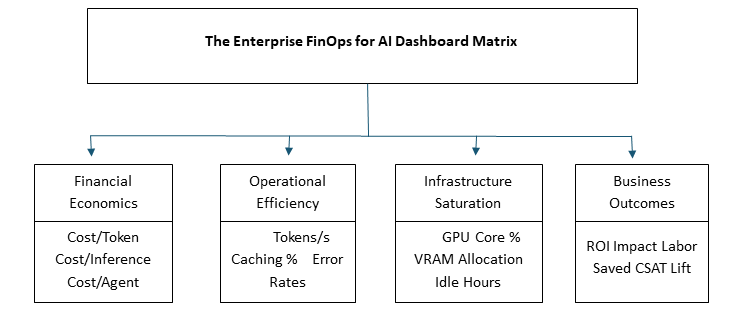
FinOps for AI metrics
The metrics below represent the core measurement standard for enterprise FinOps for AI:
Cost per token
Measures the blended expenditure for processing input and output tokens across LLM APIs. Tracking this metric at the application and provider level allows engineering teams to benchmark model efficiency and identify when prompts are driving excessive token consumption.
Cost per inference
Calculates the fully loaded operational cost to generate a single model response. This is the foundational unit-cost metric for AI products, essential for pricing customer-facing software features sustainably.
Cost per user
Tracks the average AI expenditure incurred by an individual employee or customer over a defined billing cycle. This metric quickly highlights extreme users, misconfigured accounts and underutilized enterprise SaaS seats.
Cost per agent run
Measures the cumulative cost generated by an autonomous AI agent completing a multi-step task. As agentic AI adoption accelerates, this metric prevents recursive loop runaways and helps teams establish financial circuit breakers.
AI budget variance
Compares budgeted AI operational expenditures against actual monthly run rates. Given the volatility of AI consumption, maintaining an AI budget variance under 10% signals a highly mature FinOps practice.
GPU utilization
Measures the computational saturation of provisioned graphics hardware, tracking GPU Core utilization, Tensor Core activity and allocated Video RAM (VRAM). Low GPU utilization (under 30%) on dedicated cloud instances indicates severe infrastructure overprovisioning.
AI spend by team
Attributes cloud, API and software expenditures to individual engineering groups, business departments or cost centers. This metric serves as the foundation for showback and chargeback models.
AI spend by application
Aggregates the total cost of ownership across infrastructure, API tokens, vector storage and data pipelines for a specific software product or internal automation service.
AI spend by model
Breaks down spending by individual model family (e.g., GPT-4o, Claude 3.5 Sonnet, Gemini 1.5 Pro, Llama 3 70B). This metric reveals whether development teams are defaulting to expensive frontier models where smaller, cheaper models would deliver equivalent performance.
Practical ways to reduce AI cloud costs
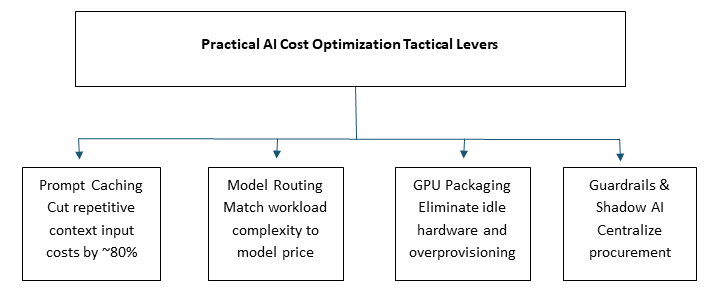
Slashing AI cloud spend does not require gutting product roadmaps or cutting access to advanced models. By executing tactical engineering optimizations, organizations can dramatically reduce operational expenses while improving overall application performance and latency.
Improve prompt efficiency
Every character sent to an LLM API costs money. Many production applications suffer from severe “prompt bloat,” passing redundant background context, unformatted JSON schemas and conversational history on every request.
Engineering teams can optimize prompt efficiency by:
- Minimizing Few-Shot Examples: Dynamic few-shot examples should only be injected when strictly necessary. Replacing extensive prompt examples with targeted fine-tuning on a small model often yields better accuracy at a lower inference cost.
- Structuring RAG Inputs: When using Retrieval-Augmented Generation, avoid passing entire documents into the context window. Use advanced semantic chunking and re-ranking algorithms to extract and pass only the top two or three relevant paragraphs.
- Strict Output Formatting: Enforce concise output formats (such as compressed JSON schemas) to reduce expensive output token generation.
Implement prompt caching
One of the most powerful cost-reduction techniques available in modern foundation models is prompt caching.
In many enterprise workloads, a massive portion of the input prompt is static: system instructions, legal guardrails, codebase repositories, or uploaded policy documentation. Without prompt caching, the model provider must process these identical tokens on every single query.
Leading providers (including Anthropic, OpenAI, and Google Cloud) offer prompt caching capabilities that allow applications to cache static context prefixes. Subsequent requests referencing the cached context receive:
- Up to an 80%–90% discount on input token costs for cached tokens
- Up to an 80% reduction in Time to First Token (TTFT) latency
For applications handling repetitive customer support or internal document search, implementing prompt caching delivers immediate, double-digit cost reductions with zero loss in output quality.
Match the model to the use case
Defaulting to the most capable, frontier reasoning model for every task is the single most common cause of enterprise AI budget waste.
Different tasks require radically different levels of reasoning capability. Routing a basic data classification or sentiment analysis request to a flagship frontier model is the computational equivalent of hiring an enterprise architect to format a spreadsheet.
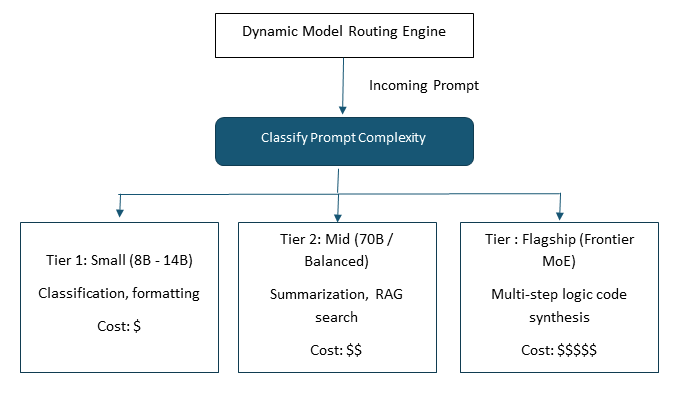
Implement an automated model routing layer that evaluates incoming queries based on semantic complexity:
- Tier 1: Small Models (e.g., Llama 3 8B, Claude 3.5 Haiku, GPT-4o-mini): Handle simple sentiment detection, text extraction, parsing and structured JSON formatting
- Tier 2: Mid-Tier Models (e.g., Claude 3.5 Sonnet, GPT-4o, Mistral Large): Handle multi-document RAG search, document synthesis, drafting communications and intermediate coding tasks
- Tier 3: Frontier Reasoning Models (e.g., OpenAI o1/o3, specialized deep reasoning modes): Reserved exclusively for complex logic, multi-step mathematical evaluation, system architectural synthesis and recursive agent planning
Eliminate idle GPU capacity
For organizations managing their own AI infrastructure, idle GPUs represent pure financial waste. An enterprise hosting a dedicated cluster of NVIDIA A100 or H100 instances to serve an internal employee tool may pay tens of thousands of dollars per month for hardware that sits completely idle outside standard business hours.
To eliminate idle infrastructure waste:
- Implement autoscaling to zero: Leverage serverless GPU architectures or modern Kubernetes orchestration engines (such as KEDA with custom vLLM metrics) that scale inference pods to zero when queue depths are empty
- Embrace multi-model serving: Use model management frameworks (like Triton Inference Server or vLLM) to load multiple specialized models onto the same shared GPU pool, maximizing VRAM saturation and computational throughput
- Leverage spot and preemptible instances: For batch inference, synthetic data generation, and offline fine-tuning pipelines, use spot GPU instances to realize discounts of 60% to 80% compared to on-demand rates
Control shadow AI
Left unmanaged, shadow AI fragments enterprise purchasing power, leaves teams paying retail prices for business software, and introduces serious security vulnerabilities.
Organizations should take proactive steps to rein in shadow AI:
- Establish an approved AI catalog: Provide employees and engineering teams with seamless, single-sign-on access to vetted, approved enterprise foundation models and AI tools. When sanctioned access is easy, shadow AI drops dramatically.
- Centralize procurement: Consolidate disparate departmental subscriptions into unified enterprise agreements with model providers, securing aggressive enterprise tier volume discounts.
- Monitor API gateway traffic: Route all internal development requests through a centralized internal AI gateway. This ensures complete observability into token consumption, enforces strict budget quotas per team, and prevents unapproved third-party API usage.
Establish spending guardrails and anomaly detection
In consumption-based environments, a silent software bug or an unhandled recursive agent loop can burn through thousands of dollars in hours.
To prevent financial runaway events, organizations must configure:
- Hard API budget caps: Set absolute monthly spending ceilings at the provider and API key level
- Real-time anomaly detection: Implement automated monitoring that flags sudden, statistically significant spikes in token consumption or API call velocity
- Agent circuit breakers: Hardcode maximum execution depth limits on all autonomous AI agents (e.g., terminating any workflow that exceeds 25 consecutive model calls without completing its objective)
FinOps FOCUS and the future of AI cost management
One of the greatest operational barriers to effective AI cost governance is the chaotic fragmentation of billing data.
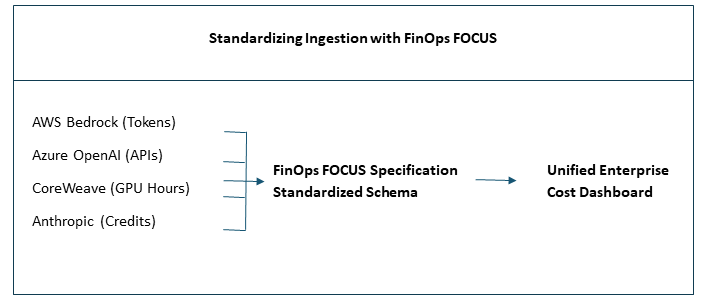
An enterprise might consume AI capabilities across five distinct vendors simultaneously: an AWS Bedrock monthly invoice, a direct enterprise contract with Anthropic, an Azure OpenAI deployment, specialized GPU instances rented through CoreWeave and AI copilot seats bundled inside SaaS contracts.
Every single vendor formats their invoice differently:
- Vendor A bills by input/output tokens in millions
- Vendor B bills by compute-seconds per inference API invocation
- Vendor C bills by the dedicated GPU wall-clock hour
- Vendor D bundles AI usage into flat per-user monthly SaaS subscription tiers
This lack of standardization forces FinOps practitioners to spend hundreds of hours manually normalizing spreadsheets rather than executing optimizations.
What Is FinOps FOCUS?
The FinOps Open Cost and Usage Specification (FOCUS) is an open-source technical specification maintained by the FinOps Foundation. FOCUS defines a standardized, vendor-neutral schema for cloud cost and usage data, establishing universal column definitions, resource metrics and pricing dimensions.
Instead of engineering custom data transformations for every individual vendor, organizations adopting FOCUS can ingest billing data from any compliant cloud or AI provider into a single, unified analytics pipeline.
Does FOCUS Cover AI and GPU Costs Yet?
AI is a top priority for the FOCUS technical working groups. The 2026 State of FinOps Report highlights that AI workloads, GPU capacity and AI-enabled SaaS services represent the most urgently demanded areas for expanded FOCUS support.
As modern FinOps teams manage AI at enterprise scale, FOCUS is expanding its specification to natively accommodate:
- Standardized token accounting (input tokens, output tokens, cached tokens)
- Normalized GPU capacity and hardware family descriptors
- Common metrics for foundation model inference invocations
By standardizing cost data across disparate ecosystems, FOCUS provides the foundational data layer required for scalable, cross-provider AI governance.
FinOps for AI vs. AI Cost Management Platforms
As enterprise leadership recognizes the urgency of controlling AI spend, organizations frequently ask: “Should we invest in building a FinOps for AI practice, or should we simply buy an AI cost management platform?”
This framing is a false dichotomy. FinOps for AI is an organizational discipline; an AI cost management platform is the technology that operationalizes that discipline.
| THE MATRIX | |
|---|---|
| FinOps for AI (The Operational Discipline) |
AI Cost Management Platform (The Technology Enabler) |
| Operating Model Defines cross-functional culture, policy and financial rules |
Software Solution
Provides automated discovery, billing ingestion and real-time dashboards |
| Governance Framework
Dictates showback/ chargeback rules and authorization workflows |
Visibility & Telemetry
Ingests data across cloud, API and SaaS providers to map exact spend |
| Accountability Structure
Determines who owns cost overruns and violates business ROI |
Analytics & Automation
Dispatches automated anomaly alerts and terminates idle compute nodes |
An enterprise cannot solve an organizational governance challenge simply by purchasing software. If a company deploys an AI cost management tool without establishing clear cost-center ownership, showback policies or architectural standards, the tool will accurately display budget overruns but no one will be accountable for fixing them.
Conversely, attempting to manage modern AI economics across dozens of platforms using manual spreadsheets is unworkable. Organizations need both:
- FinOps for AI defines how the business governs technology economics, establishes accountability and evaluates return on investment
- An AI Cost Management Platform (such as Flexera) provides the multi-cloud discovery, automated anomaly detection, centralized allocation mapping and optimization analytics necessary to execute that discipline at scale
A Crawl, Walk, Run Approach to FinOps for AI
Building an enterprise FinOps practice takes time. Attempting to deploy complex chargeback algorithms and real-time machine learning budget forecasting overnight will overwhelm engineering teams and stall adoption.
The FinOps Foundation recommends approaching implementation through an incremental Crawl, Walk, Run maturity framework.
Phase 1: Crawl (Visibility and Ownership)
The primary goal of the Crawl phase is not to cut costs but to achieve baseline operational understanding.
Core Objectives:
- Centralize Cloud & API Ingestion: Collect and aggregate billing data across major cloud providers (AWS, Azure, GCP) and prominent foundation model accounts (OpenAI, Anthropic)
- Discover Shadow AI: Conduct enterprise-wide audits of SSO access logs and expense reports to identify unsanctioned AI applications and duplicated tools
- Establish Metadata Tagging Standards: Mandate basic cloud tagging and API key naming conventions: Environment, Owner, Project and CostCenter
- Assign Direct Ownership: Ensure every active AI workload, GPU cluster and API integration has a designated engineering and business owner
- Track Basic Financial Metrics: Monitor total monthly AI spend, spend by team and budget variances
Phase Deliverables: A centralized enterprise dashboard displaying overall AI expenditure, broken down by provider, department and identified application owners.
Phase 2: Walk (Governance and Tactical Optimization)
With complete visibility established, the organization shifts toward active governance, unit-cost tracking and tactical engineering optimizations.
Core Objectives:
- Implement Showback Models: Distribute regular, itemized consumption reports to business unit leaders and engineering managers, holding them accountable for their footprints
- Track Specialized Unit Economics: Measure and track cost per token, cost per inference, and GPU utilization across production environments
- Execute High-Impact Optimizations: Deploy prompt caching on high-volume applications, institute prompt pruning and eliminate idle GPU instances
- Rationalize Tool Sprawl: Eliminate redundant departmental subscriptions and consolidate overlapping AI applications
- Implement Budget Guardrails: Configure automated billing alerts and anomaly detection triggers to catch runaway workloads
Phase Deliverables: Active showback reporting across all departments, automated spending anomaly alerts, established prompt caching architectures and measurable reductions in unutilized GPU capacity.
Phase 3: Run (Automated Value Realization)
In the Run phase, FinOps for AI evolves from a defensive cost-control mechanism into a strategic business value engine.
Core Objectives:
- Implement Full Chargeback: Direct monthly AI infrastructure and API expenditures are debited directly to the operating budgets of the responsible business units
- Automate Real-Time Model Routing: Deploy dynamic proxy gateways that evaluate incoming prompt complexity, automatically routing requests to the cheapest model capable of completing the task
- Automate Infrastructure Scaling: Implement event-driven orchestration that scales dedicated GPU clusters to zero when not actively serving inference traffic
- Correlate Costs to Business Outcomes: Connect AI unit costs directly to operational metrics measuring cost per customer service ticket resolved, revenue generated per AI-assisted workflow and net operational ROI
- Advanced Multi-Dimensional Forecasting: Use historical tokenomics and agent adoption trends to project future AI infrastructure requirements with high precision
Phase Deliverables: A fully automated AI financial ecosystem featuring dynamic model routing, automated infrastructure lifecycle management, comprehensive chargeback accounting and board-level reporting on AI return on investment.
Getting started with FinOps for AI: The implementation checklist
Enterprise leaders can jumpstart their FinOps for AI practice using this structured implementation checklist:
- Map the Entire AI Footprint: Run discovery scans across cloud accounts, API gateways and enterprise procurement logs to identify every active AI tool, platform and infrastructure cluster
- Identify and Eliminate Shadow AI: Audit corporate expense accounts and SSO identity directories to surface unsanctioned AI SaaS subscriptions
- Establish a Tagging and Attribution Standard: Mandate standardized organizational tags (Owner, Project, CostCenter, Environment) for every cloud resource and API key
- Appoint a Cross-Functional AI FinOps Working Group: Form a recurring working group comprising platform engineering, data science, technology procurement and finance leads
- Deploy Consumption Unit Metrics: Configure analytics to measure cost per token, cost per inference and average GPU utilization across core workloads
- Enforce Hard Anomaly Thresholds: Set real-time automated alerting rules to flag any daily spend spikes exceeding 20% of baseline projections
- Implement High-Impact Architectural Wins: Audit production applications to integrate prompt caching, prune system prompt bloat and eliminate idle GPU instances
- Consolidate Duplicate Applications: Merge overlapping departmental AI tools into enterprise master licensing agreements to capture volume discounts
- Tie AI Initiatives to Measurable KPIs: Establish formal business value metrics (hours saved, revenue influenced, operational costs eliminated) for every production deployment
- Establish Continuous Review Cadences: Review AI spend, unit economics and infrastructure optimization opportunities during monthly engineering architecture and finance reviews