


Key findings
- AI agents need connected, reliable context—not just powerful models—to operate effectively
- Technical debt, legacy systems and SaaS sprawl can prevent agents from seeing the full operational picture
- Strong visibility, governance and estate management are essential to scale agentic AI with confidence
AI agents promise to do more than generate content or summarize information: They can reason through tasks, orchestrate workflows and take action with increasing autonomy. But as organizations rush to put them to work, the more important question is not whether the AI model is powerful enough. It is whether the technology environment can provide the context agents need to operate effectively.
That question is central to recent McKinsey Quarterly research, which argues that the value of AI agents depends less on the model itself than on the operational data, workflow history and enterprise knowledge surrounding it. That perspective, combined with findings from Flexera’s 2026 State of ITAM Report and 2026 State of the Cloud Report, shows how fragmented estates, cloud complexity, technical debt and limited visibility can undermine AI readiness—and reveals five signs an organization’s technology foundation may not be ready for agents.
What do AI agents need to succeed?
McKinsey’s research suggests that context is becoming a strategic asset. As foundation models become increasingly similar in capability, competitive advantage shifts toward the quality of the information surrounding those models. The same agent can deliver dramatically different outcomes depending on the operational data, customer information and workflow context it receives.
That reality has significant implications for IT organizations. Most enterprises have spent decades accumulating technology. New systems were added to solve immediate business problems. Legacy platforms stayed in place because replacement costs were difficult to justify. SaaS applications proliferated as departments sought faster, more specialized solutions. The result is often an estate that works because people have learned how to navigate its inconsistencies.
AI agents don’t have that luxury. They rely on clear relationships between systems, accurate data and connected workflows. If that information doesn’t exist or can’t be accessed consistently, agents quickly reach the limits of what they can accomplish.
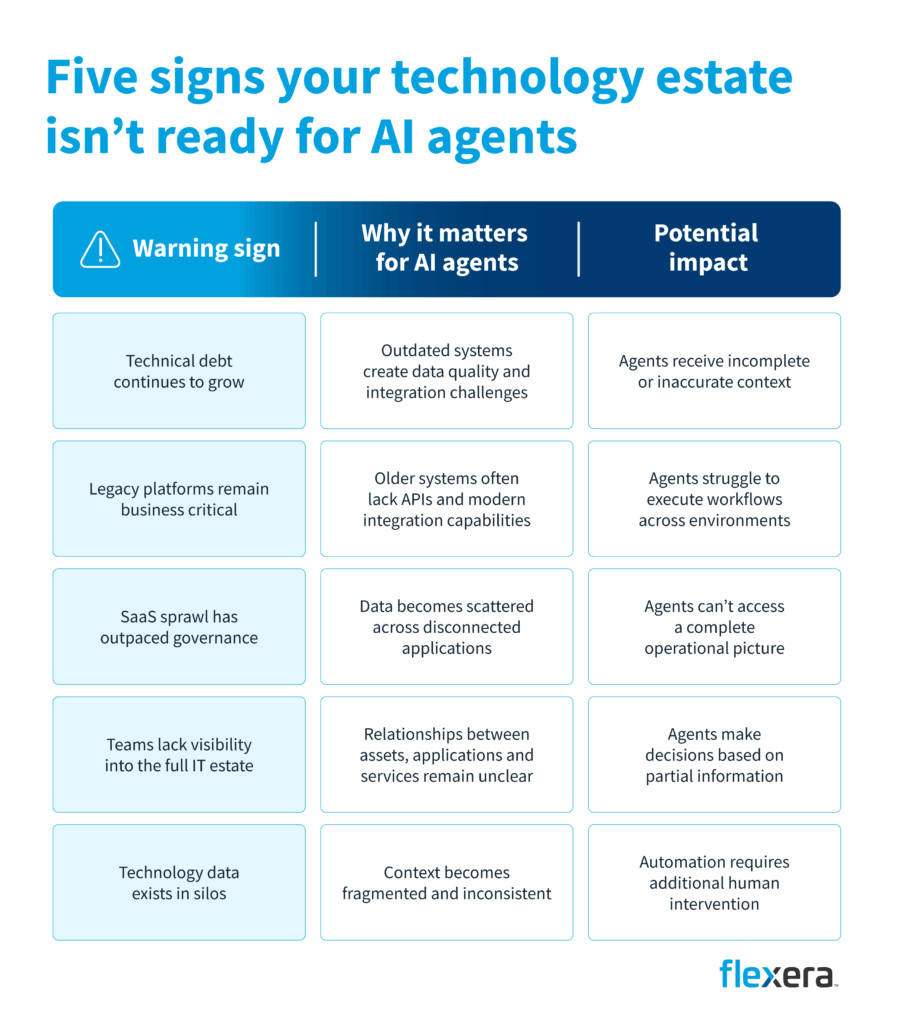
As enterprises explore agentic AI, here are five signs their technology foundations may not be as ready as they think.
Sign No. 1: Technical debt is getting in the way of visibility
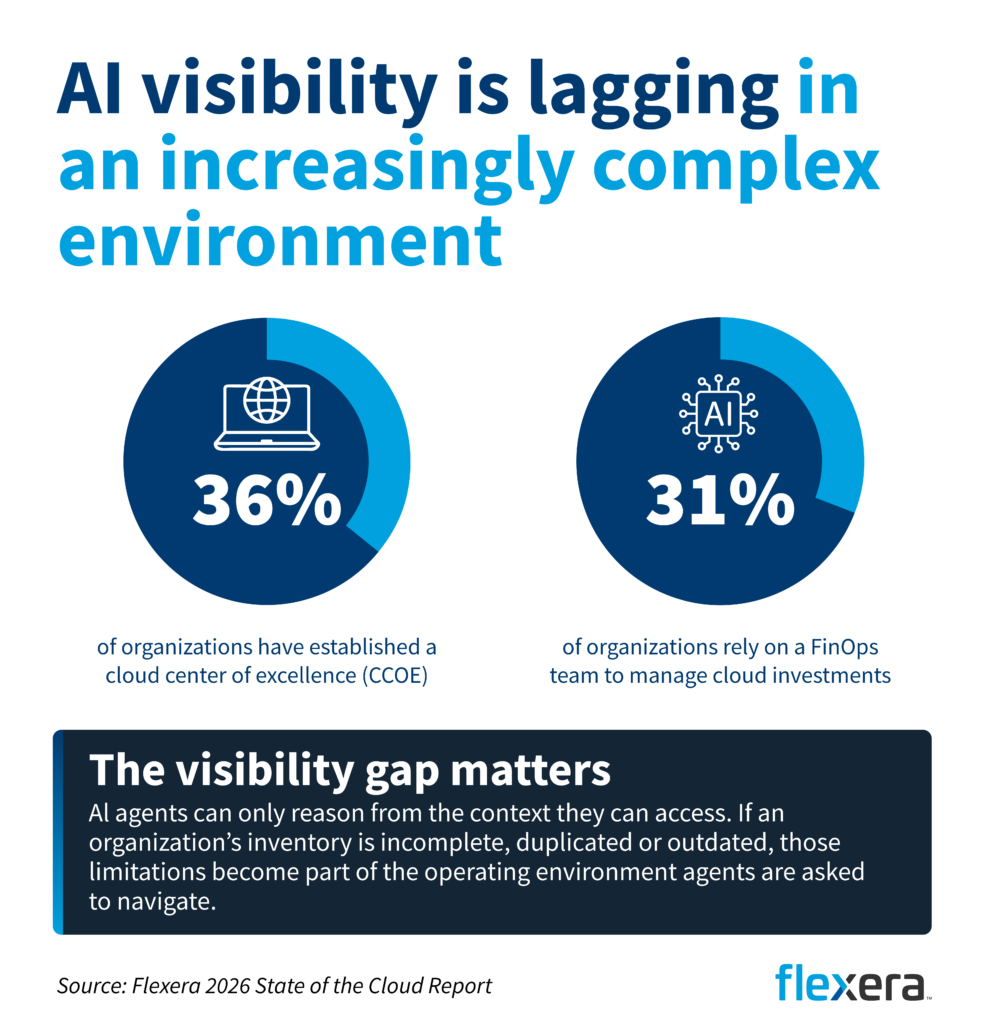
Flexera’s 2026 State of ITAM Report makes clear that many organizations are still trying to regain control of increasingly complex technology environments. Complete IT asset visibility has dropped to 36%, and while AI is quickly becoming part of the software portfolio, only 31% of organizations report having accurate visibility into AI software assets. That gap matters because AI agents can only reason from the context they can access. If an organization’s inventory is incomplete, duplicated or outdated, those limitations don’t stay confined to ITAM reports or audit prep. They become part of the operating environment agents are asked to navigate.
Most discussions about technical debt focus on cost, and understandably so. Technical debt increases maintenance requirements, slows innovation and consumes resources that could otherwise support transformation initiatives. But when viewed through an AI lens, technical debt creates a different problem as well: missing context. Older applications often contain inconsistent records, duplicate information, undocumented workflows and dependencies that only a handful of people truly understand. Over time, employees learn how to work around those issues. They know which reports to trust, where data lives and which exceptions should be ignored.
AI agents don’t possess that institutional knowledge. They depend on the quality, consistency and completeness of the information available to them. If core data sources contain inaccuracies or conflicting records, those problems become inputs into the agent’s decision-making process. The result isn’t simply that an agent makes a poor recommendation. It’s that the agent is operating from an incomplete picture of reality at the very moment organizations are hoping automation will help them move faster, reduce waste and make better decisions. That risk becomes even more significant as AI adoption accelerates and wasted AI spend continues to rise, with 59% of respondents from Flexera’s 2026 State of ITAM Report saying wasted AI spend increased year over year.
Sign No. 2: Critical business processes still depend on legacy systems
Legacy systems persist for understandable reasons. Many still run critical business processes, hold years of institutional knowledge and support operations that organizations can’t simply pause while they modernize. But the challenge becomes more complicated when those systems sit outside the broader technology ecosystem. When teams can’t clearly see how applications, infrastructure and business services depend on one another, modernization becomes harder. The same gap creates obstacles for AI agents, which need connected operational context rather than isolated systems of record.
That doesn’t mean legacy systems are automatically an obstacle to AI adoption. The issue is whether the information inside them can be accessed, understood and connected to the rest of the enterprise environment. McKinsey argues that organizations need to bring systems of record, operational data and unstructured information into a coherent information layer that agents can use. When critical workflows rely on disconnected platforms, creating that layer becomes significantly more difficult. Early pilots may still look promising because the agent is operating within a narrow set of connected data sources. The problems tend to emerge when organizations try to scale those capabilities across business functions that still depend on older, isolated systems.
At that point, the challenge shifts from building the agent to connecting it with the environment in which the work happens. A legacy platform without modern integration points may contain the right data and support the right process, yet still prevent an agent from completing the workflow. Modernizing access—not necessarily replacing the system—is what determines whether the agent can act across that process.
Sign No. 3: SaaS sprawl has created a fragmented operating model
SaaS applications have delivered undeniable benefits over the last decade. They accelerated innovation, empowered business teams and reduced dependence on long software implementation cycles. But they also introduced a different kind of complexity. As more functions adopted their own tools to solve immediate business needs, critical information became distributed across a growing number of applications, each with its own owner, governance practices, renewal cycle and integration requirements. For employees, that fragmentation is often manageable because they understand which systems matter most for their work and where to go when they need a specific answer. For AI agents, the same environment is much harder to navigate.
Agents need more than access to individual applications. They need a usable view of the business process those applications support. McKinsey’s research makes the point that proprietary context is becoming one of the key sources of advantage in an agentic world, because models become more useful when they can draw on operational data, customer information and workflow history. SaaS sprawl makes that harder when the information agents need is scattered across disconnected tools or governed differently by each business function. The issue isn’t simply application count. It’s whether those applications function as part of a connected ecosystem or as isolated islands of information.
That distinction becomes critical as organizations move from AI pilots to broader automation. Extending agentic workflows across sales, finance, procurement, IT or customer operations introduces multiple application owners, governance models and sources of truth. Without consistent controls, agents may retrieve conflicting information, repeat actions across tools or trigger workflows that require human reconciliation. SaaS sprawl therefore creates more than management overhead: It increases the coordination burden behind every automated decision.
Sign No. 4: You don’t fully understand relationships across your technology estate
One of the biggest misconceptions about AI readiness is that it depends primarily on data quality. Data quality matters, but relationship intelligence may matter even more. An AI agent doesn’t just need to know what assets exist; it needs to understand how those assets connect to applications, services, users and business processes. Without that context, it becomes difficult to assess risk, identify dependencies or predict the impact of change.
Humans can infer these relationships because they understand which systems are business critical, which integrations are fragile and which processes have downstream dependencies. Agents need those connections to be explicitly mapped and accessible. An inventory may show that an asset exists, but relationship intelligence shows what could be affected if an agent changes it. Without that understanding, an agent may complete an isolated task successfully while creating risk elsewhere in the business, making human oversight essential.
Sign No. 5: Information remains trapped in silos
The final warning sign may also be the most important because many organizations already possess much of the information AI agents need. They simply haven’t connected it in a usable way. Technology data may live in one system, financial data in another and operational metrics somewhere else entirely. Documentation is often spread across repositories, tickets, spreadsheets and team-specific knowledge bases. Individually, each source may be useful. Collectively, they often fail to provide the coherent context agents require.
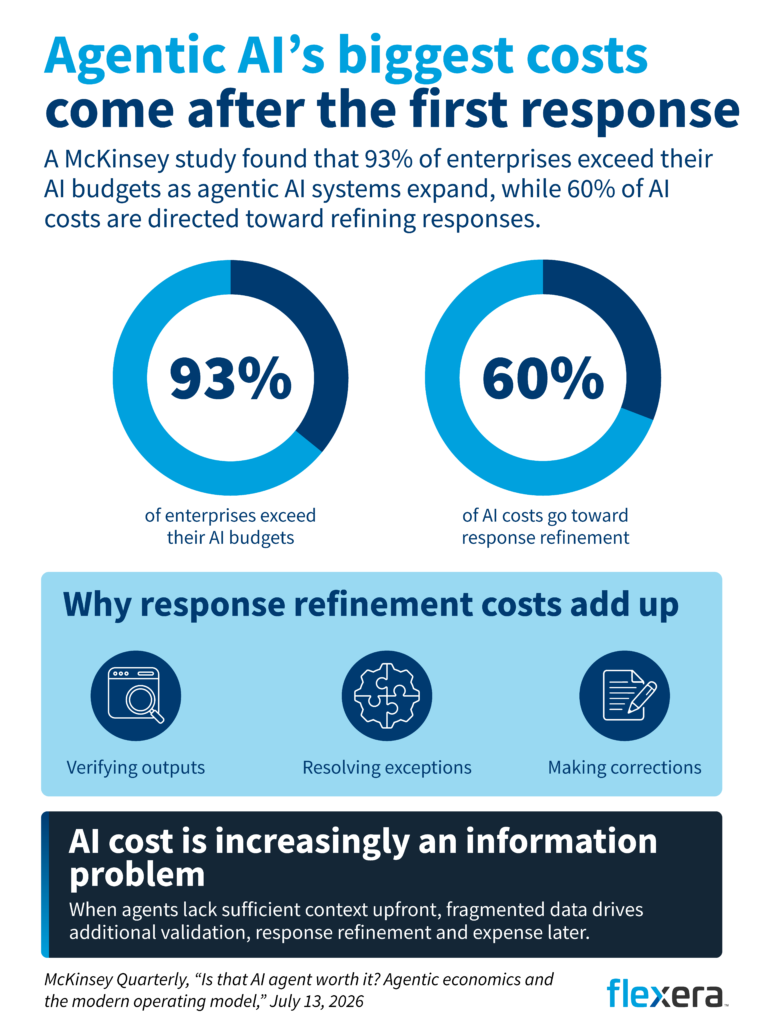
That is where McKinsey’s economic findings become especially relevant. The firm found that a significant share of agentic AI costs, 60%, can be tied to refinement rather than initial generation, which means the expensive work often happens after the first answer is produced as systems verify outputs, resolve exceptions and make corrections. Fragmented data environments contribute directly to that dynamic. When agents don’t have sufficient context upfront, they require additional validation later. Organizations may assume AI costs are primarily a model problem, but in practice, they are increasingly becoming an information problem.
The real AI readiness challenge
The conversation around AI agents often centers on technology selection: Which model should we use? Which platform should we adopt? Which vendors are moving fastest? Those are important decisions, but they are secondary to a more fundamental question: Can your technology estate provide the context agents need to operate effectively? The organizations creating the most value from agentic AI won’t necessarily be the ones with access to the most advanced models. They’ll be the ones that can connect operational data, workflow intelligence and enterprise knowledge into a coherent foundation for machine decision-making.
Technology visibility, governance and estate management determine whether organizations scale agentic AI with control or amplify existing fragmentation. A connected, well-governed environment gives agents the context to move beyond experimentation and generate meaningful business value. Ultimately, AI readiness depends as much on the estate agents must navigate as on the intelligence of the agents themselves.
Learn more about AI Cost Management
What is an AI agent?
An AI agent is a software system that can independently perform tasks, make decisions and coordinate actions toward a goal. Unlike traditional AI assistants, agents can interact with tools, access data and automate workflows with varying degrees of autonomy.
Why do AI agents need clean data?
AI agents depend on context to make decisions. Inaccurate, duplicate or incomplete data reduces reliability and often leads to additional verification, correction and human oversight.
How does SaaS sprawl affect AI initiatives?
SaaS sprawl scatters data across multiple applications, creating fragmented context. This makes it harder for AI agents to access complete information and execute workflows effectively.
Why is technology visibility important for AI readiness?
Technology visibility helps organizations understand assets, dependencies, services and relationships across the IT estate. That operational context allows AI agents to make more accurate decisions and automate workflows with greater confidence.
How can organizations assess whether their technology estate is ready for AI agents?
Organizations can evaluate AI readiness by examining data quality, system integrations, legacy dependencies, SaaS governance and visibility into relationships across assets, applications and business services. Gaps in these areas can limit the context agents need to act reliably.
Can AI agents work with legacy systems?
AI agents can work with legacy systems when the systems’ data and workflows are accessible through reliable integrations. If critical platforms are isolated, poorly documented or lack modern integration points, agents may be unable to retrieve context or complete end-to-end processes.
What role does IT asset management play in AI readiness?
IT asset management gives organizations a clearer view of the hardware, software, SaaS and AI assets in their environment. Accurate inventory and lifecycle information help teams identify duplication, manage risk and provide AI agents with more reliable operational context.
How can organizations reduce risk when scaling AI agents?
Organizations can reduce risk by starting with well-defined workflows, limiting access to approved systems and data, establishing governance and maintaining human oversight for high-impact decisions. They should also monitor agent performance and address data, integration and visibility gaps before expanding automation.