
Key findings
- AI-built software is creating a new form of shadow IT as employees increasingly generate applications, workflows and automations outside traditional procurement and governance processes
- Adoption is outpacing oversight, making visibility into AI tools, outputs, ownership, data access, risk and costs essential to scaling innovation responsibly
- As organizations gain more power to build rather than buy, enterprise software models—and the roles of ITAM, SaaS management and FinOps—must evolve beyond licenses and seats to govern AI consumption and value
AI is accelerating a shift that’s bigger than a new productivity tool or software category. It’s changing who builds software, how software gets created and what organizations need to govern.
For years, IT leaders have wrestled with the consequences of technology becoming more accessible. First, employees adopted SaaS applications without involving IT. Then cloud services gave teams the ability to provision infrastructure on demand, often outside traditional governance processes. Each wave delivered undeniable business value, but each also introduced new visibility challenges that organizations spent years trying to address.
AI is pushing that evolution one step further.
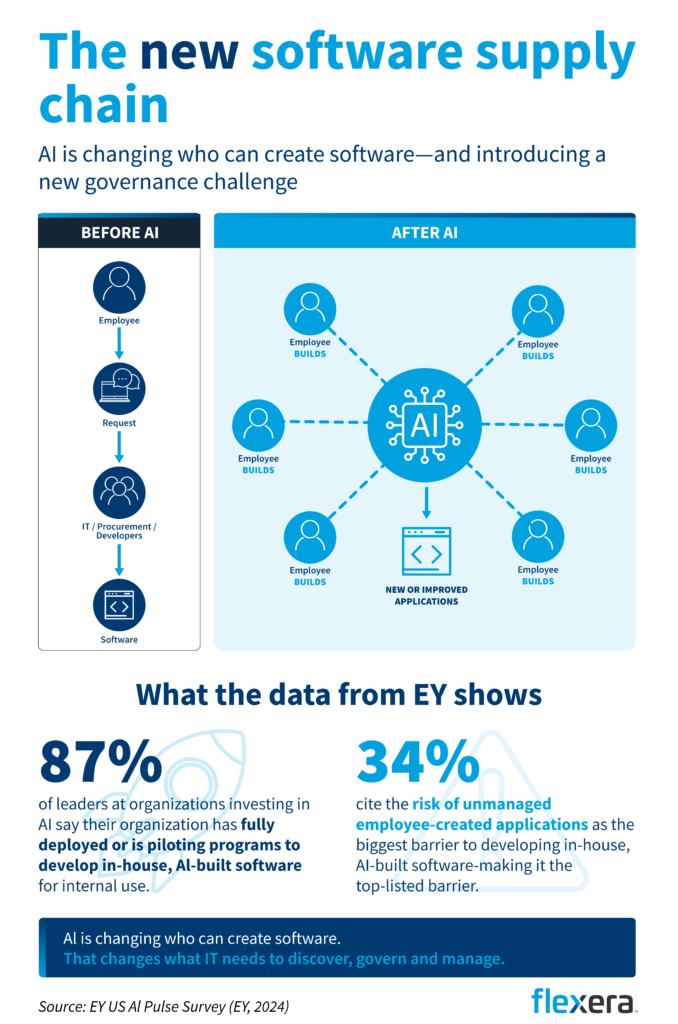
According to EY’s 2026 AI Pulse Survey Results: Wave 5 report, 87% of organizations are already piloting or deploying AI-built software internally, and 34% identify shadow IT as the biggest barrier to scaling those efforts. At the same time, AI tools are making software creation accessible to a much broader set of employees. People who once needed to request, purchase or commission software can increasingly build what they need themselves.
That shift creates a challenge that feels surprisingly familiar. The next generation of shadow IT isn’t simply being purchased. It’s also being generated, consumed, metered and billed.
From shadow SaaS to shadow software
The history of enterprise technology over the past two decades can largely be viewed through the lens of democratization. Each major technology shift has put more power into the hands of business users and individual teams, reducing friction and accelerating innovation in the process.
SaaS transformed how organizations consumed software. Rather than waiting for centralized purchasing decisions, teams could subscribe to applications that solved immediate business problems. The result was faster adoption and greater agility, but also a growing challenge around visibility, duplicate applications and unmanaged spend.
Cloud computing followed a similar trajectory. Infrastructure that once required weeks of planning could suddenly be provisioned in minutes. Organizations benefited from speed and flexibility, but they also discovered that governance frameworks weren’t built for an environment where resources could be created almost instantly.
AI-built software represents the next chapter in that story.
What’s different this time is that in addition to acquiring technology, employees also creating it themselves. Modern AI platforms can help users build workflows, automations and applications that previously would have required dedicated development resources. As those capabilities become more accessible, the traditional distinction between software consumers and software creators begins to blur.
That’s why the EY findings stand out. Organizations are concerned about AI-built software because it’s already a big part of how work gets done. The challenge then becomes whether governance practices can evolve quickly enough to keep pace.
Visibility remains the first challenge
Every major technology wave eventually runs into the same reality: Organizations can’t optimize, allocate, or defend AI investments they can’t attribute.
That was true during the rise of SaaS, when many businesses discovered they had far more applications in use than anyone realized. It was true during cloud adoption, when cost management became increasingly difficult without visibility into distributed infrastructure. And it’s becoming true again with AI.
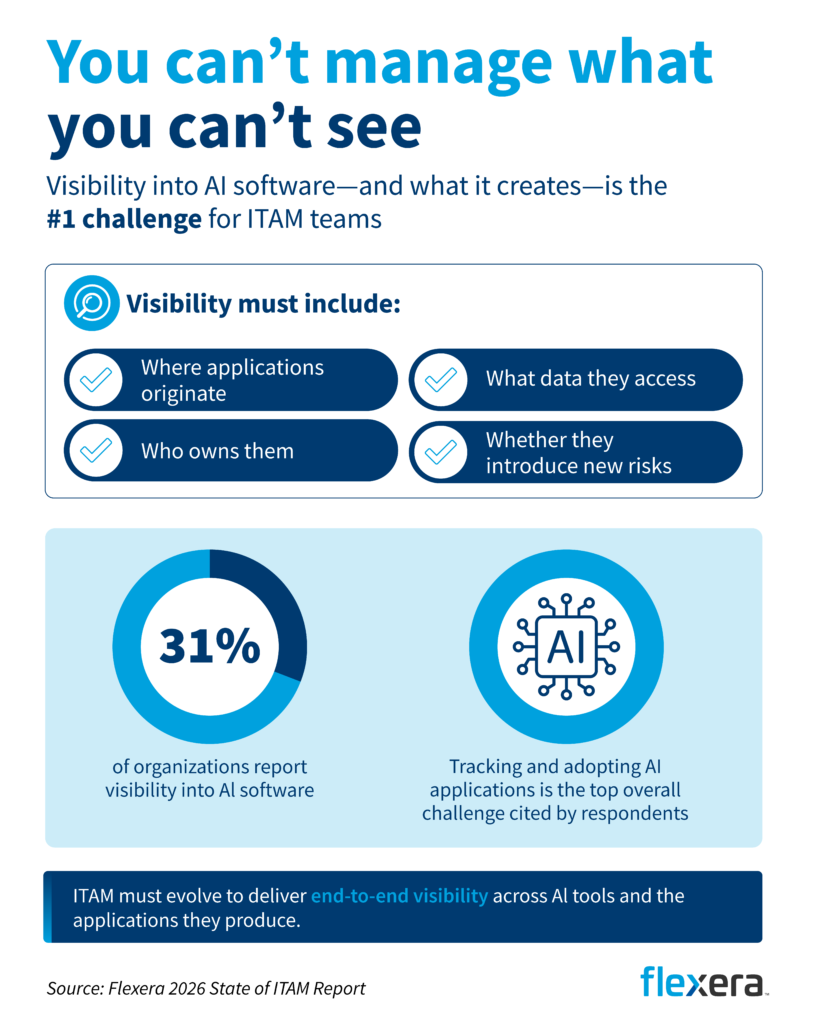
Flexera’s 2026 State of ITAM Report found that only 31% of organizations report visibility into AI software, while tracking and adopting AI applications emerged as the top overall challenge cited by respondents.
What’s particularly interesting is that visibility no longer applies only to the tools employees are using. Organizations must also understand what those tools are producing. As AI-generated applications become more common, technology leaders need insight into where those applications originate, what data they access, who owns them and whether they introduce new compliance, security, cost and licensing risks.
That challenge has implications beyond governance; it also affects efficiency. Without visibility, organizations risk creating multiple AI-generated solutions that solve the same problem, introducing a new form of technology sprawl at precisely the moment they’re trying to simplify their environments. Duplicate AI-generated solutions can also duplicate token consumption, embedded AI subscriptions, data-cloud workflows and GPU or container spend, creating a new category of waste before teams know it exists.
The lesson from previous technology shifts still applies: Visibility isn’t what slows innovation down. It’s what allows innovation to scale sustainably.
AI governance and cost accountability are lagging adoption
The contrast between AI adoption and AI governance may be one of the most important takeaways from looking at both Flexera and EY’s research.
Organizations clearly recognize the potential value of AI. Flexera’s 2026 State of the Cloud Report found that every respondent reported using generative AI in some capacity, with 81% saying they have moved beyond the experimental stage. At the same time, less than half (47%) of large enterprises have a dedicated AI governance team or leader.
Those findings suggest many organizations are experiencing a familiar pattern. The business opportunity is clear, adoption accelerates quickly and governance efforts follow behind.
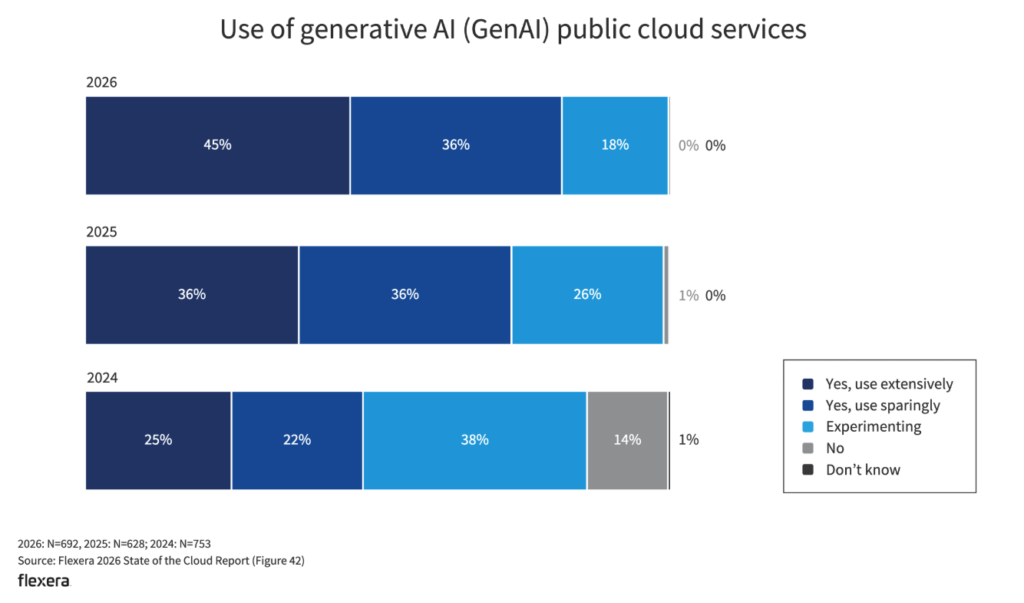
GenAI public cloud adoption is shifting from experimentation to extensive use
That approach often works in the early stages of a technology shift. The challenge emerges when experimentation turns into operational dependency. A shadow SaaS application might create a procurement problem. An AI-generated application can create governance, security, compliance, operational and cost challenges simultaneously because it may influence business processes and decision-making, trigger token usage, cloud consumption, data movement and downstream workflow costs.
As AI becomes embedded into everyday work, governance can no longer focus solely on the tools themselves. It must also address the software, workflows and business processes those tools make possible.
The enterprise software contract is being rewritten
The rise of AI-built software may also signal a deeper shift in how organizations think about enterprise software itself.
For decades, software vendors effectively owned the answer to a simple question: How do we solve this business problem? Organizations evaluated products, selected a vendor and purchased licenses. While competition existed, most companies still depended on commercial software providers to deliver the capabilities they needed.
AI has the potential to change that dynamic.
According to EY, 91% of organizations see AI-built software as a way to reduce dependence on enterprise software vendors. Meanwhile, 76% believe off-the-shelf software no longer fully meets their needs, 95% expect vendor relationships to change and 82% believe per-seat SaaS pricing will become less relevant.
Taken together, these findings point toward an emerging possibility: Organizations may increasingly choose to generate software tailored to their specific requirements rather than purchase standardized functionality. Nowadays, instead of managing only licenses and seats, leaders must now manage seats, tokens, credits, assists, conversations, data-cloud consumption and compute infrastructure, often across multiple vendors and buying centers. .
Most organizations will continue to rely on strategic technology partners, but a change in the balance of power in the relationship will be necessary. When companies have more options for creating capabilities themselves, software purchases become one choice among many rather than the default path forward.
Flexera’s 2026 State of ITAM Report found that 47% of organizations are negotiating software contract terms with vendors, up from 33% the previous year. While the research doesn’t identify the reason behind that increase, it does suggest organizations are taking a more active role in evaluating software value and challenging long-held assumptions about software spending.
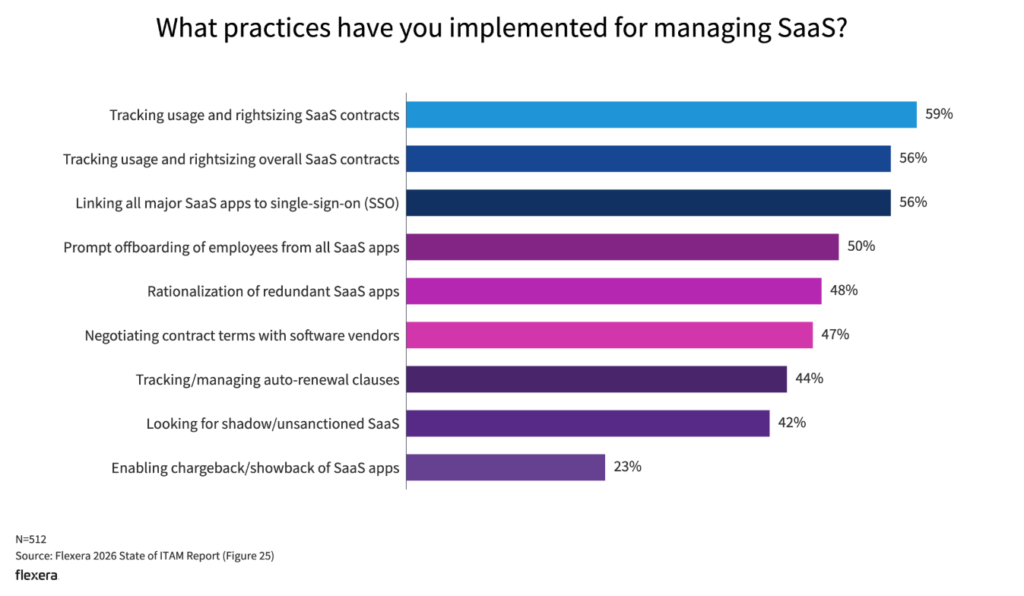
Nearly half of respondents in Flexera’s 2026 State of ITAM Report negotiate contract terms with software vendors to manage SaaS, a sharp increase of 15 percentage points from last year
What this means for ITAM, SaaS management, FinOps and AI cost management
If AI makes software creation easier and more accessible, technology management disciplines will need to evolve alongside it.
Software asset management, for example, has historically focused on purchased software. Increasingly, teams may need visibility not only into licensed applications but also into AI-generated workflows, tools and applications that exist outside traditional procurement channels.
Vendor management may experience a similar shift. As organizations gain more flexibility in deciding whether to buy or build, vendor relationships become less about licensing transactions and more about strategic value creation. Technology leaders will need to evaluate which capabilities are best sourced from vendors and which can be developed internally through AI-powered platforms.
Portfolio management also becomes more complex. As AI lowers the cost and effort required to create software, organizations could see an explosion of highly specialized applications designed to solve narrow business problems. Managing the portfolio may become less about selecting software and more about determining which solutions continue to deliver value over time.
In that environment, the disciplines that helped organizations navigate SaaS sprawl and cloud complexity become even more important. Visibility, accountability and cost optimization remain foundational capabilities, regardless of whether software is purchased, subscribed to or generated through AI.
The lesson from previous technology waves
Every major technology shift promises greater speed, agility and innovation. What ultimately determines success, however, is an organization’s ability to create enough visibility and governance to support that innovation at scale.
SaaS taught organizations that unmanaged applications eventually become a business problem. Cloud reinforced the importance of governance, accountability and cost management. AI-built software appears poised to follow a similar trajectory, but at a pace that far exceeds previous technology waves.
Viewed through that lens, the EY findings aren’t just about shadow IT. They’re about what happens when software creation becomes democratized in the same way software purchasing once did.
The organizations that thrive in this new environment won’t necessarily be the ones that adopt AI the fastest. They’ll be the ones who can say what they spend on AI, who or what is spending it, and what they get for it. To do that, they’ll need visibility, governance and optimization across every layer where AI cost is created.
The shadow IT problem didn’t disappear. It simply learned to code.
Learn more about AI Cost Management
What is AI-powered shadow IT?
AI-powered shadow IT refers to applications, workflows and automations employees create or use with AI outside traditional IT procurement, visibility and governance processes. Unlike earlier shadow IT, these solutions may be generated internally rather than purchased.
Why is AI-built software creating a new shadow IT challenge?
AI tools enable more employees to create software without dedicated development resources. This can accelerate innovation, but it can also produce untracked applications, duplicate solutions, unmanaged data access and unexpected technology costs.
How widespread is AI-built software in enterprises?
EY reports that 87% of organizations are piloting or deploying AI-built software internally. The research also found that 34% identify shadow IT as the biggest barrier to scaling those efforts.
Why is visibility important for AI governance?
Organizations need visibility into which AI tools and applications are in use, what they produce, who owns them, what data they access and what risks or costs they introduce. Without that insight, leaders cannot govern, optimize or attribute AI investments effectively.
What risks can unmanaged AI-generated applications create?
Unmanaged AI-generated applications can introduce security, compliance, licensing, operational and cost risks. They may also duplicate existing solutions and increase spending on tokens, subscriptions, cloud resources, data movement and compute infrastructure.
How could AI-built software change enterprise software purchasing?
As organizations gain the ability to build tailored applications with AI, buying off-the-shelf software may become one option rather than the default. This could shift vendor relationships away from per-seat licensing toward models based on usage, tokens, credits, data and compute consumption.
How should ITAM, SaaS management and FinOps adapt to AI-built software?
These disciplines should expand visibility beyond purchased applications and licenses to include AI-generated tools, workflows and consumption. Teams will need shared accountability for ownership, business value, risk and costs across the full AI technology portfolio.