

Key takeaways:
- AI adoption is accelerating across the public sector, but many organizations are still struggling to move beyond pilots because they lack visibility into where AI is being used, who owns it and what value it delivers
- Visibility is becoming a foundation for responsible AI governance, helping agencies manage security, compliance, privacy, risk and public trust as AI becomes embedded across cloud, SaaS and everyday workflows
- As AI investments grow, public sector leaders need a clear view of usage, costs and outcomes so they can scale the right initiatives responsibly, reduce waste and make every taxpayer dollar count
Across government agencies, education institutions and other mission-driven organizations, leaders are exploring how artificial intelligence (AI) can help them deliver services faster, reduce administrative burden and make better use of limited resources.
According to Flexera’s 2026 State of the Cloud Report, AI has become a mainstream part of cloud operations, with every organization surveyed using GenAI in some capacity and nearly half (45%) using it extensively. AI-powered capabilities are also becoming embedded in the SaaS applications employees already use every day.
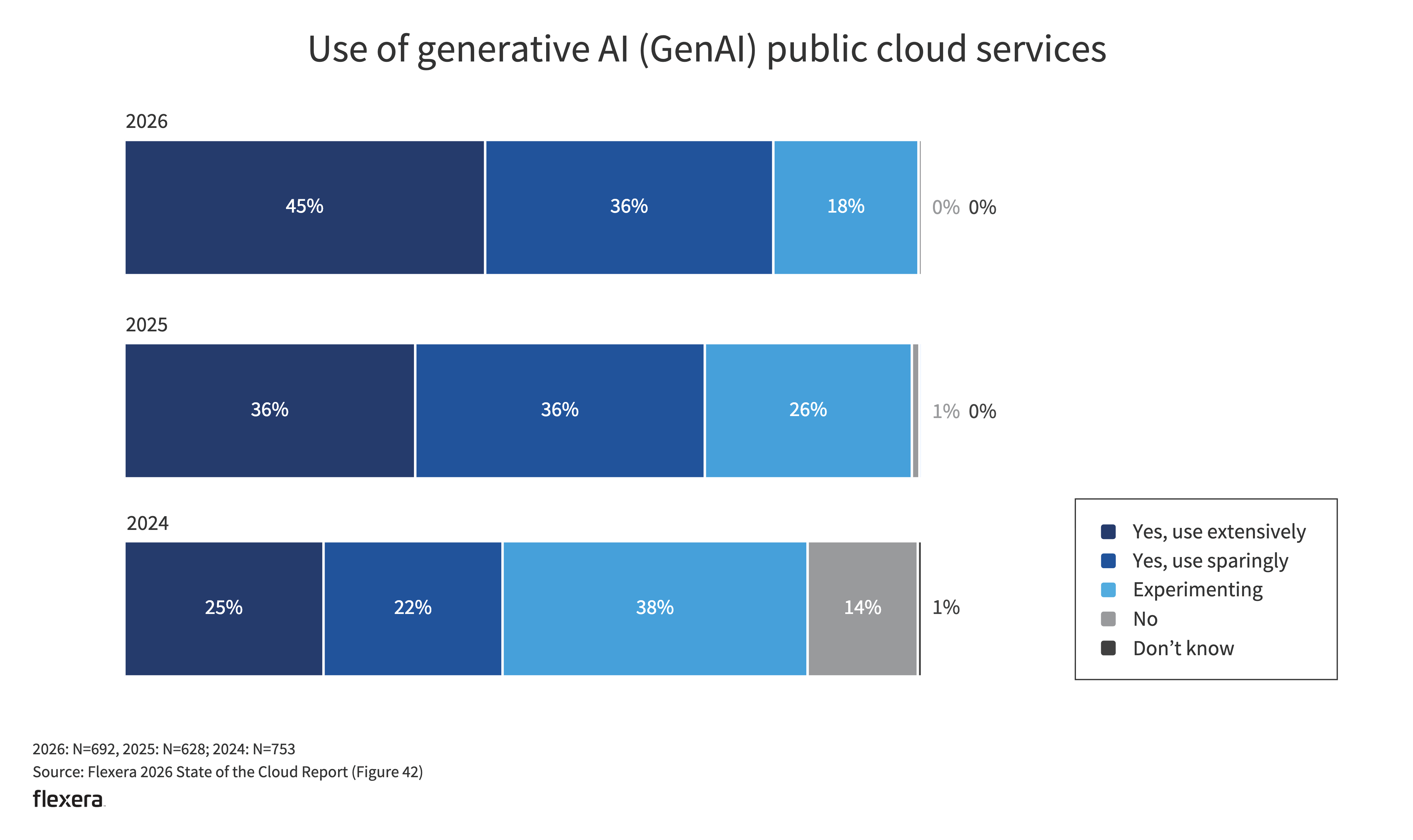
As GenAI becomes more integrated into daily workflows, its applications are taking shape across the organization, from helping teams analyze information and automate routine tasks to improving how services are delivered
For public sector leaders, that momentum matters. Agencies are under pressure to improve outcomes for residents, modernize operations and make every taxpayer dollar go further. McKinsey & Company makes a similar point in their recent series, How can the public sector meet the AI moment?, arguing that AI can help public sector organizations improve efficiency and service quality, but that real impact requires moving beyond isolated pilots and “rewiring” how services are delivered.
But that’s where many organizations get stuck. The challenge isn’t convincing people that AI has potential. The challenge is figuring out what happens after the pilot. McKinsey & Company notes that many AI efforts remain caught in “pilot purgatory,” struggling to scale because of issues related to data access, workflow integration, model risk and ongoing operating costs.
For public sector organizations, those hurdles can be even more complicated. Agencies aren’t just optimizing for speed or cost. They also have to balance access, fairness, transparency, due process, privacy, security and public trust. AI has to work within real operational constraints, and it must support the mission without introducing new risks.
That’s why visibility matters so much. Before an agency can scale AI responsibly, it needs to understand where AI is being used, who is using it, what it costs, what risks it introduces and whether it’s actually improving outcomes. Without that visibility, even the most promising AI initiatives can become difficult to govern, difficult to fund and difficult to measure.
In other words, escaping AI pilot purgatory may have less to do with finding the next breakthrough use case and more to do with creating the visibility needed to scale the ones already underway.
The problem isn’t the pilot
When public sector organizations talk about AI, the conversation often starts with use cases:
- How can AI help reduce wait times?
- How can it simplify benefits processing?
- How can it help employees spend less time on repetitive administrative work?
- How can it improve the experience of residents who depend on public services?
These are important questions, and they’ve fueled an explosion of AI experimentation in both public and private sectors. But they only answer part of the AI adoption story. The harder questions come later:
- Where is AI already being used across the organization?
- Which teams, departments or agencies are using AI-powered tools?
- How much is AI costing today?
- Who owns governance?
- What data is being used?
- What risks need to be monitored?
- How do we know whether AI is improving mission outcomes?
Increasingly, the answers to these questions determine whether an AI initiative moves beyond the pilot stage. McKinsey & Company argues that public sector organizations need to “rewire” how work gets done, not simply layer AI on top of existing processes. That means redesigning workflows, building new operating models and integrating AI into everyday service delivery in a way that supports measurable outcomes for residents.
That’s an important vision. But before agencies can rewire how work gets done, they need something more basic: They need to see what’s already happening.
It’s difficult to govern what you can’t see. It’s challenging to manage risk if you don’t know where AI is being used. And it’s nearly impossible to optimize spending if you don’t understand where the money is going.
The AI visibility gap
Flexera research shows just how real that visibility gap is.
In the Flexera 2026 State of ITAM Report, only 31% of organizations reported having visibility into their AI software usage. That’s a striking disconnect at a time when AI adoption is accelerating across cloud services, SaaS applications and enterprise workflows.
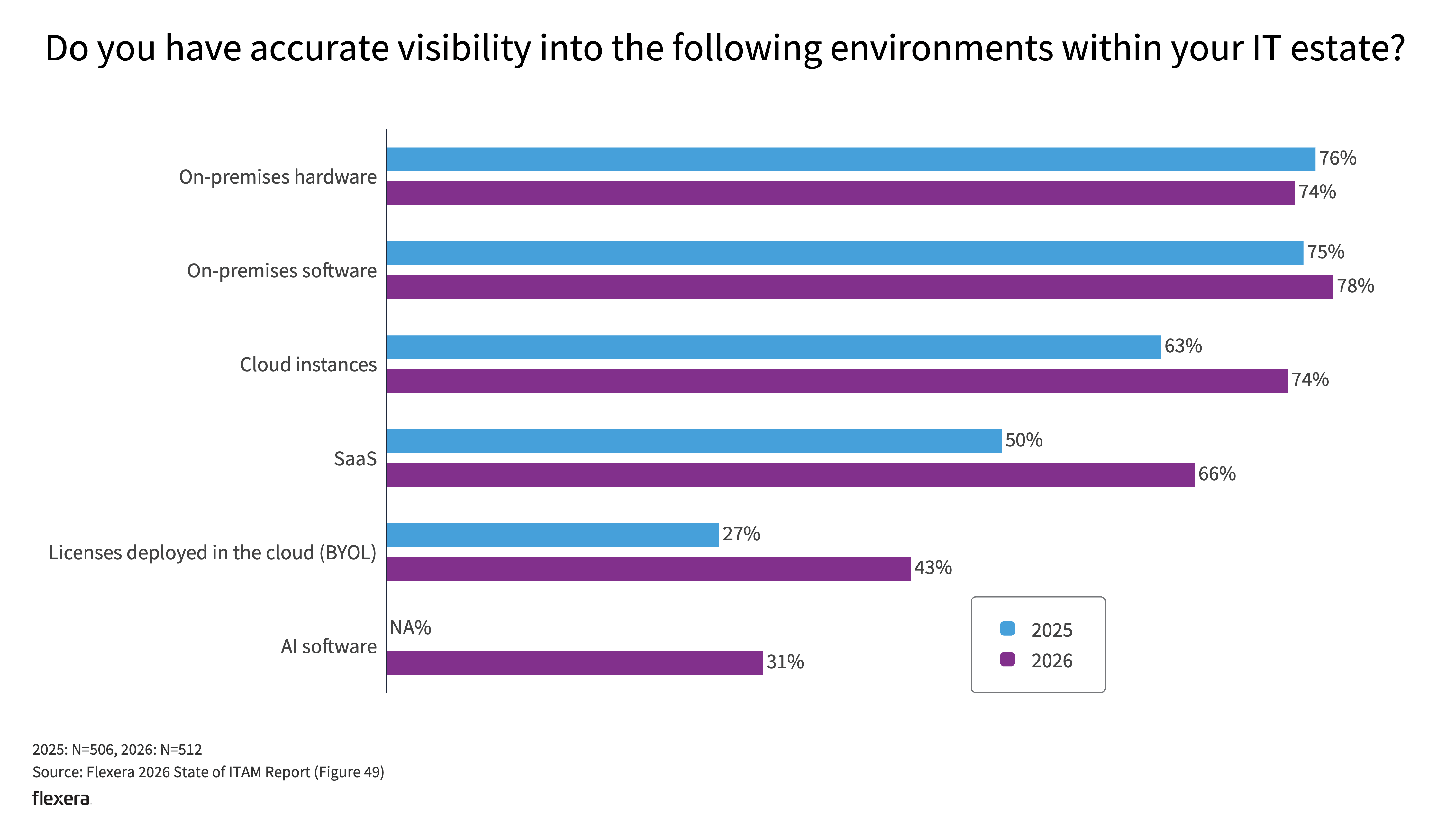
Organizations report the highest levels of visibility into on-premises hardware and software, while AI software and cloud-based licenses remain among the most difficult assets to track and govern
For public sector leaders, that lack of visibility creates more than a technology management problem. It creates an operational blind spot. Agencies may be investing in AI-enabled applications, experimenting with GenAI services, deploying AI capabilities in the cloud and seeing employees adopt AI features inside everyday tools. But if leaders don’t have a clear view of that activity, they may struggle to answer basic questions about usage, ownership, spend, compliance and value, such as:
- Which AI tools are being used across the organization?
- Which departments or programs are using them?
- Are employees using approved tools or unsanctioned applications?
- How much is being spent on AI services, licenses and cloud workloads?
- Which AI initiatives are improving service delivery?
- Where could privacy, security or compliance risks be emerging?
- Who is accountable for oversight?
These are the same types of questions organizations eventually had to ask about cloud and SaaS. The difference is that AI is moving faster, and the stakes for public sector organizations can be higher. Agencies need to innovate, but they also need to protect sensitive information, meet compliance obligations and maintain public trust.
That makes visibility the starting point for responsible scale.
From mandate to operational reality
For public sector organizations, AI governance is no longer an emerging best practice. It’s a compliance, accountability and operational mandate.
Federal agencies are already navigating a growing set of AI governance requirements. While the specifics vary, the direction is consistent: Agencies are expected to understand where AI is being used, manage associated risks and demonstrate accountability for AI adoption.
- EO 14110 (Executive Order on Safe, Secure, and Trustworthy AI) established a government-wide framework for responsible AI use and directed agencies to strengthen AI risk management, reporting and oversight practices
- OMB M-24-10 and M-24-18 expanded those expectations through agency governance requirements, including designated Chief AI Officers, AI use case inventories and minimum risk management practices for AI systems
- OMB M-26-10 further reinforces expectations around transparency, accountability and utilization-based oversight, placing greater emphasis on understanding how AI investments are being used and governed
The same pressure is emerging at the state level. The National Conference of State Legislatures reported that in the 2025 legislative session, all 50 states, Puerto Rico, the Virgin Islands and Washington, D.C., introduced AI-related legislation, and 38 states adopted or enacted around 100 measures.
This changes the visibility conversation. The question is no longer why agencies should want visibility into AI. The question is how agencies can operationalize the visibility they’re already expected to have. Before leaders can maintain inventories, assess risks, assign accountability or evaluate outcomes, they first need a clear view of where AI is being used, who owns it and how it supports the mission.
For agencies, education institutions and other mission-driven organizations, this means AI visibility now sits at the center of governance readiness. It helps leaders move from policy intent to practical oversight. It gives chief AI officers, CIOs, procurement teams, finance leaders, security teams and program owners a shared view of AI activity, cost, ownership and risk. And it creates the connective tissue needed to align AI initiatives with frameworks such as the NIST AI Risk Management Framework, a voluntary framework designed to help organizations better manage risks to individuals, organizations and society associated with AI.
That’s why visibility matters so much in the public sector. It’s not just the foundation for smarter scaling. It’s the foundation for proving that AI is being governed, funded and used in ways that support the mission, protect the public and meet the accountability expectations agencies now face.
Visibility is becoming the foundation for AI governance
A few years ago, many AI conversations centered on experimentation. Today, the conversation is shifting toward accountability.
That shift is especially important in the public sector, where AI isn’t just another productivity tool. It may influence how residents access services, how employees make decisions, how agencies allocate resources and how leaders measure performance against mission goals.
McKinsey & Company emphasizes that public sector AI requires more than technology alone. Governments and agencies need to reimagine workflows, build new ways of working and keep humans in the loop for consequential actions.
Flexera’s data reinforces why that governance foundation matters. In Flexera’s 2026 State of the Cloud Report, security and compliance concerns ranked as the top challenge associated with scaling AI workloads, cited by 53% of respondents.
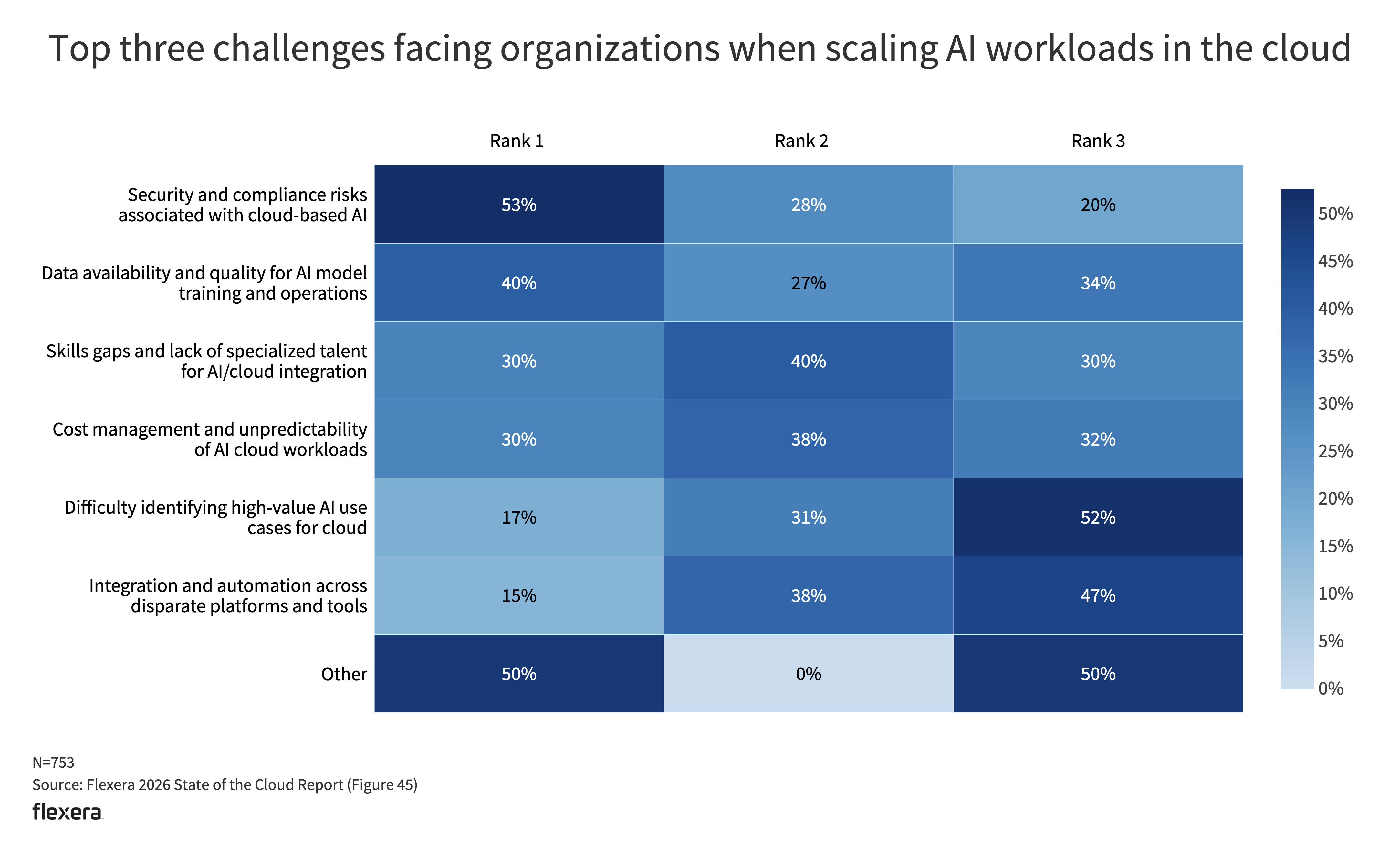
Security and compliance concerns outrank all other barriers to scaling AI workloads in the cloud, underscoring the need for strong governance foundations as AI adoption accelerates
It’s easy to see why that concern rises to the top. You can’t effectively manage security risks if you don’t know where AI is being used. You can’t monitor compliance if AI tools are operating outside approved processes. And you can’t build trustworthy AI programs if leaders lack a clear view of how tools, data, costs and responsibilities connect across the organization.
For public sector organizations, governance also must account for the real-world context in which agencies operate. Decisions may need to be explainable, reviewable and auditable. Data may be spread across departments for legitimate privacy or statutory reasons. Procurement cycles, funding mechanisms and workforce structures may not move at the same speed as AI capabilities.
That doesn’t mean AI can’t scale in the public sector—it means AI needs stronger foundations.
Visibility gives leaders the information they need to make intentional decisions about where AI should be used, where guardrails are needed, where costs are rising and where investments are producing measurable value.
The cost of not knowing
The implications extend beyond governance. Visibility also plays a critical role in controlling costs and realizing value.
According to Flexera’s 2026 AI Pulse Report, 80% of respondents said they increased their AI investments in the past year and 36% claimed they spent too much on AI applications. At the same time, 59% of respondents from Flexera’s 2026 State of ITAM Report said wasted AI spend increased year over year. And cost management remains the number one challenge cloud decision-makers face, with 85% identifying it as a top concern in the 2026 State of the Cloud Report.
Taken together, these findings point to a bigger issue. Organizations are investing aggressively in AI, but many may not yet have the visibility required to understand whether those investments are being used efficiently.
That matters in every industry. But it’s especially important in the public sector, where budgets are scrutinized, funding cycles can be rigid and leaders are expected to show that technology investments are improving outcomes for the people they serve.
McKinsey & Company notes that public sector organizations are under pressure to improve outcomes while making every taxpayer dollar count. It also highlights that AI operating costs can become difficult to manage if agencies do not forecast, allocate and contain them early.
That aligns closely with what Flexera’s research shows across cloud, SaaS and AI. Cost management and governance become harder when technology adoption spreads faster than visibility. Once AI usage expands across applications, cloud workloads, departments and teams, it becomes much more difficult to retroactively determine what exists, who owns it and what value it delivers.
Public sector organizations have already seen versions of this pattern before. Cloud adoption introduced new scale, speed and flexibility, but it also created new cost and governance challenges. SaaS growth gave employees access to more tools, but it also introduced sprawl. AI now adds another layer of complexity to an already complicated technology environment.
That’s why AI cost management can’t be treated as a separate conversation from governance. Agencies need to understand where AI exists, what it costs, how it’s being used and whether those investments are advancing the mission.
The next phase of AI maturity
Instead of being defined by how many pilots an agency can launch, the next phase of AI maturity in the public sector defined by how well agencies can scale AI responsibly, govern it effectively and connect it to measurable mission outcomes.
That requires more than enthusiasm; it requires operational discipline.
As AI becomes more deeply embedded across the technology estate, public sector leaders will need to manage AI the same way they manage other strategic investments. That means understanding where AI is being used, what it costs, who owns it, what risks it introduces and whether it’s improving service delivery.
Before you can rewire, you first need to see.
McKinsey & Company argues that public sector organizations must rewire how they work to realize the full benefits of AI. Flexera’s research illustrates how visibility is one of the first steps in that journey. Before agencies can transform workflows, govern risk or optimize investments, they need a clear view of the AI already operating across their environments.
That visibility gives leaders the foundation to make better decisions. It helps them identify where AI is creating value, where costs are rising, where risks need attention and where governance needs to mature. It also helps agencies move from experimentation to responsible scale, without losing sight of the mission outcomes that matter most.
In the end, escaping AI pilot purgatory may not come from chasing the next use case. It may come from building the visibility needed to scale the right use cases, responsibly and with confidence.
Before the public sector can rewire how work gets done, it first needs to see.
Learn more about public sector solutions
What is AI pilot purgatory?
AI pilot purgatory refers to the situation where organizations successfully test AI initiatives but struggle to scale them across the enterprise. Common barriers include limited visibility into AI usage, governance challenges, cost management concerns, data access issues and difficulty measuring business or mission outcomes.
Why is AI visibility important for public sector organizations?
AI visibility helps agencies understand where AI is being used, who owns it, what it costs and how it affects mission outcomes. Without visibility, organizations may struggle to manage risk, ensure compliance, optimize spending and maintain public trust as AI adoption grows.
What are the biggest AI governance challenges facing government agencies?
Government agencies must balance innovation with accountability, transparency, privacy, security and compliance. Many organizations face challenges identifying AI use cases, tracking ownership, monitoring costs, managing risk and ensuring that AI initiatives align with governance requirements and public expectations.
How can agencies improve visibility into AI usage?
Organizations can improve AI visibility by creating inventories of AI tools and services, identifying ownership, tracking costs, monitoring usage across cloud and SaaS environments and establishing governance processes that provide a centralized view of AI activity, risk and business value.
What risks can result from poor AI visibility?
Limited visibility can create operational blind spots that make it difficult to manage security, privacy and compliance risks. It can also lead to duplicate investments, uncontrolled spending, shadow AI usage and challenges demonstrating accountability for AI-related decisions.
How does AI visibility support AI cost management?
AI visibility enables organizations to understand where AI investments exist, how resources are being consumed and which initiatives are delivering value. This information helps leaders reduce waste, improve budget planning and make informed decisions about scaling AI programs.
What does responsible AI scaling look like in the public sector?
Responsible AI scaling means moving beyond isolated pilots to operationalized AI programs that support mission outcomes while maintaining governance, transparency and accountability. Agencies need visibility into AI usage, costs, risks and ownership to scale AI confidently and effectively.