

Key AI spending statistics (2026):
- Only 31% of organizations have accurate visibility into their AI software spend, and 59% say wasted AI spend increased over the past year (Flexera, 2026 State of ITAM Report).
- 95% of organizations studied are seeing no measurable profit-and-loss impact from their AI initiatives, and only about 5% of integrated AI pilots are extracting significant value (MIT NANDA).
- AI spending is growing at more than 3x the rate of overall IT spending (Gartner).
- Uber exhausted its entire 2026 AI budget by April, just four months after rolling out Claude Code to its engineering team, and has since capped spend at $1,500 per employee per month (Uber).
- 98% of organizations have unverified or unsanctioned apps running somewhere in their environment, shadow AI included (Varonis).
- Token consumption could grow 24-fold by 2030, reaching roughly 120 quadrillion tokens processed per month (Goldman Sachs).
Gartner’s most recent IT spending forecast predicts that global IT spending will reach $6.37 trillion in 2026, up 14.2% from 2025. At the same time, Gartner’s most recent AI spending forecast, released separately, predicts that global AI spending would reach around $2.59 trillion in 2026, up 47% from the previous year.
Put those growth rates together side by side and AI spending is growing at more than 3x the rate of overall IT spending.
So why is AI pulling up such a large share of enterprise IT budgets?
In this article, we’ll break down why AI spending has grown so fast, where the money is going, and why it’s so hard to manage as AI moves from pilot projects into everyday production use.
How much are organizations spending on AI in 2026?
AI spending is no longer just pocket change. It is now measured in trillions of dollars. And every major forecaster keeps revising their numbers upward as the year goes on.
There are several reasons AI spending keeps climbing.
Big enterprises have already found real use cases for generative AI. Others are investing because they recognize the potential benefits as AI progresses from the testing phase to widespread use. Plus, the pressure to stay competitive is pushing everyone to invest in AI so they don’t fall behind. That competitive pressure alone is pushing more money into cloud infrastructure, data centers, AI software, custom applications, and the engineers needed to run all of it.
Gartner’s $2.60 trillion AI market
Gartner’s latest forecast puts global AI spending at $2.59 trillion this year, which is a 47% increase from $1.76 trillion in 2025.
That number is moving quickly.
Back on January 15, 2026, Gartner had the same figure at $2.52 trillion with 44% growth. Just four months later, they revised it up again to $2.59 trillion and 47% growth.
That tells you something about the pace of the market.
To be clear, the $2.6 trillion figure covers the entire global AI market, meaning every dollar spent on AI infrastructure, software, services, data, and AI-focused cybersecurity tools, by anyone, including enterprise buyers.
And most of that AI spending is not coming directly out of a typical company’s IT budget.
If you want an architecture view of where that spending actually goes, Gartner breaks it down by market segment.
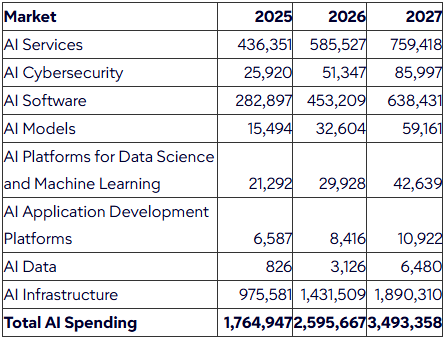
Worldwide AI Spending by Market, 2025-2027 (Source: Gartner)
IDC shows how much money is going into physical AI infrastructure
Gartner is not the only source showing rapid AI spending growth. IDC data points to the same trend at the physical AI infrastructure layer.
IDC data tracks a narrower but specific part of the AI market: the hardware that actually runs AI workloads, aka AI infrastructure, meaning servers, storage and networking. That number is climbing just as fast.
In late October 2025, IDC projected the AI infrastructure market would reach $758 billion by 2029.
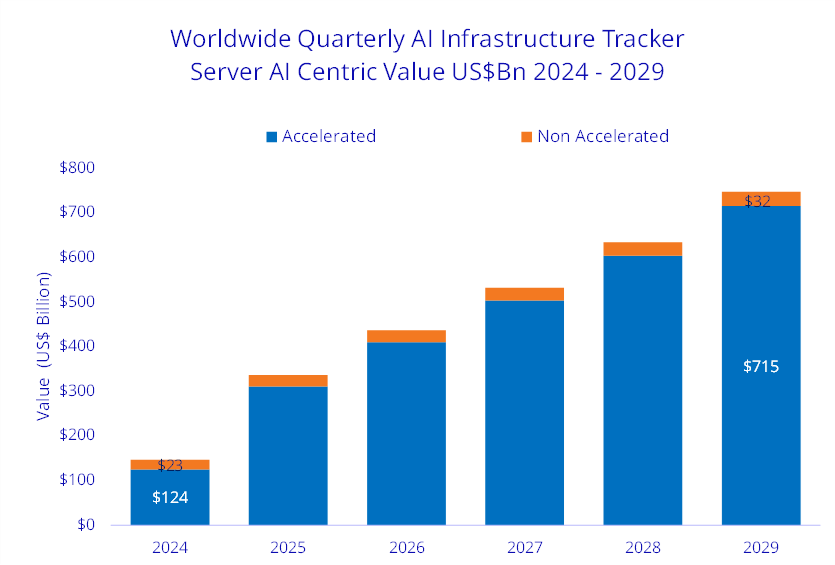
Worldwide Quarterly AI Infrastructure Tracker (Source: IDC data)
IDC has since raised that forecast as spending accelerated.
Global AI infrastructure spending reached $89.9 billion in the fourth quarter of 2025, up 62.2% from the same quarter a year earlier. That brought full-year 2025 spending to $318 billion, more than double the $153 billion recorded in 2024.
IDC now expects spending to reach $487 billion in 2026, a roughly 53% increase from 2025, and forecasts the market will top $1 trillion by 2029, a compound annual growth rate (CAGR) of about 31% from 2025. Most of that money goes toward servers.
Server spending reached $87.7 billion in the fourth quarter of 2025, or 97.6% of total AI infrastructure spending, while storage made up the remaining $2.2 billion.
The United States accounted for $69.2 billion, or 77% of global AI infrastructure spending, in the fourth quarter of 2025, up 81.5% year over year and driven largely by continued investment from hyperscalers and AI platform providers.
Gartner’s $2.59 trillion forecast covers the entire AI market, including software, services and related tools. IDC’s figures focus specifically on AI infrastructure.
Put together, they show something important: AI spending is not growing only through software and services. A significant share is also flowing into the compute, storage and physical infrastructure required to run models at scale.
Enterprise IT budgets are feeling it too
Gartner’s broader IT spending forecast puts global IT spending at $6.37 trillion for 2026, up 14.2% year over year.
Within that total, data center systems, the category most directly tied to AI infrastructure, are expected to rise 62.5% to $822 billion.
That makes data center systems the fastest-growing major category in Gartner’s IT spending forecast. IT services, however, remain the largest category overall.
AI has not taken over the entire IT budget. It is simply growing much faster than most other categories.
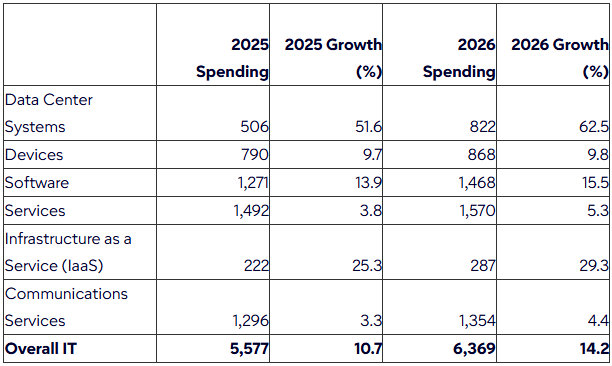
Worldwide IT Spending Forecast (Source: Gartner)
The picture also changes depending on the industry.
BCG’s AI Radar survey of 2,360 executives found organizations expect to invest an average of 1.7% of annual revenue in AI in 2026, up from 0.8% in 2025.
In other words, the share of revenue allocated to AI is expected to double.
BCG defines AI investment broadly, covering technology and infrastructure, data and architecture, talent and upskilling, and external partners.
Technology companies are at the top, with planned AI investment rising from 1.2% of revenue in 2025 to 2.1% in 2026.
Financial institutions are close behind, up from 0.9% to 2.0%.
Every industry BCG surveyed plans to increase its AI investment in 2026, although the pace varies by sector.
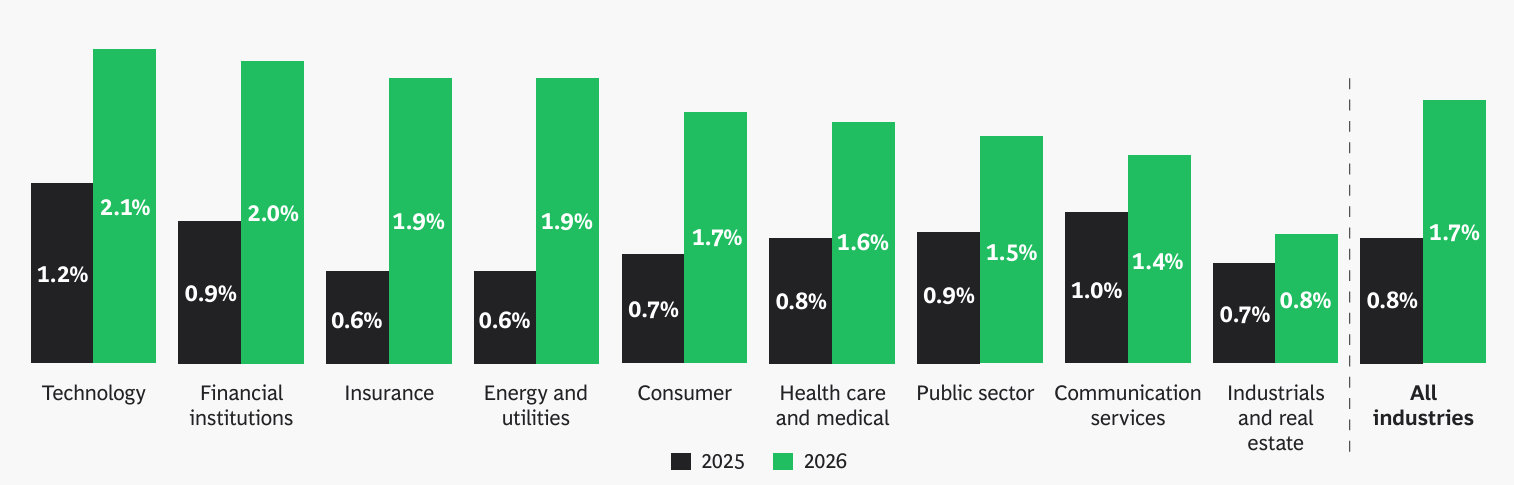
Investment in AI as share of annual revenue (Source: BCG) – AI Spending – AI Investment – IT Budget – AI Budget
Now, if you zoom in and look closely at the per-employee number, the whole pattern becomes even clearer.
The Federal Reserve Bank of Atlanta surveyed US firms and found companies expect to spend an average of $2,068 on AI for each employee this year, a 50% jump from $1,358 in 2025.
What the AI budget contains
AI spending gets treated as one number in most conversations, but it covers many pieces, from raw silicon to people who keep it all running.
Think of it as a chain:
Physical infrastructure ⇒ cloud compute ⇒ models and inference ⇒ data and AI platforms ⇒ applications and AI agents ⇒ services and talent ⇒ AI governance and security
Compute infrastructure
This includes servers packed with graphics processing units (GPUs), tensor processing unit (TPUs) or custom AI chips for training and inference.
Companies either buy racks of GPUs/TPUs (CapEx) or rent cloud GPU/TPU instances (OpEx).
Many organizations favor cloud consumption because AI hardware evolves quickly. Buying hardware that quickly becomes outdated can be a tough financial choice.
Cloud compute and APIs
Most big companies and enterprises use public clouds for AI. That means paying for on-demand GPU/CPU instances, storage (object or block) and AI service APIs.
Cloud GPU rental is not cheap.
Renting an Nvidia H100 currently runs somewhere between roughly $1.50 and $10 per GPU-hour, depending on the provider (specialized neoclouds tend to charge less; hyperscalers tend to charge more).
An 8-GPU cluster can run from around $15 an hour on a budget provider to $60 or more an hour on a hyperscaler’s on-demand pricing, and that’s before storage, networking and data transfer fees get added on.
Nvidia’s new H200 and Blackwell-based B200 chips have pushed H100 rental prices down further, since demand has shifted toward the newer silicon and left more H100 capacity on the market.
AI/ML software and tools
Licensing for machine learning platforms, model hosting and specialized AI software, plus API subscriptions to providers like OpenAI and Anthropic.
Gartner expects this segment to grow from $282.9 billion in 2025 to $453.2 billion in 2026, a 60% jump.
Professional services and talent
AI spending also includes implementation, integration, custom model development and the people responsible for building and operating these systems.
Data scientists, machine learning engineers and other AI specialists can command significant compensation, while large implementation projects often require external consultants and system integrators.
Power and data center costs
AI workloads are power-hungry in a way many traditional IT workloads are not.
According to Gartner’s June 2026 data center electricity forecast, global data center power demand is expected to reach 132 GW in 2026, up 27% from 104 GW in 2025, while annual electricity consumption is forecast to reach 565 TWh, up 26% from 447 TWh.
AI-optimized servers are expected to account for 31% of data center electricity consumption in 2026, up from about 21% in 2025.
AI governance and compliance
This includes model validation, security testing, regulatory work, policy enforcement and licensing.
It is becoming a larger part of AI operations as organizations move beyond experiments and put AI into production.
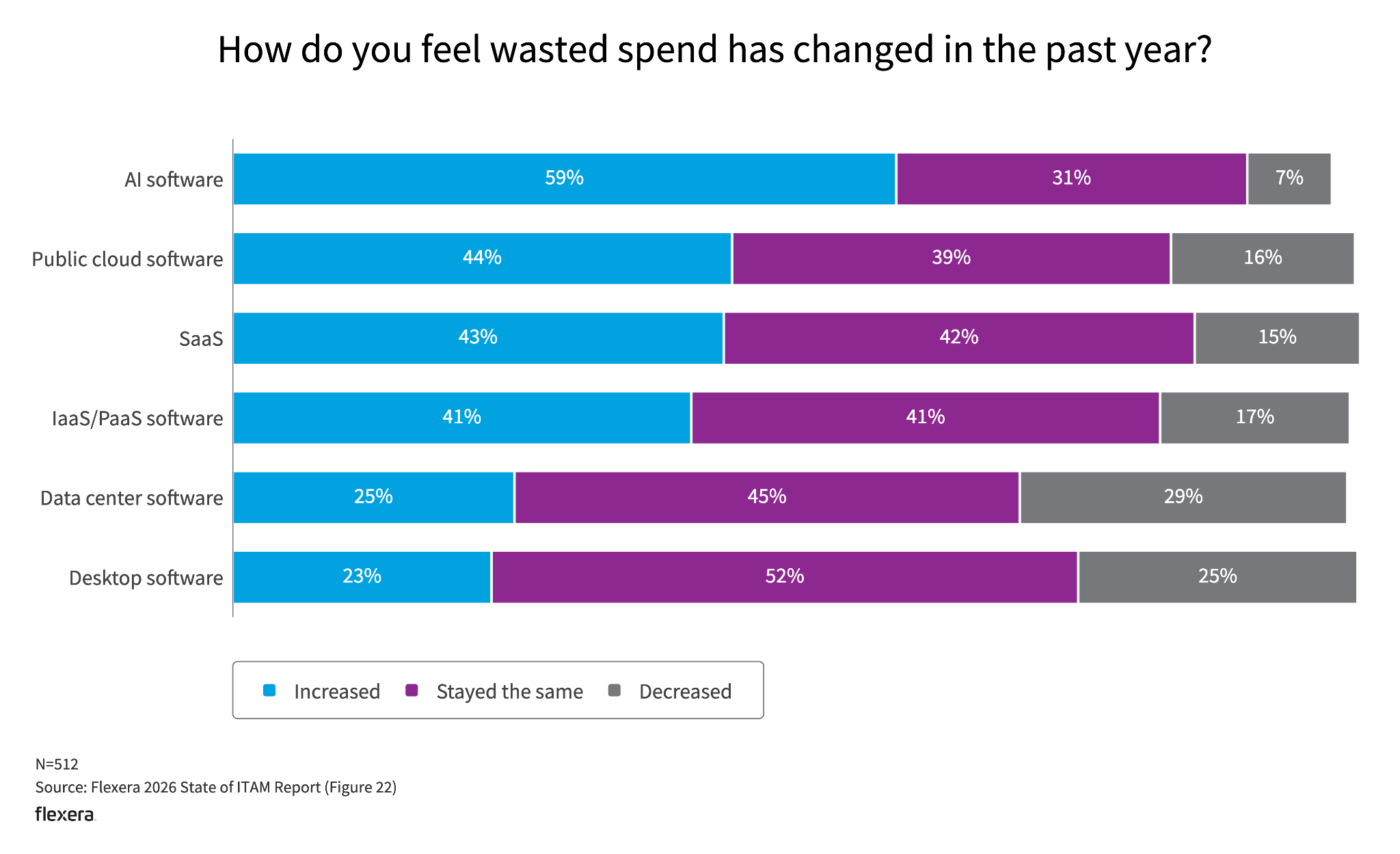
According to Flexera’s 2026 State of ITAM Report, 59% of respondents say wasted AI spend increased over the past year, and only 31% feel they have accurate visibility into their AI software spend.
You cannot manage what you cannot see. And right now, many organizations still do not have a complete view of their AI costs.
All these categories can land in different parts of the budget, which is one reason AI spending is so easy to underestimate.
A single AI project may require large volumes of training data, GPU clusters running for extended periods and a team of specialists to keep everything working.
Here’s the quick breakdown:
| Layer | What’s in it | Why it’s growing |
| Compute infrastructure | GPU and TPU servers, custom AI chips (for training and inference) | Nearly all AI hardware budget goes here. IDC found servers made up 97.6% of AI infrastructure spending in the fourth quarter of 2025. GPUs and TPUs are expensive and constantly refreshed, so enterprises either buy racks (a capital expense) or rent cloud GPU instances (an operating expense) |
| Cloud compute and APIs | On-demand GPU/CPU instances, storage, API calls (LLM inference, etc.) | Most companies default to public clouds for AI and pay by the hour, or by the token. GPU time isn’t cheap: on-demand H100 instances currently run roughly $1.50 to $12 per GPU-hour depending on the provider (median around $3 to $4). An 8-GPU cluster can run from around $15 an hour to well over $90 an hour on demand, before storage, networking and data transfer fees. That adds up fast during sustained training or inference, even with spot and commitment discounts |
| AI/ML software and tools | ML platforms, model hosting, data/annotation, API subscriptions (OpenAI, Anthropic, etc.) | This category is booming. Gartner shows AI software and platform spend rising from about $283 billion in 2025 to $453 billion in 2026. It includes licensing for pretrained models, custom AI applications, data processing and DevOps tools. Nearly every SaaS vendor is adding AI features and new subscription tiers |
| Professional services and talent | AI consulting, custom model development, integration; data scientists and ML engineers | Skilled and expert AI engineers are rare, so firms pay premium salaries and consulting rates. Adoption projects often need outside help, which lifts costs further, and demand for that help isn’t slowing down |
| Power and data center | Electricity, cooling, networking for AI servers | AI workloads suck power. Gartner reports global data center electricity demand hitting ~565 TWh in 2026 (up 26% from 2025). AI-optimized servers already account for 31% of that power use, and they draw more as models grow. (Cooling that much hardware also adds cost.) In some cases, power/cooling for a GPU farm can rival the hardware’s cost over its lifetime |
| AI governance and compliance | Model validation, bias/security testing, licensing, regulatory work | This is the fastest-growing invisible cost. More rules (and more risk) mean more audits, testing and controls. Flexera found only 31% of organizations have accurate visibility into their AI software spend, and 59% say wasted AI spend increased over the past year. Firms are scrambling to tag, monitor and audit AI usage (approved and unapproved alike), an entirely new line in the budget |
So dismissing AI spending as just another software subscription would be a mistake. According to the above data, organizations are now dedicating real funding to AI rather than simply experimenting with it. The ones paying attention to where that spending goes won’t be caught off guard later.
Who is actually writing the checks?
AI spending is enormous, but the biggest checks are still being written by hyperscalers, or the usual tech giants: Amazon, Microsoft, Alphabet (Google) and Meta.
Combined, Statista puts their 2026 capital expenditure at around $760 billion, nearly double the $413 billion they spent in 2025.
These four companies are putting most of that money into data centers, AI chips, networking gear and the power and cooling systems needed to run all of it.
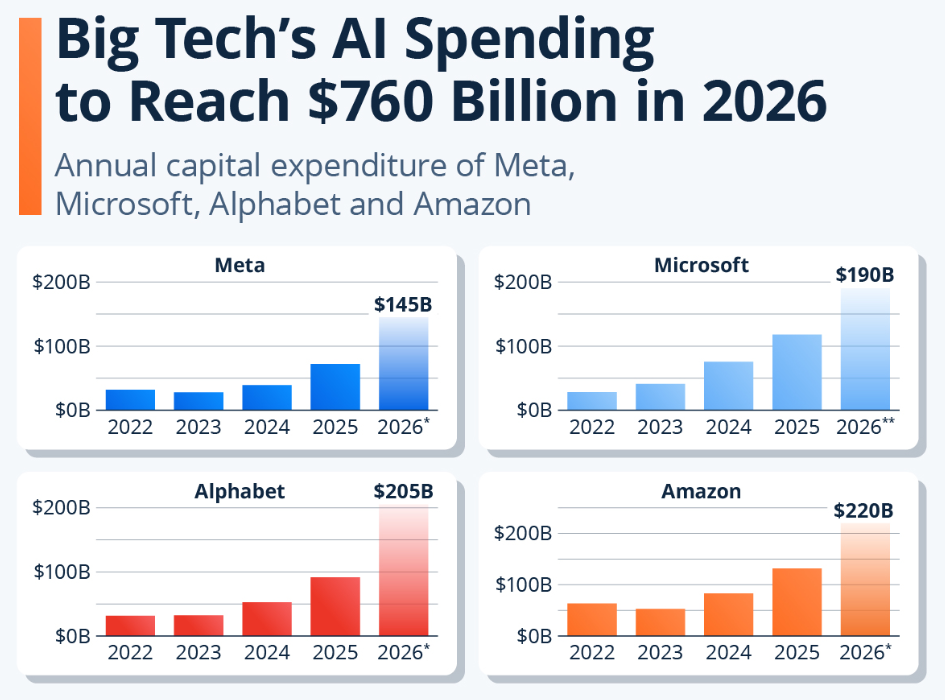
Big Tech’s AI Spending to Reach $760 Billion in 2026 (Source: Statista)
Why is AI spending accelerating so quickly?
Did AI suddenly get better overnight? Not really.
The models keep improving, but 2025 and 2026 did not bring one single capability jump that explains the surge in spending.
What changed is how organizations are using the technology and how the economics of AI adoption are evolving.
Infrastructure shortages and inflation
Amazon, Google, Meta and Microsoft are all racing to expand because demand keeps outpacing supply.
Advanced chips like the H100 and H200 are still hard to come by, and building data centers takes time.
Analysts at Goldman Sachs have warned of a 12- to 18-month chip shortage as semiconductor manufacturers ramp up production.
When demand exceeds supply, organizations compete for the available GPU capacity. That can increase infrastructure prices and slow project timelines.
Hidden vendor pricing changes
Plenty of software vendors quietly slid AI features into existing products and then jacked up the price.
Customers may not always recognize that part of a subscription increase is effectively paying for AI capabilities.
Competition and fear of missing out
Thousands of startups and established companies are racing to release AI-powered products and features.
Few executives want to explain to the board why competitors are moving faster.
That creates a feedback loop. A competitor announces an AI initiative, the board pushes for a response, teams approve larger projects and spending increases, and organizations begin rolling out AI before the economics are fully understood.
It is a little like the classic technology arms race, except this one comes with a very large electricity bill.
Agentic AI and its appetite for tokens.
Another major source of spending is agentic AI.
These systems do more than answer questions. They can plan tasks, call tools and APIs, execute multiple steps, inspect results and repeat actions when necessary.
They use far more compute per job. Running an AI agent can cost the equivalent of dozens of regular AI queries.
Even as per-token prices fall, usage keeps exploding. Goldman Sachs projects token consumption could grow 24-fold by 2030, reaching roughly 120 quadrillion tokens processed per month, as AI agents and applications keep rolling out.
Cheaper tokens don’t shrink the bill. They just open up ways to spend it.
Tokens are getting cheaper, but AI bills aren’t
Token prices, the per-unit cost of running a model, have dropped a lot.
Token prices have fallen 67% to 80% between early 2025 and early 2026. OpenAI is a clear example. By any normal market logic, that should mean AI gets cheaper to run. It hasn’t.
Enterprise generative AI spending has grown many times over across that same window, because cheaper access unlocked far more use cases than it eliminated.
Economists refer to this as the Jevons paradox.
William Stanley Jevons observed in 1865 that more efficient steam engines did not necessarily reduce coal consumption. Instead, they made coal-powered machinery economical in more situations, increasing demand.
Agentic AI is one of the clearest examples of this.
Gartner’s March 2026 analysis found that agentic workloads use 5 to 30 times more tokens per task than a standard chatbot exchange.
A simple chat response might require only a small amount of compute.
An AI agent that plans a task, calls multiple tools, checks its work and retries failed steps can consume more tokens before the job is complete.
Uber is a good example of how fast that adds up.
In December 2025, the company introduced Anthropic’s Claude Code to its engineering team of about 5,000 developers:
- By February 2026, 32% of engineers were using it. By March, that number jumped to 84%.
- Around 95% of them were using some AI tool each month, and about 70% of the code they wrote came from those tools.
- Monthly spending per engineer ranged from $150 to $250, with heavy users spending between $500 and $2,000 a month.
By April, Uber had already exhausted its entire AI budget for 2026, prompting the company to rethink its approach to AI spending. In June, Uber introduced a $1,500 monthly token-spending cap per employee for each agentic coding tool, including Claude Code and Cursor, with exceptions requiring approval.
Goldman’s forecast (24x token usage by 2030) and Gartner’s warning (agentic projects hitting cost walls) both point in the same direction:
Cheaper tokens don’t shrink budgets, they often inflate them.
The main lesson is that organizations need to plan for usage growth.
Cheaper models are good news, but only when companies track requests, workflows and AI agents they are running.
The AI cost hiding inside existing software
Some of the biggest increases show up not as new charges but as higher prices on software you already pay for. For example, Microsoft raised prices on its Microsoft 365 commercial suites by 5% to 43%, effective July 1, 2026.
A year earlier, in August 2025, Salesforce raised prices by an average of 6% across its Sales Cloud and Service Cloud enterprise editions, and updated pricing for Slack and its Agentforce AI add-ons around the same time.
SAP has also embedded its Joule assistant into its cloud subscriptions.
The base version is included with current cloud plans, while the more capable Joule Premium tier, including autonomous Joule AI agents, requires separately purchased AI units.
Once you see the pattern, it becomes hard to miss. Vendors are using AI to justify price increases on products customers already use. And it does not necessarily matter if your team enabled or adopted those features. Some of the cost appears as a clear add-on charge that you can accept or decline.
Some of it is buried in a higher-priced tier that you may have to adopt to retain capabilities you already depend on, and because it often arrives on the same software invoice as everything else, it rarely gets tagged as an AI cost.
That makes it one of the easiest categories to overlook when someone asks how much AI is costing the business.
Shadow AI makes the real budget harder to see
Ask most IT leaders how much of their organization’s AI usage they can see, and a bad answer.
According to Varonis’s 2025 State of Data Security Report, which analyzed risk data from 1,000 real-world IT environments, 98% of organizations have unverified or unsanctioned apps running somewhere in their environment, shadow AI included.
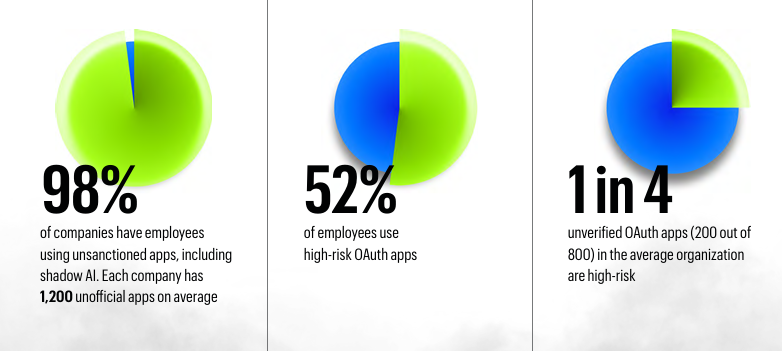
2025 State of Data Security Report (Source: Varonis)
Deloitte’s 2026 State of AI in the Enterprise found employee access to AI tools grew 50% in 2025, from under 40% of workers to around 60%, while only about one in five companies has a mature AI governance model for autonomous AI agents.
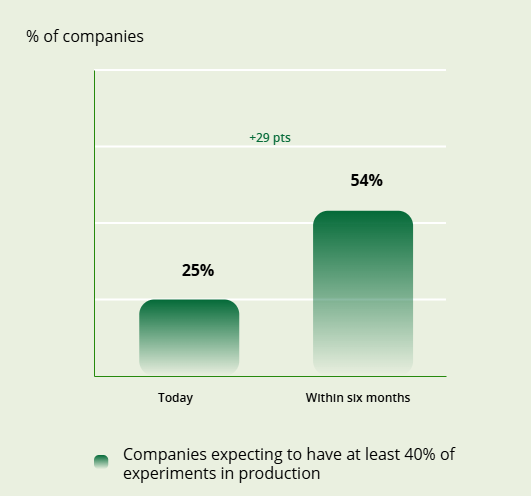
Proportion of AI experiments deployed (Source: Deloitte)
Visibility is becoming a budget problem
Flexera’s 2026 State of ITAM Report highlights the core visibility issue.
Only 31% of organizations report accurate visibility into their AI software, even though half already track AI as part of their overall software spend.
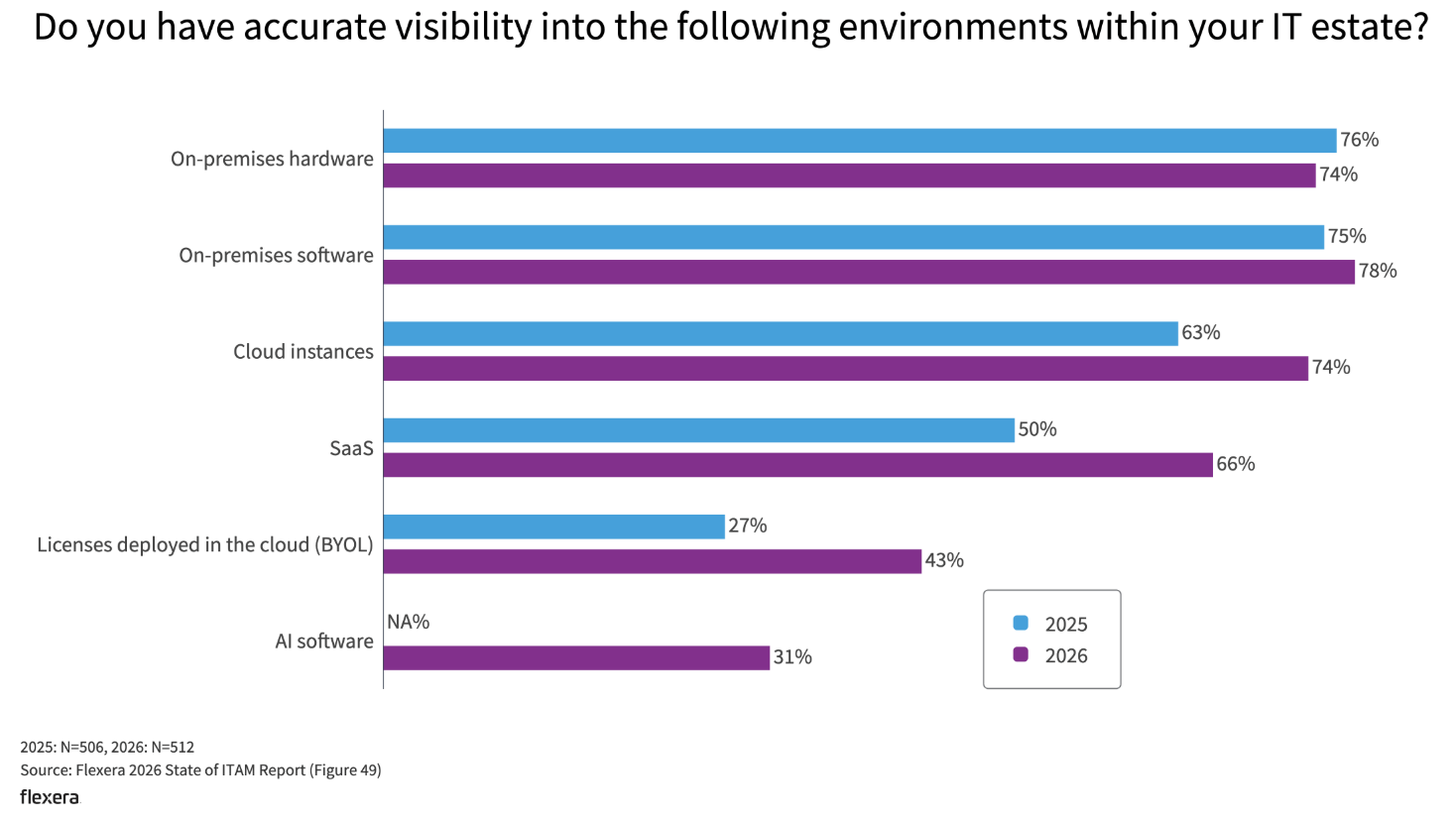
Visibility into AI software (Source: Flexera 2026 State of ITAM Report)
Complete IT asset visibility across the business dropped to 36% this year, down from 43% in 2025. In addition, 59% of organizations say wasted AI spend increased year over year.
Complete IT asset visibility (Source: Flexera 2026 State of ITAM Report)
Does all this AI spending pay off?
After all the talk about trillions of dollars and double-digit growth, there is a fair question to ask:
Are organizations getting a return?
Spending this money raises skepticism, and we owe it to ourselves to ask if it delivers value or just creates surprises.
One of the most widely cited answers comes from MIT NANDA’s The GenAI Divide: State of AI in Business 2025. The report found that 95% of the organizations and AI initiatives it studied were generating no measurable profit and loss impact, while only about 5% of integrated AI pilots were extracting significant value. The findings came from 52 structured interviews, 153 surveyed leaders and an analysis of more than 300 public AI initiatives.
That finding is worth taking seriously, but it needs context too. This wasn’t a full audit of every enterprise AI project out there, and the report itself flags the limits of its sample size. The 95% figure is a strong signal of how hard enterprises find it to turn AI pilots into measurable financial outcomes, not proof that every AI project everywhere fails.
The broader industry data points the same direction. Gartner predicted in July 2024 that at least 30% of generative AI projects would be abandoned after the proof-of-concept stage by the end of 2025, citing poor data quality, weak risk controls, rising costs and unclear business value.
Gartner made a similar prediction for agentic AI a year later, estimating more than 40% of agentic AI projects will be canceled by the end of 2027 for the same reasons: rising costs, unclear value and inadequate risk controls.
So the problem isn’t that AI has no value, it’s that the cost curve can move faster than the value measurement.
A project can have strong technical performance and weak business economics. It can improve productivity without generating measurable revenue. It can save employee time while increasing infrastructure and software costs.
That is why AI ROI needs to be measured at the workload level, not just at the project or platform level.
How we should measure AI spending
Traditional IT budgeting often works well when costs are relatively fixed.
AI needs another layer of measurement.
Here are the things we should keep track of:
| Metric | Why |
| Cost per AI task | Shows what a completed workflow actually costs |
| Cost per active user | Helps identify high-cost user groups |
| Tokens per task | Reveals inefficient prompts, context and agent loops |
| Model cost by workload | Shows whether expensive models are being used for low-value tasks |
| GPU utilization | Measures whether owned infrastructure is being used efficiently |
| AI software utilization | Identifies unused or duplicated licenses |
| Cost per successful outcome | Connects spending to business value |
| AI spend by business unit | Shows where consumption is occurring |
| Production cost vs pilot cost | Reveals whether economics survive scale |
This changes the conversation from:
“How much did we spend on AI?”
to:
“What did that spending actually buy?”
What IT and finance leaders should do about it
None of this means AI spending should slow down.
It means AI needs the same financial discipline applied to other major technology costs.
- Treat AI spending as its own category, not a small slice of “software” or “cloud”
- Ask vendors to explain exactly what a given AI-driven price increase buys you, and request usage data for any features you’re already paying extra for
- Build an accurate list of who’s using what, including the shadow AI nobody signed a purchase order for
- Set up a real governance process for agentic AI before scaling it, since cost per workflow is about to climb and autonomous AI agents carry risks a simple chatbot doesn’t
- Hold AI experiments to the same financial standard as any other project, and when one doesn’t deliver measurable value, take the lesson and move on rather than letting it linger.
The AI budget’s biggest problem is control
AI spending is growing quickly because the technology has moved beyond isolated experiments.
Models now sit inside software applications. Agents execute workflows. Cloud providers are building dedicated capacity. Enterprises are buying AI tools across business units. Vendors are adding AI to products customers already own. Infrastructure providers are building data centers years ahead of expected demand.
All of that creates spending, but it also creates a measurement problem because AI isn’t one budget line.
It’s spreading across the entire technology stack.
That is why AI can become the fastest-growing part of an IT budget even when the finance system does not have a neat “AI” line sitting on the page.
Conclusion
AI spending has become one of the fastest-growing parts of corporate IT budgets because it is cheap to start but can become expensive to scale.
Getting started may be as simple as giving employees access to an AI model or enabling a new feature in an existing SaaS platform.
Scaling it can mean building data centers, buying accelerators, consuming millions/billions of tokens, hiring specialized talent and putting governance around autonomous systems.
AI spending is being driven by several forces at once: competitive pressure, vendor pricing changes, expanding AI use cases, growing demand for compute and the emergence of agentic workloads.
None of that means AI is a bad investment. It is quite the opposite: AI can create substantial value.
The problem is that many organizations still struggle to connect that value to the money they are spending.
The ones that succeed in 2026 won’t necessarily be the biggest spenders. They’ll be the ones who can clearly explain where their AI spending went, which workloads consumed it and what those workloads achieved.
Learn More About AI Cost Management
Is AI spending its own budget line, or part of the existing IT budget?
No, most organizations don’t have a dedicated “AI” line yet, it shows up scattered across cloud, software, hardware and services budgets, which is exactly why it’s so easy to underestimate
What’s the difference between shadow AI and shadow IT?
Shadow IT is the broad category: any hardware, software, or cloud service employees use without IT’s knowledge or approval, including personal accounts, unsanctioned SaaS, or unregistered devices. Shadow AI is the AI-specific subset of that, which references unsanctioned AI tools that are being used by employees.
How can IT and finance teams get visibility into what they’re actually spending on AI?
Start by treating AI as its own tracked category rather than folding it into “software” or “cloud.” From there: build a real inventory of every AI tool, license, and API key in use (approved and unapproved), ask vendors for usage data on any AI features you’re already paying extra for, and shift measurement down to the workload level, tracking things like cost per AI task, tokens per task, and cost per active user rather than one AI line item.
How do you know if shadow AI is happening in your organization?
Some example are: AI capabilities suddenly appear inside a tool you already license after a vendor update, with no formal rollout or training; spend shows up on API keys or model-provider accounts that never went through procurement; and, most simply, employees are visibly using personal ChatGPT/Claude/Gemini accounts for work tasks.
How is buying AI tools different from buying traditional software?
Many things break the old procurement playbook. For instance, pricing is usage-based rather than seat-based. Most AI tools bill by the token, so a single heavy user can cost 8 to 12 times the average, making budgets far less predictable than flat per-seat SaaS licensing.
What questions should finance ask before approving new AI spend?
Finance should ask for the full cost picture rather than just the sticker price, since token consumption, integration work, and ongoing support can quietly outweigh the subscription fee itself. Just as important is naming an owner who’s accountable if the tool underdelivers or the automation breaks down, someone with the authority to step in and pause it.
Pramit Marattha
Pramit Marattha is a technical content writer and strategist with 5+ years of experience covering AI, data engineering, data cloud platforms and open source technologies. He turns complex technical concepts into clear, useful content for engineers and developers.