

Key findings
- AI’s biggest challenge is shifting from adoption to accountability as costs spread across tokens, cloud, SaaS and software
- Most organizations lack the visibility needed to effectively govern and optimize AI spending
- FinOps, ITAM and SaaS management must converge to provide a complete view of AI costs and business value
According to the EY’s AI Pulse Survey Results: Wave 5, 98% of senior leaders whose organizations use token-based tools say token usage and related costs have forced them to reconsider their AI approach. That’s not a warning on the horizon; it’s pointing to the reckoning already underway.
For the past few years, the AI story has centered on possibility: greater productivity, faster decision-making and new ways to create value. Now the bill is arriving, and it’s exposing how quickly adoption has outpaced financial accountability. Leaders have to answer harder questions: What does AI actually cost at scale? Who owns those costs? Which use cases produce enough value to justify continued investment?
The answers won’t sit neatly in one budget. AI spending moves through tokens, cloud infrastructure, software subscriptions, data services and SaaS platforms. That makes AI cost management an enterprise technology-spend challenge, not a line item that one team can govern alone.
AI’s cost conversation has reached a breaking point
EY’s research indicates the shift is impossible to dismiss. The organization commissioned a third-party vendor to conduct the online survey among 534 U.S.-employed decision-makers at the senior vice president level or above across 10 industry groups. Wave 5 was fielded from April 24 to May 17, 2026, with a margin of error of plus or minus 4 percentage points at a 95% confidence interval.
Their findings indicate that 82% of senior leaders at organizations investing in AI are concerned about token usage and related costs. Yet only 64% say their organizations actively monitor token usage and have clear budgets with spending guardrails.
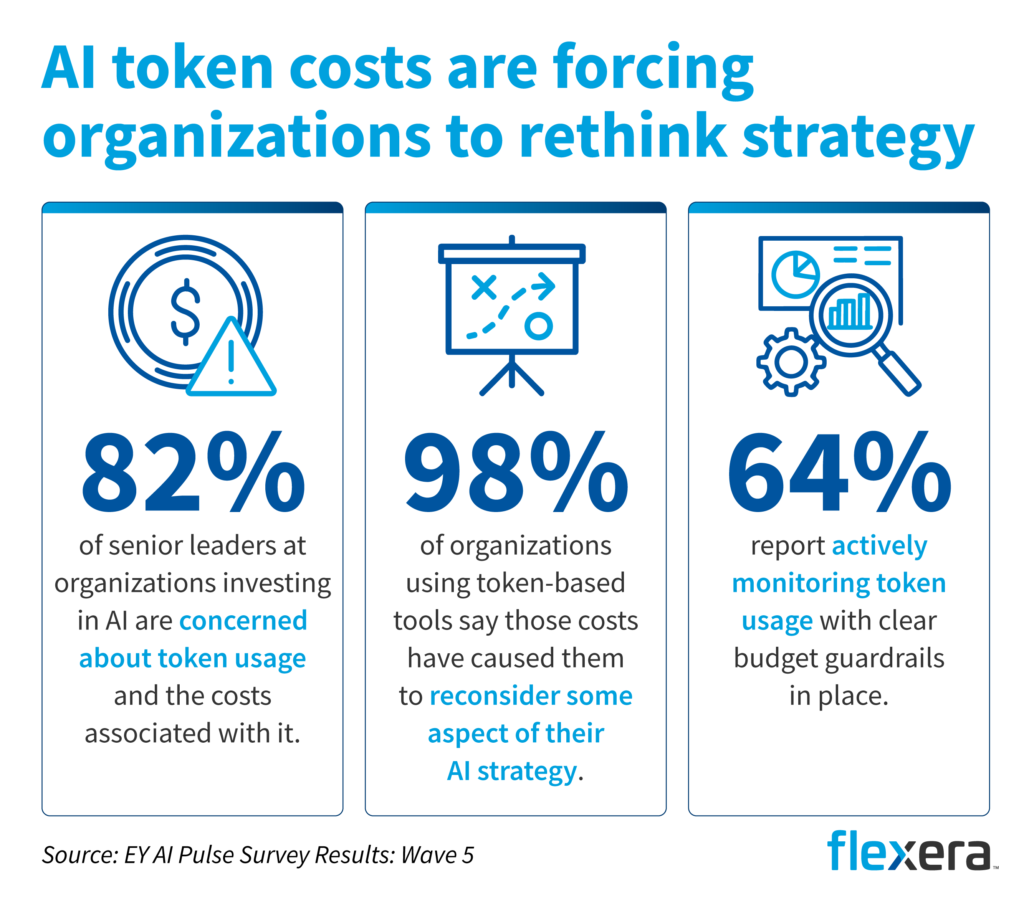
The gap between concern and control is the real story. Organizations aren’t simply discovering that AI costs money. They’re discovering that familiar budgeting practices can’t keep pace with consumption that changes by model, workload, prompt and user behavior.
A single request can hide a chain of costs
Tokens are only the most visible part of the problem. As organizations move toward agentic workflows, one user request can trigger a chain of actions across multiple models, tools and data sources. What looks like a single interaction can fan out into dozens of model calls behind the scenes. That makes consumption harder to predict, attribute and control.
The cost trail keeps expanding. AI workloads consume cloud resources. AI-powered applications add software subscriptions. SaaS vendors introduce premium AI features and new pricing tiers. Data services, integrations and supporting infrastructure add more spend. Finance may see subscriptions, cloud teams may see infrastructure consumption and procurement may see new contracts, but no one sees the full picture unless those views come together.
AI is intensifying an existing cloud cost emergency
Cloud cost management was already under pressure before AI accelerated. The Flexera 2026 State of the Cloud Report found that 85% of respondents rank managing cloud spend as a leading challenge. Cost has outranked security for four consecutive years. At the same time, 63% of organizations rely on a FinOps team and estimated wasted IaaS and PaaS spend rose to 29%, reversing a five-year downward trend.
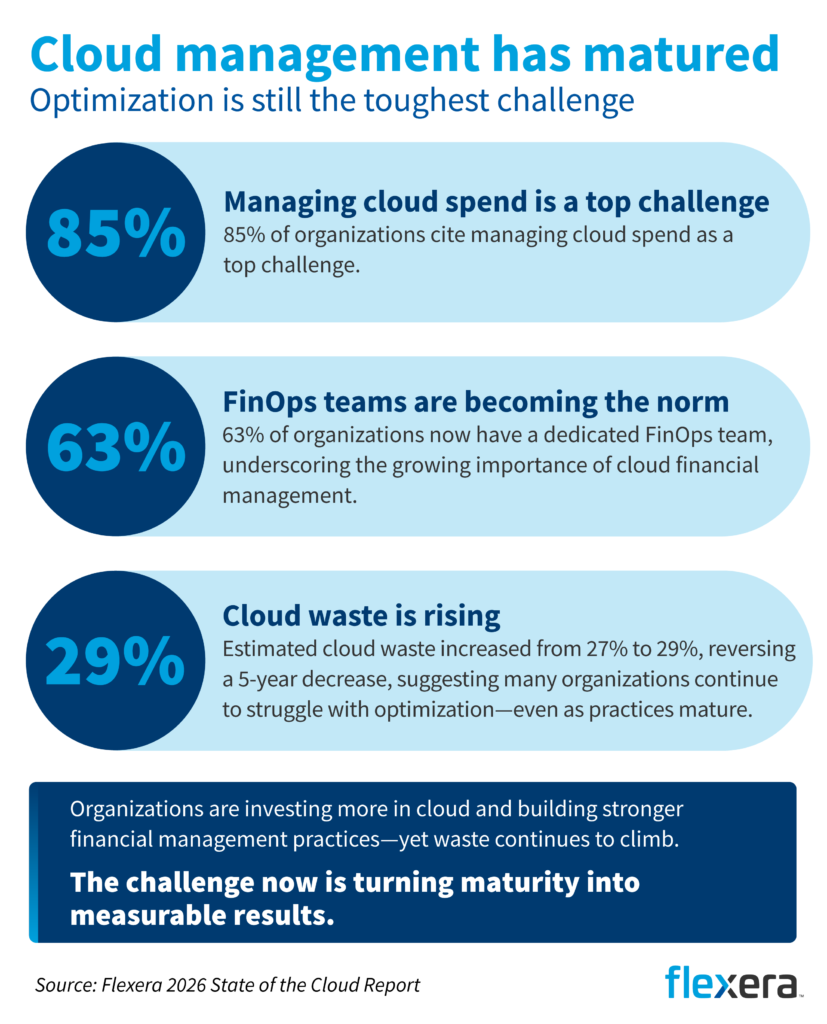
That combination matters. Organizations have invested in cloud financial management, but complexity keeps outrunning their operating models. AI now adds more dynamic workloads, less predictable demand and pricing structures that differ across infrastructure, platforms and SaaS. The result is a faster-moving version of the cloud challenge many organizations still haven’t solved.
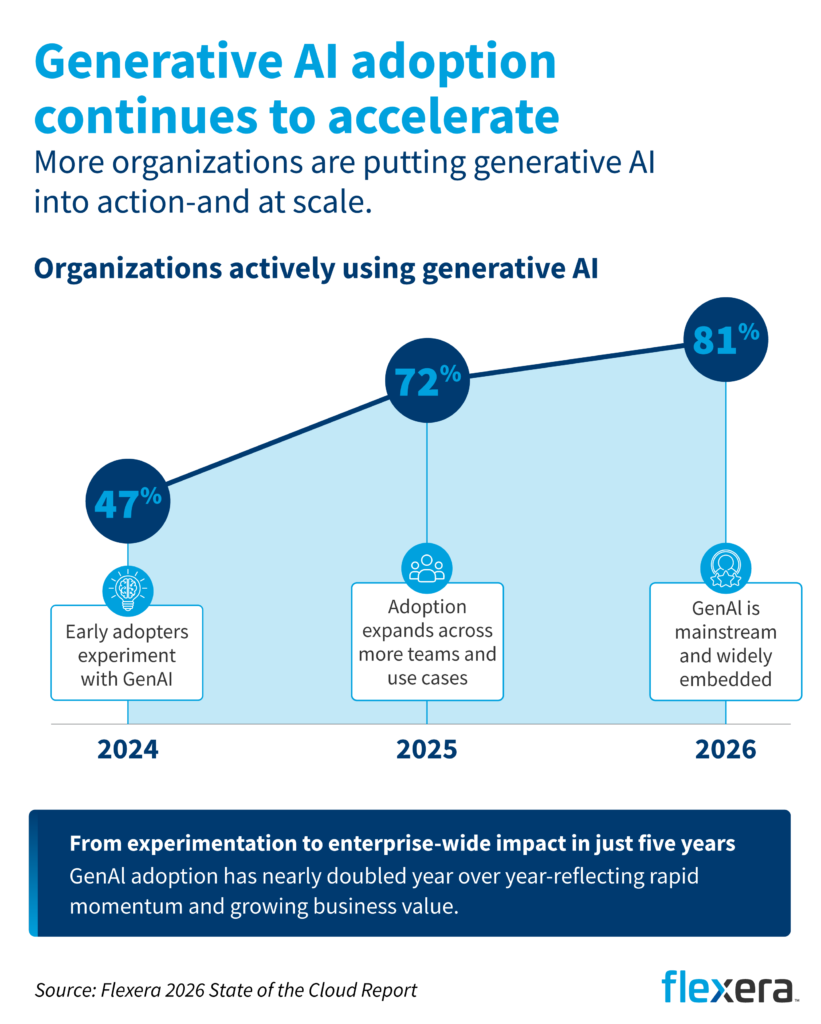
GenAI adoption underscores the urgency. In 2026, 45% of respondents say they use GenAI extensively and 36% use it sparingly. Adoption is moving into everyday operations while cost visibility and governance are still catching up.
The visibility gap extends beyond cloud
The software side tells the same story. The Flexera 2026 State of ITAM Report found that only 31% of organizations report accurate visibility into AI software, while 59% say wasted AI software spend increased year over year. At least half track AI spend as part of broader software spend, but that still leaves a significant governance gap.
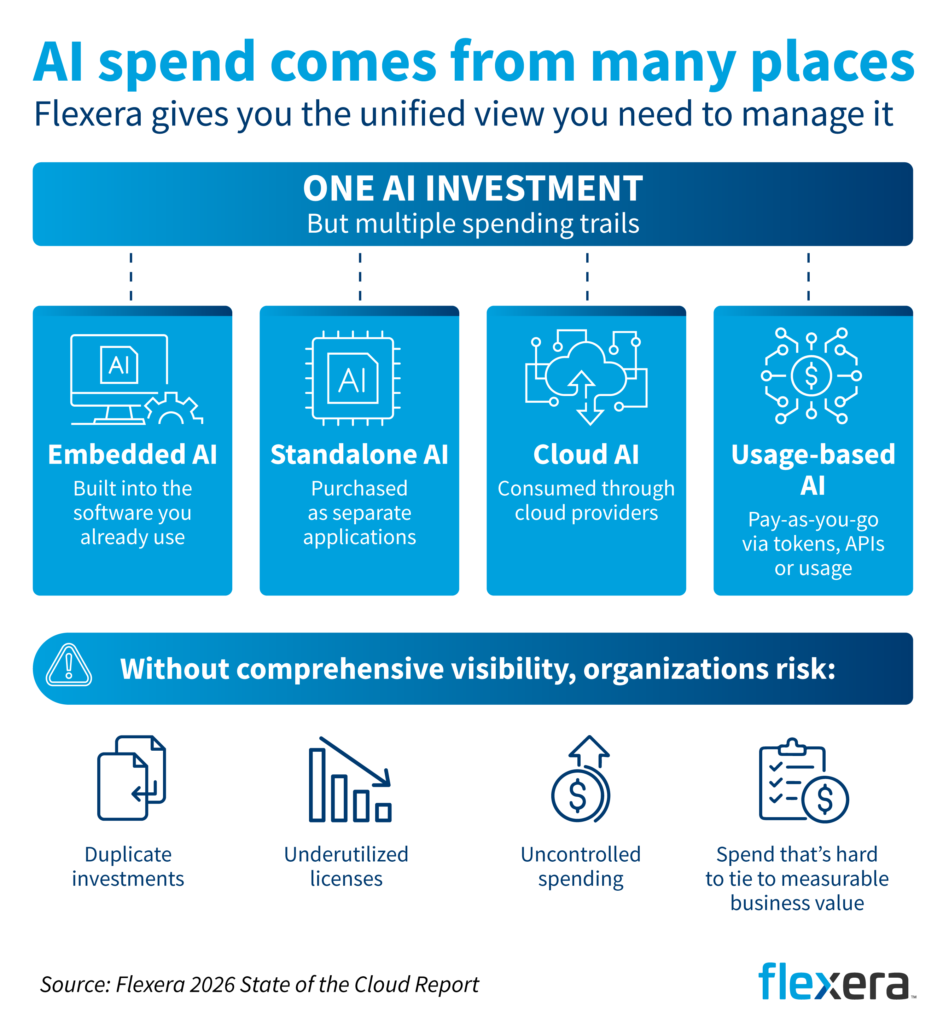
AI can be embedded in an existing platform, purchased as a standalone application, consumed through a cloud provider or accessed through a usage-based service. Each model leaves a different spending trail. Without a connected view, organizations risk duplicate tools, underused licenses and costs they can’t tie back to measurable business value.
FinOps, ITAM and SaaS management have to operate as one system
AI breaks the boundaries that once separated cloud, software and SaaS spending. A single initiative can drive token usage, cloud infrastructure costs, SaaS fees and new software investments at the same time. No single team can manage that reality from its own system and still see the economics clearly.
FinOps brings discipline to dynamic, consumption-based spending and connects cost to business outcomes. ITAM and software asset management bring visibility into software usage, licensing and risk. SaaS management exposes application ownership, utilization, renewals and overlapping functionality. Together, these capabilities create the shared intelligence organizations need to understand what they’re consuming, what’s driving cost and where to act.
Move from visibility to active cost control
Visibility is the starting point, not the outcome. Once teams can see AI consumption across models, cloud and software, they can use specific levers to change the cost curve:
- Model routing: Send routine tasks to lower-cost models and reserve frontier models for work that requires their capabilities
- Prompt caching: Reuse stable prompt content and repeated context instead of paying to process the same information again
- Context-window management: Limit unnecessary context, retrieve only relevant data and prevent oversized prompts from inflating consumption
- Usage guardrails and anomaly detection: Set budgets, monitor token and cloud consumption and flag unexpected spikes before they become quarter-end surprises
- SaaS and application rationalization: Identify overlapping AI tools, reclaim underused licenses and negotiate contracts using actual usage data
- Unit economics: Measure the cost of an AI-powered workflow, application or service against the business outcome it delivers
These levers create a practical path from reaction to control. They also force an important shift in the conversation. The goal isn’t to throttle AI indiscriminately, but to direct investment toward the models, workflows and tools that can prove their value.
AI’s next challenge isn’t adoption. It’s accountability
The AI market isn’t waiting for organizations to perfect their governance. Adoption will continue, agents will trigger more chained activity and vendors will keep introducing new ways to package and price AI. The cost emergency will deepen for organizations that continue to manage each layer separately.
The organizations that get the most value from AI won’t necessarily deploy the most models or roll out the most tools. They’ll build the operational discipline to manage AI as an enterprise cost category. They’ll establish guardrails, optimize consumption, rationalize overlapping investments, assign ownership across teams and connect spending to outcomes.
That’s why the convergence of FinOps, ITAM and SaaS management is no longer an industry talking point. It’s the operating model the moment demands. The question is bigger than whether an organization can control its AI budget. It’s whether leaders can prove that the economics of each AI-powered workflow make sense at scale.
Learn more about AI cost management
What is AI cost management?
AI cost management is the practice of tracking, governing and optimizing all costs associated with AI initiatives, including token consumption, cloud infrastructure, software subscriptions, SaaS applications, data services and AI-powered tools. Effective AI cost management helps organizations control spending while ensuring AI investments deliver measurable business value.
Why are AI token costs becoming a business concern?
As organizations scale their use of generative AI, token usage can increase rapidly across users, applications and automated workflows. Because token-based pricing is consumption-driven, organizations often face unpredictable costs unless they actively monitor usage, establish budgets and implement governance controls.
How do AI token costs differ from cloud costs?
Cloud costs are typically associated with infrastructure resources such as compute, storage and networking. AI token costs are tied to model usage and consumption. However, AI initiatives often generate both cloud and token costs simultaneously, making it important to manage them together rather than in separate silos.
What are the biggest drivers of AI spending?
AI spending often comes from multiple sources, including:
- Token and API consumption
- Cloud infrastructure
- AI-enabled SaaS subscriptions
- Standalone AI applications
- Data platforms and services
- Agentic AI workflows
- Model training and inference costs
This distributed spending makes visibility and governance challenging without a unified management approach.
How can organizations reduce AI costs without reducing innovation?
Organizations can optimize AI spending through strategies such as model routing, prompt caching, context-window management, budget guardrails, anomaly detection and application rationalization. These approaches help reduce unnecessary costs while preserving the business value generated by AI.
What is the relationship between FinOps and AI cost management?
FinOps provides the financial management framework for understanding and optimizing consumption-based technology spending. As AI adoption grows, FinOps practices help organizations track AI costs, allocate spending, establish accountability and connect investments to business outcomes.
Why is visibility important for managing AI costs?
Organizations cannot effectively control what they cannot see. AI costs can be spread across cloud environments, software licenses, SaaS platforms and usage-based services. Comprehensive visibility enables teams to identify waste, track ownership, monitor trends and make informed investment decisions.
How does SaaS management support AI governance?
Many software vendors now embed AI features into existing products or offer premium AI add-ons. SaaS management helps organizations understand application usage, identify redundant tools, optimize licenses and ensure AI spending aligns with business needs.
What challenges do organizations face when measuring AI ROI?
Measuring AI ROI can be difficult because costs often span multiple technology domains while benefits may appear across productivity, efficiency, customer experience or revenue outcomes. Organizations that connect AI spending to business metrics and unit economics are better positioned to demonstrate value.
What is the best way to govern AI spending across the enterprise?
Leading organizations are adopting a cross-functional approach that brings together FinOps, IT asset management (ITAM), SaaS management, procurement, finance and technology teams. Shared data, clear ownership and unified visibility help organizations manage AI spending more effectively and avoid fragmented decision-making.
How can organizations prepare for the growth of agentic AI?
As agentic AI becomes more common, a single user request may trigger multiple model calls, workflows and services. Organizations should establish cost visibility, usage monitoring, spending guardrails and governance frameworks now to prevent unexpected cost escalation as AI automation scales.