
Table of contents
Do not edit: TOC will be auto-generated
Many IT teams find it challenging to maintain accurate asset data across their environments—even in powerful platforms like Jira Service Management (JSM) and Atlassian’s configuration management database (CMDB). Maybe a ticket didn’t have enough context, or the CMDB was missing key information about a server or application. Or maybe those JIRA tickets had a whole lot of information that wasn’t available where it could be better leveraged, like a CMDB. These tools are powerful, but they’re only as good as the data behind them. And that’s where better IT asset data can make a huge difference.
JSM Assets helps IT teams manage their environments efficiently—and delivering quality normalized asset data to fuel that solution dramatically improves system reliability. Enhanced technology asset intelligence can take things to the next level: Improving your asset data can help solve some of the most common issues with JSM’s CMDB.

What gets in the way of fully leveraging your CMDB? What’s the problem with the CMDB?
JIRA is great for tracking issues, changes and incidents. Atlassian’s CMDB (often powered by Asset in JSM) does a great job of helping you keep track of your IT assets and how they’re connected. But there’s a catch: If your asset data is messy, outdated or incomplete, these tools can’t do their job properly.
Here are a few common problems:
- Missing or outdated asset records: You can’t manage what you don’t know exists
- Data scattered across systems: Spreadsheets here, monitoring tools there… nothing talks to each other
- No real-time updates: Your infrastructure changes fast, but your CMDB doesn’t keep up
- Weak relationship mapping: You don’t know how systems are connected, so impact analysis is a guessing game
- Manual errors: People make mistakes, especially when entering data by hand in a massive spreadsheet
Sound familiar? Probably. According to the Flexera 2025 State of ITAM Report, complete visibility into IT assets has decreased to 43% from 47% year over year.
JSM gives you the structure to manage and visualize your IT environment— and Flexera brings the data, breadth and depth, and automation to make that structure even more powerful.
Now imagine your asset data is clean, complete and always up to date. Here’s how that changes the game:
How better asset data helps
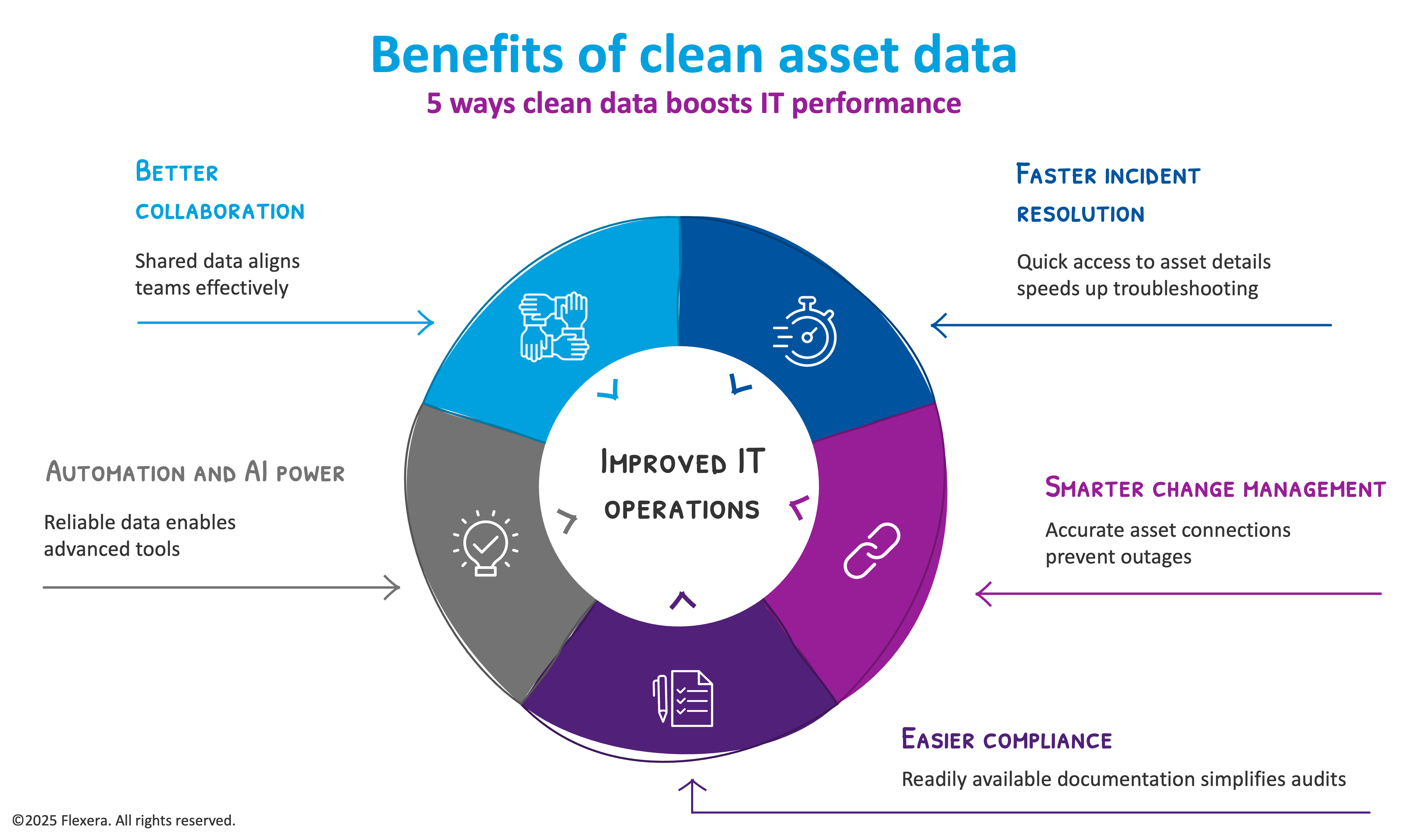
High fidelity data builds a common foundation across the organization to make better decisions, faster. With clean data, you’ll improve your overall IT operations and outcomes.
- Faster incident resolution: When something breaks, the clock is ticking. If your JIRA tickets are automatically linked to the right assets—with all the details like owner, location, recent changes and dependencies—your team can jump straight into troubleshooting. No more digging around for context
- Smarter change management: Planning a change? You need to know what systems will be affected. A well-maintained CMDB shows you exactly what’s connected to what, so you can assess risk and avoid surprises. That means fewer outages and smoother rollouts
- Easier compliance and audits: Need to prove what assets you have and how they’re configured? A clean CMDB makes audits less painful. You’ll have the documentation you need at your fingertips—no scrambling required
- More automation and AI power: Do you want to use automation or AI to streamline your workflows? You’ll need solid data first. Whether it’s auto-assigning tickets, predicting incidents or triggering alerts, these tools rely on accurate asset information to work properly
- Better collaboration across teams: When everyone—from IT to security to development—is working from the same, reliable asset data, things just run smoother. No more finger-pointing or duplicate work; everyone is on the same page
With clean data, you’ll improve your overall IT operations and outcomes:
How do you get better asset data?
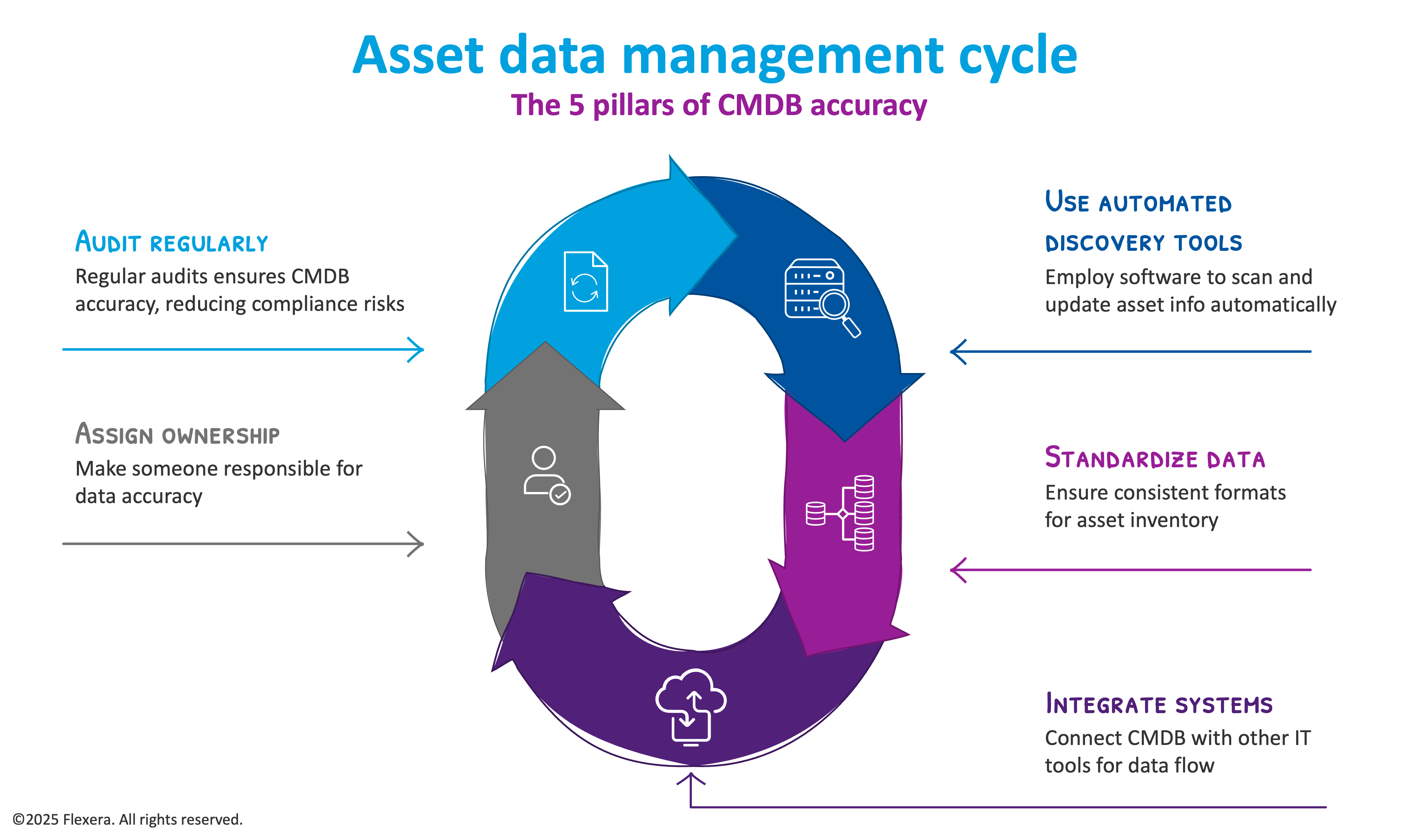
Here are a few practical steps to help you improve your data:
- Use automated discovery tools: Let software scan your network and cloud environments to find and update assets automatically. Flexera uses a combination of agent-based and agentless technologies to automatically discover hardware and software assets across on-premises, cloud and hybrid environments, and it leverages all your discovery sources
- Standardize your data: Make sure asset names, types and fields follow consistent formats. Raw discovery data is often messy and inconsistent. Flexera addresses this by normalizing the data—standardizing vendor names, product titles and version numbers
- Integrate your systems: Connect your CMDB with procurement, monitoring and endpoint tools so data flows automatically. Flexera integrates seamlessly into the IT ecosystem by connecting with tools like CMDBs, ITSM platforms, cloud providers and procurement systems. This integration ensures a continuous flow of accurate asset data across the organization
- Assign ownership: Appoint someone to keep asset data accurate and up to date. Flexera supports governance by providing context on assets to specific departments or business units, making accountability clear
- Audit regularly: Check your CMDB against what’s actually in your environment and fix any mismatches. Flexera IT Visibility and IT Asset Management help reduce regulatory and licensing compliance risk, providing proof of compliance, license usage and lifecycle status
Covering off on these steps will improve your data:
CMDB is only as effective as its IT asset data
In the end, JSM’s CMDB is only as good as the data you feed it. If your asset data is clean, current and connected, you’ll gain a lot more value. You’ll resolve issues faster, manage changes more confidently and make smarter decisions.
If you’re ready to take your asset intelligence to the next level, let’s talk. Flexera can help you make JSM your most trusted source of asset truth.
Ready to get started? Reach out for an assessment from Flexera.
No obligation assessment—see your results before any commitment.
Streamlined NDA process.