

Table of contents
Do not edit: TOC will be auto-generated
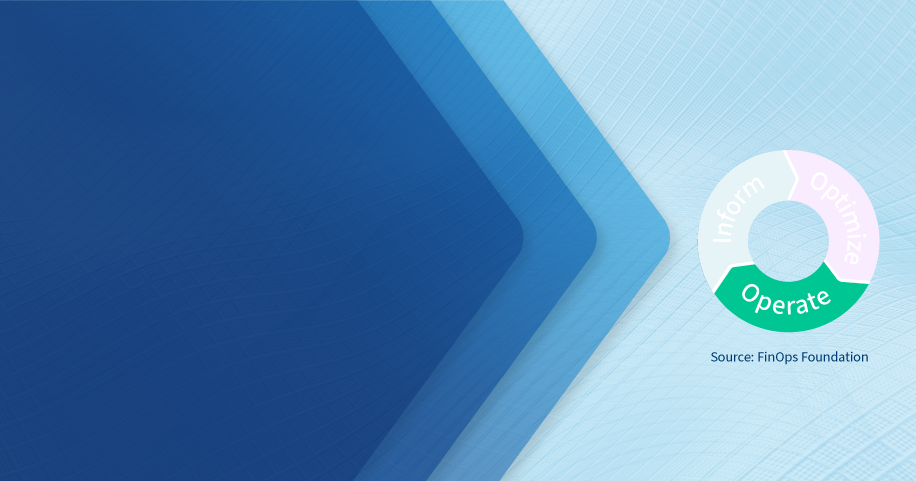
The FinOps Framework by the FinOps Foundation is an operational framework and cultural practice which helps organizations maximize the business value of their cloud and technology investments. This framework helps organizations build and mature their FinOps practices through three iterative phases: Inform, Optimize and Operate.

Source: FinOps Phases by the FinOps Foundation
To help your organization effectively adopt FinOps, we developed this practical FinOps roadmap blog series based on these FinOps Framework phases. Our blog series provides real-world implementation advice for getting started with the most critical capabilities at each phase in your FinOps adoption journey.
In Part 1 of this series, we detail the steps you need to take before you even begin practicing FinOps. In Part 2, we discuss activities associated with the Inform phase, and in Part 3 we dive into the Optimize phase.
In this Part 4 blog, we show you how to set up cloud operations to ensure continuous optimization as your environment inevitably changes, and examine capabilities that your organization may need to mature in. At this point in your journey, you’ll set governance policies that help you realize value from cloud investments. Wherever possible, you’ll automate optimization activities and expand the scope of your FinOps practice.
Re-assess your FinOps capability needs
FinOps is an iterative practice. You likely started with easy-to-tackle cost optimizations, such as eliminating wasted resource usage in your development environment.
If you followed the guidance in Part 1 of this series, you likely began to do that by defining the capabilities that are most critical for your organization and determining your maturity needs for each of those FinOps capabilities. It’s important to understand that the goal of FinOps is not to get to a “run” maturity for every capability. Instead, you should read the maturity assessment section for each capability to assess what level of maturity (crawl/walk/run) is ideal for that capability. For some capabilities, your organization may only need to operate at a crawl, while for other capabilities, a walk or run is needed.
For example, see the maturity assessment for the workload optimization capability:
- At a Crawl level of maturity, workload optimization might be as simple as addressing low-hanging fruit like eliminating “zombie resources” such as unattached storage volumes, unused IP addresses, idle VMs or orphaned snapshots
- At a Walk level of maturity, workload optimization may amount to being able to estimate the amount of time and effort required to optimize a service, and the impact it will have on performance
- If you’re using a FinOps tool, perhaps Walk maturity means implementing all optimization recommendations with a specified dollar impact
- At a Run level of maturity, workload optimization likely involves a comprehensive strategy that takes business goals into account
- You’ll assess granular cost and usage data to make decisions about cost vs. performance, and likely use automation to implement some optimizations, or receive alerts about opportunities that need investigation
Now that you have been through the phases of Inform and Optimize, it’s time to iterate on those activities in the Operate phase. Re-assess your needs; Does your business currently require more maturity or less maturity in any of these capabilities? Do you need to tackle any new capabilities?
As shown below, you will repeat this iterative cycle repeatedly as time goes on, and you’ll continually adjust your FinOps practice to align with the ever-changing needs of your business.

Here are just a few examples of actions that you and DevOps teams might consider in your next iteration of the FinOps lifecycle:
- Implementing storage lifecycle management
- Selecting cost-effective regions
- Scheduling workloads
- Upgrading to the latest instance types
- Enabling autoscaling and load balancing
- Using serverless technologies
- Using spot instances when possible
- Build a strategy to manage commitment discounts
Leverage automation to operate at scale
Cloud operations never stand still. Workload needs are always changing, new applications are being developed and deployed, and engineering teams are constantly using new resources and services. If your organization uses containerized workloads, new resources will be spun up and down by the minute. Leveraging automation can help put some guardrails around cloud usage, so you can scale your FinOps practice in a large organization with thousands of engineers, workloads and applications.
Your FinOps tool should provide you with policy-based automation to apply where possible. Not all activities can or should be constrained by policies, as you don’t want to stifle agility and innovation. Where you can find consistent waste, though, you should work with DevOps teams to implement alerts at the very least, and automated actions at best.
In addition to cost monitoring, policies can be built around compliance, operations and security. Just like with everything else in your FinOps practice, start small and grow more complex only if needed. Tackle the “worst offenders” of consistent cost overrun first and iterate continuously. Now you’re in the Operate phase.
Expand your FinOps practice to new scopes
FinOps was born to address the decentralized spending on cloud infrastructure associated with a DevOps operating model. But today, much of an organization’s technology spend is on software, and SaaS spending is decentralized in the same way that cloud infrastructure spending is. This means that FinOps practices can be extended to manage SaaS spend. FinOps teams should collaborate with ITAM professionals to provide total visibility of technology spend across the organization.
Shift FinOps left
As you get a handle on post-deployment cost optimization, you can help your organization start to think more strategically about costs. Teaching your cloud architecture teams and product management teams about FinOps best practices can help your organization become more proactive in managing costs, so you have less cleanup to do after deployment. Making cost-aware product decisions and architecting applications for cost efficiency will save everyone much time and headache.
Improve unit economics
Contrary to popular understanding, FinOps isn’t about saving money, it’s about making money. The whole goal of FinOps is to show that all this cloud spending is making the company much more money than is being spent. To do that, you need to understand your unit economics.
What does that mean? Well, for example, let’s say that your company sells sneakers. Do you know how much it costs to build and operate your company website, maintain digital transaction records, and serve your customers through your mobile app? If you can help your company get a complete picture of all these technology costs, then you can figure out how much it costs for each pair of sneakers you sell (i.e., one unit).
As a FinOps practitioner, you have been diligently ensuring all resources are tagged and charged back to the appropriate microservices and apps that your company runs, so you are in a great place to help improve the economics of selling one pair of sneakers. By optimizing all those technology costs, you lower the unit cost—even while your total IT spending may be increasing.
This is the real magic of FinOps. You’re now helping your company maximize the business value of all that spending. Congratulations—you’re now a top-notch FinOps practitioner.
What’s next
FinOps is never done. Continuous iteration is the name of the game. With each cycle through the FinOps phases, you’ll improve and tackle more so your organization can reap the benefits.
We hope this series has been helpful. If you haven’t already, we recommend joining the FinOps Foundation so you can learn from your peers.
Be sure to bookmark this page, along with Part 1, Part 2 and Part 3 of this blog series for future reference. You can also check out our resources page to learn more about how Flexera One can help you with your FinOps journey.
Ready to start saving while you run? We can help you identify and implement effective cloud cost optimization strategies tailored to your needs.