


Optimizing modern Kubernetes environments takes more than a one-time or manual effort. It takes continuous optimization that you can run confidently in production without putting application availability at risk. That’s the foundation of Flexera’s Autonomous Workload Optimization (AWO), also known as Ocean and Elastigroup, which helps teams optimize Kubernetes and virtual machine workloads.
For Kubernetes, Ocean continuously optimizes clusters to maximize efficiency and cost savings by:
- Handling spot instance interruptions automatically
- Rightsizing cluster workloads automatically
- Rebalancing nodes through intelligent bin packing
- Moving workloads to lower-cost instance types
- Moving capacity back to spot instances when possible
- Using unused Savings Plans and Reserved Instances
These actions deliver significant, ongoing savings. They also involve replacing nodes and evicting pods.
The Kubernetes eviction gap
In standard Kubernetes behavior, availability risks can appear when resources run short. By default, when a node is drained:
- Pods are evicted first
- Traffic stops flowing to them
- The ReplicaSet creates replacement pods afterward
- Those pods can stay in a “Pending” state until enough capacity is available
For single-replica, stateful or latency-sensitive workloads, even a short interruption can mean failed requests, a degraded user experience or missed SLAs.
This often forces teams to slow down optimization, limit spot instance usage or accept unnecessary costs just to stay safe.
Pre-Eviction Warmup: optimization that adapts to your applications
Pre-Eviction Warmup changes the eviction flow without slowing down optimization.
When you enable it for a workload, Ocean makes sure that:
- A replacement pod is created first
- The new pod reaches a Ready state
- A configurable warmup period is honored
- Only then is the original pod evicted
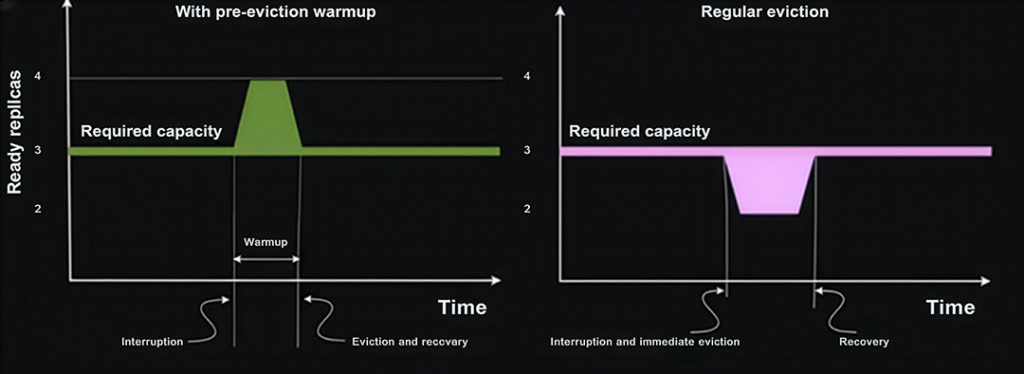
In other words, capacity is added before capacity is removed.
Traffic keeps flowing and requests are served while pods are replaced, including during spot instance interruptions and cost-driven node replacements.
Simple to enable, built for flexibility
You enable Pre-Eviction Warmup directly in your Deployment spec:
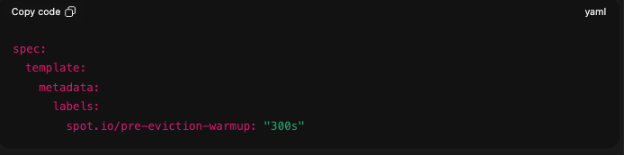
The value is a duration string (for example, 30s, 2m or 5m), which gives teams clear, per-workload control over warmup behavior.
The label value sets the maximum time Ocean waits between creating the warmup replacement pod and evicting the original one.
When platform eviction deadlines are tight, Ocean still acts safely. If needed, it evicts the pod up to 5 seconds before the enforced deadline.
The real value: room to optimize further
Pre-Eviction Warmup helps protect availability, and it expands what your team can safely automate.
- Deeper savings: Run production workloads on spot instances with confidence and let Ocean rebalance more aggressively.
- Always-on optimization: No need to pause, throttle or second-guess optimization cycles to protect availability.
- Application-aware decisions :Optimization actions take workload readiness into account, not only infrastructure signals.
- Production-grade reliability :Built for customer-facing, revenue-critical and stateful services where seconds matter.
- Granular control: Opt in per workload with simple Kubernetes labels, so you apply protection where you need it.
Optimize continuously and stay online
With Pre-Eviction Warmup, Ocean closes the gap between aggressive Kubernetes optimization and production-grade availability. See how Augury runs production AI workloads on Azure Kubernetes Service with spot VMs, or read how automatic rightsizing helps reduce Kubernetes compute waste.
See it in action
Read the Pre-Eviction Warmup documentation or learn more about Kubernetes container optimization with Flexera.
Why does Kubernetes optimization cause downtime?
By default, Kubernetes evicts pods before their replacements are ready. During node drains, single-replica, stateful or latency-sensitive workloads can fail requests while the new pods are pending.
What does Pre-Eviction Warmup do?
It creates a replacement pod and waits until that pod is Ready, plus a configurable warmup period, before evicting the original pod.
Can I use spot instances for production Kubernetes workloads?
Yes. Automated interruption handling and Pre-Eviction Warmup let you run production workloads on spot instances while protecting availability.
Yarden Kesari
Yarden Kesari is a Senior Manager, Product Management at Flexera, leading cloud infrastructure optimization products focused on Kubernetes, performance, and cost efficiency. He drives product strategy across FinOps and large-scale cloud infrastructure optimization, working closely with engineering and go-to-market teams. Prior to his current role, Yarden led DevOps and SRE teams, bringing strong technical and people leadership alongside hands-on experience in building and scaling cloud-native production systems.