

Flexera’s January 2026 updates deliver major enhancements across ITAM, FinOps, IT Visibility, and Security. Highlights include new ITAM API endpoints, real‑time FinOps KPIs, carbon emissions forecasting, AI‑powered Data Explorer capabilities, and upgraded SVM features for faster patching and tighter security. These innovations help organizations improve visibility, reduce cost, and strengthen operational efficiency across their hybrid environments.
Learn more about what’s coming with Flexera’s 2026 AI Innovation Roadmap here.
Innovation area: IT Visibility
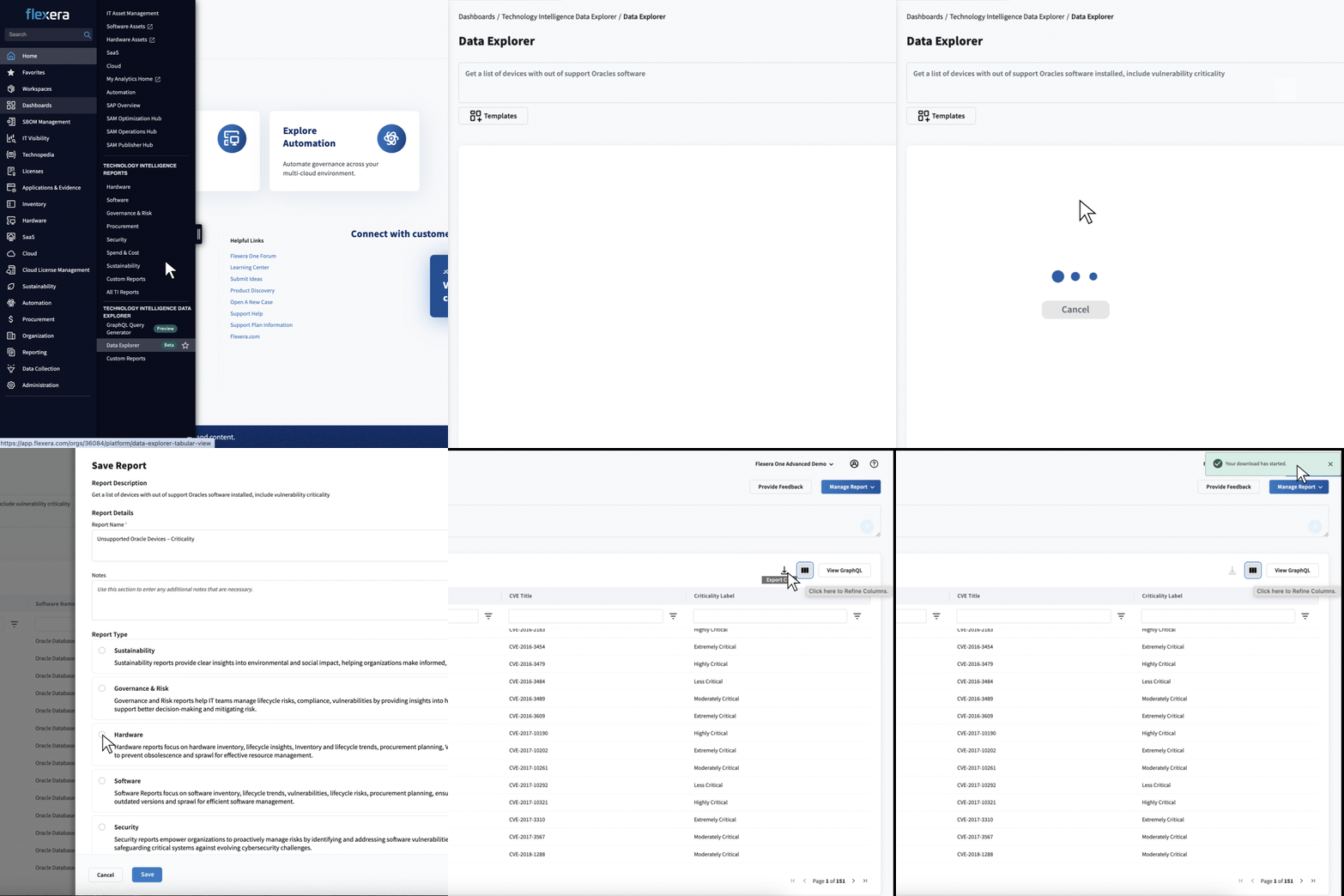
Data Explorer now available in IT Visibility
Data Explorer in IT Visibility delivers a groundbreaking AI-native capability built on the Technology Intelligence (TI) Platform for Flexera One. Designed to accelerate decision-making, Data Explorer gives users natural-language access to Technology Intelligence Inventory data, returning relevant tabular reports and insights directly within Flexera One.
Key highlights
- Natural language data queries make report generation accessible to non-technical users.
- Customizable and exportable reports include built-in UI tabular views: add or remove columns as needed using an intuitive interface.
- Role-based access and collaboration grants you the ability to create, edit, duplicate, and delete any data explorer report within the organization.
- Template reports for quick start can be duplicated and customized, reducing setup time for common use cases.
- Comprehensive native report management: save, organize, and manage custom reports, including editing details, saving versions, and deleting obsolete reports.
- Transparency and technical insight: view the GraphQL query behind each report and enable advanced users to understand or replicate the data extraction logic.
Why it matters
- Faster, higher-confidence decisions
Ask in plain English (“Show devices nearing end of support this quarter”) and get exactly what you need—initially in table format—so teams act quickly. - One trusted source for everyone
Create a view with a simple prompt (“List non-compliant software by business unit”), save it and share securely. Everyone sees the same version, reducing debate and keeping focus on decisions. - Scales as data grows without complexity
As new datasets arrive, keep using natural language (“Show me servers with different patch levels running the same OS version”). The same interface makes them instantly explorable, expanding use cases while staying simple.
For more detailed information see our release blog here.
Innovation area: IT Asset Management
Flexera One ITAM APIs
New System Health and Tasks Endpoints: Two new API endpoints have been added for Flexera One ITAM enhancing data access and monitoring capabilities by providing improved visibility into system health and task execution.
Why it matters
These new endpoints empower ITAM customers with greater control by enabling automated checks on system health and task status, reducing manual effort, boosting operational efficiency, and supporting proactive monitoring for a smoother ITAM operation experience.
Innovation area: Cloud Cost Optimization
FinOps KPIs
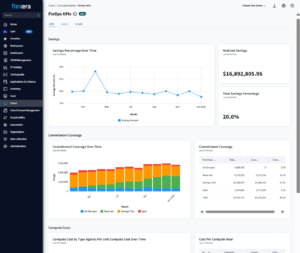
Flexera One Cloud Cost Optimization (CCO) now provides real-time KPIs and visualizations for current and historical cloud spend, usage, and optimization. This feature enables FinOps practitioners to instantly access and track the most common FinOps KPIs for each cloud provider, eliminating manual data exports and report creation. With out-of-the-box, vendor-specific KPIs, teams and departments can easily see how they are performing against their goals.
Key highlights
Key Performance Indicators (KPIs) support:
- Commitment Coverage History
- Savings Realized
- Compute Cost Per Hour Per Month
- Storage Cost Per Hour Per Month
- Database Cost Per Hour Per Month
Why it matters
- Less manual work, more efficiency
Tracking common FinOps KPIs is now a click away in the Flexera One CCO dashboard—freeing FinOps and cloud cost management teams for higher-value work, not manual reporting. - Hyperscaler-specific insights
Understand which KPIs are on track for any or all of these major hyperscalers—AWS, Microsoft Azure, or Google Cloud Platform—improving insights precision for FinOps teams. - Build trust through KPI alignment
FinOps and cloud cost management teams can partner more effectively with Engineering and other FinOps personas by making it easier to align on common KPIs.
For FinOps for AI, see the blog here. Detailed documentation, Feature Release notes and a Community Post will be live shortly.
Cloud Sustainability carbon emissions forecasting
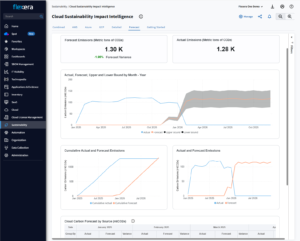
Flexera One Cloud Sustainability (available as a stand-alone solution or with Flexera One Cloud Cost Optimization) now supports carbon emissions forecasting. Carbon forecasting enables organizations to predict, plan, and proactively manage cloud-based carbon emissions the same way they manage cloud spend. Just as finance teams forecast budgets, track spending, and analyze variances, cloud sustainability teams can now forecast carbon emissions, monitor actual consumption, and identify deviations from targets.
This transformation shifts carbon management from reactive reporting to predictive planning, enabling teams to act early, set achievable goals, and avoid costly surprises.
Key highlights
- Carbon Forecasting enables FinOps and cloud cost management teams to forecast emissions and track variances with auditable data
- Google Cloud Carbon Emissions dashboard provides standardized views to monitor GCP footprints
- Azure context in reports enables slice-and-dice analysis through new Subscription and Resource Group attributes added.
- Power BI Custom Reports helps FinOps and cloud cost management teams build tailored Sustainability views for stakeholders and partners, ensuring alignment across all personas.
Why it matters
- Increase predictability, drive accountability
Know your carbon spend before it happens while supporting accountability by assigning carbon budgets to teams and projects. - Improve optimization, meet compliance needs
Now it’s easier to identify high-emission workloads for remediation while still meeting reporting requirements with auditable data. - Align sustainability with overall cloud strategy
With data-driven forecasting, FinOps and cloud management teams can better align sustainability decisions with organization-level cloud strategy.
Innovation area: Security vulnerability
Software Vulnerability Manager (SVM) Updates: Level Up Your Patch + Security Workflow
The latest SVM on‑prem and cloud release delivers enhanced patch publishing, smoother AdminStudio integration, and stronger security controls for SSO and API access. These updates ensure a more automated, secure, and streamlined workflow for vulnerability and patch management teams.
We’re delivering updates across both our on‑premises and cloud products that make patching, packaging, and vulnerability management easier, more automated, and more secure.
Enhanced Automation & Packaging Workflows
Across both on‑prem and cloud, Patch Publisher gains deeper integration with AdminStudio. Whether using monitored folders on‑prem or REST API automation in the cloud, it’s now faster and easier to import, customize, and distribute software packages with less manual effort.
More Flexible Patch Deployment
We’ve expanded support for modern deployment tools.
- On‑Prem: Publish SPS and VPM patches directly to Config Manager.
- Cloud: SVM Cloud supports Intune publishing for both MSI and EXE‑based Vendor Patch Module packages, greatly increasing application coverage.
Stronger Security & Access Controls
Security gets a boost across the board:
- On‑Prem: Root accounts can disable standard login when SSO is enabled, and a new API Access permission offers more granular control.
- Cloud: New IP‑based access restrictions ensure users can only operate within approved networks, while new warnings make it clearer when a package is unsigned.
UI Improvements & Better Visibility
The new SVM Cloud UI now supports Network Appliance Groups, making network‑based scanning easier. Both Patch Publisher and SVM Cloud also include clearer indicators and warnings around digitally signed packages.
Why it matters:
SVM’s latest updates help teams work faster, stay secure, and maintain a more reliable patching and remediation pipeline:
- Reduce manual effort
- Tighten authentication controls
- Unify packaging and publishing processes
For more information on SVM on-premises, please see release notes here and the
community blog here.
For more information on SVM cloud, please see release notes here and the
community blog here.
What’s coming in 2026?
We reveal product updates and innovations every month. Subscribe to our blog so you don’t miss a thing.