


Artificial intelligence (AI) is expanding across enterprises faster than most teams can govern or measure. Adoption is nearly universal, spending is rising sharply and new risks are emerging in cloud, SaaS and data environments. Yet the organizations creating real value from AI aren’t the ones simply experimenting or scaling quickly—they’re the ones establishing clarity, strengthening governance and treating AI as an operational discipline.
The inaugural Flexera 2026 AI Pulse Report brings together insights from Flexera’s flagship research (Flexera 2026 State of the Cloud Report and IT Priorities Report) to help leaders understand where AI is heading and how to stay ahead of accelerating exposure, spending and complexity. We’re going to look at some key highlights in this blog, but you can find the full findings, charts and industry-specific insights in the complete report:
AI adoption is accelerating faster than organizations can prepare for
AI isn’t emerging—it’s here, multiplying and reshaping IT strategy at historic speed. Nearly all organizations are using or actively integrating AI and machine learning into their technology stacks, and generative AI continues to drive widespread experimentation and usage across functions like development, security, analytics and operations.
But rapid adoption doesn’t automatically translate to value. The report shows that while enthusiasm is high, many leaders struggle with the fundamentals needed to govern and measure AI effectively. Shadow AI, rising SaaS usage, embedded model behavior and cross‑platform proliferation all contribute to risks that compound quickly when visibility is limited.
Rising spend and waste signal a widening discipline gap
AI investment is surging, but many leaders report that they can’t fully justify or track where that spend is going. Eighty percent of organizations have increased AI investments, yet more than one third say they overspent on AI applications and 14% report wasted AI spend. This disconnect stems from several forces the report surfaces:
- AI workloads behave unpredictably, with bursty compute and volatile GPU demand
- AI-powered SaaS introduces unclear metering, fees buried in tiers and shifting pricing models
- Shadow experimentation widens the financial surface area, often outside procurement or IT’s oversight
- Embedded AI features appear quietly across tools, obscuring when spend is actually tied to AI
Traditional cloud-era cost controls weren’t built for AI. Leaders now face financial models more volatile than cloud ever was. The answer is not reactive cost cutting, but proactive instrumentation built on unified visibility.
Visibility is becoming the defining prerequisite for control
The report shows that visibility gaps are one of the most critical barriers standing between organizations and AI value. Eighty‑five percent of organizations say gaps in IT visibility pose a major risk, and nearly half report they don’t always know how or when employees are using AI tools.
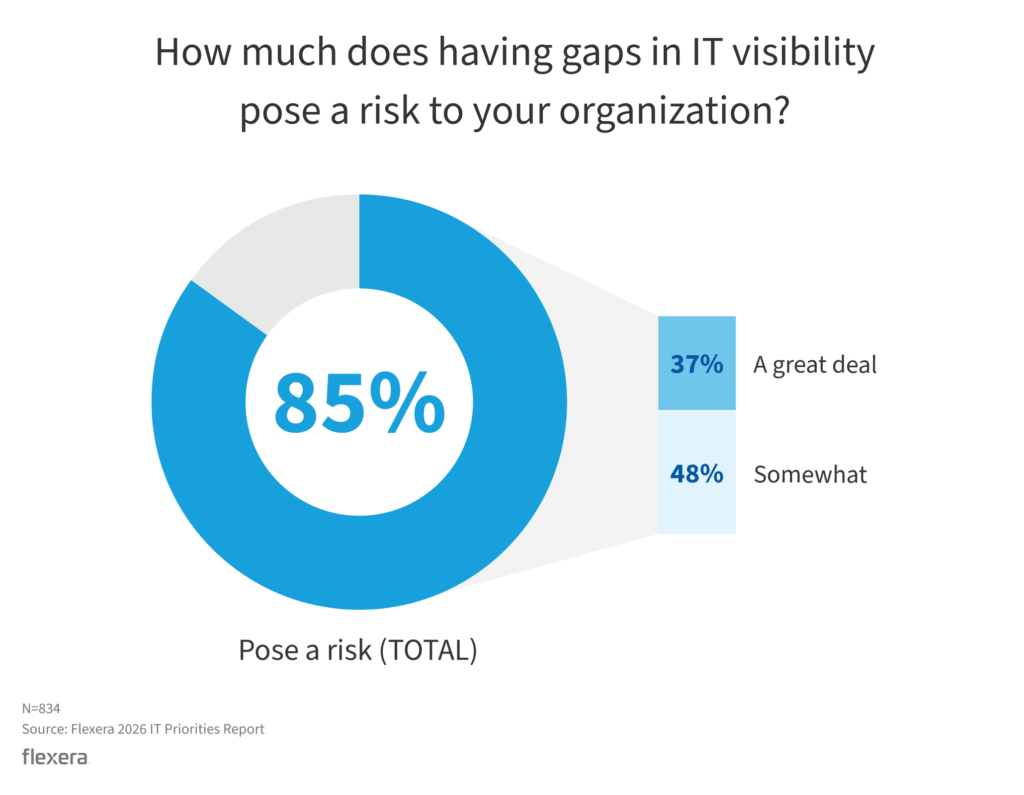
This lack of clarity has consequences:
- Shadow AI proliferates without detection
- AI-powered SaaS features activate without notice
- Data flows cross systems IT can’t fully monitor
- Contracts include AI-related terms teams may not review
- Security, compliance and procurement teams operate without a shared picture
Flexera’s data shows that visibility is foundational—not an afterthought. It enables governance, cost attribution, risk mitigation and the ability to tie usage to measurable outcomes.
“AI visibility is no longer just an operational concern—it’s a board-level risk.” — Conal Gallagher, Flexera CIO and CISO
Governance is the hinge between innovation and trust
AI’s risks aren’t limited to cost. Security, compliance and shadow usage are rising across cloud-based AI environments. In the Flexera 2026 State of the Cloud Report data, security and compliance risks related to cloud-based AI rank as the top challenge among respondents, outpacing cost, talent and operational issues.
To address these risks, high-performing organizations are reframing AI governance as an operating system rather than a checklist. The report highlights a framework grounded in:
- Unified visibility across AI and AI-powered SaaS
- Policy built directly into workflows
- Secure, modern data governance
- Responsible AI alignment across regulatory and ethical standards
- Cross-functional ownership across IT, legal, security, procurement, finance and business leaders
- AI model security practices to prevent prompt injection, model poisoning or adversarial attacks
This approach ensures governance isn’t something teams visit at the end—it sits at the center of every decision as AI matures across the enterprise.
Realizing ROI starts with clarity, control and continuous measurement
Organizations that successfully generate AI value don’t rely on assumption or speed. They establish visibility first, embed governance early and measure outcomes continuously. Value isn’t created at scale unless leaders can answer foundational questions: Where is AI used? What does it cost? How does it behave? What business impact is it generating?
The Flexera 2026 AI Pulse Report outlines clear traits shared by mature organizations, such as tracking usage across cloud, SaaS and AI-powered features, connecting cost behavior to business outcomes and monitoring usage after deployment to prevent drift while maintaining value.
As underscored in the report: AI value isn’t inevitable—it’s engineered.
Read the full Flexera 2026 AI Pulse Report
These takeaways only scratch the surface of the current state of AI usage and monitoring for enterprise organizations. No matter where you are in your AI journey, the message is clear: Getting a handle on visibility, governance and spend will set you up for reduced risk as AI adoption continues to permeate into every corner of business. Read the full report to explore the findings, data and practical guidance shaping AI’s next era.
FAQ
What is the Flexera 2026 AI Pulse Report?
The Flexera 2026 AI Pulse Report is Flexera’s inaugural research-backed overview of AI adoption, risks, spending trends and value realization patterns across global organizations. It brings together data from Flexera’s State of the Cloud and IT Priorities reports to provide a unified view of how enterprises are integrating, governing and scaling AI today.
What can organizations learn from the Flexera 2026 AI Pulse data?
Organizations can learn how rapidly AI adoption is accelerating, where overspend and waste are occurring, how visibility gaps create risk, why governance models are struggling to keep up and which practices lead to measurable AI value. The report highlights the need for clarity, cost discipline, governance and continuous measurement as AI becomes embedded across cloud, SaaS and business operations.
Why is visibility so important for AI governance and ROI?
The report shows that 85% of organizations see visibility gaps as a major risk, and nearly half don’t know when employees are using AI tools. Without unified visibility, organizations can’t control costs, reduce shadow AI, enforce policy or measure ROI. Visibility is the foundation of both governance and value realization across AI ecosystems.
What challenges are enterprises facing with AI cost management?
AI workloads are inherently unpredictable. Licensing evolves quickly, GPU demand spikes, AI-powered SaaS introduces hidden fees and shadow experimentation expands financial exposure. More than one third of organizations overspent on AI applications, and 14% reported wasted AI spend. Traditional cloud cost management approaches don’t fit AI’s volatility, making proactive instrumentation essential.
What is shadow AI and why does it matter?
Shadow AI includes any AI usage happening without formal approval or oversight—public GenAI tools, embedded SaaS features, browser assistants or unapproved plug-ins. The report reveals that 45% of leaders don’t always know how or when employees use AI, which creates risks around data exposure, compliance, cost and intellectual property.
How can organizations drive measurable AI ROI?
The report outlines a clear path: establish full visibility, embed governance early, align every AI initiative to specific business outcomes and measure value continuously. Successful organizations treat AI value as engineered—not assumed—through operational discipline, financial clarity and frameworks like FinOps for AI that tie cost, usage and outcomes together.