


Table of contents
Do not edit: TOC will be auto-generated
In today’s dynamic software landscape, vendor audits aren’t just occasional roadblocks—they’re a fact of life. Still, many organizations react to audits with by scrambling at the last minute instead of seeing them as opportunities for smart, ongoing management.
At Flexera, we believe that being audit-ready isn’t just about avoiding headaches—it’s about unlocking real business value. With a proactive IT asset management (ITAM) approach, you can move from crisis mode to confident control, minimizing risks while driving efficiency and strategic advantage. Let’s dive into why audit readiness matters and how Flexera’s expertise can help you turn compliance into a catalyst for success.
- Financial fallout: The hidden costs of non-compliance. If you aren’t audit-ready, the financial impact can be immediate and severe. Vendors may impose hefty non-compliance penalties, backdated license fees and settlement costs that can quickly spiral into millions in unbudgeted spend. Without accurate data, you lose negotiation leverage and may be forced to accept vendor claims at face value. Worse, these surprise liabilities wreak havoc on budget predictability, derailing planned investments and strategic initiatives.
- Operational disruption: The ripple effect across teams. Audits don’t just hit the IT department—they pull in finance, security, procurement, legal and more. A lack of readiness means longer audit cycles, more resource drain and delays in business-as-usual (BAU) operations. When software asset data is clean and trusted, compliance reporting becomes streamlined. Embedding audit defense into daily operations transforms audits from fire drills into manageable routines.
- Strategic setbacks: Losing ground in vendor relationships. Vendors often use audits as a sales tactic. If you’re unprepared, the power dynamic shifts in their favor. But when you’re ready, you can steer conversations toward value creation rather than compliance gaps. Audit readiness also signals strong governance—a key factor for regulators, boards and investors. Plus, the same data used for audit defense can uncover unused licenses, redundant applications and SaaS sprawl, which can unlock significant savings and efficiency.
Common challenges to audit readiness
Even with the undeniable advantages of audit readiness—like avoiding financial penalties, minimizing operational disruption and gaining strategic leverage—you may still find yourself unprepared when a vendor audit strikes. The journey to compliance isn’t without its challenges, and it’s important to recognize the persistent obstacles that stand in the way. Here are some of the most common issues organizations face on the road to audit readiness:
- Lack of a vendor onboarding framework: Without a structured process, new software publishers slip through the cracks
- Poor asset visibility: Cloud, AI and distributed SaaS usage make it hard to track assets
- Missing entitlement data: Without clear license rights, compliance becomes guesswork
- Complex licensing terms: Models like bring your own license (BYOL) add layers of confusion
The proactive ITAM framework: A path to readiness
A reactive approach simply doesn’t cut it anymore—and the stakes are high: Financial penalties, operational disruptions and missed strategic opportunities all loom if you’re unprepared.
To overcome these challenges, you must adopt a proactive ITAM framework and gain the structure and foresight necessary to address these persistent obstacles head-on. Here’s how it can pave the way to true audit readiness:
- Intake and prioritization: New publishers are flagged via procurement, SaaS discovery or mergers and acquisitions (M&As), and they’re ranked based on spend, renewal cycles and audit risk
- Discovery and inventory baseline: Integrate tools like SCCM, Tanium, JAMF and cloud usage to verify coverage and completeness
- Entitlement and contract ingestion: Centralize contracts and licenses, validate product use rights and structure data in your software asset management (SAM) tool
- License position modeling: Build an effective license position (ELP) using hybrid metrics and identify optimization levers like true-ups and downgrade rights
- Operationalization and governance: Assign ownership, define review cadences and align procurement workflows to entitlement structures
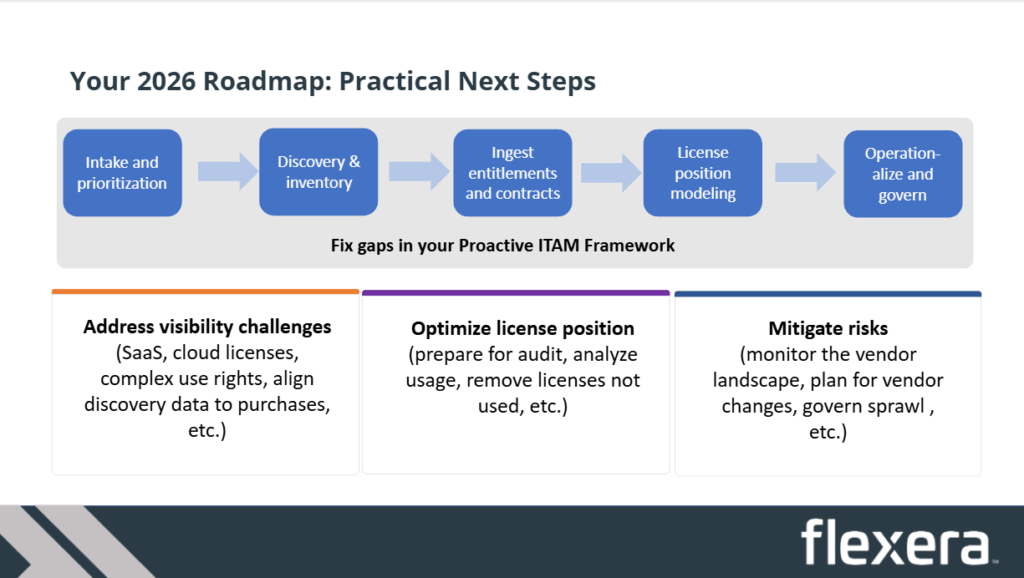
A proactive ITAM framework helps you achieve the structure and foresight necessary to address these persistent obstacles head-on
Why it matters now: 2025 licensing shifts
The software licensing landscape is evolving at a breakneck pace, catching many organizations off guard. Licensing models are changing fast. Volume discounts are disappearing, consumption-based pricing is rising and legacy contracts are being phased out. Without proactive planning, you face:
- Budget shocks from unexpected renewal costs
- License sprawl due to stricter assignment rules
- Contract mismatches that eliminate favorable terms
- Vendor lock-in risks that make switching costly
- Governance gaps that invite harsher penalties
- Operational disruptions from retired services and features
Recent licensing changes include:
- Salesforce: “Flex Credits” Model for AI/Agentforce (live 2025)
- Microsoft: Removal of EA/MPSA Volume Discount Tiers (A–D) (effective November of 2025)
- Microsoft Dynamics 365: Mandatory License Assignment and Usage Enforcement (November of 2025)
- Adobe: VIP Commercial Program Retirement to VIP Marketplace (May of 2025)
- Oracle: Java SE Universal Subscription (employee-based licensing) (ongoing in 2025)
Next steps for 2026
To prepare for Tier 1 vendor management in 2026, you must be proactive. Vendors like Salesforce, Microsoft, Adobe and Oracle are introducing new subscription frameworks, mandatory license enforcement and retiring established programs—rapidly shifting the SAM landscape. Successfully navigating these operational disruptions requires a forward-thinking approach. You must reassess your vendor relationships, enhance visibility into software entitlements and ensure compliance with increasingly complex licensing requirements.
- Implement the ITAM framework to turn new publishers into managed assets
- Address key challenges like fragmented visibility and complex licensing
- Mitigate business impacts such as surprise audits and wasted spend
- Align discovery and entitlement data to reduce risk and optimize usage
- Monitor vendor trends and plan for upcoming changes
- Close governance gaps to ensure compliance and continuity
By establishing robust governance and audit readiness strategies now, you can mitigate risks associated with surprise audits, unnecessary expenses and compliance gaps. Audit readiness isn’t just about avoiding penalties—it’s about enabling smarter decisions, stronger vendor relationships and sustainable growth. The time to act is now.