

In today’s rapidly growing, ever-evolving tech landscape, organizations face unprecedented complexity in managing their IT environments. The proliferation of SaaS, cloud, and AI-driven solutions, coupled with decentralized procurement and rising security threats, has made IT Asset Management (ITAM) more critical, and more challenging than ever before.
Yet, despite its strategic importance, ITAM programs often struggle to secure executive sponsorship, cross-functional buy-in, and investment needed to deliver maximum value. Selling ITAM internally is not just about justifying a tool or process, it’s about positioning ITAM as a business enabler that drives measurable outcomes across cost, risk, and operational efficiency in SaaS management.
Why ITAM, why now?
The urgency for robust ITAM and a solid ITAM strategy has never been greater. Key technology trends are reshaping the IT landscape:
- Distributed procurement: IT typically purchases enterprise-level productivity tools, but the bulk of technology purchasing is distributed across line of business budgets. Departments acquire technology through direct, partner, pay-as-you-go, and marketplace models, increasing the risk of shadow IT and redundant spend.
- SaaS and AI sprawl: The ease of acquiring SaaS and AI tools has led to uncontrolled growth, making it difficult to track usage, manage costs, and ensure compliance.
- Cloud complexity: New licensing models (PAYG, BYOL) and hybrid environments require sophisticated tracking and optimization.
- Security pressures: With the rise of cyber threats, IT security is a board-level concern. Unmanaged assets and unknown applications increase vulnerability. AI applications and agents make this challenge even more difficult.
- Cost and ROI scrutiny: The cost of AI and cloud infrastructure is significant, and CIOs are under pressure to demonstrate ROI and control budgets to enhance cloud optimization and cost optimization.
According to Gartner’s 2025 Magic Quadrant for SaaS Management Platforms, “Per-employee SaaS spend currently averages $1,562, a 51% increase since 2022. As many as 25% of provisioned SaaS licenses are not regularly used by employees. Organizations are generally only aware of 40% of applications in use.” These statistics underscore the urgent need for visibility, control, and optimization which are core tenets of ITAM.
How do you connect ITAM to business goals?
To sell ITAM internally, it’s essential to align the program with your organization’s strategic objectives. Common drivers include:
- Mergers and acquisitions: Staying compliant, rationalizing technologies, and removing technical debt and risk.
- IPO readiness: Achieving SOC2 Type 2 compliance and meeting regulatory standards.
- Cost optimization: Freeing up budget for innovation (e.g., AI investments) or improving margins.
- Security enhancement: Addressing a recent breach or strengthening cyber defenses.
- Regulatory compliance: Meeting evolving standards and audit requirements.
Ask yourself: What are your company’s top priorities? How can ITAM help achieve them? Tailoring your message to these goals makes ITAM relevant to executive stakeholders in SaaS management.
What are the questions that ITAM must answer?
A compelling ITAM program provides clear answers to critical questions:
- What assets do we have, and where are they?
- Who is using them, and how much are they used?
- What are the costs, and risks associated with our technology portfolio?
- Are we getting value from these assets? Should we keep this technology, expand its use or retire its use?
These questions form the foundation for building trust and credibility with business leaders.
Defining success: Which KPIs and metrics are most important in ITAM?
To gain and sustain support, ITAM and the ITAM strategy must demonstrate measurable impact. Key performance indicators include:
- Percentage of environment inventoried
- Percentage of licenses unallocated and unused
- Reduction in unused/redundant applications and contracts
- Inventory of contracts, invoices, and product use rights
- Savings during renewals/keeping renewals flat
- Reduction in EOL/EOS/vulnerable assets
- Elimination of license compliance risk
- Removal of deny-listed and shadow applications
Tracking and reporting on these KPIs shows progress and justifies ongoing investment.
Scoping ITAM: Where do you focus?
ITAM’s scope can be defined by technology domains (on-premises, SaaS, cloud, AI, containers) or organizational units (IT, engineering, business units). It’s important to clarify where ITAM operates and where it intersects with other functions, such as FinOps (focused on cloud infrastructure spend) or security teams. Highlighting these boundaries helps identify collaboration opportunities and gaps to address.
Gap Analysis: the path to maturity
A structured gap analysis compares the current state to the desired future state across key metrics. By technology area (hardware, on premises end user software, data center software, cloud infrastructure, cloud software, SaaS software), answer these questions:
- What are the key products we must track (top spenders/most risk)? E.g., Windows vX.X. Do we know of all the assets we should track (shadow IT, etc.)
- How is this software purchased and budgeted? (via partner, marketplace, direct, on a Pcard)
- Who manages the software/asset (license allocations/reclamation, renewal, software upgrades if applicable, retiring the asset, etc.)
- What are the tools and processes used to manage the assets? Are there tooling gaps? Many times a tool can inventory (what is it, and where is it) but not detect usage or analyze the ELP, etc.
- Tooling should answer:
- What is it, where is it
- Is it obsolete, end of support or does it have security flaws? Is it deny listed, vulnerable?
- Is it being used and by whom, or how many resources is it consuming?
- How much did it cost?
- What are the use rights? Can we use it in prod and dev, or can it be use across on-premises and cloud environments, etc.
- Processes should answer:
- Who and what tooling is responsible for inventorying the data and understanding security, cost and usage aspects? How often is this done? Is it always on (e.g. via APIs, etc.)
- Who validates data accuracy and how often?
- What are the analysis to be run on the data? (KPIs)
- What is done with the output? Is there an automated process that is run with the data? How do you know you are making progress?
- Tooling should answer:
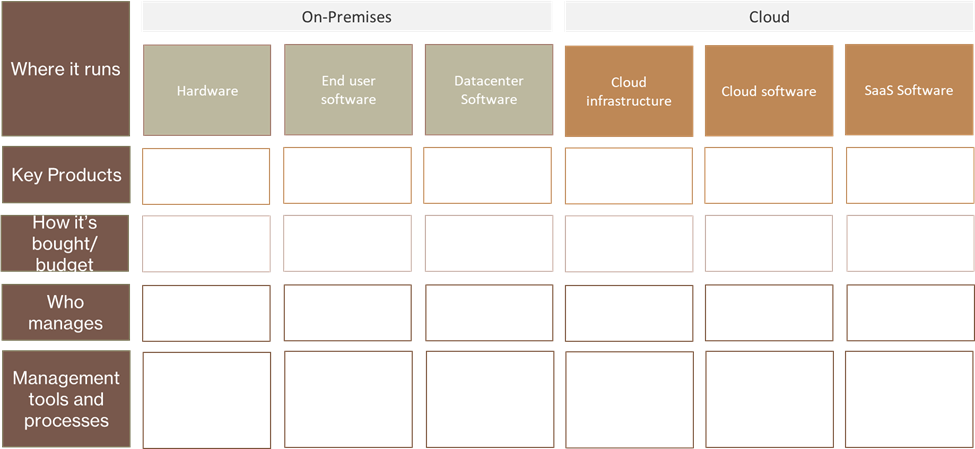
Sample framework for mapping IT asset data and process gaps.
Stakeholder engagement: Is ITAM a team sport?
ITAM’s success depends on strong partnerships across the organization. Key stakeholders include:
- ITSM/CMDB: Ensures accurate configuration data and lifecycle management.
- Security/GRC: Reduces risk by identifying unauthorized or vulnerable software.
- Procurement/vendor management: Optimizes contracts and renewals.
- Finance: Supports budgeting and cost optimization.
- Internal audit: Ensures compliance and transparency.
- Cloud/FinOps: Manages cloud resource allocation and spend for cloud optimization.
- Enterprise architecture: Guides technology standards and rationalization.
- App owners/business units: Provides critical input on usage and requirements.
Mapping these relationships and clarifying roles (e.g., through a RACI matrix) ensures alignment and accountability, and helps ensure there are no gaps in your processes.
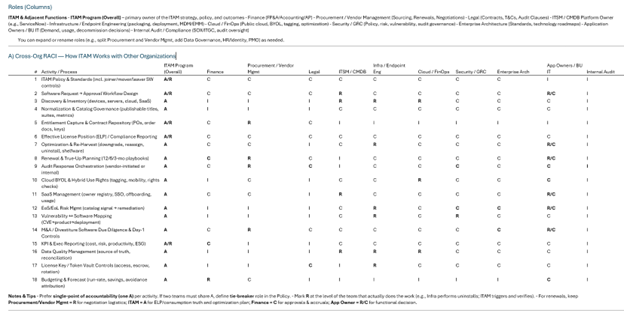
The above is a sample RACI you can work through with your organization.
Making ITAM a business enabler
To close gaps and drive outcomes, align ITAM strategy and priorities with business objectives. For example, focus on initiatives that reduce risk, cut costs, or improve compliance, all areas that resonate with executive sponsors. Use real-world examples, such as audit risk reduction, cost savings, or improved renewal outcomes, to illustrate value.
Asking for support
Finally, selling ITAM internally means inviting feedback and support. Ask stakeholders: Do our priorities reflect the organization’s needs? Where can we better integrate or support your objectives? This collaborative approach builds trust and ensures ITAM remains relevant and impactful.
Create your ITAM sales document
Start creating your internal selling document by answering the questions outlined above with a clear ITAM strategy in mind. Here’s a template you can use to start building your pitch. By aligning ITAM with strategic priorities, measuring and communicating impact, and building strong cross-functional partnerships, you can secure the buy-in and investment needed to make ITAM a true business enabler.
Download our template: ITAM mission and roadmap.