Flexera’s 2026 State of the Cloud Report marks a pivotal moment in cloud maturity. Now in its fifteenth year, the report shows cloud entering the value era—where organizations tie cloud decisions to measurable business outcomes, accelerate GenAI adoption and lean on centralized governance to manage rising complexity.
Those looking to get a handle on cloud spend and cloud governance must pay attention to these trends and to the goals that can help drive the most value possible, or risk getting left behind in reactive states.
Cloud success is increasingly measured by value, not just savings
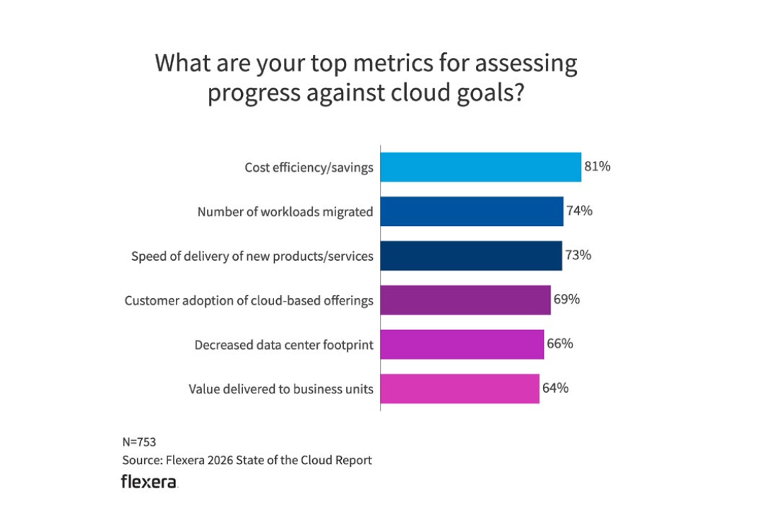
For the first time, organizations are measuring cloud success less by cost efficiency and more by the value technology delivers. Sixty‑four percent of organizations now rely on value delivered to business units as their top metric for cloud progress, up twelve percentage points from last year. Cost efficiency dropped six points, reflecting a broader shift toward prioritizing impact over savings.
- Value delivered to business units rose 12 percentage points year over year
- Use of unit economics increased from 40% to 49%
- Cost efficiency dropped 6 percentage points
Nearly half of organizations (49%) now leverage unit economics to measure cost per service and link cloud consumption to business outcomes, up from 40% last year. This shift reflects a more proactive and mature approach, as FinOps teams move from simply explaining past spend to shaping architectural and investment decisions early in the process. Cloud is increasingly recognized not just as infrastructure, but as a strategic driver of growth, innovation and competitive advantage.
FinOps has expanded from a cloud cost discipline into a strategic capability focused on technology value. Teams aren’t just looking at what cloud costs add up to, but they’re also looking at what cloud delivers, and they’re shaping decisions long before workloads hit the cloud.
AI is everywhere, and making cloud waste worse
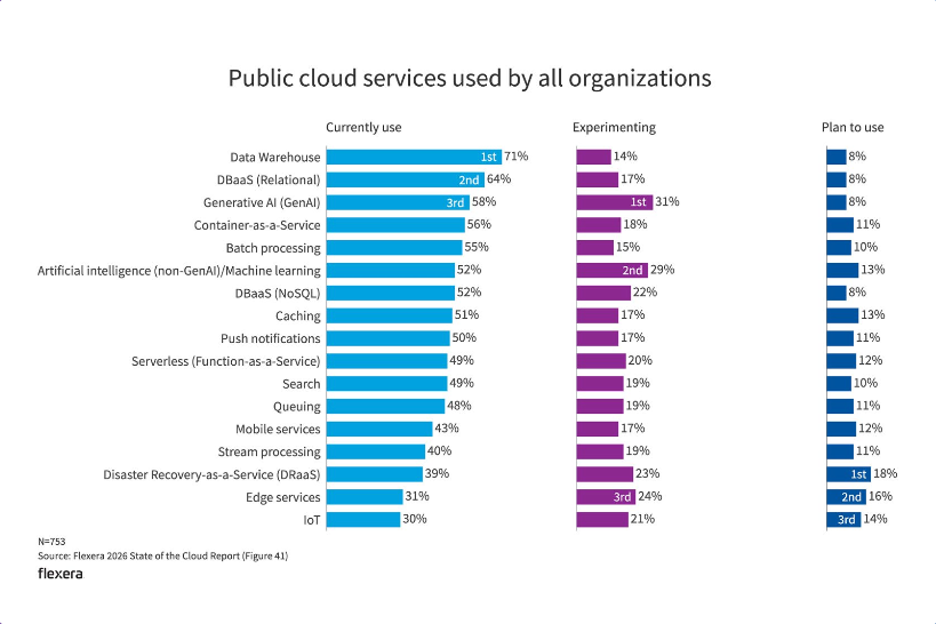
Despite the increase in FinOps maturity placing focus on value, this year’s report shows cloud-based AI workloads are surging causing an increase in wasted cloud spend (29%) for the first time in five years. AI is permeating every area of tech, but Generative AI (GenAI) specifically has moved rapidly from experimentation to everyday use. In 2026, GenAI surged to the third most widely used public cloud service, rising to 58% from 50%. AI is now one of the most widely adopted public cloud services, reshaping both cloud economics and risk profiles.
But rapid adoption has introduced new challenges, such as:
- Security and compliance risks
- Data quality concerns
- Difficulty forecasting unpredictable usage patterns
Security and compliance are now the top concern for cloud-based AI initiatives, followed closely by data quality and the difficulty of forecasting unpredictable usage patterns. AI workloads behave differently than traditional cloud services, making visibility, governance and financial controls harder—but more essential—than ever.
AI is no longer experimental. As organizations integrate GenAI into everyday workflows, strong governance ensures they can innovate with confidence while keeping cost, risk and performance in balance.
Organizations are responding by formalizing oversight. A significant majority of large enterprises now have a dedicated AI leader or governance team, signaling that AI is no longer a side project; it’s a core business capability that demands discipline and accountability.
Hybrid cloud and centralized governance remain essential
Seventy-three percent of respondents are using hybrid cloud, an increase from last year. Multi‑cloud adoption also continues to rise, but often unintentionally. This trend could stem from mergers, siloed application teams or inherited architectures rather than deliberate strategy.
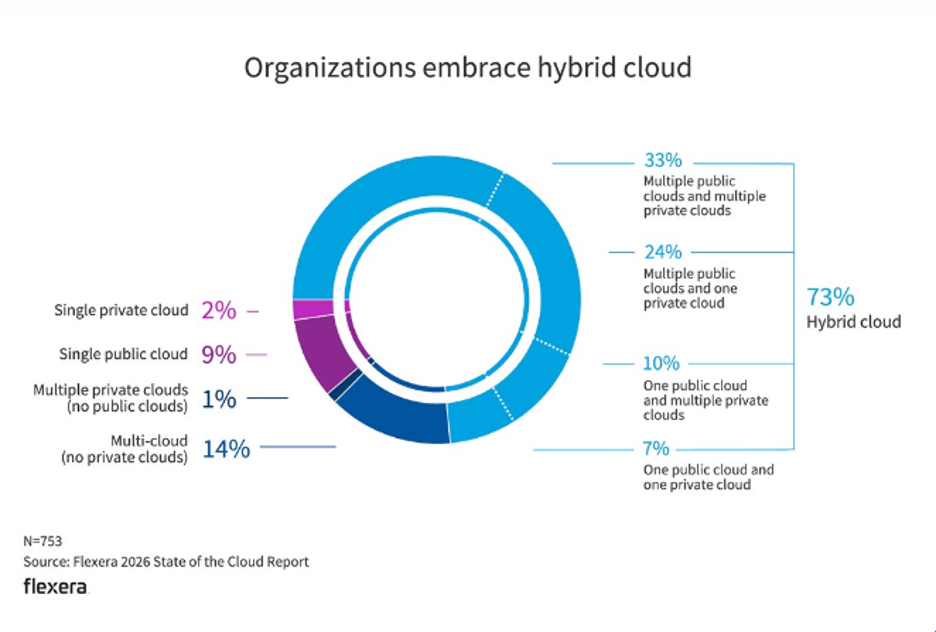
Organizations with higher monthly cloud spend are more likely to run hybrid estates, suggesting greater sophistication and a stronger need for workload placement flexibility. SMBs and enterprises alike continue using hybrid environments to balance cost, performance and governance.
Cloud spend continues to climb—along with waste
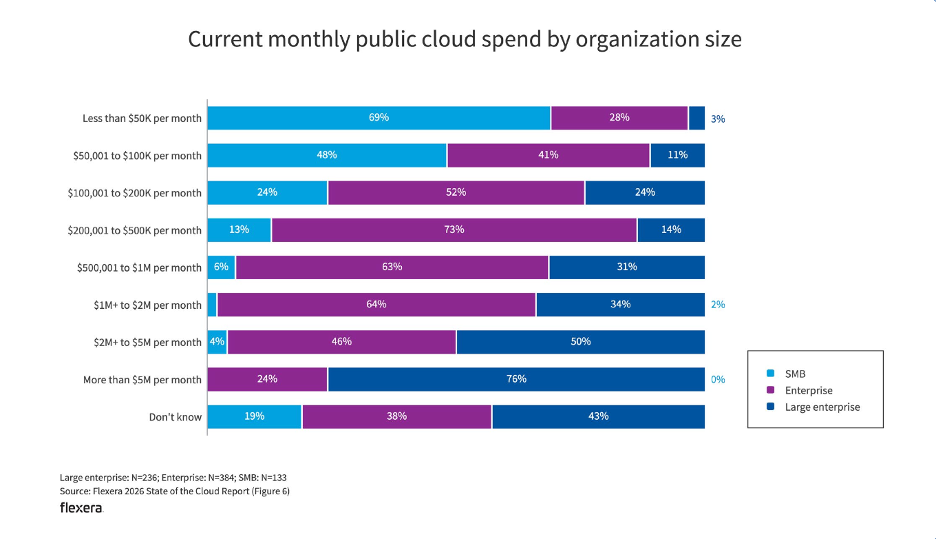
Cloud spending is trending upward, with large enterprises leading the way: 76% of large enterprises now spend more than $5 million monthly on public cloud. The increase in monthly spend paired with reversal in wasted spend underscore why centralized governance and FinOps discipline are becoming essential, not optional.
Centralization and governance gain momentum
As cloud environments grow more complex, organizations are doubling down on centralized oversight. Seventy‑one percent have a cloud center of excellence (CCOE) or equivalent, and 63% rely on a FinOps team. Business units and software asset management teams are also becoming more involved, reflecting a broader organizational commitment to governance and accountability.
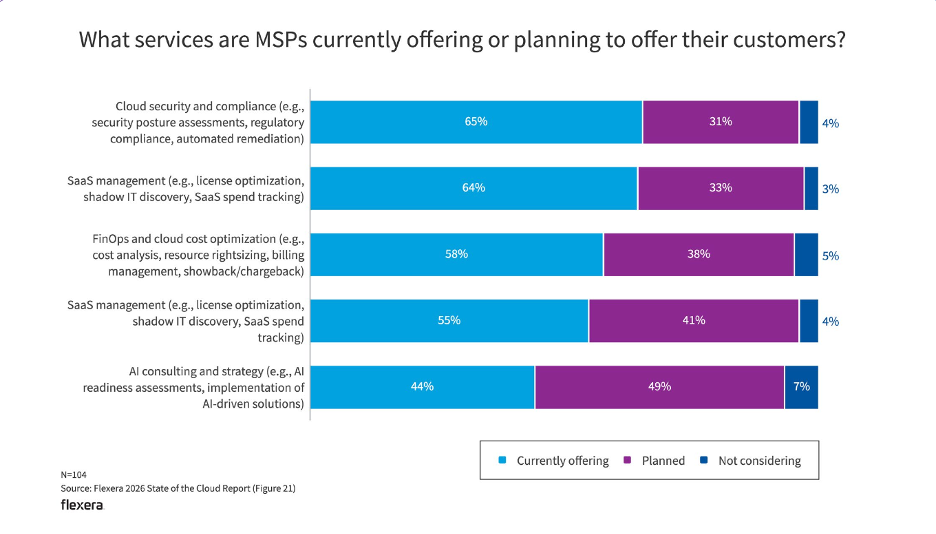
MSPs continue to play a role, but their focus is shifting. Nearly half plan to expand into AI consulting or SaaS management, while enterprises increasingly rely on them for specialized support. SMB use of MSPs dipped this year, potentially due to budget constraints or improved internal capabilities.
Cloud migration strategies evolve with a shift‑left mindset
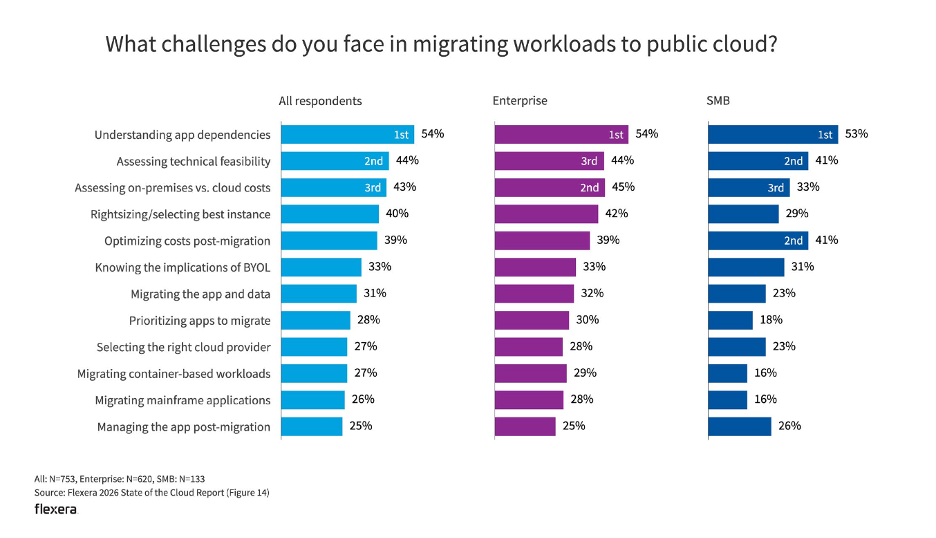
Organizations are investing earlier in architectural and cost planning. Cost optimization after migration dropped from the third- to the fifth-ranked challenge, while selecting the best instance and assessing cloud vs. on‑premises costs increased in importance. This shift‑left approach reflects a growing understanding that planning early prevents expensive inefficiencies later.
Europe sees parallel trends with subtle distinctions
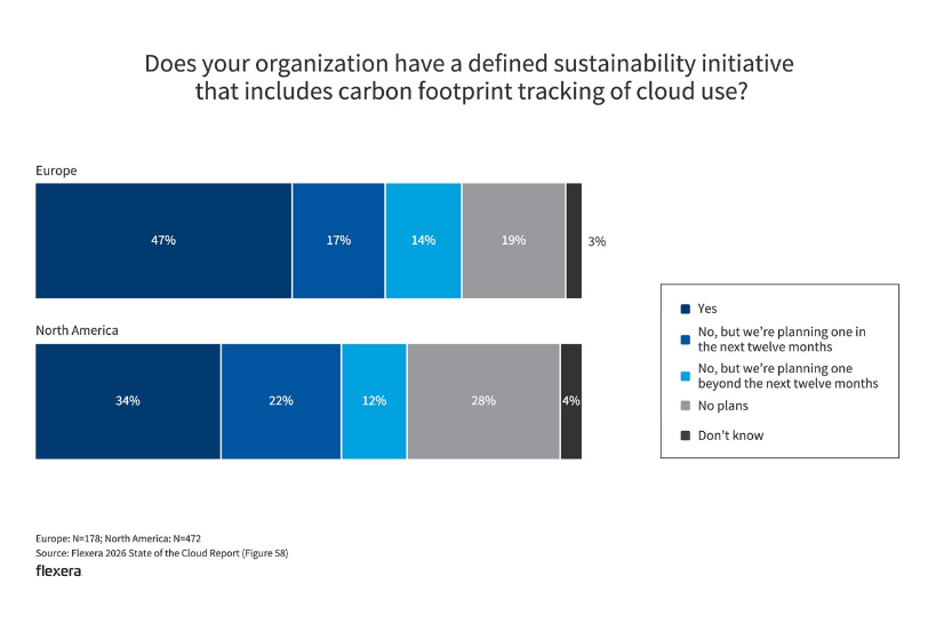
European organizations largely mirror global trends, including increased use of FinOps teams (up nine points) and a strong preference for Azure for significant workloads. Sustainability initiatives saw a modest increase as regulations shift, with 47% of European respondents reporting defined programs.
Cloud success hinges on governance, value and AI oversight
The 2026 findings point to a cloud landscape that is more complex, more strategic and more value-focused than ever. Organizations are maturing their FinOps practices, accelerating AI adoption and strengthening governance structures to manage scale and risk. IT, finance and operations teams are collaborating more closely, building the unified visibility and accountability needed to support innovation while maintaining control.
Looking ahead at 2026 and beyond, organizations that excel at effective oversight and managing complexity will stand out in the pack. They’ll unlock new opportunities for growth and build resilience as they innovate.
Dig deeper into our 2026 insights
We only scratched the surface of all the intel and data we’ve provided in this year’s State of the Cloud Report. These findings set the stage for deeper conversations about how teams are operationalizing FinOps, AI governance and multi‑cloud strategies.
Don’t miss the chance to grab your copy and check out our related webinar. Explore the full set of findings, including cloud migration statistics, hybrid cloud trends, GenAI adoption patterns and cost optimization insights in the report.
Go beyond the data at FinOps Forward—a virtual summit on April 15
The Flexera 2026 State of the Cloud Report shows where cloud strategy is headed—but the real question is how organizations are acting on these insights. At FinOps Forward, our virtual summit on April 15, the conversation moves into real‑world application. Hear directly from Steve Trask, COO of the FinOps Foundation, gain analyst perspective from IDC and join a live panel of your peers as they share how they’re applying FinOps principles to drive measurable business outcomes across cloud, SaaS and AI.
April 15, 2026 at 9:00–11:15 a.m. CDT / 3:00–5:15 p.m. BST
FAQ
What is the State of the Cloud Report?
The State of the Cloud Report is Flexera’s annual research study highlighting global cloud adoption trends, spending patterns and governance maturity. The 2026 edition is based on a survey of 753 cloud decision-makers and shows major shifts toward value‑driven metrics, rising GenAI adoption, hybrid cloud dominance and increasing cloud waste. It also highlights how CCOEs and FinOps teams are expanding to manage growing complexity. Explore the full findings in the 2026 State of the Cloud Report.
Who should read the State of the Cloud Report?
The report is most valuable for IT leaders, cloud architects, FinOps teams, procurement and finance stakeholders responsible for cloud strategy or technology investment decisions. Its data reflects how organizations of all sizes—from SMBs to large enterprises—are navigating hybrid cloud growth, cloud spend, AI governance and unit economics, offering benchmarks that help teams align on cloud priorities.
Why is cloud governance more important in 2026?
Cloud governance matters more in 2026 because cloud environments have become more complex, more expensive and more AI‑driven. The report shows governance structures like CCOEs have grown to 71 percent adoption, and FinOps teams to 63 percent, as organizations respond to hybrid cloud expansion, rising waste, SaaS proliferation and an increase in AI‑related risk. Strong governance helps teams align cloud usage with business outcomes while preventing costly inefficiencies.
How does generative AI impact cloud costs and financial planning?
Generative AI increases cloud costs by introducing dynamic, harder‑to‑predict workloads and new pricing patterns that affect forecasting and budgeting. The report shows GenAI is now one of the most widely used public cloud services at 58 percent, and organizations cite security, compliance and unpredictable usage as top challenges—all of which directly influence cloud financial planning. This shift is driving more teams to create AI governance roles and integrate AI‑specific planning into FinOps practices.
What are the key cloud computing trends in 2026?
The top cloud trends in 2026 center on value, AI adoption and stronger governance. Organizations are shifting from pure cost reduction to value‑based metrics, accelerating their use of GenAI, expanding hybrid cloud strategies and increasing spend as waste rises. Centralized governance through CCOEs and FinOps teams is becoming essential to manage this complexity. Explore additional insights in the full State of the Cloud Report and related hybrid cloud resources on our blog.
How can my organization use the 2026 report to improve our cloud strategy?
You can apply the report’s benchmarks to refine your cloud roadmap and improve oversight. It highlights where to deepen FinOps, strengthen cloud and AI governance and shift from cost‑only KPIs to value‑driven metrics. You can dive into related guidance in our cloud governance and cost optimization blog posts.