Webinar
From alert to action: How intelligence, prioritization and patching drive security outcomes
Overview
Security teams are flooded with vulnerability alerts, yet only a small percentage represent real risk. This webinar shows how to cut through the noise by combining threat intelligence, asset context and patch availability. You’ll learn how to focus remediation on the vulnerabilities that matter most and automate patching to shrink exposure windows across large, complex environments.
Key takeaways for security leaders, vulnerability teams and IT operations
- Reduce alert noise with validated vulnerability intelligence
- Understand why CVSS alone misrepresents real-world risk
- Improve prioritization using threat scoring and asset context
- Focus patching on the small set of vulnerabilities that drive most risk
- Shorten remediation timelines with automation
Vulnerability management challenges, outcomes and business impact
1. Why vulnerability alerts overwhelm security teams
Organizations face record volumes of advisories and CVEs each year. Many are not exploitable or relevant, yet teams still spend time investigating them instead of fixing real threats.
Outcome: Security teams fall behind, leaving critical vulnerabilities exposed longer.
2. Why CVSS alone leads to poor prioritization
CVSS scores reflect theoretical severity, not attacker behavior. A high score doesn’t always mean a vulnerability is being exploited or poses meaningful business risk.
Outcome: Teams prioritize based on labels instead of likelihood and impact.
3. How threat intelligence changes remediation decisions
Threat intelligence adds exploit activity, malware associations and real-world attack data to vulnerability analysis. This makes it clear which vulnerabilities attackers are actively using.
Outcome: Teams focus remediation where it reduces risk the most.
4. Why patch availability and lifecycle context matter
While many advisories include patches quickly, some vulnerabilities require upgrades or lifecycle decisions instead of simple fixes.
Outcome: Organizations choose the right remediation path and avoid unnecessary delays.
Speakers

Dan Hutchison
Regional Account Manager
Flexera

Dylan Hudak
Senior Solution Engineer
Flexera

Jeroen Braak
Major Account Manager
Flexera

Raheel Aslam
Principal Solutions Engineer
Flexera
Why vulnerability prioritization matters
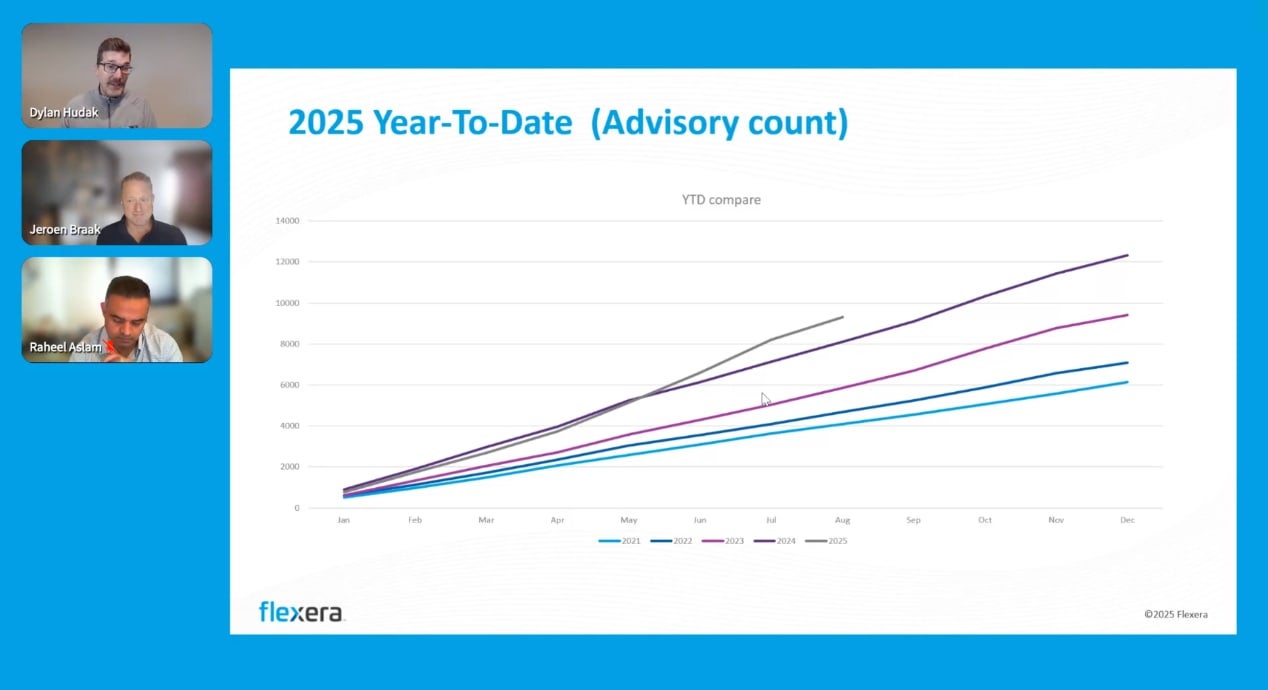
Thousands of advisories and tens of thousands of CVEs are disclosed each year, creating unprecedented alert volume.
While most advisories include a vendor patch quickly, remediation still lags behind.
If your team needs clearer prioritization and faster patching, Flexera Software Vulnerability Management helps operationalize the strategies covered in this webinar. See how intelligence-driven prioritization and automated patching work together across complex environments.
Contact us to see Flexera Software Vulnerability Management in action.
Frequently Asked Questions
Threat‑aware prioritization helps teams focus on vulnerabilities that are actively exploited rather than those with high theoretical severity. This reduces wasted effort and improves remediation speed.
SVR enriches and validates public data, filling gaps in metadata, exploit details, and scoring. SVM then applies this intelligence to real‑time prioritization and patching workflows, improving accuracy and outcomes.
Teams can adopt curated intelligence, apply threat scoring to existing vulnerability queues, and automate high‑impact patches to reduce exposure windows more consistently.
CVSS measures technical severity but not likelihood of exploitation. Without exploit context, teams may patch low‑risk items while high‑risk vulnerabilities remain exposed.
Transcript
[00:15] Introduction: From vulnerability alerts to action
[00:15] Jeroen Braak:
Welcome to this session on how intelligence, prioritization, and patching improve security outcomes.
Organizations face a growing volume of vulnerabilities and increasing noise. The real challenge is not identifying vulnerabilities, but determining which issues matter most and how to act efficiently.
[01:31] The vulnerability landscape and Secunia Research
[01:31] Jeroen Braak:
Flexera’s Secunia Research team validates vulnerability intelligence before it is published.
Each vulnerability is:
- Tested and verified
- Assessed for severity and exploitability
- Published as a Secunia Advisory
This ensures organizations act on validated, relevant threats, rather than raw, unverified data.
[04:20] What a Secunia Advisory provides
[04:20] Jeroen Braak:
A Secunia Advisory consolidates vulnerability context into a single, actionable view, including:
- Criticality
- Threat score
- Impact and consequences
- CVSS metrics
- Grouped CVEs
This removes the need to piece together fragmented vulnerability data and helps teams prioritize effectively.
[05:19] Dylan Hudak:
Advisories group related vulnerabilities at the product level, making it easier to understand risk in real-world terms.
Most organizations only need to remediate a small percentage of vulnerabilities—but they need to identify the right ones.
[06:44] Record vulnerability volume and increasing noise
[06:44] Jeroen Braak:
Vulnerability volumes continue to increase significantly. Thousands of advisories and tens of thousands of CVEs are reported annually, creating a major operational burden for security teams.
Not all vulnerabilities are meaningful threats. Many require:
- Validation
- Contextual analysis
- Assessment of exploit relevance
Without filtering, security teams risk spending time on issues that do not impact their environment.
[09:01] Dylan Hudak:
Noise comes from both:
- Increasing attacker sophistication
- Vendors publishing large volumes of lowpriority issues
Validated intelligence is essential to reduce this noise.
[11:42] Why vulnerability prioritization requires more than CVSS
[11:42] Jeroen Braak:
CVSS scores alone are not sufficient for prioritization.
Effective prioritization requires:
- Asset context
- Business criticality
- Exposure and accessibility
- Exploit intelligence
A high CVSS score does not always indicate high operational risk, and lower scores may still represent significant realworld threats.
[12:53] Dylan Hudak:
Understanding which systems support critical business services is key to prioritizing remediation effectively.
[13:57] Zero days, exploited vulnerabilities, and patch coverage
[13:57] Jeroen Braak:
Recent data highlights:
- The presence of zeroday vulnerabilities
- Increasing numbers of actively exploited vulnerabilities
- High availability of vendor patches for many issues
Flexera also identifies vulnerabilities before CVEs are assigned, helping organizations act earlier.
Rejection advisories are equally important—they eliminate noise and allow teams to focus on real threats.
[17:59] Why rejection advisories improve prioritization
[17:59] Jeroen Braak:
Rejection advisories indicate vulnerabilities that are:
- Not exploitable in practice
- Blocked by existing controls
- Dependent on unrealistic conditions
These insights reduce unnecessary remediation effort and improve prioritization accuracy.
[19:28] Dylan Hudak:
Some vulnerabilities only become relevant under extreme conditions. Identifying these cases helps teams focus resources where they matter most.
[20:20] Threat intelligence and threat scoring
[20:20] Jeroen Braak:
Flexera enhances vulnerability data with threat intelligence, including:
- Exploit availability
- Malware associations
- Ransomware links
A threat score (0–99) indicates the likelihood of exploitation. Even moderate scores can signal active risk, making this metric critical for prioritization.
[21:21] Patch availability and lifecycle considerations
[21:21] Jeroen Braak:
Most vulnerabilities have patches available quickly, but some require alternative actions.
Key scenarios include:
- Immediate patch availability
- Workarounds or partial fixes
- No fix available (end-of-life software)
[22:19] Dylan Hudak:
When no fix is available, organizations must address lifecycle risk, not just patching. Unsupported software introduces longterm exposure.
[23:31] The risk window and remediation challenges
[23:31] Jeroen Braak:
The mean time to remediation remains a major challenge.
Operational constraints—such as change control and deployment processes—often delay remediation, even when patches are available.
Modern security operations must reduce this risk window from weeks to days or even hours.
[30:20] How risk scoring works in practice
[30:20] Jeroen Braak:
Effective prioritization combines:
- CVSS scoring
- Threat intelligence
- Asset inventory
- Business context
This approach enables organizations to identify highrisk, highimpact vulnerabilities and act quickly.
[32:10] Software Vulnerability Research: unified intelligence view
[32:10] Jeroen Braak:
Flexera Software Vulnerability Research (SVR) provides a centralized view of vulnerability intelligence.
This includes:
- Advisory details
- Threat scores
- Patch availability
- Exploit context
SVR integrates with other systems and supports analytics, workflows, and ticketing.
[37:35] Software Vulnerability Management: scanning and visibility
[37:35] Raheel Aslam:
Effective vulnerability management starts with visibility.
Flexera Software Vulnerability Management (SVM):
- Scans endpoints across Windows, Linux, and macOS
- Identifies insecure and endoflife software
- Maps vulnerabilities to specific assets
Without accurate inventory data, organizations cannot assess or manage risk effectively.
[40:14] Using Secunia data to prioritize vulnerabilities
[40:14] Raheel Aslam:
SVM integrates directly with Secunia Advisories, providing:
- Criticality and threat score
- Patch availability
- Affected versions
- Remediation guidance
This allows teams to prioritize vulnerabilities based on realworld risk, not just severity scores.
[42:20] Risk-based prioritization using Smart Groups
[42:20] Raheel Aslam:
SVM uses Smart Groups to filter vulnerabilities based on criteria such as threat score.
For example:
- Identify vulnerabilities with high exploit probability
- Focus on assets with critical exposure
This enables teams to prioritize the highest-risk vulnerabilities first, even in environments with thousands of endpoints.
[45:06] Patch catalogs and ready-to-deploy updates
[45:06] Raheel Aslam:
Flexera provides curated patch catalogs with thousands of ready-to-deploy updates.
These patches:
- Require no manual customization
- Integrate with tools like Intune, Configuration Manager, Tanium, BigFix, and Workspace ONE
- Accelerate remediation workflows
[46:38] Simplifying patch deployment with Patch Publisher
[46:38] Raheel Aslam:
Patch Publisher enables:
- Multi-platform patch distribution
- Automated package creation
- Built-in deployment scripts
This removes manual effort and simplifies large-scale patching.
[49:45] Precision patching with applicability rules
[49:45] Raheel Aslam:
Applicability rules ensure patches are deployed only where needed.
This:
- Reduces unnecessary deployments
- Eliminates manual filtering
- Improves operational efficiency
[51:45] Automating vulnerability remediation
[51:45] Raheel Aslam:
Patch automation enables organizations to:
- Automatically deploy updates
- Define conditions based on risk
- Respond quickly to zero-day vulnerabilities
For example, high-risk vulnerabilities can trigger automatic patching workflows, reducing time to remediation significantly.
[54:12] Final insights: From intelligence to action
[54:12] Jeroen Braak:
Effective security outcomes require connecting:
- Intelligence (validated data)
- Prioritization (risk-based decisions)
- Execution (automated patching)
Organizations that align these elements can reduce risk more effectively and operate with greater confidence.
[55:26] Closing remarks
[55:26] Jeroen Braak:
Thank you for joining the session.
We hope this webinar has provided a clear understanding of how actionable intelligence and automated patching can reduce risk and simplify security operations
Let’s get started
Our team is standing by to discuss your requirements and deliver a demo of our industry-leading platform.