
Webinar
IBM audit readiness: How to prepare, respond and protect your license position
Overview
IBM software licensing is shaped by layered contractual requirements, complex sub-capacity rules, evolving container licensing models and Passport Advantage reporting obligations that most organizations underestimate. Understanding how these work—and where the gaps are—is essential for compliance, cost control and audit risk reduction.
In this on-demand webinar, Flexera's Nathan Stevens and Toby Ivens break down what triggers an IBM audit, how to assess your environment's risk profile, and the six-step framework for proactive IBM license management—covering sub-capacity reporting, entitlement centralization, containerized licensing, user-based license complexities and how to control the audit process when it starts.
You'll learn how to move from reactive audit response to proactive license governance, including:
- How to assess your IBM environment risk profile—from simple to high risk—and understand what triggers an audit
- How sub-capacity reporting, ILMT replacement and container licensing requirements work in practice—and where organizations commonly fall short
- How Flexera One ITAM serves as IBM-authorized tooling to centralize entitlements, automate license consumption tracking and generate defensible audit reports
This session is designed for IT asset managers, SAM practitioners, procurement leaders and compliance teams who need a clear, practical understanding of IBM audit readiness before their next renewal, contract negotiation or audit letter.
Speakers

Nathan Stevens
Senior Director, Solutions Engineering (APAC)
Flexera

Toby Ivens
Services Consultant (IBM Licensing)
Flexera
Key takeaways for ITAM practitioners, SAM teams, procurement leaders and compliance officers
- IBM audits are triggered by risk signals, not just random selection. Audits are commonly driven by commercial indicators (intent not to renew), risk-based signals (missing reporting, organizational changes, M&A) or time-based triggers. Understanding what raises your risk profile is the first step to reducing it.
- Missing sub-capacity reports—even a single quarter—can invalidate your sub-capacity terms entirely. IBM requires quarterly reporting (monthly recommended) retained for two years. If reports are missing or incomplete, your organization may be required to pay for full physical capacity licensing rather than virtualized cores—a dramatically higher cost.
- Non-compliance penalties are calculated at IBM's then-current list prices, plus up to two years of back maintenance. Under Passport Advantage terms, if you can't prove when excess deployment started, IBM can charge list price for all unlicensed deployments plus two years of retroactive maintenance, taxes and fees. This is why proactive management isn't optional.
- Containerized IBM software is a rapidly growing blind spot. One customer believed they had roughly 3,000 containers—later discovered they had 75,000 and growing. The IBM License Service is the only tool IBM accepts for sub-capacity container reporting, and Flexera integrates directly with it to bring that data into a single view.
- User-based licensing is more complex than most organizations realize. IBM defines multiple user license types (authorized user, concurrent user, floating user, user value unit), each with different terms for direct and indirect access. Shared logins—like a marketing team joint account—can mean every person in that team requires a license, not just the account holder.
- Passport Advantage entitlements don't always match what's in your signed contract. Organizations should verify that Passport Advantage purchase documentation accurately reflects their current agreement—and flag discrepancies before an audit, not during one.
- Proactive management transforms the audit from a threat into a negotiation advantage. Organizations that know what they own, what they consume and where the gaps are can enter renewals on the front foot—right-sizing investment, reducing unnecessary spend and demonstrating compliance with confidence.
Why IBM audits catch organizations off guard—and how to be ready
Why IBM audit risk is higher than most organizations think
IBM is the second most-audited software vendor, and high-risk environments face an estimated 60%+ annual audit probability. The webinar introduces a four-tier IBM risk profile framework: simple (few products, physical servers, full-capacity licensing), moderate (ILMT installed, some virtualization), complex (sub-capacity licensing, hybrid cloud, weak ILMT hygiene) and high risk (M&A, organizational changes, lapsed support, no ILMT, no reporting). Most organizations don't assess their risk profile until the audit letter arrives—by which point preparation time is compressed and leverage is limited.
Outcome: Understanding your risk tier enables proactive investment in the right areas before an audit is triggered—reducing exposure and strengthening your negotiating position.
Why missing sub-capacity reports lead to full-capacity licensing costs
IBM requires quarterly sub-capacity reports retained for two years—and missing even one reporting period can invalidate your sub-capacity terms. Sub-capacity licensing allows organizations to license only the virtualized cores running IBM software rather than the full physical server. But this benefit is conditional: you must have an eligible tool (ILMT or Flexera) deployed on all relevant devices, scanning every 30 minutes, with reports saved quarterly for a minimum of two years. If reports are missing, incomplete or not retained, IBM can require full-capacity licensing—multiplying your license obligation significantly.
Outcome: Complete, continuous sub-capacity reporting protects your right to license at virtual capacity—potentially saving millions compared to full physical capacity requirements.
Why container licensing is a fast-growing compliance risk
The IBM License Service is the only tool IBM accepts for sub-capacity container reporting—and many organizations don't know the scale of their container estate. Containerized IBM software is growing rapidly, but visibility is lagging. The webinar shares a real example: one customer initially estimated 3,000 containers, only to discover 75,000—and growing. Without the IBM License Service deployed and properly tagging containers, organizations must license all cores in the cluster at full capacity. Flexera integrates with the IBM License Service to ingest container data, and the Flexera Kubernetes inventory agent provides additional visibility into what's actually running.
Outcome: Deploying the IBM License Service and integrating it with Flexera closes the container visibility gap before it becomes a full-capacity licensing obligation.
Why proactive entitlement management changes the audit outcome
Organizations that centralize entitlements, validate license configurations and fix gaps before an audit can control the process—not be controlled by it. The webinar walks through a six-step framework:
- Centralize entitlements by gathering all contracts and cleaning Passport Advantage data
- Inventory all deployments across on-premises, cloud and containers
- Validate license configurations including upgrade/downgrade rights, non-production restrictions and cold/warm standby exclusions
- Proactively fix gaps by addressing unlicensed installs and non-eligible virtualization
- Control the audit process by assigning a single point of contact, reviewing NDAs, defining scope in writing and providing reports—not system access
- Maintain ongoing SAM governance through regular internal checks and mock audits
Outcome: Proactive management transforms IBM from a reactive audit risk into a controlled, optimized vendor relationship—with defensible data and stronger negotiation leverage.
Why IBM audit readiness matters
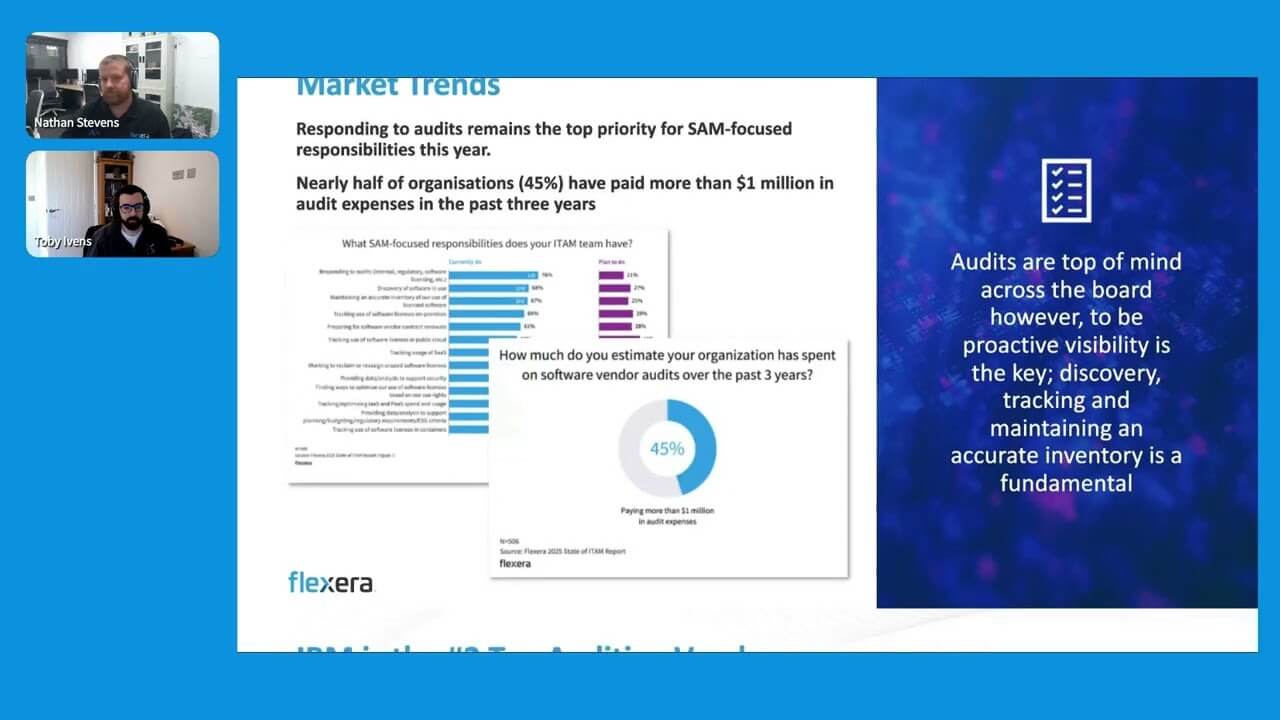
- 45% of organizations have spent more than $1 million on software vendor audits in the past three years—and IBM has the third-highest number of audits over that period. Getting caught underprepared doesn't just cost money; it pulls resources from multiple departments for months. (Flexera 2025 State of ITAM Report)
- 37% of organizations have faced an IBM audit in the past three years, and high-risk environments—those with hybrid cloud, weak ILMT hygiene and poor entitlement documentation—face estimated audit probabilities exceeding 60%. (Flexera: Conquering IBM Audit Complexity)
- Aviva achieved 100% audit risk mitigation across two IBM audits and saved £75M over five years through proactive license management with Flexera—demonstrating that audit readiness pays for itself many times over. (IBM Audit Defense Best Practices Guide)
- DBS Bank eliminated reactive audit exposure by proactively using Flexera to manage both Oracle and IBM—with vendors accepting Flexera data as part of their renewal and audit processes. (DBS Bank Case Study)
Watch our latest webinar on Conquering IBM audit complexity with confidence
If your team needs to prepare for an IBM audit, optimize your license position or replace ILMT, Flexera One IT Asset Management helps:
- IBM-authorized tooling and certified ILMT replacement—with contracts, entitlements, Cloud Pak VPC counting and sub-capacity reporting in a single platform (flexera.com)
- AI-based entitlement ingestion, Passport Advantage document processing and automated license optimization with 2.1M+ software use rights (flexera.com)
- Integration with IBM License Service for container licensing, plus inventory coverage for Oracle, Microsoft, VMware and Red Hat in the same deployment
Frequently asked questions
IBM audits are typically triggered by commercial signals (e.g., intent not to renew), risk-based indicators (missing reporting, M&A, organizational changes, lapsed support) or time-based factors (no audit in a significant period). The webinar outlines a four-tier risk profile—from simple environments with 5–10% annual audit probability to high-risk environments exceeding 60%. Understanding your risk tier is the first step to proactive preparation.
IBM requires organizations using sub-capacity licensing to deploy an eligible tool (ILMT or Flexera), scan devices every 30 minutes and retain quarterly reports for a minimum of two years. If any reports are missing or incomplete, IBM can require full physical capacity licensing instead of virtualized cores—significantly increasing your license obligation and cost.
Flexera One ITAM is IBM-certified authorized tooling that replaces ILMT while adding capabilities ILMT doesn't offer: contract and entitlement data ingestion, effective license position calculation, Cloud Pak VPC counting, license optimization and multi-vendor coverage (Oracle, Microsoft, VMware and more) from the same agent and platform.
IBM requires the IBM License Service for sub-capacity reporting in containers—it's the only tool IBM accepts. Without it deployed and properly configured, organizations must license all cores in the cluster at full capacity. The webinar shares a real example where a customer's container estate grew from an estimated 3,000 to 75,000 without adequate visibility.
Under Passport Advantage terms, non-compliant organizations must purchase excess licenses at IBM's then-current list prices and may owe up to two years of back maintenance if they can't prove when the excess started—plus additional taxes, duties and fees. Proactive management with defensible data is the best way to avoid or minimize this outcome.
Transcript
Nathan Stevens (13:29 – 22:09)
All right, thank you everybody for joining us today. So we're just gonna give everyone a few seconds to join us on the stage today, get familiar with Goldcast and join us.
And we can see some people coming into this session, the webinar today. So just get familiar with the controls, get comfortable.
For the next half an hour, we're gonna go through IBM audit readiness. And for those that have just joined us as well, so we're going to have q and a at the end of the session today.
So if there's any pressing questions about your IBM order readiness, please drop them in the chat. We we will address them at the end of the session today.
We'll be there to answer those questions for you. I'm joined today by Toby who is going to cover off all the details that I can.
He's one of our experts around the IBM topic. So today, there is no surprises, no setbacks.
So it's a topic that we're really keen to bring into the team across APAC today. So we're really looking at how do we actually prep for an audit? You know, we wanna make sure that we're right sizing the investment in the technologies that we're consuming, and IBM is no different to the likes of the Microsoft, the Oracles, the Adobe's.
So we wanna make sure that if you do get the audit letter or you're really just prepping and planning and being proactive throughout the year, it's leveraging the Flexera technology to get those outcomes for you, right sizing the investment on technology that you're consuming and owning. So we wanna make sure that we're investing in things that you actually need, that you actually own, and you're actually using.
So today's all about that and some guidance around how we get to those outcomes. So for those that have joined us maybe for the first time, you know, this is a series of webinars that we've run over the course of last year and this year.
So the eight on screen in front of you summarize the topics that we've covered during that time frame. So if you're keen to learn a little bit more about those, Ash will actually put those links into the chat for you today, and you can look at those on demand and actually consume that content whenever you feel is appropriate.
So some great content previously to catch up on. So just looking ahead, so today, April 22 is all about IBM and audit readiness.
So gonna dive into what triggers, you know, an audit or the proactiveness and preparedness around an audit, look at some of the fundamentals. So Toby is gonna take us through the fundamentals of what it means to go through and be prepared for an audit, some of the gotchas, some of the things that you need to be very mindful about, you know, passport advantage contracts, how to get that into the system, and really dive into the drug dynamics in the very complex IT environment.
In May, we've had a bit of a change in the schedule that we were originally planning for those that have joined us last month, but we're gonna dive into vulnerabilities and patching. So a very interesting topic about how to see the risks that others miss in terms of the vulnerability of states and what you should be looking out for and where maybe CVEs aren't really up to scratch anymore and where Flexera can help.
And we push the what was in May into June around proving ITEM value, and once again, we'll be joined by some other colleagues of ours to really drive into, you know, where we can help around that value discovery, understanding how to really talk about ITAM at the executive level. So keep an eye out for those, keep an eye out for the links on LinkedIn, and please register your interest across those three.
Alright. So today, we're gonna dive in specifically around IT asset management.
Now for those that have been through other sessions, we've really touched on a number of different, you know, capabilities of the FlexeraOne portfolio here, and today is really about IT asset management and narrowing down. It may touch on some other elements, but really 99% of what we're doing is focusing on the data that we collect and present within IT asset management, and looking at the contracts and the entitlements that you own and how to attribute those or how to assign those out within the environment.
So today we're going to focus in just on that particular green square in front of you. Now as always, I do like to start these sessions with, you know, placing us at the center of the world.
So really, you know, we're at that tipping point of technology spend, and technology is only really ever, you know, second to people spend within an organization. So that technology spend is something that we compete in for budgets with against people, but that technology spend is also increasing year on year.
When we start to look at, you know, IBM and other vendors out there, there's more and more investment in terms of technology spend being a business enabler. Now over the last three years in particular, around 47–51% on cloud and SaaS spend, we see that growth throughout the market, whether that's on premise, in SaaS, or in cloud.
And this market is growing rapidly, so we need to make sure that we're in control of spend within our technology landscape.
Now really, why focus on IBM? There's a couple key reasons, but at the end of the day is IBM is still auditing and second on this list only after Microsoft.
And now Toby's gonna take us through the IBM environment risk profile and take us through what it means to be prepared with IBM, being proactive and using Flexera to do that.
Toby Ivens (22:09 – 50:32)
Thank you, mate. Hi.
So in terms of the IBM risk profile, so you can see on the screen here, we've got simple, moderate, complex, and high risk. Simple representing few products, physical servers, full capacity licensing, so a simple environment.
And then, obviously, down to high risk where we've got mergers and acquisitions, organizational changes, lapsed support, lack of reporting, and no ILMT.
Now what we've got on the next slide is a breakdown into the details for these scenarios in terms of the risk profile.
Firstly, IBM has a number of different contractual reporting requirements that are required. If we do not have all of the reporting requirements being conducted regularly and per the terms, that raises the risk profile from an audit perspective.
Audits are typically commercially based, risk based, or time based. IBM won’t state a single reason, but there are usually signals.
ILMT deployment is required for sub-capacity reporting. Flexera is an eligible replacement, but it must be properly deployed and configured.
Reports must be taken quarterly at a minimum, monthly recommended, and retained for two years. Missing reports can invalidate sub-capacity terms.
Hardware topology, cloud visibility, and containerized IBM software all introduce risk if not properly inventoried and reported.
The IBM License Service is the only accepted tool for container sub-capacity reporting, but Flexera integrates with it.
Entitlements and proof of purchase must be accurate and aligned with Passport Advantage and signed contracts.
User-based licensing introduces complexity, especially with shared or indirect access.
IBM Passport Advantage requires annual license verification reporting and allows audits across all environments.
Non-compliance can result in list-price purchases and up to two years of back maintenance.
Proactive management includes centralizing entitlements, inventorying deployments, validating license configurations, fixing gaps, controlling the audit process, and maintaining ongoing SAM governance.
Flexera is IBM-authorized tooling, an ILMT replacement, and provides entitlement management, Cloud Pak counting, optimization, and multi-vendor coverage.
Nathan Stevens (50:32 – 52:23)
Perfect. Now look, appreciate Toby, and the detail you've gone through in explaining how we manage IBM.
One of the case studies that really drives this home is DBS in Singapore, proactively managing Oracle and IBM with Flexera.
If you're concerned about how you're managing IBM audits and want to learn more, please reach out via the QR code on the screen.
We'll now move into Q&A and answer any questions in the chat. Thanks everyone for your time today.
Let’s get started
Our team is standing by to discuss your requirements and deliver a demo of our industry-leading platform.