Webinar
Unlock value with Flexera
How to expand FinOps value across cloud, SaaS, licensing and data center with Flexera
Overview
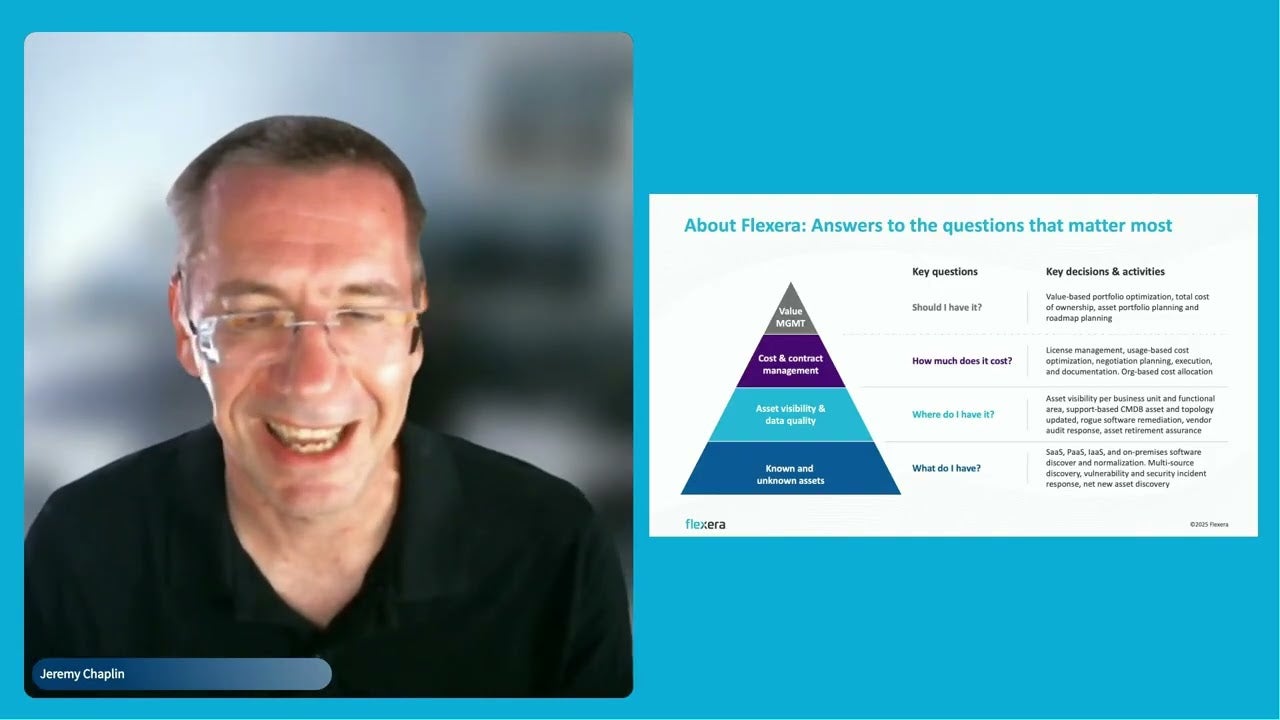
This webinar explains how FinOps is evolving beyond public cloud to cover SaaS, data center, AI and licensing, and how Flexera One supports these broader outcomes. It shows how organizations can improve financial accountability, automate optimization for dynamic workloads and unify ITAM, SaaS management and cloud cost data for better decisions. Viewers learn how a single platform helps answer core business questions—what they have, what it costs and whether it delivers value—and how to drive better cost, sustainability and productivity results.
Key takeaways for FinOps practitioners, ITAM leaders, cloud architects, procurement teams and SaaS owners
- Understand how FinOps scope now includes SaaS, licensing, AI and data center for unified optimization.
- Learn how to use Flexera One to combine ITAM, SaaS and cloud data for clearer spend accountability.
- Apply automated optimization for dynamic cloud workloads using predictive analytics and Spot technology.
- Improve cloud license management by reusing existing entitlements to avoid 3–4x higher pay‑as‑you‑go costs.
- Evaluate cost and carbon impact together for smarter workload placement and sustainability reporting.
- Strengthen decision‑making with visibility into cost, usage, emissions, electricity and water at resource level.
Speakers

Jeremy Chaplin
Director Solutions Architecture & Advisory
FinOps
Ranjit Shenoy
Manager Solutions Architecture & Advisory
FinOps
What’s holding FinOps back—and how to expand value beyond cloud
1. Why FinOps visibility breaks down across cloud, SaaS and ITAM
Most organizations manage cloud, SaaS, licensing and data center spend in disconnected tools owned by different teams. This fragmentation makes it difficult to understand total technology spend, assign ownership or measure value consistently.
Outcome: Unified visibility across cloud, SaaS and IT assets enables FinOps teams to answer foundational questions—what they have, what it costs and whether it delivers value.
2. Why manual optimization can’t keep up with dynamic environments
Cloud usage patterns now change continuously due to autoscaling, containers, Kubernetes and AI workloads. Manual tuning and static rules can’t adapt fast enough, leaving gaps in savings coverage and efficiency.
Outcome: Predictive analytics and automation optimize commitments, placement and workloads continuously, allowing FinOps teams to scale optimization without increasing manual effort.
3. Why licensing remains a hidden driver of cloud overspend
Many organizations default to pay-as-you-go cloud pricing even when they own reusable licenses tied to existing agreements. Without connection between ITAM and FinOps data, license-related overspend often goes unnoticed.
Outcome: Bridging licensing and cloud cost data reduces unnecessary pay-as-you-go spend and aligns cloud usage with existing entitlements.
4. Why AI and SaaS consumption undermine cost predictability
AI introduces token-based usage models, while SaaS portfolios continue to expand with inconsistent access controls and ownership. These consumption patterns make forecasting and accountability difficult.
Outcome: Visibility into AI, SaaS and cloud usage supports tighter governance, clearer accountability and more predictable cost management.
5. Why sustainability now shapes financial decisions
Cost optimization decisions increasingly impact carbon, electricity and water consumption, but these signals are often disconnected from financial data.
Outcome: Resource-level visibility into cost and emissions enables emissions-aware optimization and more defensible sustainability reporting.
Why organizations rely on Flexera for FinOps expansion
- Flexera One unifies ITAM, SaaS, cloud cost and emissions data in a single platform.
- Predictive analytics from Spot technology improves savings coverage and workload optimization.
- Resource‑level cost, carbon, electricity and water data supports compliant sustainability reporting.
If your organization needs unified, decision‑grade visibility across cloud, SaaS, licensing, AI and sustainability, Flexera One provides a single platform to connect cost, usage and emissions data, automate optimization at scale and help FinOps teams answer the questions that matter most—what they have, what it costs and whether it delivers value.
Contact us to see Flexera One in action.
FAQs
You expand FinOps by including SaaS, licensing, data center and AI, and by unifying data across these domains. The webinar shows how Flexera One provides consolidated visibility and automation to broaden financial accountability and improve optimization outcomes.
Automation requires predictive analytics, commitment management and workload optimization. Flexera One uses Spot technology to automate savings coverage and dynamic workload placement so teams reduce manual tuning and achieve greater cost efficiency.
Cloud licensing determines whether organizations pay full pay‑as‑you‑go rates or reuse existing entitlements. This can mean 3–4x cost differences. The webinar explains how bridging ITAM and FinOps helps avoid unnecessary licensing spend.
Use platforms that combine cost, emissions, electricity and water data at the resource level. Flexera One provides this unified dataset so organizations can make workload placement decisions based on both cost and carbon impact.
AI introduces token‑based consumption, unpredictable usage and procurement complexity. The webinar outlines how Flexera supports visibility and governance to help teams track value and manage costs as AI adoption grows.
Transcript
[00:05] Introduction: FinOps beyond public cloud
Jeremy Chaplin:
Welcome to the first session in Flexera’s FinOps webinar series. Today’s discussion focuses on how FinOps is expanding beyond public cloud into SaaS, licensing, data center environments and hybrid IT, and how organizations can optimize value across all technology investments.
Ranjit Shenoy:
I’m Ranjit Shenoy and I head up the FinOps advisory team within Flexera.
Jeremy Chaplin:
I’m Jeremy Chaplin and I lead solutions architecture and advisory services for FinOps. I’ve had a long background in FinOps, well before the term was coined. I’ve spent time with other vendors and in the partner space as well.
It’s a really exciting time to be doing what we’re doing, Ranjit. I don’t know what your perception is, but seeing the industry get to this stage where, certainly for Flexera, our strategy is being played out and we’re seeing FinOps become much more relevant for all IT personas is particularly exciting.
Ranjit Shenoy:
Absolutely. Everyone’s now talking FinOps. Across the company there’s a lot of ownership and accountability, so yes, the dynamics have been changing quite a lot.
[02:02] Agenda and session focus
Jeremy Chaplin:
- Explain Flexera’s mission and vision and how it aligns with modern FinOps
- Explore how the FinOps framework is expanding into new scopes
- Show how the Flexera One platform supports value realization across IT
- Focus on business outcomes, not just tooling or technology capabilities
This webinar provides a strategic overview and sets the foundation for deeper, followup sessions
[03:22] Flexera’s mission and why it matters for FinOps
Jeremy Chaplin:
Flexera exists to help organizations drive value from the technology investments they make, wherever those investments sit.
Historically, Flexera focused on onpremises IT asset management and software asset management. As organizations shifted investment toward cloud services, SaaS applications, and hybrid environments, the mission stayed the same: help customers understand, manage, and optimize technology spend.
FinOps has followed a similar path. Originally built around public cloud, the framework is now being applied to SaaS, licensing, data center, and AI driven services as organizations seek greater financial accountability everywhere.
[06:50] The key questions businesses need answered
Jeremy Chaplin:
- What technology do we have?
- Where is it running?
- What are we spending on it?
- Is it delivering value?
- Should we continue investing in it?
The challenge is answering these questions across dynamic, consumption based environments that now include SaaS and AI.
[08:09] What Flexera customers are asking for today
Jeremy Chaplin:
Ranjit, does this resonate with what you’re hearing? You’re working closely with Flexera’s FinOps customers. Are they mostly looking at SaaS, maybe technical SaaS rather than business SaaS? What’s the general sentiment?
Ranjit Shenoy:
Yes, I think it starts very much with financial prudence. A lot of customers are looking for cost allocation because it drives accountability, so they want to understand who’s spending what across the company and what they’re spending it on.
As you said, SaaS is right up there. A lot of FinOps teams have been asked to take on the management of SaaS spend. Licenses in the cloud are more expensive, so that’s another very important line item.
What we’re also seeing is that many customers are already good at the basic optimizations like turning things on and off or selecting the right sizes. But because workloads are now so dynamic, they really need automation and tools to unlock further benefits.
Jeremy Chaplin:
That makes a lot of sense. The SaaS space is an interesting one. It doesn’t surprise me that this is becoming the next natural domain for a FinOps practice or persona to take on.
I’m seeing a lot of trends in the industry around SaaS, and of course AI is driving both cloud and SaaS adoption. What we’re seeing is that AI introduces complexity in cost allocation and optimization, but also in procurement and licensing.
A lot of people assume AI presents the same familiar challenges, but there are some interesting new ones. For example, how do you know how many tokens for a particular AI service you need to buy when usage depends on how someone writes a query or how many users are interacting with a chatbot?
I think we’re going to see SaaS management become a really big area as the complexity of that procurement challenge continues to grow.
Ranjit Shenoy:
Yes, and importantly, it’s also about who gets the benefit of that AI service. Who should actually be paying for it?
Jeremy Chaplin:
You’ve hit a really sensitive point there, because tracking the value proposition of AI is hard. We’re seeing lots of spend and lots of investment in that area, but actually tracking outcomes and proving value remains really difficult.
Ranjit Shenoy:
Yes, definitely. It’s a major challenge. But at the moment we still see a lot of customers focusing on more conventional SaaS, especially business SaaS like Salesforce and Workday. That continues to be a challenge in terms of sensitive information, access rights and user counts.
[12:14] How Flexera One supports FinOps across IT
Jeremy Chaplin:
Let’s move on and look at Flexera’s response to these customer challenges. We now have, under a single platform, all the modules and capabilities that organizations might want to use in order to solve the value realization challenge wherever that IT investment sits.
As we saw from the Magic Quadrants and from the broader FinOps framework, you might adopt IT asset management and IT visibility to answer questions like what do I own and what value does it bring me.
Then moving across the platform, we have what we now increasingly label as FinOps because of the expansion of the framework and its scopes: SaaS management, cloud license management, and more recently, through our Spot acquisition, cloud commitment management and container and virtual machine workload optimization.
This is where my excitement becomes very clear, because having all of these capabilities on a single platform means customers can adopt the framework, take the capabilities and domains that matter most to them and access all of the data they need in one place.
[14:02] Sustainability, cloud cost optimization and hybrid IT
Jeremy Chaplin:
One area Ranjit is especially interested in is sustainability, where that one plus one equals three effect really matters.
If we drill deeper into the portfolio, under our cloud cost optimization solution you’ll see sustainability capabilities available as an add-on. Being able to look at public cloud usage alongside emissions data is incredibly valuable for customers.
But the roadmap for that add-on is not limited to public cloud. Organizations are increasingly going to be legally obliged to report on their emissions, and that won’t stop at cloud. It will involve reporting on how the business and the services it delivers are producing emissions.
By integrating sustainability data from our cloud cost optimization module with IT visibility capabilities on the left-hand side of the platform, powered by Technopedia, customers can understand emissions at the manufacturer level, power consumption and potentially go all the way down to scope 3 reporting.
Ranjit Shenoy:
One of the most exciting things about sustainability is that we are the only provider that has cost, carbon, electricity and water consumption at a resource ID level on a single line.
Using Flexera Cloud Cost Optimization with the sustainability add-on, and combining that with the IT visibility hardware content pack, we provide the most comprehensive sustainability data for customers operating in a hybrid cloud estate.
[20:07] Commitment management with Flexera and Spot Eco
Jeremy Chaplin:
We touched on commitments earlier because they are one of the areas where making a financial commitment can break the link between cost and carbon. Commitment management is absolutely part of the FinOps portfolio and often a source of very quick return on investment.
Through the capabilities we acquired from Spot, we now have a commitment management offering. That’s a super exciting offering and I think it will likely be the topic of the next webinar in this series.
Ranjit Shenoy:
The moment someone thinks about commitment management, the traditional approach is to look at the native tools and reserve capacity there. But very quickly, customers realize that there’s much more available through prediction and predictive analytics.
[26:08] Cloud license management and collaboration between teams
Jeremy Chaplin:
Another important area is cloud license management, which acts as a bridge between IT asset management and the cloud practitioner.
Customers are spending a lot in this area. We’ve seen cases where up to 25% of a customer’s cloud bill can be tied to marketplace usage and licensable software such as Windows Server and SQL Server.
Ranjit Shenoy:
Oracle licenses can cost three or four times as much in the cloud as they would on equivalent on-premises infrastructure. The cloud license management product has become a great meeting point for both FinOps teams and ITAM teams.
[29:10] Business outcomes that matter most
Jeremy Chaplin:
- Reduced technology spend
- Improved financial accountability
- Better sustainability reporting
- Stronger vendor compliance and audit readiness
- Increased productivity through automation
[30:24] Closing remarks
Jeremy Chaplin:
Thank you for joining us. This session provides a foundation for the rest of the series, where we will dive deeper into specific capabilities and use cases.
Ranjit Shenoy:
Thank you. We look forward to continuing the conversation and exploring these topics in more detail.
Let’s get started
Our team is standing by to discuss your requirements and deliver a demo of our industry-leading platform.