Webinar
How to allocate cloud costs accurately with FinOps cost allocation
Overview
Organizations struggle to understand who owns cloud spend—and why. In this on-demand webinar, you’ll learn how to allocate cloud costs accurately across business, financial and technical dimensions, even in complex multicloud environments.
Designed for teams building or maturing a FinOps practice, the session shows how to move from basic visibility to automated, repeatable cost allocation that supports showback, chargeback and smarter optimization decisions.
Key takeaways for FinOps, finance and cloud teams
- How to allocate cloud spend across cost centers, applications and environments
- How to design a scalable tagging and metadata strategy
- How to handle shared and untaggable cloud costs using allocation rules
- How to build rule-based dimensions with historical accuracy
- How to measure allocation maturity using percent of spend allocated
- How automated allocation supports better optimization decisions

Cloud cost allocation challenges, outcomes and business impact
1. Why cloud cost allocation fails in real environments
Most organizations can’t rely on cloud provider billing data alone to understand who owns cloud spend. Tags are often inconsistent, missing or change over time. On top of that, finance, engineering and leadership all need different views of the same costs.
Outcome: Large portions of cloud spend stay unallocated or misallocated, which erodes trust in FinOps reporting and slows decision‑making.
2. Why tagging alone cannot scale cost allocation
Tagging is essential, but it isn’t enough on its own. Tag standards vary across cloud providers, evolve over time and become harder to enforce as environments grow. Resource‑level tagging also can’t capture the full business context teams need.
Outcome: Allocation accuracy declines over time, forcing teams into manual reconciliation and month‑end rework.
3. How shared and untaggable costs block accountability
Many cloud costs can’t be tagged at all. This includes enterprise support fees, platform services and shared infrastructure like containers or security tooling. When these costs aren’t deliberately allocated, they default to IT or remain unassigned.
Outcome: Business units don’t see the full cost of what they consume, weakening showback and chargeback models.
4. How rule‑based dimensions improve allocation accuracy
Rule‑based dimensions let organizations allocate cloud costs using logic that combines cloud data with external business metadata. These rules can change as teams, applications or ownership models evolve while preserving historical accuracy.
Outcome: Cost allocation becomes automated, repeatable and auditable over time.
5. Why accurate allocation is foundational to FinOps success
Cost allocation sits at the foundation of the FinOps lifecycle. Without it, optimization, forecasting, unit economics and accountability all rely on incomplete or unreliable inputs. When allocation is automated and multidimensional, teams spend less time fixing data and more time improving cloud value.
Outcome: Organizations shift from reactive reporting to proactive, value‑driven FinOps practices.
Why cloud cost allocation matters
- Cost allocation is the foundation of a successful FinOps practice and supports optimization and accountability
- By combining tagging, rule-based dimensions and shared cost methods, organizations can automate allocation and reduce manual effort
If your organization needs trusted, audit-ready visibility into cloud costs across teams, applications and services, Flexera One FinOps supports automated, multidimensional cost allocation. By combining tagging, rule-based dimensions and shared cost methods, it helps FinOps teams move from reactive reporting to consistent showback, chargeback and optimization.
Contact us to see Flexera One FinOps in action.
Frequently asked questions
Use a combination of cloud tags, logical account or subscription structures and rule‑based dimensions that map spend to business metadata. The outcome is accurate, repeatable allocation without manual spreadsheets.
Shared costs should be allocated using proportional, even‑split or usage‑based methods depending on the cost type. This ensures fair distribution and prevents IT‑only cost ownership.
Tags degrade over time and rarely capture full business context. Combining tags with external systems and rule‑based logic improves accuracy and long‑term governance.
Track the percentage of total cloud spend that is automatically allocated. A higher allocation percentage indicates greater maturity and less manual effort.
Finance, engineering, product owners and leadership all need different views of the same spend. Cost allocation enables role‑specific visibility and accountability.
Transcript
[00:02] Introduction: Why cost allocation matters in FinOps
[00:02] Jeremy Chaplin:
Welcome to the FinOps with Flexera webinar series. This session focuses on cost allocation, which is the foundation of any effective FinOps practice.
Cloud spend continues to grow, making it increasingly difficult for organizations to understand:
- Where costs originate
- Who owns those costs
- How to manage and optimize spend
Cost allocation provides the business context needed to turn raw cloud cost data into actionable insight.
[02:55] Flexera platform overview for FinOps
[02:55] Jeremy Chaplin:
Flexera provides a unified platform, Flexera One, that supports:
- Cloud cost optimization (FinOps)
- IT visibility and asset management
- SaaS management
- Hybrid IT cost tracking
This enables organizations to manage costs across public cloud, private cloud, SaaS, and onprem environments within a single framework.
[03:49] The FinOps framework and lifecycle
[03:49] Jeremy Chaplin:
FinOps is both a financial discipline and a cultural practice. It focuses on maximizing the value of cloud spend—not just reducing cost.
The core lifecycle includes:
- Inform (visibility and allocation)
- Optimize (cost reduction and efficiency)
- Operate (ongoing monitoring and governance)
Cost allocation sits within the Inform phase, where organizations build foundational visibility into cloud spend.
[06:33] Key components of cost allocation
[06:33] Jeremy Chaplin:
Cost allocation involves several core capabilities:
- Cost ingestion and normalization
- Tagging and metadata strategy
- Hierarchical cost structuring
- Shared cost allocation
- Showback and chargeback
These elements collectively enable organizations to assign cloud costs to meaningful business dimensions.
[08:08] Why cost allocation is foundational
[08:08] Jeremy Chaplin:
Cost allocation enables organizations to:
- Understand cloud spend across multiple vendors
- Normalize data across environments
- Align costs with business structures
In multi-cloud environments, cost allocation ensures consistent reporting across providers such as AWS, Azure, and Google Cloud, even when using different currencies or billing models.
[09:30] Why there is no single source of truth
[09:30] Jeremy Chaplin:
Cloud cost data alone is not enough to allocate costs effectively.
Organizations must combine multiple data sources, including:
- Cloud billing systems
- Financial systems (cost centers, budgets)
- CMDB and service management tools
- Enterprise architecture data
This combination creates a richer, more accurate business context for cost allocation.
[11:43] Building a complete cost dataset
[11:43] Jeremy Chaplin:
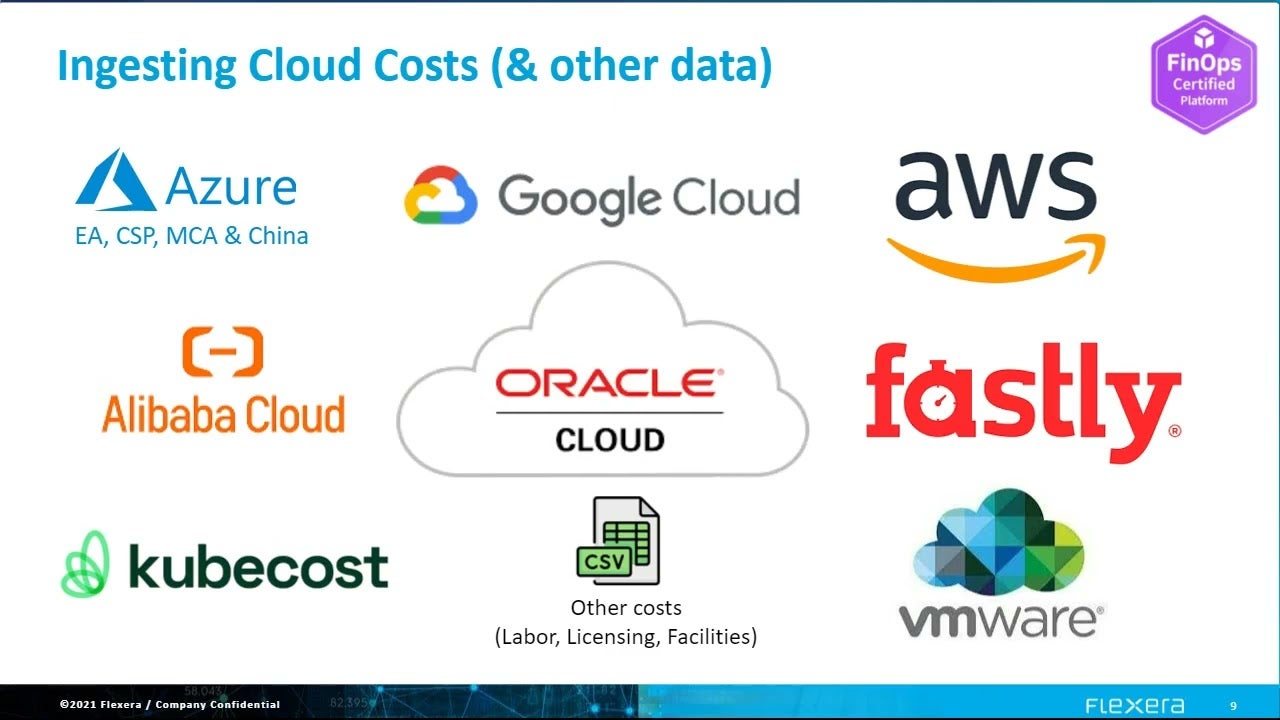
Effective cost allocation starts with ingesting:
- Public cloud billing data
- Private cloud and onprem costs
- Container and platform costs
- Licensing, labor, and facilities costs
This enables a total cost of ownership (TCO) view that reflects the full cost of delivering services.
[14:40] Metadata and tagging for cost allocation
[14:40] Jeremy Chaplin:
Metadata is essential for adding business context to cloud spend.
Common approaches include:
- Resource-level tagging (e.g., cost center, environment)
- Account, subscription, or project-level mapping
- External data enrichment (e.g., CMDB or finance systems)
Organizations should avoid over-reliance on resource-level tagging alone, especially at scale, and use logical cloud structures where possible.
[18:47] Rule-based dimensions and flexible cost allocation
[18:47] Jeremy Chaplin:
Rule-based dimensions allow organizations to define custom allocation logic.
For example:
- Map costs based on account, tags, or metadata
- Assign costs to applications, departments, or projects
- Integrate external data sources
These dimensions are time-aware, preserving historical accuracy even when organizational structures change.
[20:48] Hierarchical cost views with billing centers
[20:48] Jeremy Chaplin:
Billing centers provide a hierarchical structure for cost allocation.
This enables:
- Reporting by business hierarchy
- Role-based access control
- Targeted visibility for stakeholders
This structure supports both financial reporting and operational decision-making.
[22:18] Multidimensional cost allocation
[22:18] Jeremy Chaplin:
Cost allocation is inherently multidimensional.
Organizations can analyze the same spend across multiple dimensions, including:
- Cost center
- Application
- Environment (production, development, test)
- Business unit
- Geography
This allows different stakeholders to view cloud costs from their own perspective.
[24:16] Shared costs and allocation strategies
[24:16] Jeremy Chaplin:
Many cloud costs cannot be directly tied to a single owner.
Examples include:
- Enterprise support charges
- Shared infrastructure
- Security and monitoring tools
Shared costs can be allocated using:
- Proportional allocation
- Equal distribution
- Usage-based allocation
More mature organizations move toward usage-based allocation for greater accuracy.
[26:58] Measuring success in cost allocation
[26:58] Jeremy Chaplin:
Key performance indicators include:
- Percentage of allocated spend
- Percentage of unallocated spend
- Accuracy of allocation over time
High-performing organizations can achieve over 99% allocation through automation, reducing manual effort and enabling teams to focus on optimization.
[30:31] From allocation to optimization
[30:31] Jeremy Chaplin:
Cost allocation directly supports optimization by:
- Identifying ownership of spend
- Enabling accountability
- Supporting informed decision-making
Without allocation, organizations cannot effectively act on cost optimization opportunities.
[34:10] Cost normalization and consistency
[34:10] Jeremy Chaplin:
Normalization ensures consistent comparison across environments by:
- Aligning tax treatment
- Applying currency conversion
- Standardizing billing formats
This is especially important in multi-cloud and global environments.
[35:45] Tag normalization and governance
[35:45] Jeremy Chaplin:
Tagging inconsistencies are common due to:
- Different naming conventions
- Capitalization differences
- Manual input errors
Normalization and governance ensure:
- Consistent reporting
- Improved data quality
- Better alignment across teams
Organizations should focus on meaningful, standardized metadata rather than large volumes of tags.
[38:43] Reporting and visibility across environments
[38:43] Jeremy Chaplin:
Effective reporting allows organizations to:
- View multi-cloud spend in a single currency
- Track trends over time
- Analyze spend across multiple dimensions
The goal is not just visibility, but actionable insight tied to business outcomes.
[40:25] Advanced allocation with rule-based logic
[40:25] Jeremy Chaplin:
Rule-based allocation enables:
- Complex mapping rules
- Integration with enterprise systems
- Dynamic cost attribution
This reduces reliance on manual updates and enables scalable cost allocation strategies.
[43:35] Access control and stakeholder visibility
[43:35] Jeremy Chaplin:
Role-based access ensures:
- Stakeholders see only relevant data
- Teams focus on their own cost responsibility
- Decision-making is more targeted
This improves engagement across FinOps personas.
[44:51] Automating shared cost allocation
[44:51] Jeremy Chaplin:
Shared costs can be:
- Automatically distributed across business units
- Tracked alongside direct costs
- Adjusted over time as allocation improves
This reduces manual overhead and improves reporting accuracy.
[46:28] KPIs and continuous improvement
[46:28] Jeremy Chaplin:
Tracking allocation KPIs enables organizations to:
- Measure progress
- Improve accuracy
- Demonstrate FinOps maturity
Cost allocation is part of a continuous improvement cycle, not a one-time exercise.
[52:04] Closing remarks
[52:04] Jeremy Chaplin:
Cost allocation is essential for managing cloud spend effectively.
Organizations should:
- Start simple
- Build visibility
- Iterate over time
- Align stakeholders
This approach enables sustainable FinOps maturity and long-term cost optimization.
Let’s get started
Our team is standing by to discuss your requirements and deliver a demo of our industry-leading platform.