Webinar
How to take your first step toward FinOps automation with Flexera One Cloud Commitment Management
Overview
Cloud commitment recommendations are easy to generate. Acting on them at scale is where most teams get stuck.
In this on-demand webinar, you’ll learn how FinOps and cloud teams move from static recommendations to automated execution—without increasing financial risk. We show how to reduce cloud waste and on-demand spend by automating commitment management across AWS, Azure and Google Cloud.
If your team already has cost visibility but struggles to execute consistently, this session shows how to turn intent into measurable savings.
Key takeaways for FinOps leaders, cloud cost managers, finance leaders and cloud architects
- How to automate commitment execution so recommendations become realized savings
- How to use effective savings rate (ESR) to measure real outcomes across compute and non-compute services
- How to avoid overcommitment and undercommitment by continuously aligning commitments to usage
- How tiered strategies using smaller purchases and more convertible commitments reduce risk
- How to manage commitments across AWS, Azure and Google Cloud with consistent reporting
- How commitments can still support Kubernetes and Spot usage without adding tool sprawl
Speakers

Theron Dekok
Solution Architect
Flexera

Li-Or Amir
Senior Product Manager
Flexera

Donal Bourke
Senior Cloud Optimization Consultant
Flexera
Why cloud commitment management must be automated to deliver real FinOps savings
Why commitment recommendations don’t become real savings
Teams surface optimization recommendations, then return weeks later to find nothing changed. Purchasing, exchanging and converting commitments takes time, coordination and confidence many teams don’t have.
Outcome: Savings stay theoretical and on-demand spend persists.
Why manual commitments create lockin fear and delays
A commitment that looks small can represent meaningful financial lockin, like committing to $10 per hour which is roughly $260,000 of locked spend.
Outcome: Teams hesitate to act, coverage targets drift and the organization loses time to value.
Why 100% coverage can increase waste instead of savings
Coverage does not automatically mean utilization, and buying every provider recommendation can push portfolios into waste quickly.
Outcome: A risk balanced strategy improves utilization and protects against paying for unused commitments.
Why multicloud commitments are hard to optimize consistently
Commitment economics differ by cloud, including cases where enterprise discounts do not stack with reservations in the way teams expect.
Outcome: A consistent approach helps teams choose which commitments to pursue and where value is real across clouds.
Why cloud native and Kubernetes workloads still benefit from commitments
Even with dynamic usage, a portion of containerized workloads is persistent enough to justify a mixed portfolio of Savings Plans and Reserved Instances when aligned to demand curves.
Outcome: Engineering teams can reduce baseline cost while keeping flexibility for bursts and scaling.
Why cloud commitment management matters now
- Commitment decisions can represent large financial lock in, even when the hourly amount looks small.
- Flexera One Cloud Commitment Management supports more than 60 commitment types across AWS, Azure and Google Cloud.
- The approach emphasizes shorter average lock in of around five to six months to reduce long term risk while still improving savings outcomes.
If your team needs handsfree commitment execution, clearer ESR tracking and lower overcommitment risk, Flexera One Cloud Commitment Management helps operationalize the strategies covered in this webinar.
Ready to evaluate it in your environment? Contact us to speak with an expert .
Frequently asked questions
You improve effective savings rate by managing compute, noncompute and Spot savings together rather than in isolation. Measuring ESR across all spend types shows real savings after utilization and waste are accounted for, helping teams focus on actual financial impact instead of commitment coverage alone.
High commitment coverage does not guarantee savings if utilization is low or workloads change. Rigid commitments can increase waste when usage shifts. A balanced strategy that prioritizes flexibility and continuous alignment to demand helps protect savings while reducing financial risk.
Automation uses machine learning models and demand curves to continuously align commitments with real usage. Automated purchasing, exchanges and conversions allow teams to act faster and more consistently, improving utilization, increasing ESR and reducing operational workload.
The most effective approach is centralized, automated commitment management. Managing all commitment types in a single system improves visibility, consistency, and control across clouds, reducing manual effort and lowering the risk of underutilized or misaligned commitments.
Yes. Even highly dynamic Kubernetes environments usually have a baseline level of predictable usage. Aligning commitments to this persistent demand, while using automation and Spot Instances for variable workloads, allows organizations to reduce baseline cost without sacrificing flexibility.
Yes. Flexera Cloud Commitment Management works with existing commitments such as Savings Plans and Reserved Instances. The platform evaluates the current commitment mix and builds a transition strategy based on usage patterns, risk tolerance and future plans rather than requiring a full reset.
Transcript
[00:06] Welcome and introduction
[00:39] Li-Or Amir:
Welcome, everyone, to today’s webinar: Take Your First Step into FinOps Automation.
This is not just a product launch or a name-change webinar. This session is about how Flexera sees commitment management done right within the broader context of FinOps automation and cloud cost optimization.
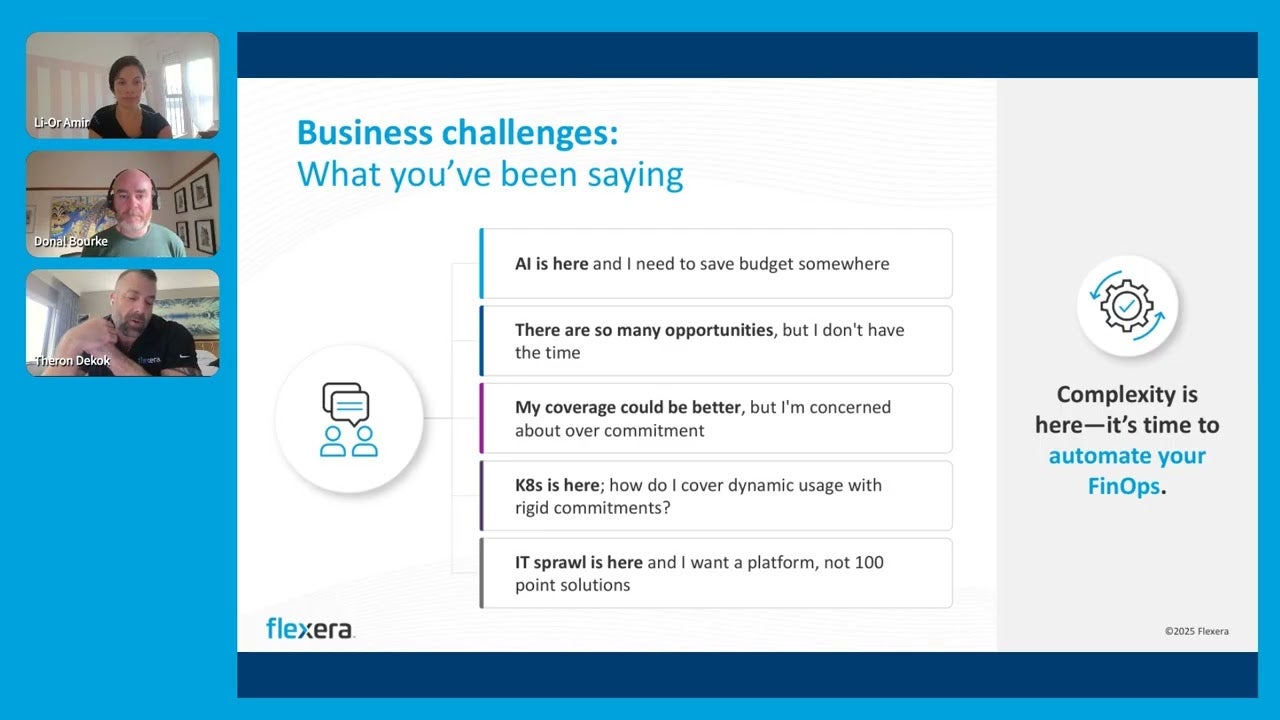
So why automate FinOps in the first place? Cloud spend is becoming harder to control every year. New technologies, new architectures, and new services all create more moving parts — and with them, more actionable insights from your cloud financial management tools.
But when you get dozens of cost optimization recommendations every day and still have to carry them out manually, those insights are not really actionable.
Flexera recognized this challenge, and earlier this year it acquired Spot by NetApp. Spot has been associated with FinOps automation for almost a decade.
Now, as part of Flexera One, cloud cost visibility and automated cloud optimization are brought together in one platform.
That means today we can walk you through what we see as phase one of FinOps automation: automating cloud commitment management. Not as a theory, but as a practical capability available to Flexera One users.
[02:05] Webinar agenda and speaker introductions
[02:05] Li-Or Amir:
In this session, we will:
- Examine the challenges organizations face when managing cloud commitments
- Discuss how commitments will evolve as we move into 2026
- Explain how Flexera Cloud Commitment Management works and how it differs from other tools
- Outline what customers can expect during onboarding, whether they are new to Flexera, existing Spot users, or current Flexera customers
I’m joined by Theron DeKok, a cloud native and FinOps specialist based in the US, and Donal Bourke, one of Flexera’s cloud cost and commitment management analysts based in Ireland.
[03:10] AI, cloud spend and Commitment Management
[03:20] Donal Bourke:
AI is fundamentally changing the shape of cloud spend. Organizations are deciding whether to run AI workloads in public or private environments, and when AI runs in the public cloud, commitment management can significantly reduce cost.
For example:
- In Azure, services like Azure OpenAI use Provisioned Throughput Units (PTUs)
- In AWS, AI workloads may leverage Savings Plans with services like SageMaker
- In Google Cloud, AI services such as Cloud Run also offer commitment opportunities
Using the right commitments allows organizations to control AI costs while freeing up budget for innovation.
[04:21] Li-Or Amir:
This highlights a key point: commitment management is not just about saving on traditional infrastructure. It also plays a critical role in making AI adoption financially sustainable.
[04:50] Why cloud cost recommendations alone are not enough
[04:50] Donal Bourke:
Many organizations already have cloud financial management tools that surface savings recommendations. The problem is execution. When recommendations are not acted on, savings remain theoretical.
Manual commitment management introduces risk. For example, committing to just $10 per hour represents approximately $260,000 in financial lockin. Without automation and confidence, teams often hesitate to act.
[05:59] Li-Or Amir:
This is also why 100% commitment coverage is not always the right goal. Coverage does not automatically translate to utilization or value.
[06:23] Donal Bourke:
Optimization requires balancing risk and return, which is difficult to achieve without specialized expertise and automation.
[06:42] The challenge of multicloud commitment management
[06:42] Li-Or Amir:
Another challenge is multicloud. Most organizations now operate in a multicloud environment, but true multicloud commitment portfolios are still uncommon. Is that mostly because of time and complexity?
[07:06] Donal Bourke:
Typically, AWS has much higher commitment coverage than other providers, partly because of the structure of its savings instruments.
With AWS, you can often benefit from both commitment savings and enterprise discounts.
In Azure and Google Cloud, it is sometimes an either-or situation. For example, if you already have an enterprise agreement discount, buying a reservation may replace that discount rather than stack on top of it.
A good example is Azure Managed Disks, where the enterprise agreement discount can sometimes be more valuable than the reservation itself.
The challenge is not just buying commitments — it’s knowing which commitments to pursue and where they actually deliver value.
That complexity makes it difficult for individual FinOps teams to manage effectively across all three clouds.
[08:17] Commitment management for Kubernetes and cloud native workloads
[08:17] Li-Or Amir:
Theron, you work with a lot of cloud-native customers running workloads on Kubernetes, whether in Amazon EKS or elsewhere. Are commitments still relevant when usage is so dynamic?
[08:45] Theron DeKok:
Even in highly dynamic, containerized environments running on Kubernetes, a portion of workloads is predictable enough to justify commitments.
Organizations benefit from using a mix of:
- Standard Reserved Instances
- Convertible Reserved Instances
- Savings Plans
What matters most is aligning commitments with actual workload behavior over time.
[09:18] Li-Or Amir:
When commitments are purchased by a FinOps team, how do you ensure engineers can actually operationalize that value in auto-scaling environments?
[09:43] Theron DeKok:
Engineering teams do not want more dashboards. That’s why Cloud Commitment Management works alongside Flexera’s workload optimization and container optimization capabilities. Commitments, Spot usage, and autoscaling environments are managed together, and everything can integrate with Terraform workflows.
[10:45] Matching commitments to real cloud usage
[10:45] Theron DeKok:
Manual commitment strategies often fail because usage fluctuates while commitments remain static. This leads to overcommitment, undercommitment, or unnecessary on-demand spend.
With Flexera Cloud Commitment Management, commitments are adjusted continuously using a tiered strategy that aligns more closely with real usage patterns.
[11:32] Li-Or Amir:
This approach relies on flexibility, including micropurchasing and convertible commitments, to adapt to bursts and shifts in demand.
[12:19] How Flexera Cloud Commitment Management works
[12:19] Theron DeKok:
Flexera uses AI and machine learning to define an optimal commitment strategy for each organization.
A key metric we use is the Effective Savings Rate (ESR), which measures savings across:
- Standard compute services
- Managed services
- Blended environments that include Spot Instances
Commitment coverage and ESR are tracked across AWS, Azure, and Google Cloud, giving organizations a consistent view across their multicloud estate.
[13:44] Li-Or Amir:
Another important point is that cloud commitments are no longer just about compute.
Historically, people focused on compute because that’s where commitments often produced the highest discount rates.
But today, organizations spend heavily on non-compute services too—including AI services, databases, and analytics platforms.
When you have one solution that helps optimize savings across all of those services, cloud savings become much more comprehensive.
That’s what we’re building with Flexera.
[14:19] What makes Flexera different in Cloud Commitment Management?
[14:30] Theron DeKok:
Flexera Cloud Commitment Management stands out in four ways:
- Broad coverage—supporting more than 60 commitment types across AWS, Azure, and Google Cloud
- Lower risk—with average lockin periods of around five to six months
- Hybrid approach—combining AI automation with human FinOps cost specialists
- Platform integration—commitment management is part of Flexera One, alongside SaaS management, cloud license management, sustainability, and workload optimization
[16:32] Li-Or Amir:
Human expertise matters because future business changes cannot be inferred from historical usage alone. Analysts can translate roadmap-level context into smarter commitment strategies.
[17:11] Product Demo: Flexera Cloud Commitment Manager dashboard
Demo walkthrough: Effective savings rate, coverage and commitment expiry
[17:19] Theron DeKok:
The Cloud Commitment Manager dashboard shows:
- Effective Savings Rate by service type
- Coverage and utilization trends over time
- Commitment expiry to manage risk
- Automated and analyst-assisted actions
This view helps organizations understand savings performance and risk exposure at a glance.
[20:24] A day in the life of Flexera Cloud Commitment Management
[20:31] Donal Bourke:
Flexera Cloud Commitment Management operates in four stages:
- Analyze – evaluate current usage and opportunities
- Customize – adapt strategy based on business context
- Automate – continuously exchange or convert commitments
- Optimize – ongoing review with a Flexera cost specialist
This combination of automation and expertise is a core differentiator.
[25:22] Optimizing savings while managing risk
[25:22] Donal Bourke:
Effective optimization focuses on achieving maximum savings without introducing unacceptable risk.
Strategies include:
- Micropurchasing
- Automated waste conversion
- Balancing short and long-term commitments
- Coordinating commitments with Spot Instances
- Aligning commitments with cyclical workload patterns
When commitments and Spot are used together correctly, organizations can achieve strong ESR results while maintaining performance.
[30:02] Closing remarks
[30:02] Li-Or Amir:
Thank you for joining us. This webinar is available on demand and we encourage you to reach out for a personalized walkthrough of Flexera Cloud Commitment Management.
We look forward to continuing the conversation and exploring deeper FinOps automation use cases in future sessions.
Let’s get started
Our team is standing by to discuss your requirements and deliver a demo of our industry-leading platform.