
The July 2026 Flexera releases help organizations gain greater visibility, control, and confidence across technology spend, IT assets, infrastructure, and security operations. New capabilities include a streamlined Azure onboarding experience for Cloud Cost Optimization, powerful NextGen dashboards that simplify cloud cost analysis and reporting, and security enhancements across Software Vulnerability Manager and Software Vulnerability Research. Together, these innovations help organizations accelerate time-to-value, improve decision-making, strengthen governance, and reduce operational complexity by bringing greater transparency, automation, and control to FinOps and security workflows.
Innovation area: FinOps
Azure Unified Onboarding
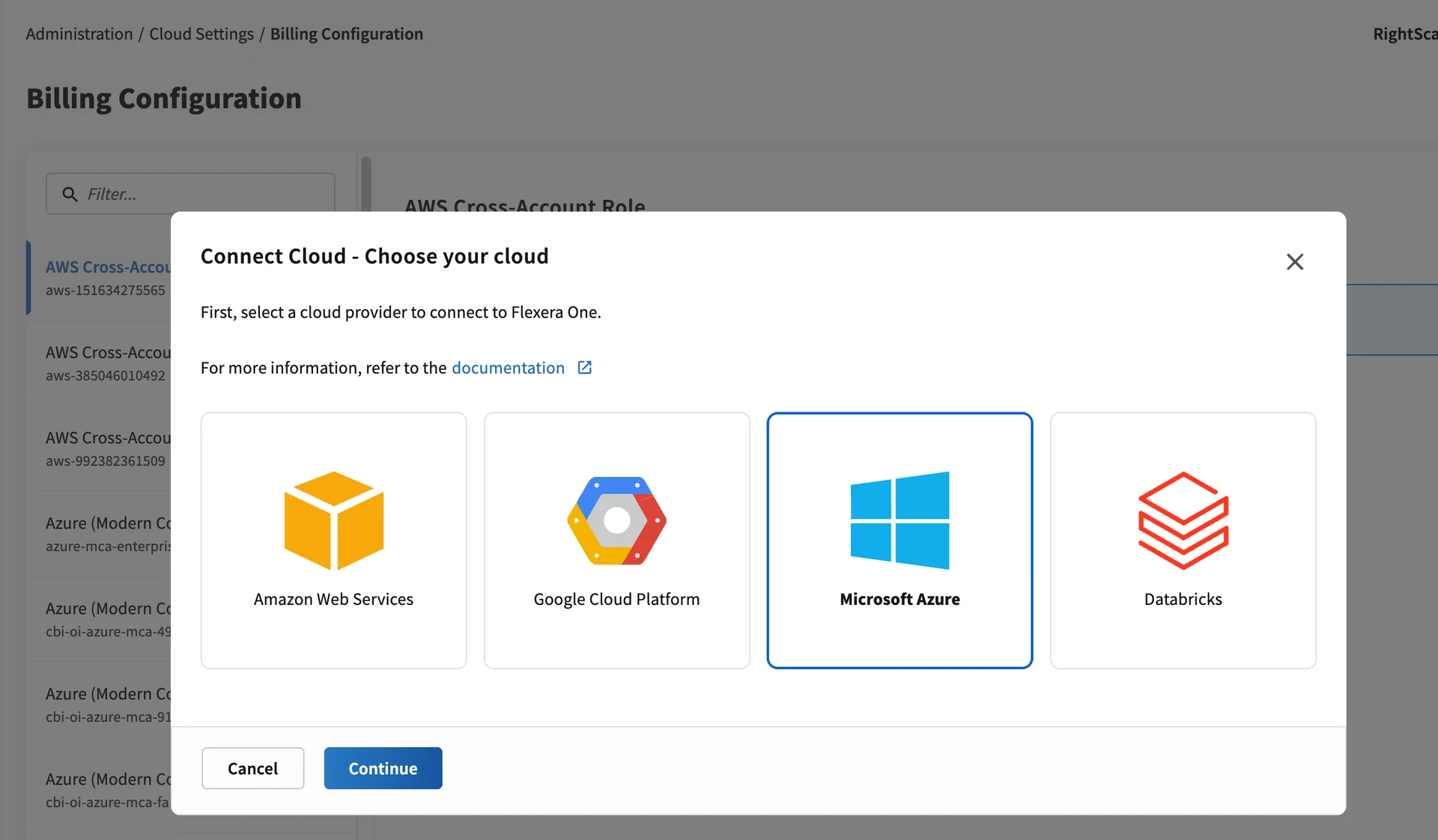
Flexera One Cloud Cost Optimization (CCO) now provides a unified Azure onboarding experience that enables customers and MSP partners to onboard billing ingestion, inventory collection, and recommendations setup through a single guided workflow. Supporting Enterprise Agreement (EA), Microsoft Customer Agreement (MCA), and Cloud Solution Provider (CSP) account types, the new experience replaces fragmented onboarding processes with one consistent flow that accelerates deployment, reduces configuration errors, and speeds time-to-value.
Key Highlights:
- One streamlined onboarding experience: Customers and MSP partners can onboard Azure billing, inventory, and recommendations through a single UI wizard instead of navigating multiple setup workflows.
- Support for all major Azure agreement types: A unified experience supports EA, MCA, and CSP agreements, while surfacing the appropriate billing configuration requirements for each agreement type.
- Automatic tenant and subscription discovery: Auto Discovery connects an entire Azure tenant and automatically discovers linked subscriptions, reducing manual configuration effort.
- Simplified billing scope management: Customers can configure multiple billing profiles or invoice sections in a single onboarding action, helping organizations with complex Azure billing structures onboard more efficiently.
- Guided permissions setup: The onboarding wizard generates a downloadable script that creates the required app registration and service principal and assigns key platform permissions, reducing manual setup tasks.
- Improved visibility and governance: Clear progress indicators, connection status reporting, RBAC-controlled access, and platform-managed billing visibility provide greater operational transparency.
- Unified bill management experience: Bills connected through our unified onboarding experience appear in Billing Configuration and Bill Processing Status views as Platform Managed, making it easier to distinguish them from legacy billing connections.
Why it matters
Onboarding involves multiple stakeholders responsible for billing, cloud operations, and optimization initiatives. By bringing these activities together, customers and MSP partners can streamline onboarding, reduce administrative overhead, and gain access to actionable cost and optimization insights quickly. This enhancement helps teams establish an efficient operational foundation for FinOps, enabling informed decision-making and faster realization of value from their cloud investments.
Availability: Generally Available now.
To learn more about Flexera’s new Azure onboarding experience, see Flexera documentation.
NextGen dashboards for Cloud Cost Optimization
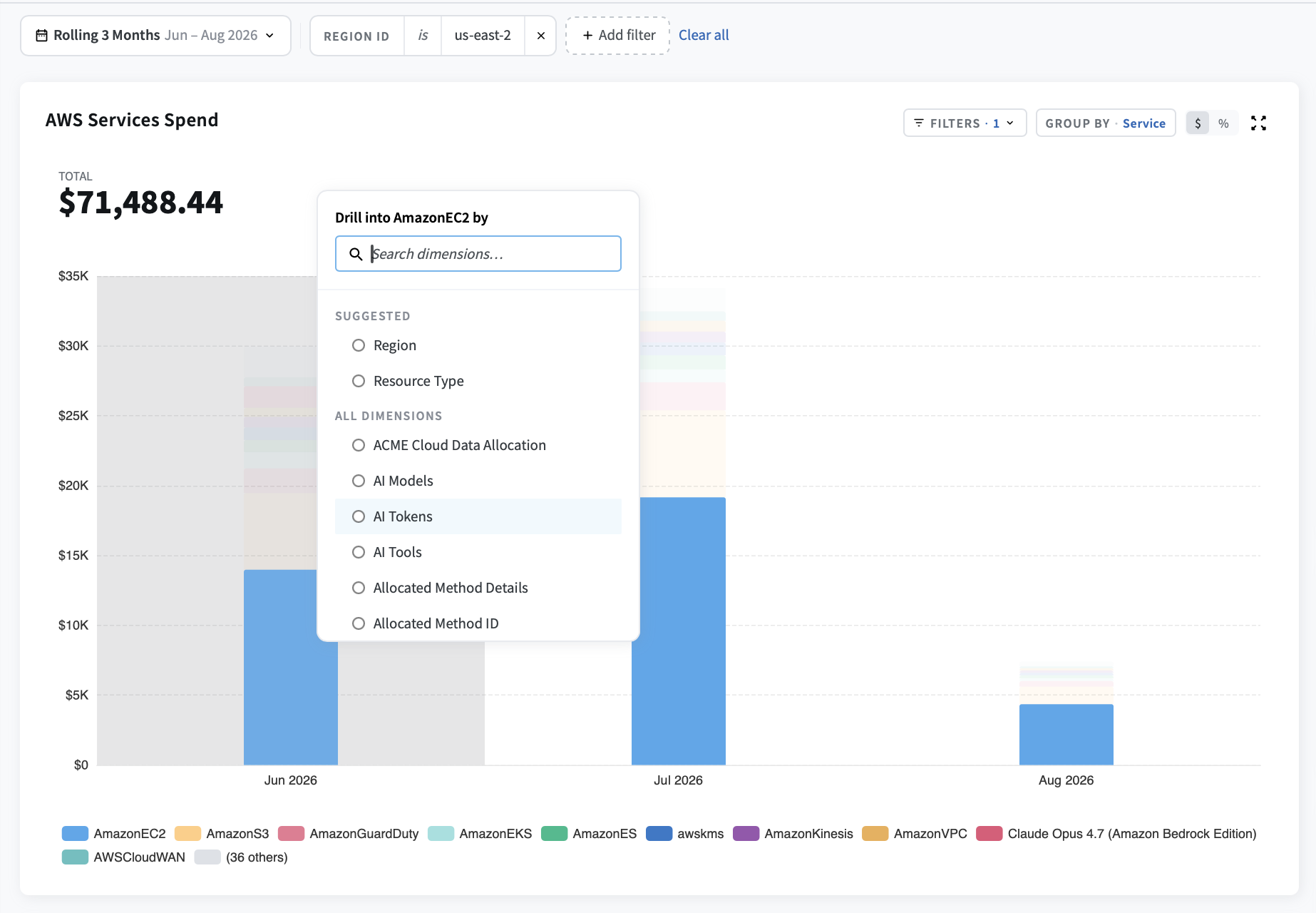
NextGen dashboards give CCO customers and MSP partners a clearer way to work with cloud cost data. Teams can investigate cost changes, organize dashboards around their priorities, and prepare focused PDF reports for stakeholders from one connected workspace. Existing dashboards remain available through the dashboard selector, and Billing Centers dashboards now use the updated interface.
Key Highlights
- Explore cost drivers in context: Select a value in a supported chart and drill into dimensions such as region, service, or resource. Multiple levels of drill-down help teams move from a high-level trend to the underlying cost drivers without leaving the dashboard.
- Build dashboards around your priorities: Create and tailor dashboards for specific FinOps questions, audiences, or reporting needs. Drag, resize, and reposition widgets on a flexible grid, and add text to organize related views or provide context for other users.
- Compare costs across time horizons: Set an absolute or relative date range for the full dashboard, or configure individual widgets to show different periods. Supported widgets can compare results with the previous period or the same period last year, helping teams identify and investigate changes in spend.
- Focus analysis with dashboard and widget filters: Apply filters across the dashboard or configure individual widgets with their own filters and date ranges. Teams can examine different services, providers, dimensions, or periods in one place instead of creating separate dashboards.
- Create clearer reports for stakeholders: Use print view to create a dedicated PDF layout by adjusting the header, widget order, widget size, and included content. The exported PDF can include the dashboard name, generation date, selected time range, and applied filters, giving stakeholders a focused summary even if they do not regularly access Flexera One.
Why it matters
Consistent cloud cost reporting builds confidence and supports faster decisions. NextGen dashboards align reporting with a unified cost data model, reducing discrepancies across cost views and providing a more reliable foundation for analysis. Users can investigate the services, regions, or resources driving a change and prepare a focused stakeholder report from the same dashboard. This cleaner workflow reduces time spent reconciling data and makes it easier for teams to understand cost changes, share findings, and prioritize optimization efforts.
Availability: Generally available for MSP and Enterprise CCO v2 orgs.
Innovation area: ITAM
Improved purchase order and software license mapping for contract ingestion
Flexera One IT Asset Management (ITAM) now reduces manual effort by automatically associating ingested contracts with existing purchase orders and software licenses in IT Asset Management. This helps you maintain accurate contract-to-entitlement relationships without manually linking records after each import.
Key Highlights:
- Purchase Orders: The system matches primarily by PO number. When multiple purchase orders share the same number, additional criteria are evaluated, including vendor alignment, processing status, PO date proximity to the contract effective date, and associated business unit or cost center. Each candidate is scored based on how closely it matches the contract details. When a single high-confidence match is identified, the purchase order is mapped automatically.
- Software Licenses: The system matches by license name, then validates additional attributes such as vendor/publisher, product name, SKU/part number, license type, and contract dates. Each potential match is evaluated using a confidence score based on the number and quality of matching attributes. The highest-confidence match is selected for automatic mapping where appropriate.
Why it matters
Contract ingestion no longer stops at extracting contract data. By automatically linking newly ingested contracts to the relevant purchase orders and software licenses already tracked in IT Asset Management, Flexera helps maintain the critical relationship between contracts, entitlements, and assets without requiring manual reconciliation.
To learn more about Flexera’s new and improved mapping of purchase orders and software licenses for contract ingestion, see Contract Mapping Logic and Scoring.
Innovation area: SaaS Management
Improved grouping for Adobe Single App subscription bundles
Flexera One SaaS Management (FOSM) now provides a clearer more consolidated view of Adobe Single App subscriptions bundles that are retrieved through the Adobe connector.
Key Highlight:
- Product profiles: previously appeared as separate subscription records are now grouped under their parent Single App subscription
Why it matters
Flexera One SaaS Management now groups Adobe Single App subscription bundles under a parent Single App subscription.
With this enhancement, product profiles that previously appeared as separate subscription records are now grouped together so customers see subscription data the way Adobe actually licenses it. Metrics such as purchased, assigned, unassigned, and over-assigned licenses are calculated at the correct subscription level while still allowing visibility into individual product profiles.
Innovation area: Security Vulnerability Management
Greater Control and Cleaner Insights in Software Vulnerability Manager
The July 2026 Software Vulnerability Manager update improves administrative control, streamlines vulnerability reporting, and enhances Microsoft Intune package management. These enhancements help teams reduce noise, strengthen security governance, and simplify operational workflows.
Key Highlights
- Restrict user access at the host level: limit access to specific hosts using hostnames or IP addresses for more granular security and administrative control.
- Reduce false positives in zombie file reporting: exclude Windows System32 and SysWOW64 files from zombie file detection to focus teams on actionable results.
- Manage Intune Scope Tags during package publishing: assign Intune Scope Tags directly when publishing packages, simplifying package deployment and administration.
Why It Matters
IT and security teams need precise controls and accurate data to operate efficiently. These updates help organizations strengthen access governance, reduce time spent reviewing non-actionable findings, and streamline Intune package management workflows. The result is improved operational efficiency, more focused remediation efforts, and stronger control over software and vulnerability management processes.
Availability: Generally Available now. For more information, see our release notes.
Stronger API Security, Visibility and Access Controls in SVR
The July 2026 Software Vulnerability Research (SVR) update introduces new API monitoring and security capabilities, enhanced authentication protections, and improved auditing controls. These enhancements help organizations strengthen governance, improve security posture, and gain greater visibility into API activity across their environment.
Key Highlights
- Monitor API usage with a new dashboard: gain visibility into API consumption, throttling activity, and usage trends to better manage integrations and identify potential issues.
- Improve API governance with token lifecycle management: set token expiration dates and enforce stronger access policies to reduce security risk and improve compliance.
- Audit token activity and detect anomalies: track token changes and identify suspicious behavior, such as usage from previously unseen IP addresses, to strengthen security oversight.
- Strengthen protection for two-factor authentication settings: require password verification before disabling 2FA and automatically notify users of security-related changes.
- Improve account security during login attempts: provide clear lockout warnings and enforce protection against repeated authentication failures to reduce the risk of unauthorized access.
Why It Matters
As organizations rely more heavily on APIs and automated integrations, security and governance become increasingly important. These enhancements give administrators greater visibility into API activity, stronger controls over credentials and access, and better tools to detect and respond to suspicious behavior. The result is improved operational security, reduced compliance risk, and greater confidence in managing critical vulnerability and security data.
Kevin Miller
Kevin Miller is the Director of Product Marketing at Flexera. He develops marketing strategy and messaging, with a focus on IT insights, data quality, and technology value optimization.