
This June, Flexera releases help organizations gain greater visibility, control, and confidence across technology spend, IT assets, infrastructure, and security operations. New capabilities include Snowflake cost visibility for stronger FinOps governance, enhanced Oracle and IBM license compliance insights to reduce audit and licensing risk, deeper Kubernetes and software inventory visibility to improve operational decision-making, and Security Vulnerability Management enhancements that streamline patch governance and deployment. Together, these enhancements help organizations make more informed decisions, reduce risk, improve accountability, and optimize technology investments across hybrid and cloud environments.
Innovation area: FinOps
Snowflake Cost Visibility: Flexera One now ingests Snowflake billing and compute data
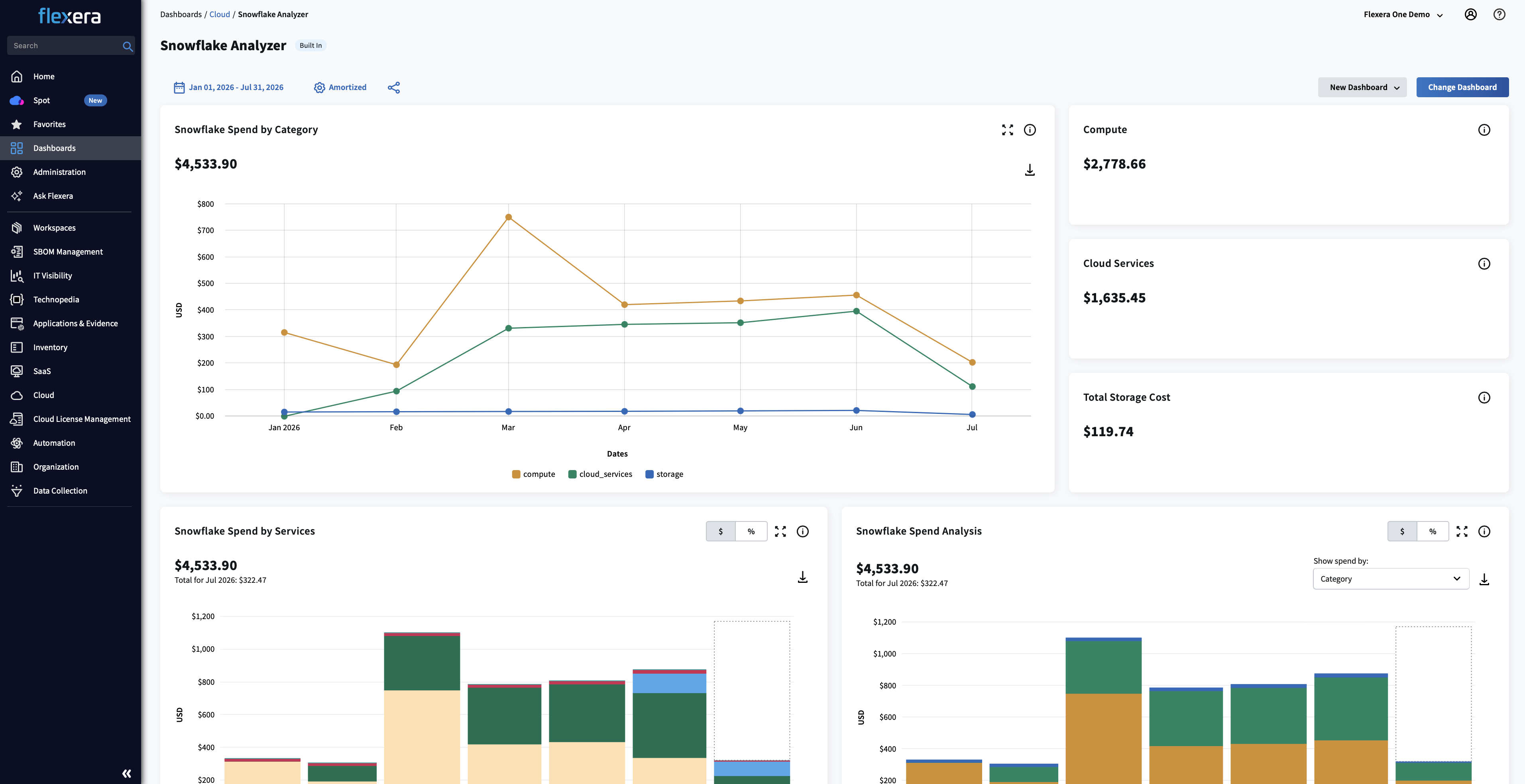
Flexera One: Data Cloud Optimization (DCO) now supports Snowflake Cost Visibility via Bill Connect, an automated, cloud-provider-independent pipeline that ingests Snowflake cost, compute, storage, and data transfer cost & usage metadata directly into Flexera One. This enhanced visibility empowers FinOps teams, cloud architects, and data platform owners to accurately track, allocate, and optimize their data cloud spend.
Key Highlights:
- Automates data ingestion: Brings Snowflake cost and usage data into Flexera One so teams can analyze spend without relying on disconnected manual reporting.
- Provides granular cost visibility: Breaks down Snowflake spend across key cost drivers such as warehouses, compute, storage, and usage patterns so teams can better understand what is driving cost.
- Unifies data cloud and cloud spend: Shows Snowflake spend alongside Databricks and public cloud costs in Flexera One, giving teams one place to manage technology spend.
- Supports dashboards, budgets, and forecasting: Uses pre-built and customizable views to help teams monitor spend, set budgets by team, product, or project, and forecast end-of-period costs.
- Improves allocation and accountability: Helps allocate Snowflake spend to teams, projects, or business units so organizations can support showback, chargeback, and better cost ownership.
Why it matters
As Snowflake becomes more central to analytics, AI, and data-driven decision-making, its consumption-based model can make spend harder to predict and govern. Costs can grow quickly across warehouses, databases, teams, and workloads, but many organizations still struggle to connect that spend back to the business owners, projects, or outcomes driving it.
Flexera One: Data Cloud Optimization (DCO) gives teams the clarity needed to manage that spend with confidence. By bringing Snowflake billing and usage data into Flexera One alongside cloud and Databricks costs, organizations can see where spend is coming from, allocate it to the right owners, forecast future usage, and identify optimization opportunities. The result is stronger financial accountability, better cross-team decision-making, and a clearer path to ensuring data cloud investments are delivering measurable business value.
Availability: Generally Available now.
To learn more about Flexera’s new Snowflake cost visibility capabilities, explore the June 2026 release notes, watch our Data Cloud Cost Visibility & Control webinar, and see how Flexera One Data Cloud Optimization helps organizations manage and optimize data cloud spend.
Innovation area: ITAM
Oracle Linux Virtualization Manager (OLVM) inventory visibility and license compliance
Flexera One IT Asset Management (ITAM) now supports collecting inventory from Oracle Linux Virtualization Manager (OLVM). This capability provides visibility into OLVM infrastructure across your organization and enables data to be used in license compliance calculations.
Key Highlights:
- Supports inventory collection directly from OLVM environments: When enabled, OVLM infrastructure data is collected and displayed on the All Inventory and All Discovery Devices pages
- Data displayed:
- Host devices are collected from OVLM inventory, including the associated .ndi file and virtual machines references
- Detailed virtual machine inventory is obtained separately through the FlexNet inventory agent (or other supported sources)
- Both host and virtual machine information are displayed
- Data reconciliation and integrity: Flexera One ITAM is designed to preserve OVLM-specific data even when a host is already known to the system through other inventory sources, such as agent-based collection. In these cases:
- Existing devices are updated rather than duplicated
- OLVM-specific hardware properties are retained
- Shared properties are updated without overwriting OLVM-exclusive data
Why it matters
Oracle licensing is one of the most complex and highest-risk areas of software asset management and virtualized Oracle environments make it even harder.
Without clear visibility into Oracle Linux Virtualization Manager (OLVM) hosts and the virtual machines running on them, organizations face real exposure: unbudgeted true-ups, audit findings, and costly over-licensing driven by incomplete or inaccurate data.
With native OLVM inventory support in Flexera One ITAM, customers can now:
- Close a critical blind spot by capturing OLVM host and VM relationships that traditional agent-based discovery alone can miss, giving license managers the complete picture Oracle expects during an audit.
- Strengthen license compliance calculations with authoritative virtualization data feeding directly into entitlement and consumption analysis, reducing the risk of misreported Oracle Processor or Named User Plus positions.
- Protect data integrity across sources thanks to smart reconciliation that preserves OLVM-specific hardware properties while updating shared attributes leading to no duplicates, no overwritten details, and no guesswork.
To learn more about Flexera’s new OLVM visibility capabilities, explore the June 2026 release notes
IBM Sub-capacity technology eligibility
IBM regularly updates the list of operating systems and virtualization technologies eligible for sub-capacity licensing, removing versions that have reached end of standard support (EOS) by their vendors. Once removed, these technologies are no longer supported by the IBM License Metric Tool (ILMT). Customers are typically provided a 180-day window to migrate to supported versions; however, in some cases, the effective removal date may extend beyond 180 days, with compliance required by the specified deadline.
To keep customers informed and enable proactive planning for upgrades, Flexera One IT Asset Management now leverages IBM EOS lifecycle data to automatically identify inventory devices associated with IBM sub-capacity licenses that are running operating systems and virtualization technologies that have reached or are approaching EOS.
Key Highlights:
- Continued tracking with backward compatibility: Flexera One ITAM maintains backward compatibility with inventory agent versions that support EOS operating systems and virtualization technologies. This ensures continued resource usage data collection and accurate sub-capacity license calculations, even during transition periods.
- Enhanced compliance visibility: Provides enhanced visibility into devices running EOS operating systems and virtualization technologies that are associated with IBM sub-capacity licenses.
- Proactive Risk Identification: Customers can quickly identify non-compliant or at-risk environments where EOS technologies are in use. This enables proactive upgrade planning and informed discussions with IBM regarding migration timelines.
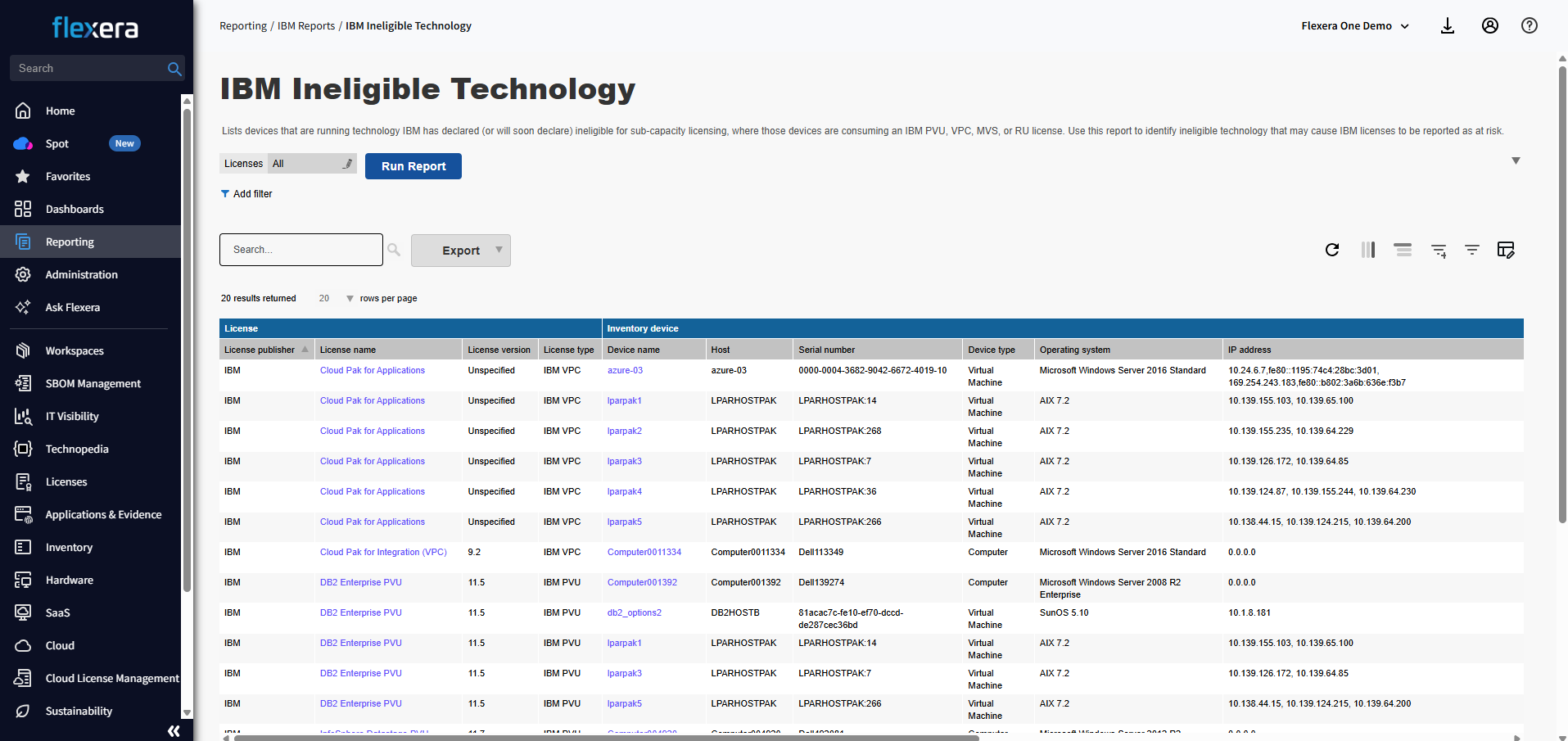
- Dedicated EOS Visibility Report: A new IBM Ineligible Technology report provides a consolidated view of all devices running currently ineligible technologies (removal date passed) and those approaching a future removal date, enabling prioritized upgrade planning.
Why it matters
When IBM removes operating systems or virtualization technologies from the eligible list, customers running those versions can lose sub-capacity rights overnight, defaulting to full-capacity licensing and facing dramatic, unbudgeted cost increases. Staying ahead of IBM’s End of Support (EOS) lifecycle is not a “nice to have”, it’s essential to protecting the bottom line.
With automated IBM EOS lifecycle tracking in Flexera One ITAM, customers can now:
Avoid costly full-capacity fallback by proactively spotting devices running EOS operating systems and virtualization technologies before IBM’s removal deadlines hit preserving valuable sub-capacity entitlements and the savings that come with them.
Plan upgrades with confidence using the new IBM Ineligible Technology report, which consolidates both currently ineligible and soon-to-be-ineligible technologies in one place, so IT and SAM teams can prioritize migrations, align budgets, and negotiate migration timelines with IBM from a position of strength.
Maintain continuity during transitions thanks to backward compatibility with inventory agents supporting EOS technologies, ensuring uninterrupted resource usage data collection and accurate sub-capacity calculations while upgrades are underway.
To learn more about Flexera’s new IBM sub-capacity licensing capabilities, explore the June 2026 release notes
Innovation area: IT Visibility
Container Inventory Overview: unified visibility for Kubernetes environments
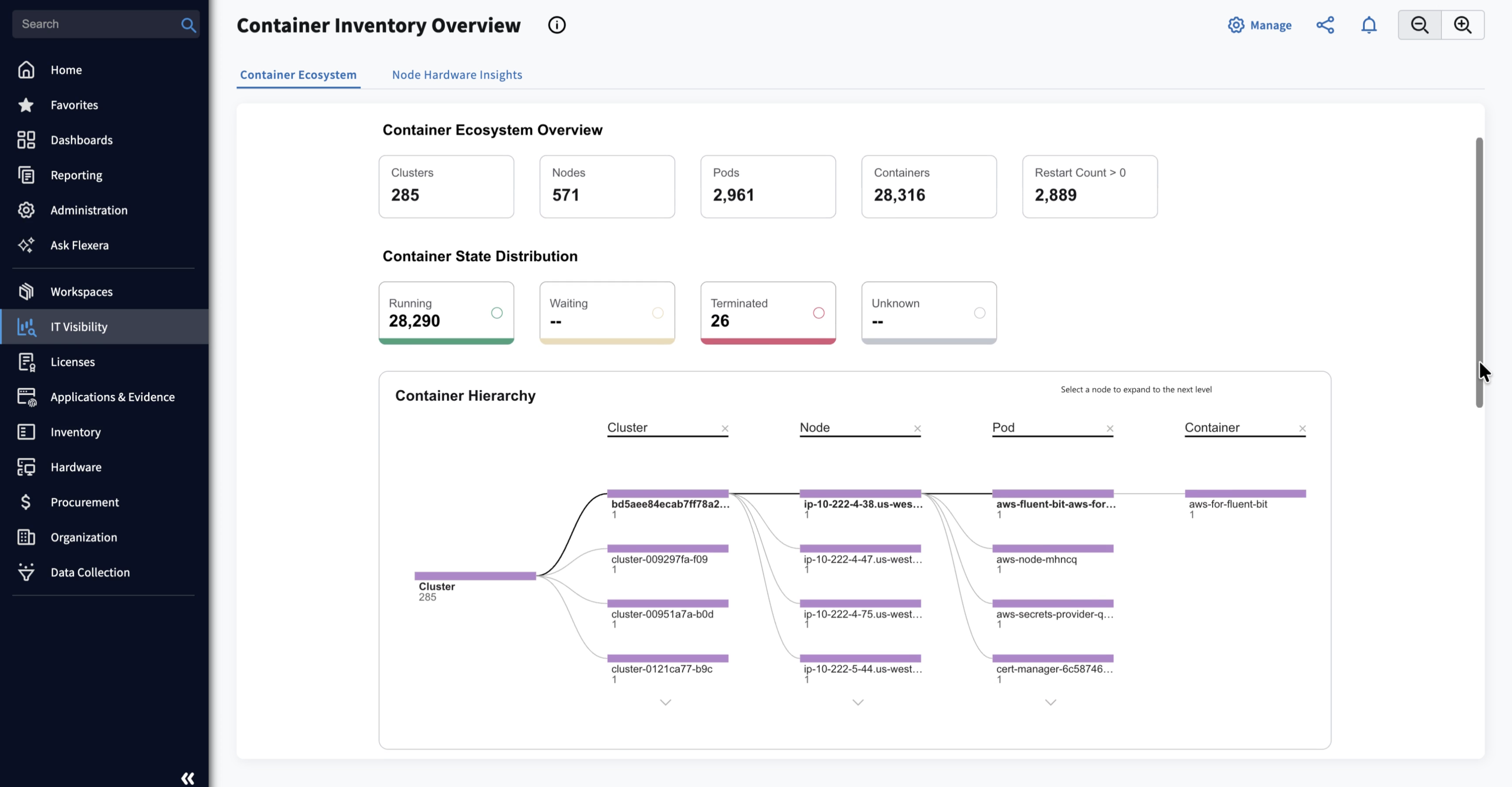
The new Container Inventory Overview report in Flexera One IT Visibility gives organizations a single, connected view of their Kubernetes container ecosystem. Container Inventory helps platform, infrastructure, and operations teams understand what’s running, where it’s running, and the infrastructure supporting it. It transforms fragmented container data into actionable insights that improve governance, operational health, and lifecycle management.
Key Highlights
- Gain end-to-end container visibility with a unified view of clusters, nodes, pods, and containers.
- Understand container footprint and growth to identify container sprawl, deployment spikes, and scaling trends. [
- Monitor container health and stability with insights into container state, restart activity, and workload reliability.
- Connect workloads to infrastructure by mapping containers to the nodes and hardware they depend on.
- Identify infrastructure risk earlier with visibility into hardware lifecycle status, including end-of-sale and obsolete systems.
- Improve capacity planning and optimization by tracking workload density, growth trends, and infrastructure utilization.
- Move from high-level insights to root-cause analysis with drill-through views and detailed inventory metadata.
Why it matters
Container environments often grow rapidly across clusters, nodes, and teams, making it difficult to maintain visibility, control costs, identify risk, and ensure operational stability.
The Container Inventory Overview report helps organizations move from siloed views of containers and infrastructure to a single source of truth, enabling better governance, proactive lifecycle management, improved reliability, and more informed decisions about scaling and modernization.
As support expands beyond Kubernetes to additional container technologies and container software visibility, customers will gain even deeper insight into the applications and components running across their environments
Availability: Generally Available now. For more information, see our community post and product documentation.
Full Transparency into File Evidence
Overview
IT Visibility now provides complete visibility into all file evidence collected across your environment, helping you better understand software recognition results and investigate unmapped data with confidence. Customers can view Active, Unrecognized, and Irrelevant file evidence while maintaining the same recognition metrics and workflows they rely on today.
Key Highlights
- See all collected file evidence for greater transparency into discovery and recognition outcomes.
- Investigate recognition gaps faster by viewing Active, Unrecognized, and Irrelevant evidence categories.
- Maintain trusted recognition metrics since summary counts continue to reflect recognized Active evidence only.
- Improve troubleshooting and audits with the new Irrelevant Reason field available in the UI and CSV exports.
- Gain deeper insight into software discovery behavior with access to previously hidden evidence and recognition context.
- Analyze evidence consistently across views and exports for easier validation and investigation workflows.
Why It Matters
When file evidence is not visible, it can be difficult to understand why software remains unrecognized, leading to lower confidence in discovery and recognition results. This enhancement increases transparency by exposing all evidence categories while preserving existing recognition metrics, helping teams troubleshoot issues faster, validate recognition outcomes, and build greater trust in their software inventory data.
Learn more
For a detailed explanation of file evidence categories, recognition rates, and FAQs, refer to our KB article: Understand file evidence in IT Visibility
Innovation area: Security Vulnerability Management
SVM On-Prem June 2026 Release: improved patch management and governance
Overview
The June 2026 SVM On-Prem release introduces usability, governance, and platform enhancements that help teams manage patches more efficiently and accurately. New filtering, subscription management, and publishing improvements streamline daily operations while platform updates improve security and maintainability.
Key Highlights
- Find patches faster with advanced filtering by deployment type and architecture.
- Reduce duplicate patch publishing through a unified subscription view that identifies redundant subscriptions.
- Improve patch governance with organization-wide visibility and enhanced management controls.
- Simplify Intune package management with new cleanup capabilities that reduce operational clutter.
- Increase patch deployment accuracy through fixes to incorrect “Installed” status reporting.
- Publish more package types with support for compressed packages.
- Strengthen security and compliance with support for PHP 8.4 and updated platform components.
- Simplify platform maintenance with an improved RPM installation experience in SSL-enabled environments.
Why It Matters
Patch management teams need efficient tools to manage growing software estates without adding complexity. This release helps organizations reduce administrative overhead, improve patching accuracy, strengthen governance, and keep their platform current so teams can focus more on security outcomes and less on day-to-day maintenance.
Availability: Generally Available now. For more information, see our release notes.
Jennifer Kuvlesky
Jennifer is a Director of Product Marketing at Flexera, focused on IT asset management problems and solutions. Most of her career has been serving customers in the ITAM and IT operations management categories with emphasis in product marketing, customer value and product management.