
Webinar
Optimizing ServiceNow license costs, minimizing audit risk
Unlock practical strategies to optimize ServiceNow licensing costs and minimize audit risk. Watch now for actionable tips and real-world insights from Flexera experts.
Overview
Want to keep ServiceNow costs under control and stay ready for audits? Flexera experts Clayton Starko and John Suehr explain licensing models, and share compliance best practices. Learn optimization strategies, explore AI trends and get governance tips to help you maximize value. Watch now to take charge of your ServiceNow license position.
Recap: ServiceNow licensing best practices
SaaS audit landscape: What’s changed in the SaaS era
- SaaS vendors audit too. According to the 2025 State of ITAM Report, over 20% of surveyed companies have faced a ServiceNow audit in the past three years.
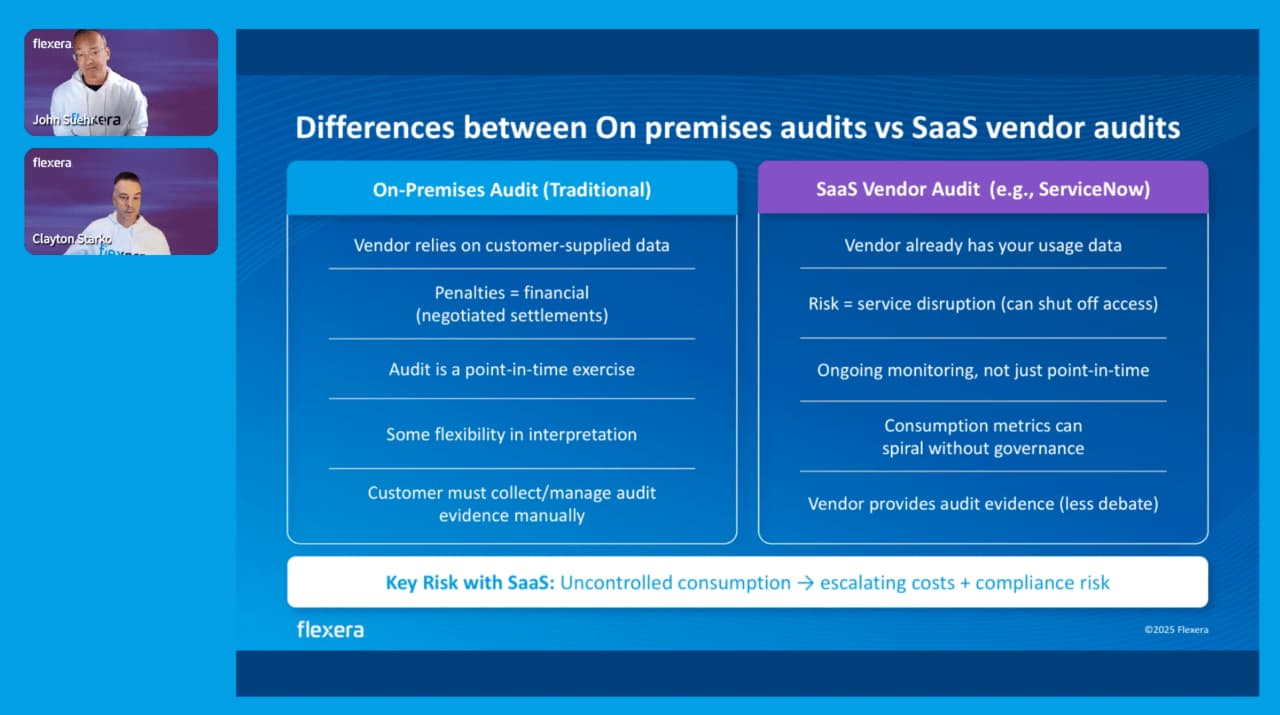
- SaaS vendors can see usage: Unlike on-premises software, SaaS providers can see usage directly in their cloud, reducing debate over evidence and shifting leverage.
- Contract terms matter: may include up to two audits per year, negotiated timing, and true-up periods; repeated overages can lead to service disruption.
- Continuous monitoring vs point-in-time: SaaS pushes ongoing consumption oversight; uncontrolled usage leads to escalating cost and compliance risk.
ServiceNow licensing models explained (and where compliance risk hides)
- Traditional: user-based licenses with roles like requester, business stakeholder/approver, fulfiller (paid component for ITSM). Rights-based vs unrestricted: Unrestricted licenses (easier to manage, often discounted) vs rights-based (assign exactly what each user needs)—a strategic choice visible in Subscription Management.
- Capacity-based licensing: pooled entitlements (e.g., Integration Hub, SecOps, ITOM/AIOps, ServiceNow Assist transactions). Storage overages are increasingly relevant to watch.
- Reality = hybrid: Many organizations mix user-based for fulfillers/approvers with unrestricted or capacity models for broad access (e.g., HR portal).
Speakers

Clayton Starko
Director, Solutions Architecture & Advisory
Flexera
With over 25 years of hands-on IT experience, Clayton leads Flexera’s Solutions Architecture team, specializing in ITAM and ServiceNow optimization.

John Suehr
Solutions Architect
Flexera
John is a Solution Architect with deep practical expertise in SaaS license management, helping organizations streamline software usage and maximize ROI.
License types
| License Type | Description | Management Considerations | Risks | License Type |
|---|---|---|---|---|
| User License | Based on named users assigned roles | Track actual usage vs. assigned roles; avoid over-allocation | Overlapping subscriptions, unused roles | User License |
| Role-Based License | Tied to packaged app entitlements and specific roles within ServiceNow | Validate role assignments; monitor direct vs. group-based roles | Blind spots in Subscription Management V2 | Role-Based License |
| Application License | Licensed per ServiceNow application (e.g., ITSM, CSM) | Monitor application usage; reconcile against purchases | Misalignment between usage and entitlements | Application License |
| Consumption License | Based on volume of Integration Hub, API calls and storage consumption API calls | Track integration hub usage and storage consumption | Hidden charges and audit exposure | Consumption License |
GenAI in ServiceNow: adoption, data readiness and cost management
- GenAI Licensing: ServiceNow’s GenAI features use a token-based model (Assist, Skill, Action). Usage and costs depend on the complexity of tasks.
- AI Evolution: ServiceNow has progressed from scripted workflows to agentic AI, enabling more autonomous operations.
- Governance & Data: Effective GenAI adoption requires strong governance and clean, reliable data to ensure accurate outputs and control costs.
- Industry Adoption: Most organizations are adopting or planning to adopt GenAI, but readiness and cost management are key concerns.
- Flexera’s Role: Flexera is developing AI-driven tools to automate contract analysis and optimize ServiceNow licensing.
How to prepare for GenAI in ServiceNow
- Know GenAI Licensing: Understand ServiceNow’s GenAI constructs to forecast usage and costs.
- Govern Usage: Implement governance to monitor consumption and avoid surprises.
- Optimize Continuously: Use tools to automate license management and identify savings.
ServiceNow Compliance Data Foundations: Roles, Groups and Reporting
- Subscription → Application → Role → Role Type chain drives who is counted; e.g., fulfiller is the paid component in ITSM, while requester may be free.
- Subscription Management vs Use Verification Report (UVR):
- UVR used for audits; excludes users inactive >365 days and service/web-service accounts from chargeable use (fairness rules).
- Subscription Management may appear over-consumed because it lacks those exclusions.
- Blind spot to fix: Direct role assignments outside Groups aren’t visible to Subscription Management; UVR will catch them—so reconcile both views.
- Group-first governance: Defining groups and approvers provides instant controls and makes optimization/reporting repeatable (even if migration from direct roles is effortful).
Five ways ITAM and ITSM teams can optimize ServiceNow licensing
- Find overlapping subscriptions: Many subscriptions grant access to the same capabilities/apps; decide which subscription each user should “count against” to use purchased capacity before buying more.
- Choose by availability or cost: For example, you can assign some users who overlap to ITSM Pro where you have more room, and the rest to CSM Pro. You can also choose the SKU that costs the least.
- Downgrade under-used fulfillers: If a fulfiller has no rights activity in 90 days (UA app usage), consider a requester or cheaper role—without impacting productivity. Trend usage before acting.
- Attack “phantom” consumption: Sort by last login (e.g., >300/365/90 days) and reclaim; UVR won’t charge for >365-day inactive and service accounts, but reclaiming frees headroom.
- Monitor storage/capacity: Customers report storage overages increasing—track growth, dedupe opportunities and set alerts for thresholds.
Audit-readiness = renewal readiness (how to stay ahead)
- Trust but verify: Use third-party views to reproduce UVR, correlate with Subscription Management and justify negotiations with underlying evidence.
- Forecast with history: Two years of license and usage history enables linear or seasonal regression forecasting; incorporate joiners/leavers and business events to rightsize renewals.
- Policy & AI governance: With agentic features expanding, define guardrails (who can invoke which Skills/Actions, quotas, review points) to prevent consumption spikes and compliance issues.
Frequently asked questions
ServiceNow uses user‑based licenses (e.g., fulfiller, approver, requester) and capacity‑based metrics (e.g., Assist transactions, Integration Hub). Many organizations use a hybrid of both, requiring careful tracking of assignments and usage.
Requesters typically have free access, stakeholders approve items and fulfillers are paid users. Mapping subscriptions to roles and measured types determines audit counts.
Rights‑based models assign licenses to specific users, offering control but needing management. Unrestricted models cover broad user groups and are easier to manage but less precise.
These models use pooled entitlements consumed by actions or workflows. Usage can spike with automation, so monitoring is key to avoid overages.
Subscription Management shows license allocations and compliance views/report and the Use Verification Report shows user activity views. Differences between them must be reconciled.
Users inactive for over 365 days and service accounts are usually excluded from audits. However, they may still appear in Subscription Management, requiring reconciliation.
Groups offer scalable assignment, governance and better reporting. Though setup takes effort, it simplifies optimization and audit readiness.
Clean operational data and trend analysis are essential to ensure accurate AI outputs and control consumption. Poor data increases governance challenges and costs.
Once permissions are set and the connector runs, data is usually available within 24 hours. Most delays come from setting up service accounts.
Flexera identifies users counted in multiple subscriptions and suggests optimal assignments. It prioritizes available or lower-cost entitlements to avoid overspending.
By analyzing 90-day usage data, Flexera spots fulfillers with minimal activity who can be reassigned to cheaper roles. This supports controlled license optimization.
Flexera doesn't change roles directly but shows current roles, usage and governance gaps. Teams can use this data to apply corrections via existing workflows.
SaaS vendors monitor usage continuously, so audit and renewal data are the same. Use UVR alignment, cleanup and forecasts to prepare for renewals confidently.
Transcript
[00:00] Welcome and introduction
Clayton Starko: Welcome to today’s session on optimizing ServiceNow licensing costs and minimizing audit risk.
My name is Clayton Starko, and I’m joined by my colleague John Suehr. We’re excited to dive into today’s content.
We’re already seeing the chat light up with participants joining from around the globe—great to have you all here.
Agenda: ServiceNow licensing, AI and audit risk
[00:35] Agenda overview
Clayton Starko:
Here’s what we’ll cover today:
- Introductions and context
- Overview of ServiceNow licensing models, including AI licensing
- Practical tips for optimizing ServiceNow compliance and costs
- How to reduce audit risk in SaaS environments
- Key takeaways and Q&A
Please drop your questions into the Q&A—we’ll answer as many as we can live.
[01:26] Speaker introductions
Clayton Starko: I’m a Director at Flexera, leading a team of solution architects focused on ServiceNow optimization and SaaS management.
Before joining Flexera, I was a Flexera customer and have been working in the ServiceNow ecosystem since early releases like Calgary.
John Suehr: I’m John Suehr, a Solution Architect at Flexera. My focus is helping organizations solve challenges around SaaS management, licensing optimization, and cost control.
[02:16] Why ServiceNow licensing optimization matters
Clayton Starko: Every year, Flexera publishes its State of IT Asset Management report.
While vendors like Microsoft, IBM, SAP, and Oracle still lead in audits, we’re seeing SaaS vendors like ServiceNow increasingly audit customers.
In our 2025 report, 21% of respondents reported being audited by ServiceNow.
That makes ServiceNow license compliance and audit readiness more important than ever.
[03:06] SaaS audits vs traditional software audits
Clayton Starko: Let’s compare traditional on-prem audits with modern SaaS audits.
Traditional audits were:
- Manual and time-consuming
- Reactive and point-in-time
- Negotiation-heavy
John Suehr: With SaaS platforms like ServiceNow, things are very different:
- Vendors already have your usage data
- They don’t need access to your data center
- Audits can happen continuously
- Contracts may allow service suspension if overuse isn’t corrected
This introduces a new risk: real-time compliance exposure.
Key takeaway: SaaS licensing requires continuous monitoring, not periodic audits.
[05:08] Key SaaS licensing risks
John Suehr: With SaaS, the biggest risks are:
- Uncontrolled consumption
- Escalating operating costs
- Lack of visibility into usage
- Audit exposure
That’s why ServiceNow license management and governance are critical.
[06:02] ServiceNow licensing models explained
Clayton Starko: Let’s break down ServiceNow licensing models.
1. User-based licensing
- Roles: Fulfiller, Approver, Requester
- Requires active management and tracking
2. Capacity-based licensing
- Pools of usage (e.g., transactions, integrations)
- More scalable but harder to predict
3. Consumption / AI-based licensing
- Example: Now Assist (GenAI)
- Based on transactions, tokens, and actions
Most organizations operate a hybrid model across these licensing types.
[07:42] Rights-based vs unrestricted licensing
John Suehr: ServiceNow offers two primary approaches:
Rights-based (fulfiller model)
- Assign licenses per user
- More control
- Requires ongoing management
Unrestricted model
- All users licensed
- Easier to manage
- Typically discounted
Choosing the right model is a strategic licensing decision.
[09:14] Capacity licensing and storage considerations
Clayton Starko: Examples of capacity-based licensing include:
- Integration Hub
- ITOM / AIOps
- Now Assist
- Automation Engine
John Suehr: One growing issue we’re hearing from customers:
- Storage overages in ServiceNow
Even though storage is relatively inexpensive, it can still create:
- Unexpected costs
- Compliance concerns
[10:08] ServiceNow AI licensing: Now Assist explained
Clayton Starko: Let’s talk about ServiceNow AI licensing, specifically Now Assist.
AI licensing is based on:
- Assists (tokens)
- Actions
- Skills (complexity-driven consumption)
Example:
- Simple task is 1 assist
- Complex workflow is multiple assists and actions
AI usage can scale quickly—so governance is essential.
[11:45] AI consumption example
Clayton Starko: Take a password reset use case:
- Analyze incident
- Validate user
- Identify issue
- Execute reset
That could consume multiple assists and actions for a single workflow. Without governance, AI costs can grow rapidly.
[13:06] ServiceNow AI evolution
Clayton Starko: ServiceNow’s AI journey:
- Scripted workflows
- Predictive workflows
- Conversational AI
- Agentic AI
As platform owners, we must adapt to new licensing models tied to AI consumption.
[15:42] ServiceNow licensing data and role mapping
John Suehr: ServiceNow licensing relies on:
- Subscription → Application → Role → User mapping
- Role types (Fulfiller, Requester, etc.)
- Group-based role assignment
The Subscription Management module provides visibility—but not complete coverage.
[18:02] Key ServiceNow licensing blind spots
John Suehr: Important gaps to watch:
- Users inactive for 365+ days (not billed, but visible)
- Service accounts (excluded from billing)
- Direct role assignments outside groups
These create compliance blind spots.
[20:42] Optimization strategy #1: Overlapping subscriptions
John Suehr: One major opportunity is overlapping subscriptions.
Example:
- A user could qualify for multiple licenses
- You assign them to the most cost-effective one
Goal: maximize existing entitlements before buying more.
[24:28] Optimization strategy #2: License downgrades
John Suehr: Another key strategy: license downgrading.
Example:
- A user has a Fulfiller license
- But only performs read-only actions
They can be downgraded to a Requester license. This reduces cost without impacting productivity.
[26:46] Importance of usage data and trends
Clayton Starko:
- Don’t rely on snapshots—use historical trends
- Identify temporary inactivity
- Avoid incorrect downgrades
- Make data-driven decisions
[27:38] Role management best practices
John Suehr: The biggest challenge: correct role assignment.
Best practice:
- Use group-based role management
- Avoid direct role assignments
- Establish governance workflows
This improves:
- Reporting accuracy
- Audit readiness
- Optimization opportunities
[30:18] Forecasting SaaS licensing costs
John Suehr: With historical data, you can:
- Forecast license demand
- Perform regression analysis
- Plan for growth or seasonal usage
This supports renewal readiness and budgeting.
[31:23] Key takeaways: ServiceNow licensing optimization
Clayton Starko: To summarize:
- Understand ServiceNow licensing models deeply
- Maintain clean entitlement data
- Continuously look for optimization opportunities
- Implement strong SaaS governance frameworks
- Prepare for AI-driven licensing changes
[32:52] Final thoughts and call to action
John Suehr: Key message: Audit readiness means renewal readiness.
Ask yourself:
- Do we know exactly what we use?
- Are we paying for unused licenses?
- Are we prepared for renewal negotiations?
Also: Trust, but verify—especially with vendor-provided data.
Let’s get started
Our team is standing by to discuss your requirements and deliver a demo of our industry-leading platform.