Webinar
Understanding IBM software licensing metrics and measurement models
Overview
IBM software licensing is governed by layered agreements, product-specific metrics, and usage rules that vary significantly across physical, virtualized, and containerized environments. Understanding how these rules work is critical — not only for compliance, but for avoiding unintentional over-licensing and cost exposure.
IBM software licensing is governed by layered agreements, product-specific metrics, and usage rules that vary significantly across physical, virtualized, and structured, how full-capacity and sub-capacity models differ, and how container licensing and Cloud Paks work in practice.
Key takeaways for IT asset managers and licensing teams
- Most IBM licensing challenges stem from complex metrics and fragmented deployment visibility, not intentional non-compliance.
- Accurate usage measurement is what determines whether organizations can avoid defaulting to full-capacity licensing.
- Sub-capacity and container licensing only deliver savings when measurement data is complete, consistent, and trusted.
- Cloud Paks enable license flexibility and re-use only when entitlements and ratios are applied correctly.
- Sustainable compliance depends on reliable tooling and repeatable measurement practices—not one-off reporting efforts.
Understanding what drives IBM licensing complexity and cost exposure
1. Why IBM licensing risk often stems from measurement blind spots
IBM licensing risk most commonly arises when organizations lack a complete and accurate view of how software is deployed and measured across environments. Licensing calculations span physical servers, virtual machines, and container platforms, each with different rules and metrics.
When deployment data is fragmented or incomplete, teams may misinterpret usage and apply incorrect metrics.
Outcome: Centralized, reliable deployment data creates the foundation for accurate licensing calculations and reduces unintentional over-licensing.
2. Why full-capacity licensing is often triggered unintentionally
Many organizations default to full-capacity licensing not by choice, but because they cannot demonstrate eligibility for sub-capacity models. Without trusted measurement data, reporting processes are often unable to reflect how resources are actually allocated to IBM software.
In these cases, full physical capacity becomes the safest but most expensive assumption.
Outcome: Accurate, defensible measurement enables organizations to license only the capacity that software truly consumes.
Speakers

Phil Perfetti
Sr. Product Marketing Manager
Flexera

Shaun Padayachee
IBM Practice Lead
Anglepoint

Tyson Harrop
Senior Manager, IBM Practice
Anglepoint

Jerry Nelson
Senior Manager, Alliances and Channels
Anglepoint
3. Why sub-capacity and container licensing savings depend on trusted data
Sub-capacity and container licensing models can significantly reduce costs, but only when usage data is complete, consistent, and validated. In virtualized and Kubernetes environments, even small gaps in configuration or data collection can undermine licensing accuracy.
Without confidence in the underlying data, organizations are unable to rely on these models at scale.
Outcome: Trusted measurement data allows organizations to confidently apply sub-capacity and container licensing where it is supported.
4. Why Cloud Pak flexibility requires disciplined entitlement management
IBM Cloud Paks bundle multiple products under a single SKU and enable license re-use through VPC-based metrics. While this model offers flexibility, it also introduces complexity around entitlements, ratios, and eligibility rules.
When entitlements are poorly managed, Cloud Pak benefits can be diluted or misapplied.
Outcome: Clear entitlement tracking and automated ratio application allow Cloud Paks to deliver genuine licensing flexibility and efficiency.
5. Why repeatable measurement practices matter more than one-off reporting
Manual data collection and ad-hoc reporting approaches make it difficult to sustain accurate IBM licensing over time. As infrastructure changes—particularly in virtual and containerized environments—outdated data quickly leads to inaccurate positions.
Sustainable outcomes depend on tooling and processes that adapt alongside the environment.
Outcome: Repeatable, system-driven measurement practices support consistent licensing accuracy as environments evolve.
Why IBM licensing accuracy matters
- Forty-two percent of organizations surveyed spent over $1 million on true-ups and audit costs, according to Flexera’s State of ITAM report.
- Errors in IBM reporting can lead to forced full-capacity licensing and higher long-term spend.
Looking for the latest guidance on IBM audit readiness? Watch our Conquering IBM audit readiness webinar, which covers current IBM audit trends, risk benchmarks, and best practices for maintaining an always-on audit readiness posture.
If your team needs accurate, audit-ready visibility into IBM deployments across physical, virtual, and containerized environments, Flexera One ITAM helps ensure sub-capacity and container usage is measured correctly, supports defensible IBM license reporting, and reduces the risk of costly full-capacity licensing.
Contact us to see Flexera One ITAM in action.
Frequently asked questions
Yes. Flexera offers Flexera One ITAM, which is designed specifically for managing IBM software licensing. It enables organizations to establish accurate IBM license positions while supporting sub-capacity and container licensing without requiring the full Flexera One ITAM platform.
Yes. Flexera is the only certified alternative to IBM ILMT. Organizations must use either ILMT or Flexera to qualify for IBM sub-capacity and container licensing.
IBM container licensing allows software to be licensed based on fractional core usage in container platforms like Kubernetes. IBM License Service identifies deployed software and integrates with Flexera to support container-level license calculations.
Cloud Paks bundle multiple IBM products under a single SKU using the VPC metric. This enables license sharing across eligible products and simplifies licensing in containerized environments.
Organizations work with Anglepoint to gain expert support for IBM licensing strategy, audit preparation, ELA renewals, and ongoing compliance. Anglepoint provides specialist expertise that complements tooling, helping organizations reduce risk, control costs, and improve negotiation outcomes.
Transcript
[00:01] Welcome and introduction
[00:01] Phil Perfetti: This session features Flexera and Anglepoint experts discussing common IBM licensing challenges and how organizations can improve compliance, reduce audit risk, and optimize IBM software usage across traditional, virtualized and containerized environments.
Joining me today are:
- Shaun Padayachee, Senior Manager focused on IBM at Anglepoint
- Tyson Harrop, Senior Manager focused on IBM at Anglepoint
- Jerry Nelson, Senior Manager, Alliances and Channels at Anglepoint
[02:24] Why IBM software licensing is complex
[02:24] Tyson Harrop: IBM software licensing is complex because licensing terms are governed by multiple layers of agreements, metrics, and usage rules that vary by product and environment.
At a high level, licensing rules are defined by IBM agreements such as Passport Advantage, with additional complexity introduced through enterprise-specific agreements like ELAs or ESSOs. These agreements determine how software can be used, where it can be deployed, and which environments and products are covered.
Licensing complexity increases further due to different license metrics, including:
Subcapacity metrics, such as PVU-based licensing, which depend on hardware characteristics like processor type, make, and model
Nonsubcapacity metrics, such as user counts or managed storage, which are often more difficult to calculate automatically
Understanding these rules is essential. Incorrect installations or default configurations can unintentionally trigger higher licensing requirements, increasing compliance risk and cost exposure.
[06:00] IBM full-capacity vs sub-capacity licensing explained
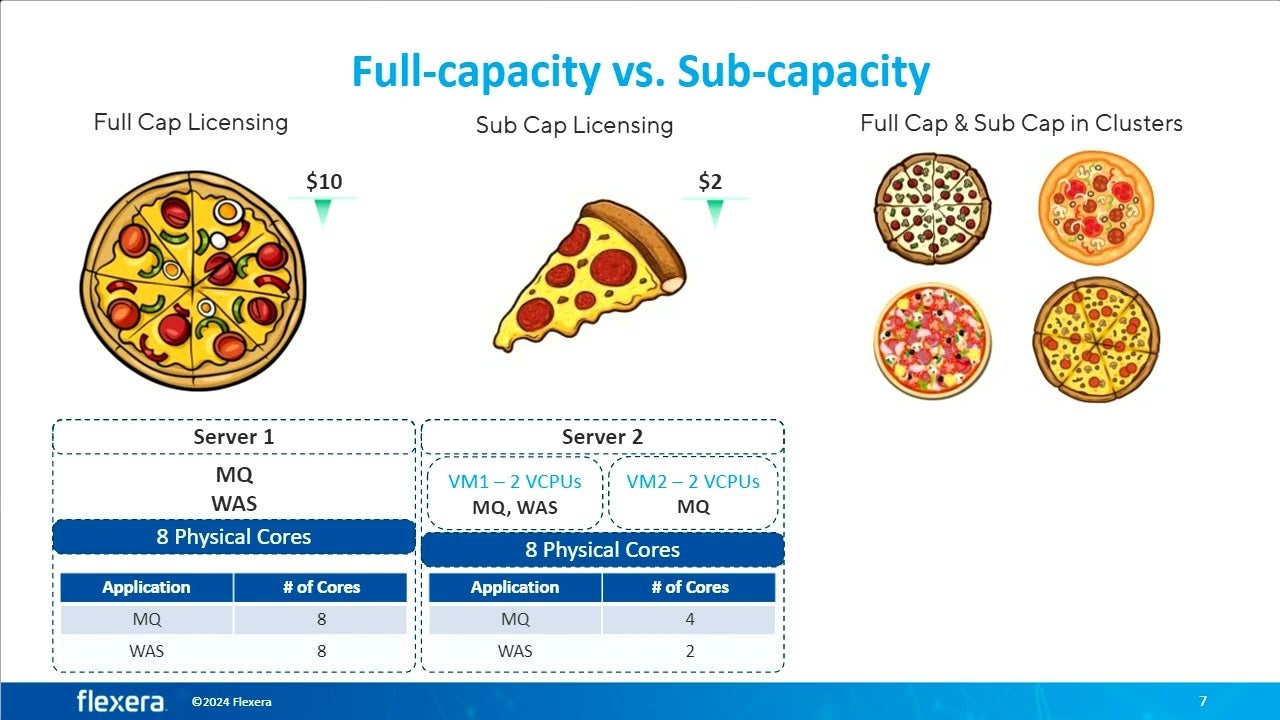
[06:00] Tyson Harrop: Full-capacity licensing requires organizations to license the entire physical capacity of a server, regardless of how much of that capacity the software actually uses.
Sub-capacity licensing, by contrast, allows organizations to license only the portion of server resources allocated to the software. This is especially valuable in virtualized environments, where workloads can be segmented across virtual machines or partitions.
Sub-capacity licensing enables:
- Lower licensing costs
- More efficient resource allocation
- Greater flexibility in virtualized and clustered environments
Without accurate measurement and reporting, organizations risk defaulting to full-capacity licensing, which can significantly increase costs.
[09:30] How IBM container licensing and Cloud Paks work
[09:30] Shaun Padayachee: IBM container licensing builds on sub-capacity principles by enabling licensing based on fractional core usage rather than whole cores. In containerized environments, software can consume partial CPU resources, allowing organizations to license smaller units of capacity aligned with actual usage.
IBM container licensing relies on IBM License Service (ILS), which runs within Kubernetes and identifies deployed software. This data integrates with Flexera to support compliance reporting and container-level license calculations.
IBM Cloud Paks further simplify licensing by bundling multiple IBM products under a single SKU, measured using the VPC metric. Cloud Paks enable:
- License reharvesting across eligible products
- Simplified purchasing and renewals
- Support for containerized platforms such as Kubernetes and Red Hat OpenShift
- More efficient transitions from traditional PVU-based licensing
Flexera applies Cloud Pak ratios automatically, helping organizations manage complex licensing models accurately and at scale.
[20:19] How Flexera supports IBM software licensing compliance
[20:19] Phil Perfetti: Flexera helps organizations establish accurate IBM license positions across full-capacity, sub-capacity, container, and Cloud Pak environments.
Flexera is the only certified alternative to IBM License Metric Tool (ILMT). Organizations must use either ILMT or Flexera to qualify for IBM sub-capacity and container licensing. Without one of these tools, IBM licensing defaults to full-capacity calculations.
With Flexera, organizations can:
- Manage IBM licensing from a single, SaaS-based platform
- Support ILMT, IBM License Service, and Cloud Paks without multiple tools
- Automate license calculations and entitlement management
- Reduce audit risk and unexpected true-ups
Flexera is trusted by IBM as a system of record, helping organizations maintain compliance while optimizing software spend.
[25:30] How Anglepoint helps organizations manage IBM licensing and audits
[25:30] Jerry Nelson: Anglepoint provides advisory and managed services that complement Flexera’s tooling with deep IBM licensing expertise.
Organizations partner with Anglepoint to:
- Prepare for IBM audits and ELA renewals
- Improve license compliance and reporting accuracy
- Establish a single source of truth for IBM usage data
- Reduce audit exposure and negotiation risk
Anglepoint also participates in IBM’s IASP program, which helps qualifying organizations optimize licensing and avoid audits when enrolled. This combination of tooling and expert guidance helps organizations manage IBM software with greater confidence and control.
[33:22] IBM-specific customer challenges Anglepoint helps solve
[33:22] Jerry Nelson: Circling back to the context of today’s webinar, the types of IBM-related challenges we help customers with include:
- Rightsizing IBM licenses
- Mitigating audit risk
- Preparing for ELA renewals
- Addressing inventory challenges
- Improving the quality of compliance reporting
- Replacing or supplementing ILMT with a more scalable approach
- Producing an accurate baseline that matches entitlements
One common issue is questionable inventory. ILMT is a free offering from IBM, but it can create administrative burden and the inventory is not always as reliable or as easy to manage as organizations need.
What we can do is help you get to a single source of truth so that when it comes time to provide reports back to IBM or other publishers, you have more confidence in the data.
A lot of organizations also come to us six to twelve months before an ELA renewal so we can help them enter negotiations from a stronger position.
We can also perform ILMT health checks, support migrations to Flexera One and help customers choose between the full Flexera One ITAM platform and the Flexera One Select for IBM option.
Even when tooling is limited, Anglepoint can bring a human layer of expertise to the process. Tools are very valuable, but expert interpretation is still essential when you are trying to establish an accurate IBM effective license position.
The benefits to your organization include:
- better access to software usage data and trends
- improved rightsizing and cost control
- elimination of shelfware
- stronger support for Cloud Pak transitions
- guidance on future IBM products and licensing models
- reduced risk and stronger compliance posture
Another strong point for Anglepoint is IBM’s IASP program. This is a program IBM offers to help customers rightsize and better understand how they buy IBM products.
Only four organizations are currently able to enroll customers in IASP, and Anglepoint is one of them, alongside Deloitte, KPMG and Ernst & Young.
Many customers prefer Anglepoint because we are not an audit firm. We are more neutral in that sense.
One requirement of IASP is that you be under an IBM managed service with one of those organizations. The major advantage is that if you are enrolled in IASP, IBM will not audit you. It also supports sub-capacity licensing and can help improve the overall commercial relationship with IBM.
With a managed service provider like Anglepoint acting as an intermediary, the compliance and reporting burden becomes much easier to manage.
We’ve covered a lot of IBM-focused content today. We’d be very happy to continue the conversation, and just like Flexera, Anglepoint can also transact through IBM if needed.
I’ll pass it back to Phil.
[41:00] Flexera Technology Intelligence Summit
[41:00] Phil Perfetti: I want to mention the Technology Intelligence Summit coming up next month. It will be held on April 9 for the Americas and April 11 for Europe.
We’ll be discussing how FinOps is expanding beyond just what’s happening in the cloud and how ITAM is becoming more complex with software in containers, software as a service and different cloud assets.
The goal of the summit is to help organizations understand how these disciplines are starting to intersect and how teams need to collaborate to get a full picture of the IT estate.
You’ll hear from partners, analysts and customers.
Let’s get started
Our team is standing by to discuss your requirements and deliver a demo of our industry-leading platform.