Webinar
Demystifying Microsoft licensing: Cut costs, reduce risk and prepare for audits
Reduce Microsoft licensing costs and audit risk with proven optimization tactics, agreement insights and governance steps you can apply immediately before renewals.
Overview
Watch to learn how to identify audit triggers, build audit readiness fast and cut Microsoft spend through rightsizing M365, BYOL in Azure and smarter agreements. Get practical guidance on data sources, governance for AI and consumption and negotiation tactics that improve compliance and renewal leverage.
Recap: Microsoft licensing optimization and audit readiness
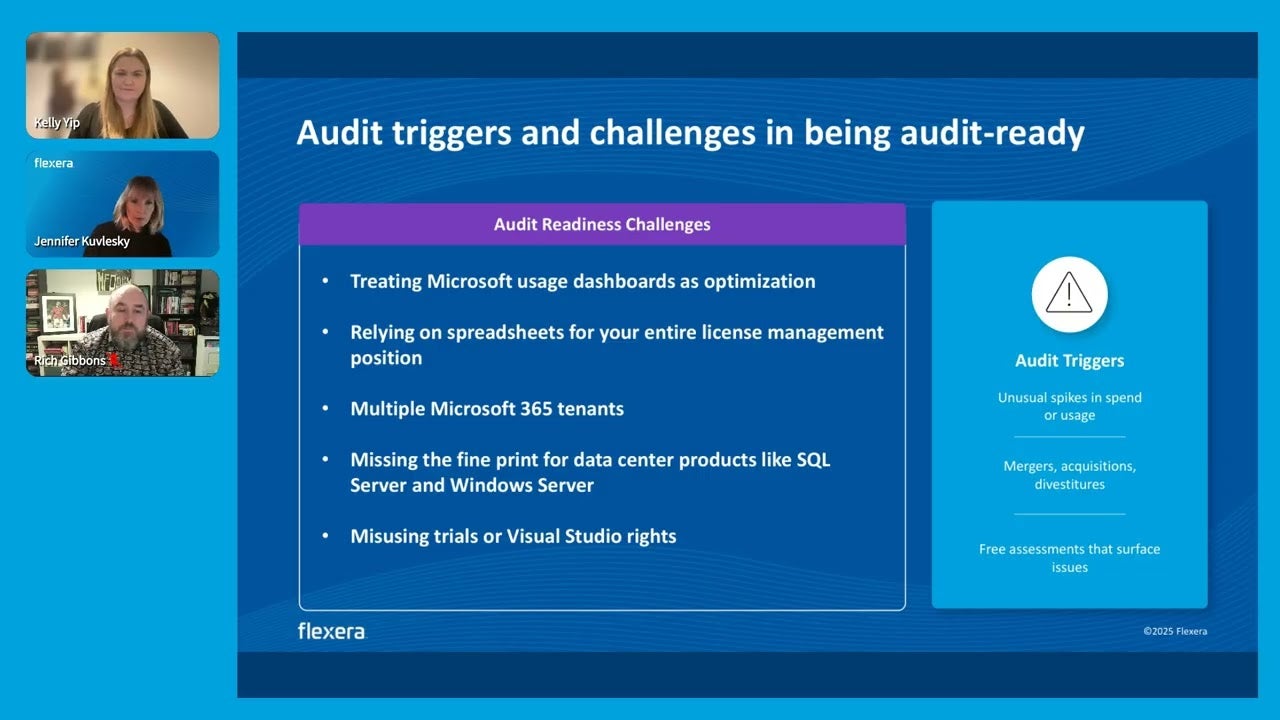
Microsoft audit triggers and audit readiness
- Cross-team alignment determines whether licensing decisions reduce cost—or create new compliance and architecture risk
- SAM foundation: reconcile what you bought (and use rights) with what you actually deploy and consume
- Vendor change increases complexity as agreements shift, discounts disappear, bundles expand and consumption/credit billing grows
- Operational controls keep savings from resetting into overspend after a one-time optimization effort
- ACTION: Build a cadence with ITAM, FinOps and cloud/technical owners to review licensing impact before renewals, migrations and upgrades
- ACTION: Keep it current with a living entitlement-to-usage view using portals and tooling—not spreadsheets alone
Audit triggers and audit readiness data
- Audit triggers often follow measurable change: spend/usage spikes, major M&A, or “free assessments” that surface overuse
- Portal blind spots happen when optimization requires correlating exports across multiple admin centers and specialized portals
- Dashboards mislead: adoption views don’t reliably prove license-level underuse without deeper validation
- Fine-print risk lives in use rights (cloud/virtualization), core-based licensing, Visual Studio trials/entitlements and SQL Server DR configuration choices
- ACTION: Flag trigger events—spend changes, usage spikes, M&A, vendor assessments—and immediately validate entitlement, deployment and contracts
- ACTION: Audit data inputs by inventorying required exports and integrations across Microsoft portals and reducing spreadsheet dependency
- ACTION: Validate licensing inputs with technical owners by reviewing use rights, trials and SQL Server configuration assumptions
Speakers

Kelly Yip
ITAM Thought Leader and Advisor
ITAM Forum

Jennifer Kuvlesky
Director of Product Marketing
Flexera

Rich Gibbons
Head of Microsoft Intelligence
Synyega
Know your contract and the associated levers for optimization
- EA tradeoffs: price protection and enterprise-wide management, but weaker discount dynamics for cloud services
- CSP/MCAE tradeoffs: more flexibility and “pay for what you use,” but often less leverage for special terms and negotiated discounts
- Rights vary by agreement (software assurance/equivalent rights), including mobility constraints such as cloud portability
- Stakeholder impact differs, so ITAM and FinOps should evaluate agreement changes together—not through a billing-only lens
- ACTION: Map constraints across agreement types, renewal terms, discount exposure, software assurance needs and cloud portability requirements
- ACTION: Align before switching to CSP/MCAE—operationally and commercially—and identify where special terms are needed to preserve critical rights
Cost optimization levers for Microsoft 365, Azure, SQL Server and Dynamics 365
- Joiner/leaver controls prevent recurring waste by keeping provisioning and deprovisioning aligned with workforce change
- Rightsizing nuance: user profiles, security and compliance needs can block simple bundle downgrades and add overhead
- BYOL savings are highest for steady Azure workloads when pay-as-you-go licensing is used despite owned entitlements
- Hidden spend shows up in add-ons and adjacent products (Project/Visio), Dynamics edition choices and SQL Server upgrades that shift Standard vs. Enterprise viability
- ACTION: Standardize workflows for joiner/leaver provisioning and set an ongoing optimization cadence so savings stick
- ACTION: Validate BYOL for Azure workloads by confirming eligibility and required evidence
- ACTION: Reduce cloud waste with FinOps by addressing idle and overprovisioned resources and applying reservations/savings plans where relevant
- ACTION: Recheck SQL + Dynamics at upgrades and renewals so edition choices and use rights match the new architecture
AI licensing governance for Copilot credits and agents
- AI licensing shifts quickly as Copilot/agent constructs evolve, credits emerge and plan boundaries stay unclear
- Credits change costs: end-user behavior becomes a spend driver, so usage visibility and guardrails matter
- Agents add risk because non-human actors can consume credits through actions like joining meetings and sending emails
- Bundling pressure increases lock-in when suites expand and you can’t selectively license only what you use
- ACTION: Set AI guardrails for allowed use, expected behaviors and controls for credit-based consumption, including agent scenarios
- ACTION: Track sprawl + changes so adoption, budgeting and governance keep pace with new AI tools and shifting licensing models
Frequently Asked Questions
An audit is a contractual verification of entitlements vs deployment and use. A true-up is a periodic reporting and purchase adjustment, often annual in EAs. Audits can be triggered by change events and require evidentiary data.
It is matching what you purchased and the product use rights to what is actually deployed and consumed. It requires normalized inventory, user/workload mapping, and contract terms. The output is a defensible compliance position and optimization insights.
Flexera automates data collection and normalization so reports don’t go stale after a point-in-time project. It supports repeatable reconciliation cycles and consistent evidence. That improves defensibility during audits and accelerates savings identification.
Segment users by role and compliance/security requirements before downgrading bundles. Validate whether features like security or compliance are embedded in higher tiers. Pilot changes with a rollback plan and measure impact over 30–60 days.
Flexera can assist with tracking consumption-driven cost drivers and identifying tool sprawl as models change. It supports policy-driven controls and reporting for autonomous agent usage. Review credit consumption trends monthly and adjust guardrails quickly.
You usually need contract/price sheets, product use rights, and admin portal exports across Microsoft’s fragmented centers. Combine these with inventory, user identity, and usage data. Validate dashboards because adoption views don’t prove license-level underuse. Flexera helps correlate data across multiple admin centers and sources into one user or workload picture.
Standardize provisioning and deprovisioning workflows with clear ownership and SLAs. Reclaim licenses quickly after departures and validate role-based bundles at onboarding. Automate where possible and review exceptions weekly or biweekly. Flexera can surface underused licenses and support reclaim actions tied to joiner/leaver processes.
Bring Your Own License applies existing eligible licenses to Azure workloads instead of paying embedded licensing repeatedly. It is most valuable for steady workloads (a few weeks to months) or where pay-as-you-go licensing persists despite owned rights. Flexera can connect cloud resource usage with licensing eligibility to flag where BYOL could apply.
Flexera can highlight usage decay and overlapping entitlements across adjacent products. That makes it easier to target high-cost add-ons and edition choices for change. Use findings to build a prioritized optimization backlog before renewals.
Flexera can provide shared views and workflows that align cost optimization with product use rights. It supports joint review cadences and tracks decisions that affect compliance. This prevents a FinOps-only “billing” view from missing licensing constraints.
Let’s get started
Our team is standing by to discuss your requirements and deliver a demo of our industry-leading platform.