

Key takeaways
- Cloud spending has skyrocketed over the past five years, with 76% of large enterprises spend more than $5 million monthly on the cloud. This makes financial accountability and governance more important than ever
- Cloud waste remains stubbornly high (29% estimated wasted spend), driven by growing complexity across hybrid cloud, SaaS and AI environments
- Leading organizations are shifting from cloud cost management to cloud value management, focusing on business outcomes alongside optimization
From 2021 to 2026, cloud spending scaled dramatically—but waste remained, complexity intensified and organizations shifted to business value
In 2021, cloud was still defined by acceleration. Organizations were adopting multi-cloud strategies, moving more workloads and data into public cloud environments and prioritizing cost optimization as usage grew. According to the Flexera 2021 State of the Cloud Report, 36% of enterprises were already spending more than $1 million monthly on public cloud, and 61% of organizations planned to optimize cloud costs, making it the top cloud initiative for the fifth year in a row at the time.
Five years later, the majority of respondents (68%) still rank optimizing cloud costs at the top of their priority list, far surpassing other priorities, but the conversation has evolved. The Flexera 2026 State of the Cloud Report shows cloud entering a new phase—one defined by value, governance and conquering complexity, with GenAI accelerating, hybrid cloud remaining dominant and CCOEs and FinOps teams expanding their reach. Cloud cost management is no longer just about reducing waste after the fact. It’s about building the visibility, accountability and governance needed to connect cloud investments to business outcomes.
Cloud spending entered a new league
Cloud spending isn’t just a significant IT line item; it’s a major business investment. In 2021, public cloud spend was already growing quickly: 31% of respondents spent at least $12 million annually, and 36% of enterprises exceeded $12 million annually—more than $1 million per month—on public cloud.
By 2026, the scale of cloud investment had expanded dramatically. The latest report finds that 76% of large enterprises spend more than $5 million per month on cloud, while the top public cloud spending tiers increased overall, signaling continued movement toward higher cloud expenditures. Findings from the 2026 report survey also show that spending continues to rise as more workloads are migrated to, or born in, the cloud.
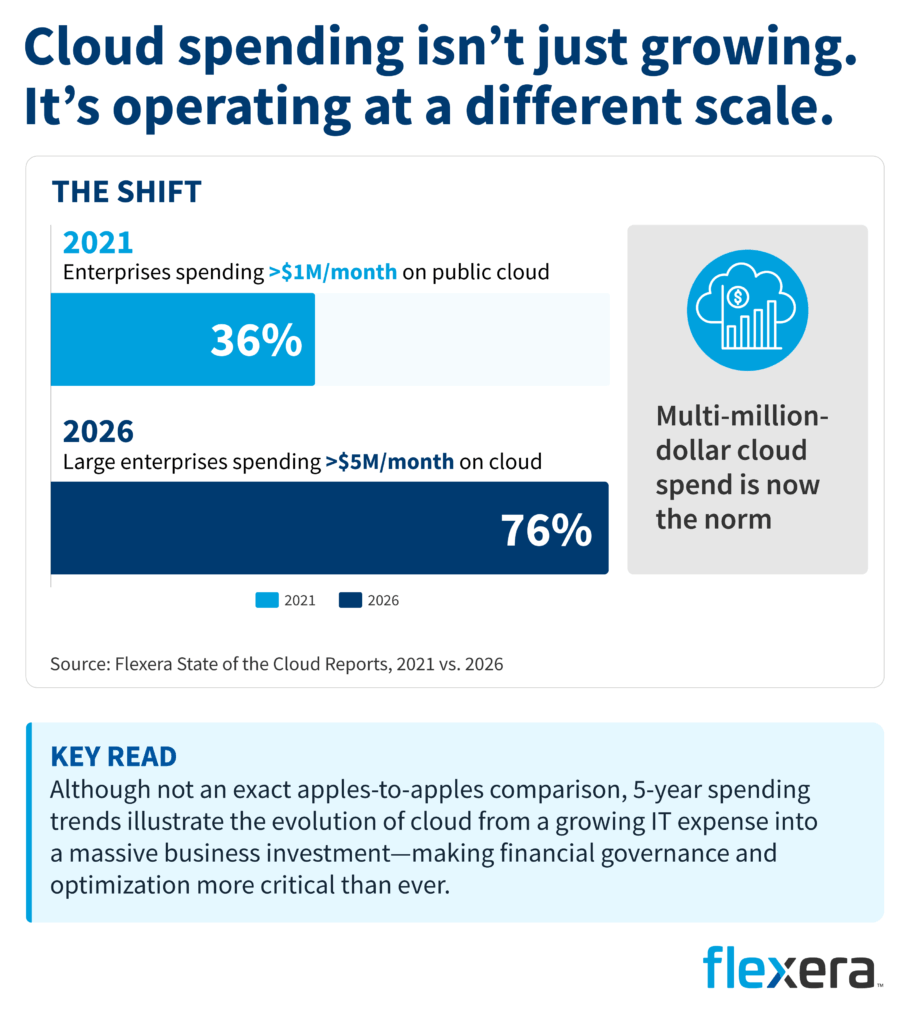
This isn’t meant to be an exact apples-to-apples comparison; the audience segments and spend thresholds differ, but a clear trend has emerged. Cloud budgets have become materially larger, and the margin for inefficiency has become more expensive.
Waste didn’t go away—it scaled
Despite growing maturity, cloud waste has remained stubborn. Five years ago, respondents estimated that 30% of cloud spend was wasted and public cloud spend was over budget by an average of 24% with expected cloud spend growth of 39% over the following year.
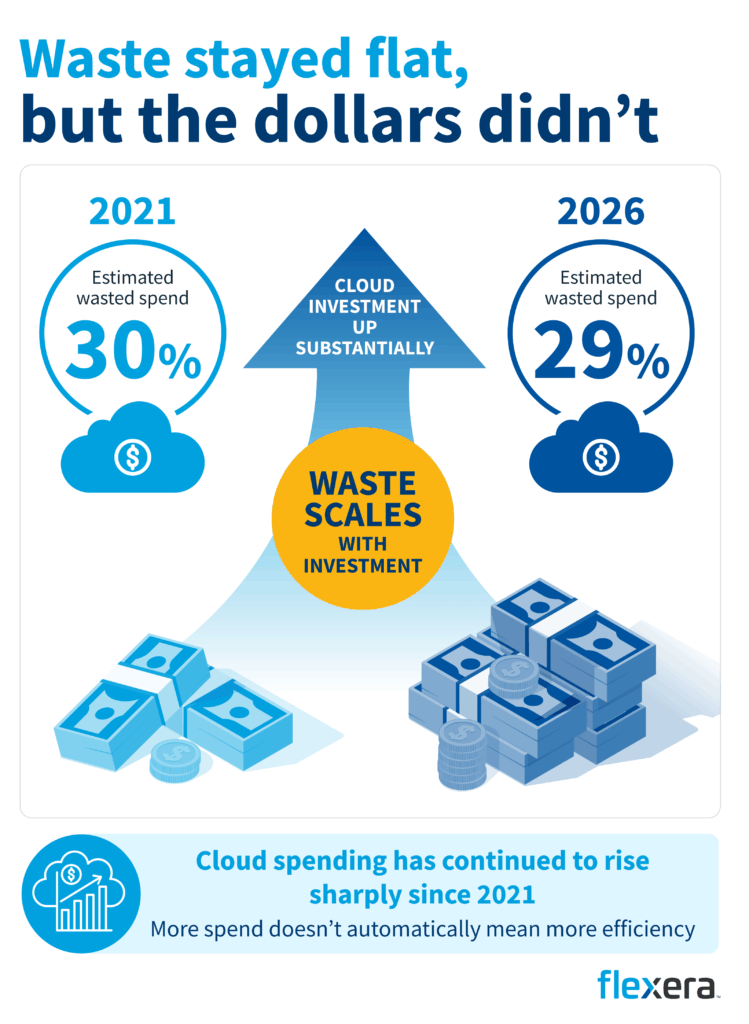
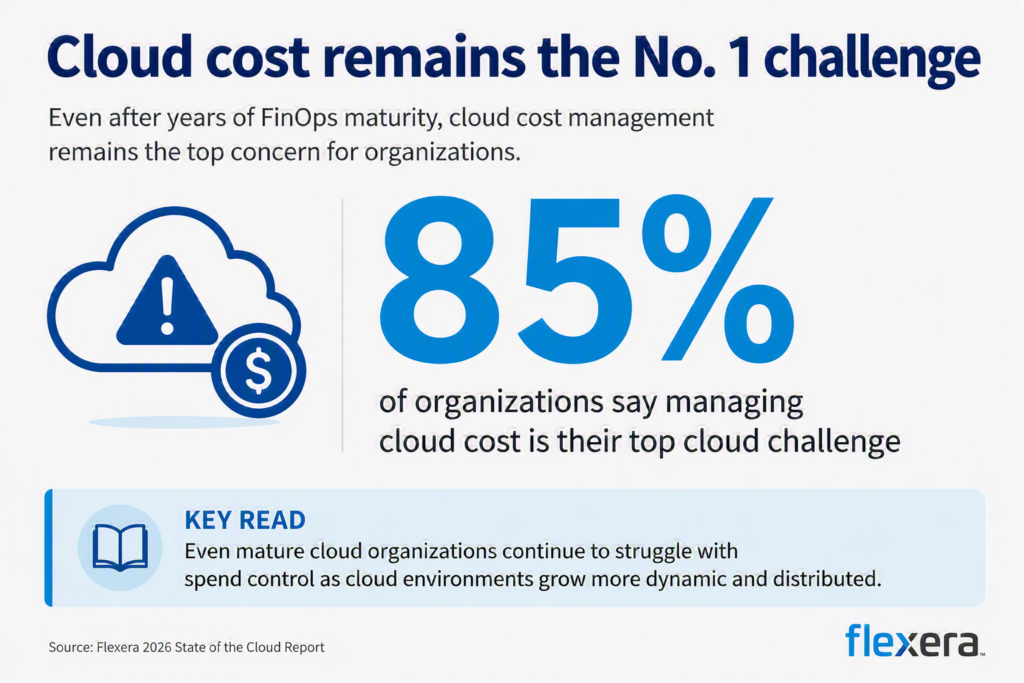
But these days, waste is still a central challenge. The 2026 report finds that estimated wasted cloud spend on IaaS and PaaS is 29%, reversing a five-year downward trend and reflecting added cost complexity from AI and new PaaS/SaaS offerings. At the same time, 85% of respondents say managing cloud costs is their top challenge, ahead of security at 82% and managing software licenses at 78%.
Organizations have become better at recognizing the problem, but the problem itself has changed. Waste is no longer just a byproduct of rapid migration. It’s now tied to increasingly complex service models, decentralized ownership, evolving pricing structures and the accelerating use of AI.
Why cloud cost management is getting harder
The persistence of cloud waste isn’t a sign that organizations have failed to mature. It reflects the fact that cloud environments have become more complex. In 2021, multi-cloud was already the dominant enterprise strategy: 92% of enterprises had a multi-cloud strategy, and 80% were using a hybrid cloud strategy. Applications were often siloed on different clouds, with nearly half of respondents using that type of multi-cloud implementation. These multi-cloud architectures were more complex and challenging to manage.
By 2026, hybrid cloud remains dominant, with 73% of organizations operating hybrid estates, and multi-cloud adoption continues to rise. But the 2026 report adds a sharper layer of nuance: complexity is now compounded by simultaneous migration and repatriation, SaaS proliferation and the rapid adoption of AI. Findings from the 2026 report show that both cloud-based workloads and cloud-based data repatriation increased by 2 percentage points year over year, suggesting organizations are placing workloads where they make the most sense to run.
When it comes to SaaS, 8% of respondents aren’t tracking the associated costs, up from 5% the prior year. This opens the door to shadow IT and visibility problems as SaaS proliferates. SaaS spending itself is also growing: the largest share of respondents now report monthly SaaS spend between $200,001 and $500,000, while spending in the top five SaaS tiers climbed by 9% overall.
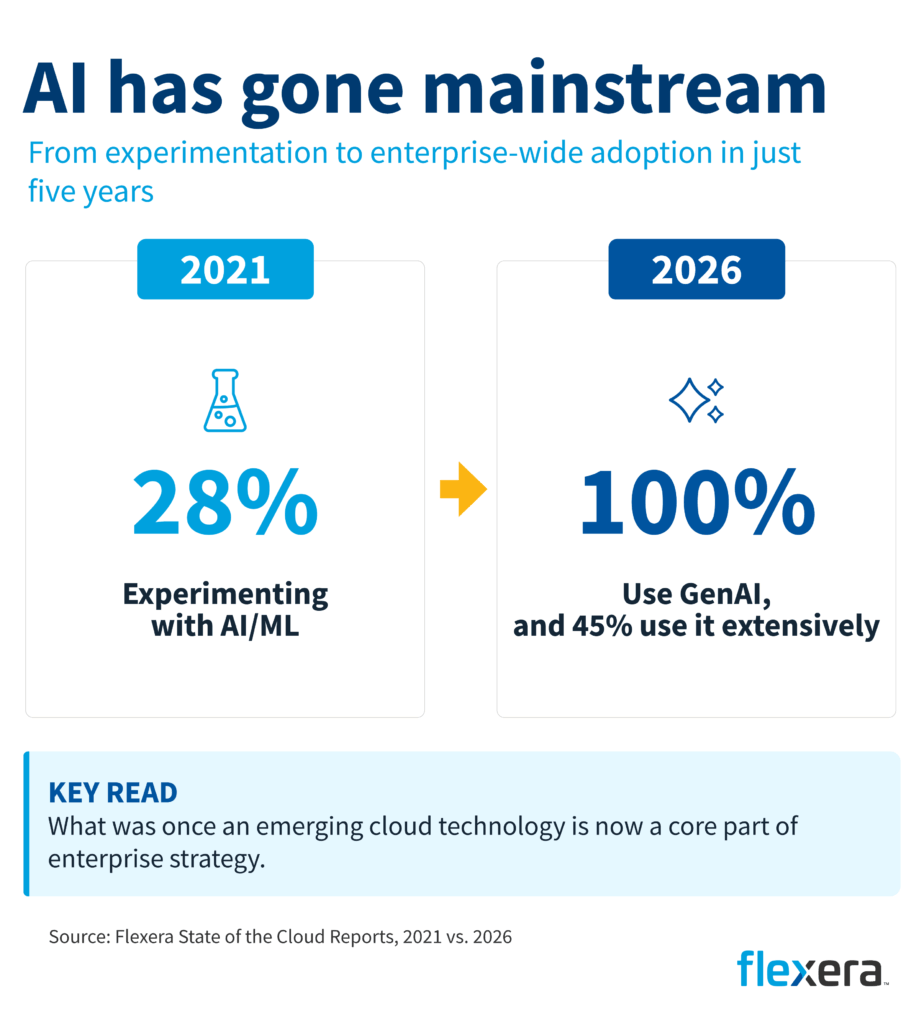
And if that weren’t enough, just add AI into the mix. In 2021, artificial intelligence (AI) and machine learning (ML) were still emerging in the cloud, with 28% of enterprises experimenting with AI/ML, more than any other PaaS service. Fast forward to 2026, GenAI has become mainstream: All survey respondents report using GenAI in some capacity, 45% use it extensively, and current GenAI public cloud service usage rose from 50% to 58%.
That growth creates new governance and cost challenges. Cloud-based AI services are notably more expensive than traditional options, and SaaS and PaaS vendors frequently use different pricing structures than IaaS providers. These factors contribute to growing complexity, despite 63% of organizations having implemented FinOps practices. AI usage also makes forecasting difficult, rightsizing AI resources requires balancing cost and performance, and new pricing metrics make cost visibility and optimization challenging.
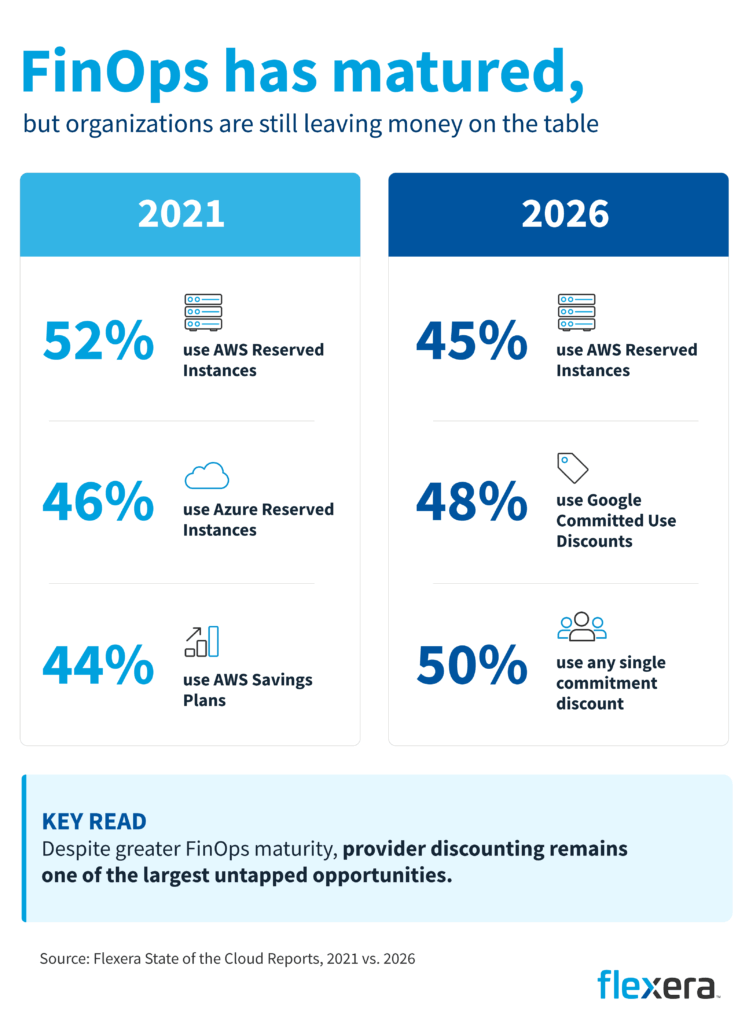
Finally, provider discounting remains underused. In 2021, organizations weren’t taking advantage of all available cloud provider discounts, including reserved instances and savings plans. In 2026, the pattern persists: Fewer than half of organizations are utilizing any one commitment discount per cloud provider, while more than half continue using on-demand pricing.
Taken together, the “why” behind persistent waste isn’t one issue—it’s the convergence of many. Hybrid and multi-cloud complexity, SaaS growth, AI adoption, variable pricing, forecasting difficulty, underused discounts and distributed ownership all play a role.
Measuring cloud success is shifting from savings to value
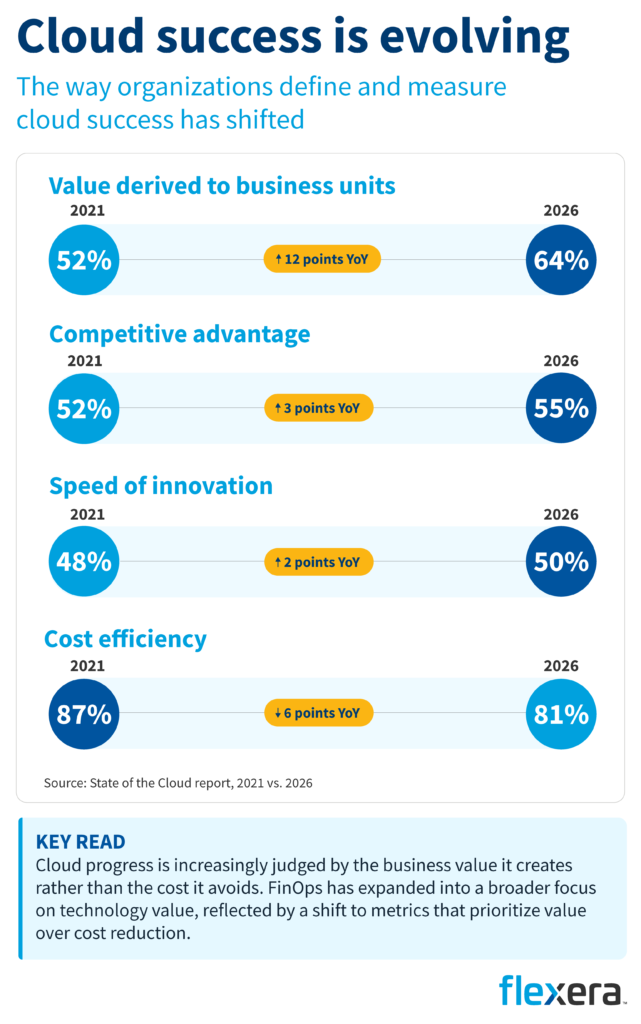
Cloud success used to be heavily tied to cost efficiency. In 2021, 76% of organizations used cost efficiency and savings to measure cloud progress, and the top three progress metrics were cost efficiency and savings, delivery speed of products and services, and cost avoidance.
But by 2026, that picture has changed. Cost efficiency still matters, but current report data shows a clear pivot toward business outcomes, with 64% of organizations relying on value delivered to business units to measure progress against cloud objectives, up 12 percentage points year over year. Cost efficiency and savings dropped by 6 points year over year. This illustrates growing FinOps maturity and a shift toward metrics that prioritize value over cost reduction.
This doesn’t mean cost optimization is less important. In fact, the 2026 report shows 68% of organizations still rank optimizing cloud costs as their top initiative, followed by migrating more workloads to cloud and improving financial reporting. What has changed is the purpose of optimization. The goal is no longer simply to spend less—it’s to spend more deliberately and explain what the business receives in return.
That shift is also visible in governance structures. In 2021, 75% of organizations had a central cloud team (CCOE) tasked with providing controls, tools and best practices to accelerate adoption while reducing cost and risk. Since then, FinOps as a formal practice has rapidly taken off, becoming an essential discipline for enterprises managing unpredictable, consumption-based cloud bills. Report findings from 2026 show that now 71% of organizations have a CCOE or similar, and 63% rely on a FinOps team to advise on, manage or execute cloud cost optimization strategies.
Responsibility is also broadening. The 2026 report shows FinOps teams’ responsibility for governing IaaS/PaaS usage and cost rose from 38% to 45% year over year, business unit involvement grew from 20% to 25% and SAM team participation expanded from 6% to 15%. This matters because cloud cost management increasingly spans infrastructure, software, SaaS, AI and business accountability—not just central IT.
Finally, this year’s findings also point to stronger unit economics. Nearly half of organizations are using unit metrics to understand cost per service and align spending with outcomes. That’s a powerful signal that cloud financial management is moving beyond retrospective reporting toward business-aligned decision-making.
Cloud cost management is becoming cloud value management
Taking a retrospective look over the past five years, it’s not just that cloud spend has increased; it’s that cloud cost management has become more strategic. Five years ago, enterprises were accelerating cloud adoption, managing rapid spend growth and prioritizing optimization as workloads moved into public cloud environments. Since then, the landscape—and associated challenges—has evolved. Cloud is now a larger, more complex and more business-critical environment shaped by hybrid architectures, SaaS growth, AI adoption and expanding governance models.
Organizations that succeed in this next era won’t be the ones that simply cut the most cost. They’ll be the ones that can see where spend is going, understand what value it creates, govern it across teams and continuously optimize as technology changes. In the value era of cloud, cost control is still essential, but it’s no longer the destination. It’s the foundation for better decisions, stronger accountability and measurable business outcomes.
Read the 2026 State of the Cloud Report
What is cloud cost management?
Cloud cost management is the practice of monitoring, governing and optimizing cloud spending to ensure organizations use cloud resources efficiently. Today’s cloud cost management extends beyond cost reduction to include visibility, accountability and aligning cloud investments with business outcomes.
Why is cloud cost management becoming more difficult?
Cloud cost management has become more challenging because organizations must manage hybrid and multi-cloud environments alongside growing SaaS portfolios and AI workloads. Variable pricing models, distributed ownership, workload migration and repatriation all add complexity to cloud financial management.
What causes cloud waste?
Cloud waste can result from overprovisioned resources, underutilized services, limited visibility into usage, forecasting challenges, decentralized purchasing and underused cloud provider discounts. As cloud environments grow more complex, organizations often find it harder to identify and eliminate unnecessary spending.
How does AI affect cloud costs?
AI workloads can significantly increase cloud costs because AI services often require more compute resources and use different pricing models than traditional cloud services. As AI adoption grows, organizations need stronger governance, forecasting and cost visibility practices to manage spending effectively.
What is cloud value management?
Cloud value management is an approach that measures cloud success based on business outcomes, not just cost savings. Organizations increasingly evaluate cloud investments based on the value delivered to business units, innovation outcomes and return on investment alongside traditional efficiency metrics.
What is FinOps and how does it help control cloud spending?
FinOps is a financial management discipline that helps organizations optimize cloud spending through collaboration between technology, finance and business teams. FinOps teams provide guidance, governance and accountability to help organizations manage cloud usage, costs and business value more effectively.
How can organizations reduce cloud waste and improve cloud ROI?
Organizations can improve cloud ROI by increasing visibility into spending, adopting governance practices, using provider discounts more effectively, measuring business value and aligning cloud investment decisions with organizational goals. Successful organizations focus on both optimization and outcomes.