As organizations scale across SaaS, public cloud and AI, ITAM teams are being asked to do more than track assets: They’re expected to restore visibility, prove value and govern environments that are growing faster than policy can keep up.
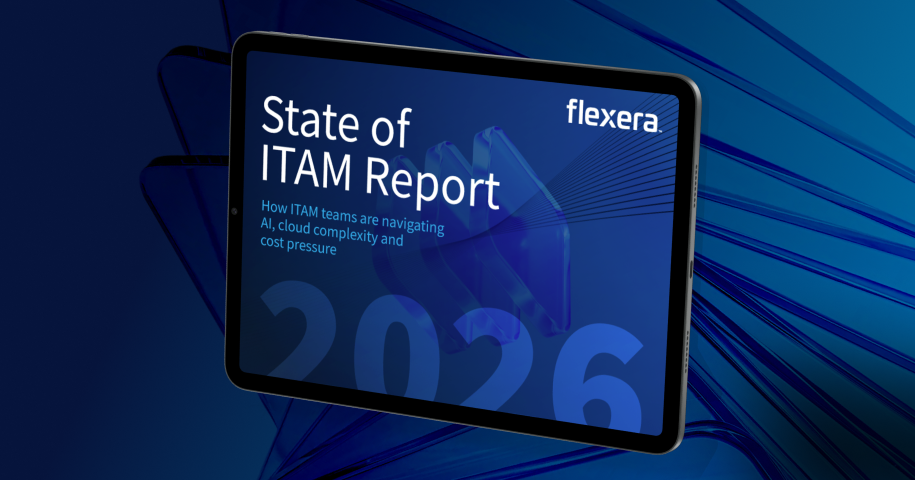
Based on a global survey of 512 professionals, Flexera’s 2026 State of ITAM Report shows clear progress. But complexity continues to outpace control.
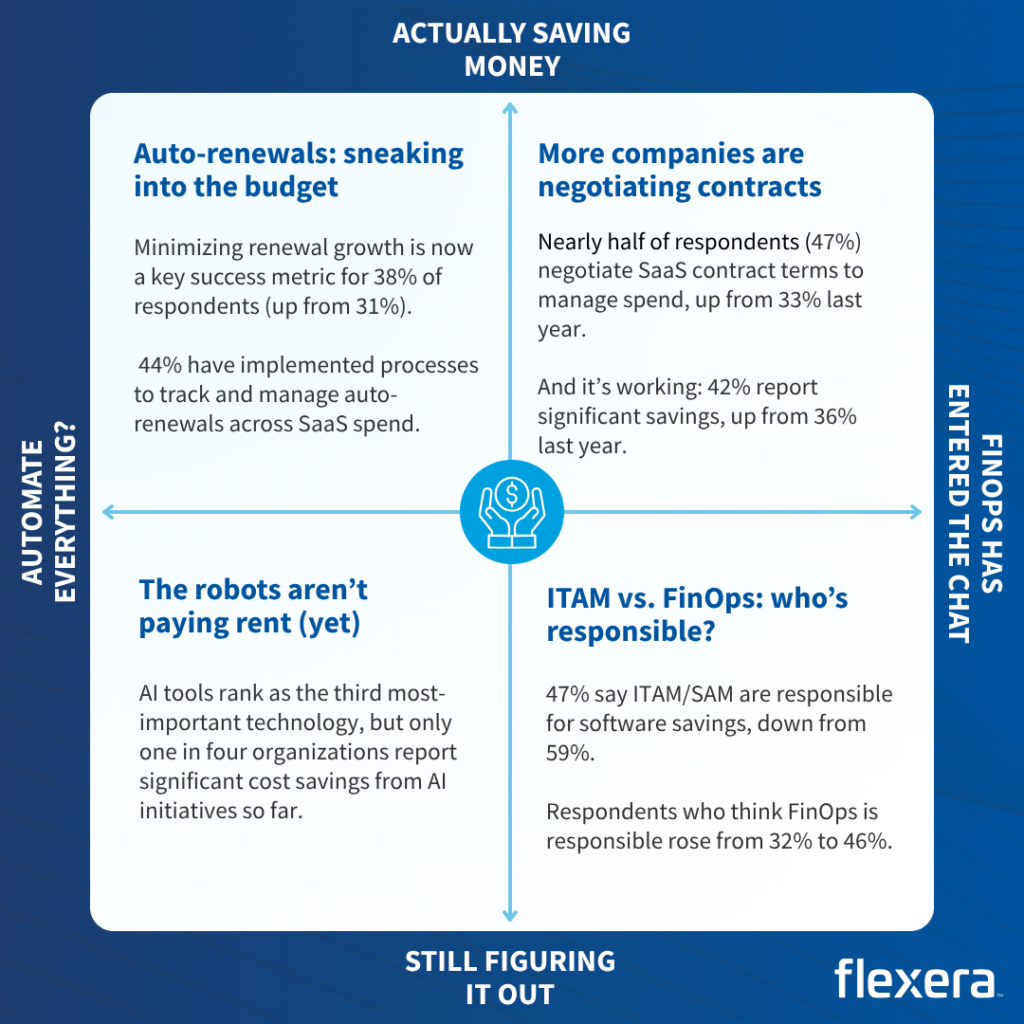
Highlights from this year’s State of ITAM report
Below, we break down the key findings through the lens of the questions IT leaders are asking most right now.
The visibility gap across cloud, SaaS and AI
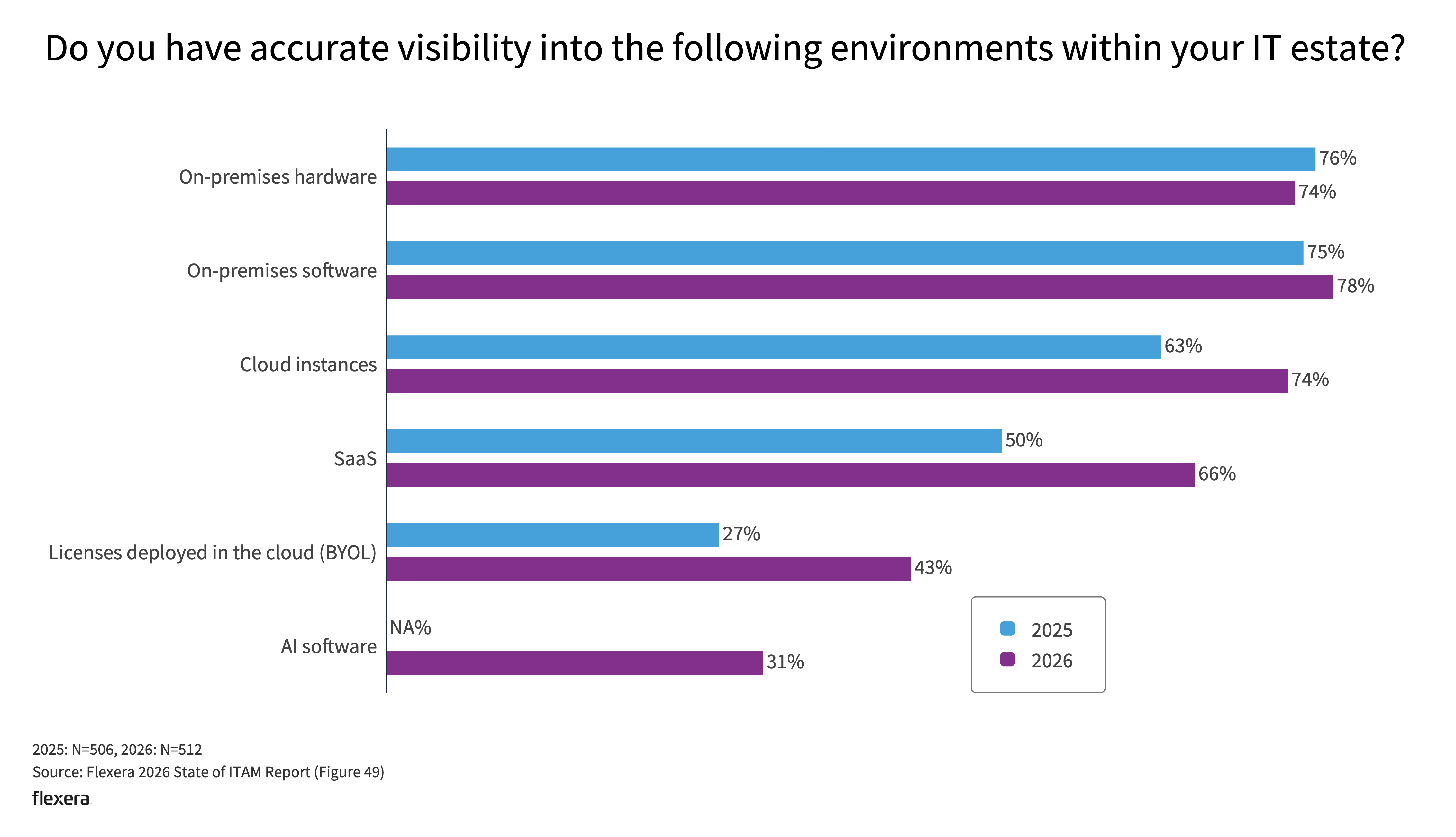
While visibility improves across cloud and SaaS environments, limited insight into AI highlights a new challenge for ITAM as organizations expand into emerging technologies
Visibility remains the biggest structural gap in modern ITAM.
- Only 31% of organizations report visibility into AI software
- Complete IT visibility has dropped to 36%, down from 43% in 2025
- Tracking or adopting AI applications is now the top combined challenge, cited by 84%
While visibility into on-premises, SaaS and cloud environments continues to improve, AI has created a new blind spot.
At the same time, ITAM’s scope is expanding:
- 75% manage cloud software licenses
- 64% manage SaaS licenses
- 51% support AI spend visibility
Takeaway
Visibility is no longer a tooling problem. It’s a scope problem. As asset types expand, ITAM teams need a single system of record that spans cloud, SaaS and AI.
The growing pressure to prove ROI on AI, cloud and SaaS
Optimization remains the clearest path to proving value. But AI is still catching up.
- Optimizing software spend is the number one SAM priority, leading all others by more than 19 percentage points
- ITAM teams spend the largest share of SAM time optimizing cloud and SaaS software
- Nearly one-third of total ITAM time is dedicated to software optimization
AI introduces a new challenge:
- AI tools aren’t yet producing strong savings outcomes
- Only 29% of organizations currently measure the value of AI software
Meanwhile, proven ROI drivers still dominate:
- License reuse generates significant savings for 43% of organizations
- Mature ITAM programs consistently deliver savings through reuse and negotiation
Takeaway
For most organizations, ROI comes from optimization, reuse and governance. AI investments are scaling fast, but value realizationhasn’t kept pace.
Escalating waste and audit exposure across the IT estate
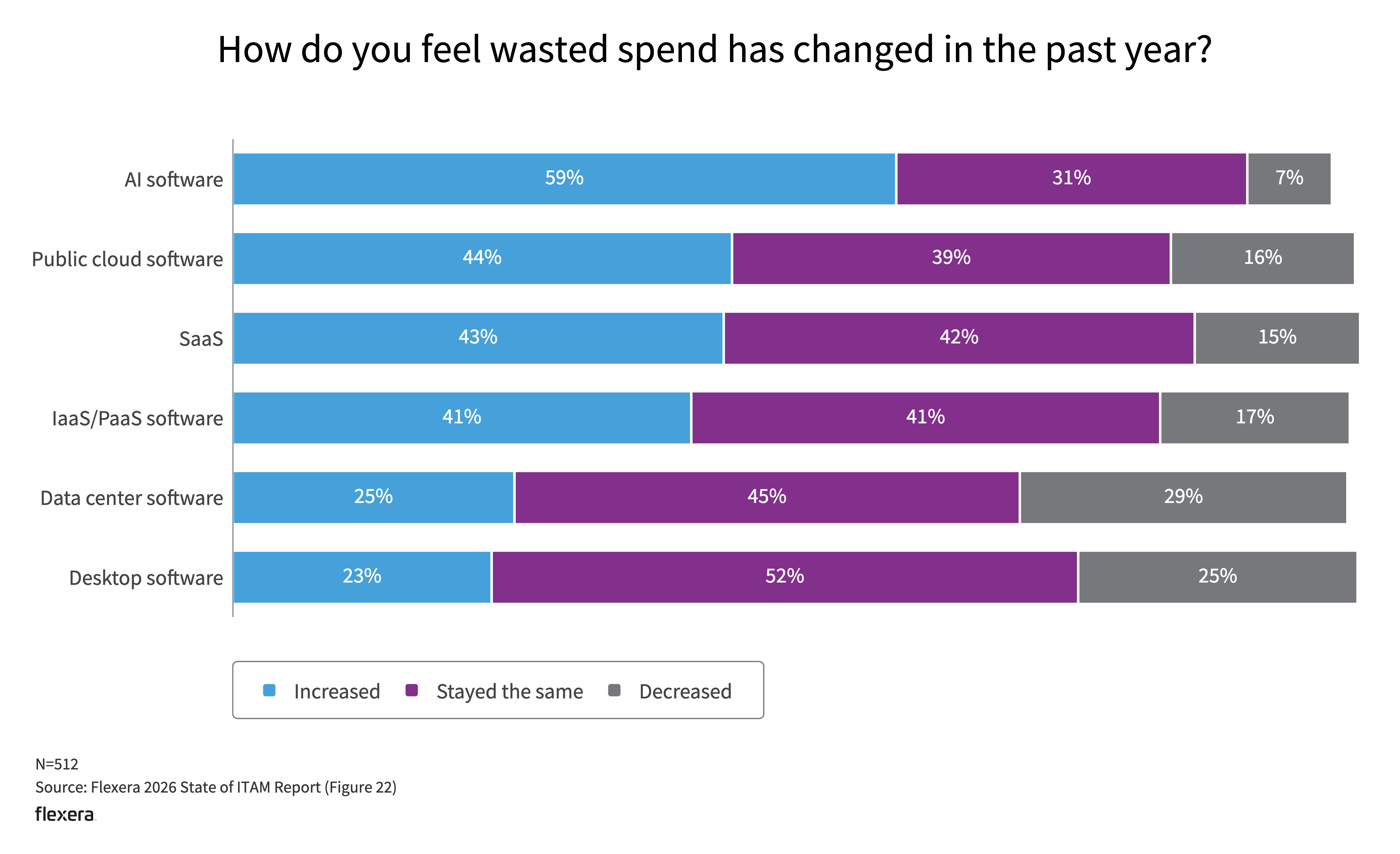
Wasted spend is rising fastest in AI, with the majority of organizations reporting increased inefficiencies as adoption accelerates
AI adoption is moving faster than governance frameworks can support.
- 59% of organizations report increased wasted AI spend
- Only 31% have visibility into AI software
- 48% are tracking and rightsizing AI contracts
- 45% are actively identifying unsanctioned AI usage
The challenge isn’t adoption. It’s an uncontrolled growth.
- AI tracking is the top planned responsibility for ITAM teams
- More than half of ITAM teams already support AI-related activities
Takeaway
Most organizations are reacting to AI risk instead of preventing it. ITAM is emerging as the control layer that brings structure, accountability and guardrails to AI experimentation.
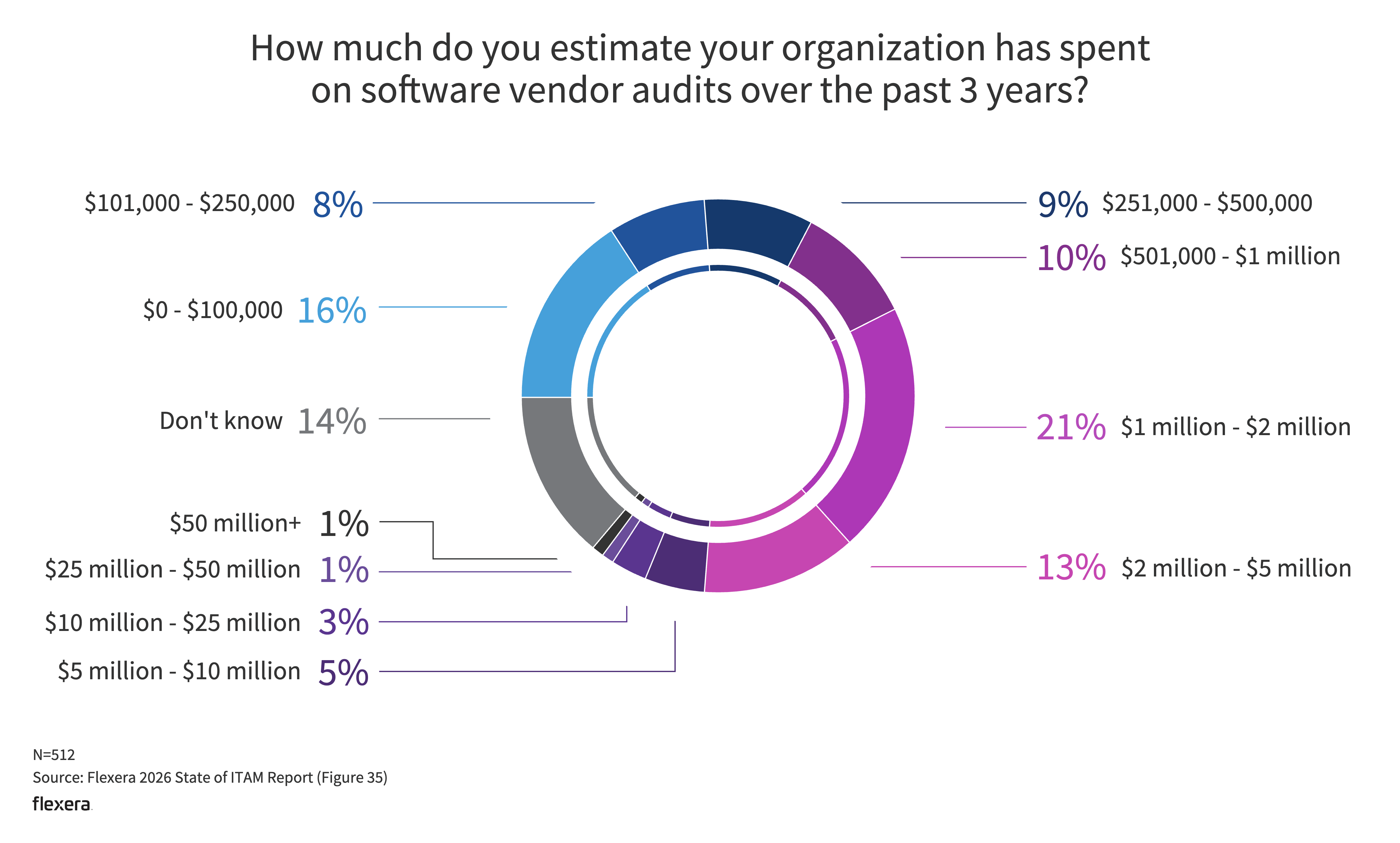
Software vendor audits are a significant cost burden, with many organizations spending $1 million or more over three years
Cost pressure and audit exposure remain persistent and expensive.
- 48% of organizations were audited in the past year
- 44% spent more than $1,000,000 on audits over the past three years
- 64% of audited organizations reported Microsoft audits
Takeaway
Audit risk and waste aren’t disappearing. They’re evolving alongside AI and SaaS complexity. Organizations that improve visibility and licence control stand to unlock the greatest financial gains.
Why SaaS management is harder than expected
SaaS sprawl, cost pressure and fragmented ownership continue to create challenges.
- Tracking SaaS and public cloud software keeps rising as a core ITAM responsibility
- SaaS wasted spend continues to increase year over year
- Negotiating SaaS contract terms jumped 14 percentage points compared to 2025
The root causes are clear:
- A growing number of applications
- Decentralized procurement
- Increasingly complex software use rights
Not surprisingly, 78% of ITAM teams say maintaining an accurate inventory is their top priority.
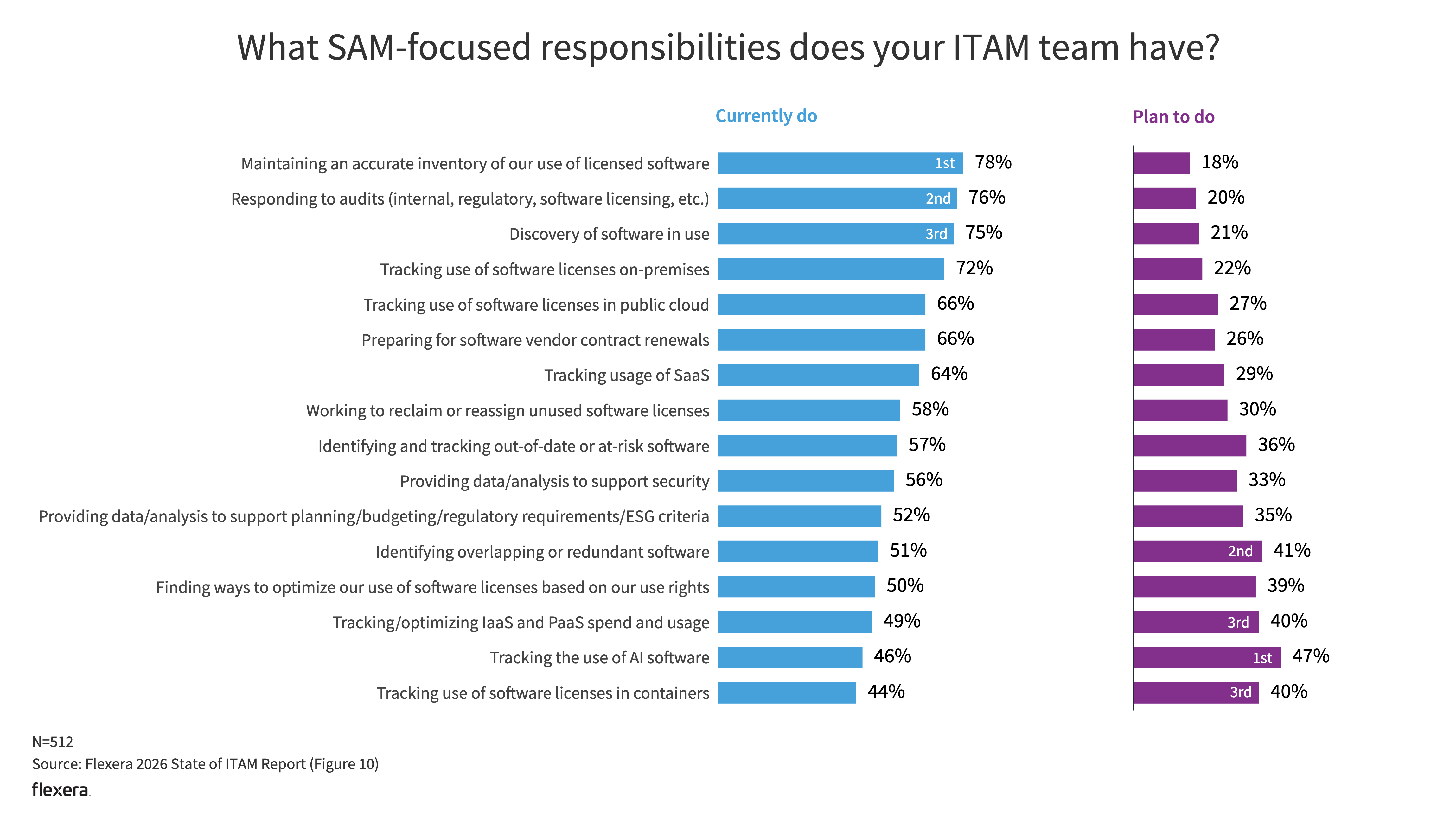
Maintaining an accurate software inventory is the top ITAM responsibility, with 78% of teams actively managing it—underscoring its critical role as the foundation for effective SAM
Takeaway
SaaS is difficult to manage because it’s fast-moving, fragmented and hard to normalize. Without strong inventory, discipline and governance, sprawl becomes unavoidable.
The bigger shift: ITAM is evolving from SAM and HAM
Across every trend, one theme stands out. ITAM is becoming a strategic control layer for cloud, SaaS and AI.
- 78% of organizations now have a FinOps team, and ITAM and FinOps responsibilities increasingly overlap
- Ownership of cloud optimization is nearly split between ITAM and FinOps
This convergence reflects a new operating model:
- ITAM owns visibility and governance
- FinOps owns financial accountability
- Together, they define how organizations can control technology spend at scale
Final takeaway
The findings in the report show real progress, but it also makes one thing clear: AI and SaaS expansion are moving faster than most organizations can govern. To do this, leading teams are focusing on three priorities:
- Unifying visibility across cloud, SaaS and AI
- Driving measurable ROI through optimization and reuse
- Closing governance gaps before they turn into financial or audit risk
Phil Perfetti
An accomplished IT Product Marketing Manager with experience at Device42, Lansweeper, and OVHcloud. Graduated from James Madison University - Go Dukes!