Flexera’s newly-released 2026 State of ITAM Report reveals a growing disconnect: Organizations are investing heavily in AI tools, yet many lack the visibility and governance needed to manage them effectively. This tension creates a new challenge, and IT leaders are asking themselves:
How do we govern AI usage without slowing innovation and limiting ROI?
Below, we break down the key AI-specific findings shaping enterprise ITAM strategies today.
AI adoption is accelerating—but only 31% of organizations report having visibility into AI software
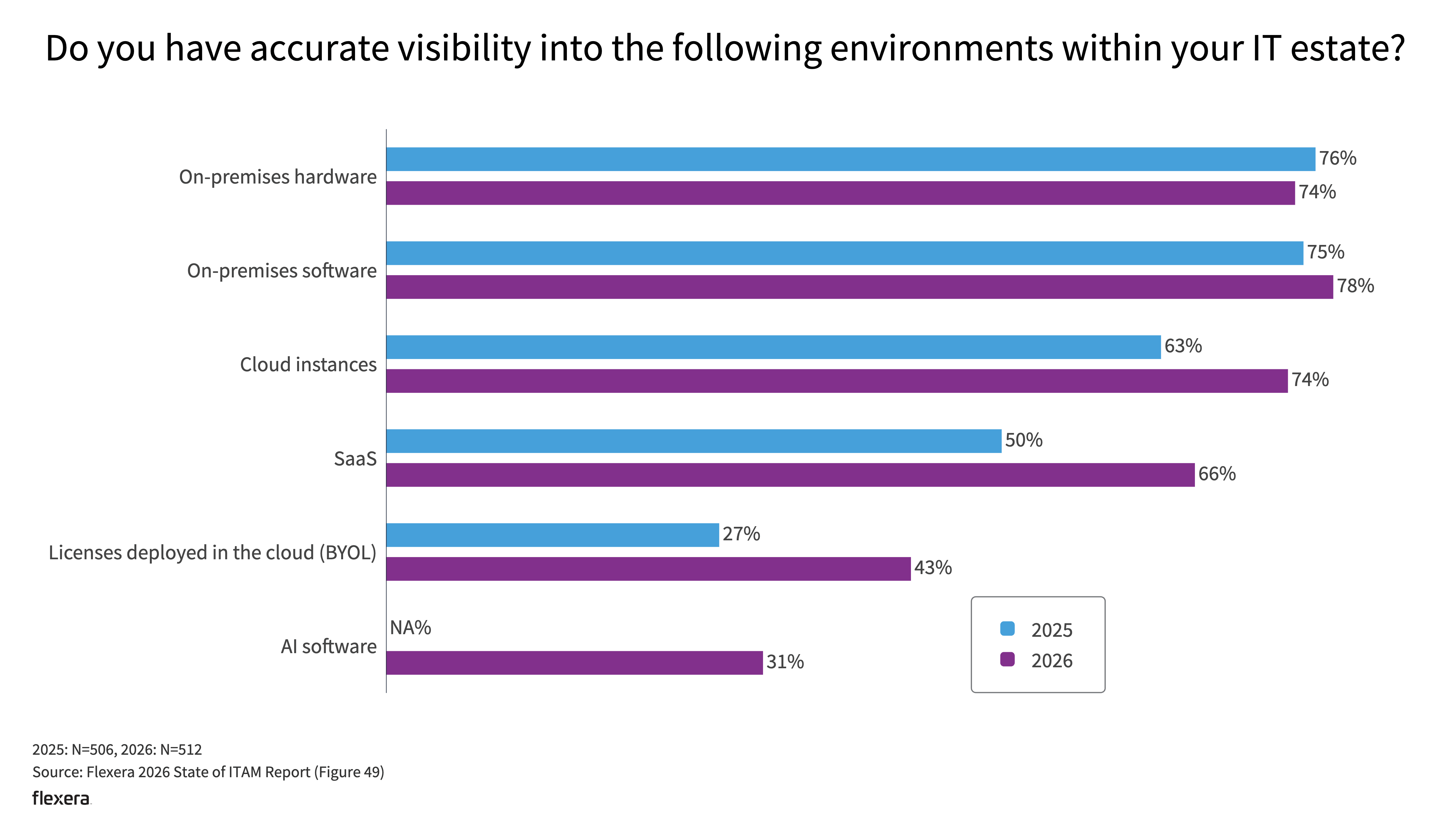
Only 31% of respondents report visibility into AI software
AI has rapidly moved from experimentation to a core part of the IT estate.
- AI tools have surged in importance, rising from 1.94 to 3.13 on a 5-point technology relevance scale in just one year
- 47% of organizations plan to significantly increase their focus on AI software
- Only 36% report complete visibility across their IT estate, a year-over-year decline
At the same time, 84% of respondents highlight AI tracking as a top challenge. AI is expanding faster than traditional asset management models can support. Without visibility into AI tools being used, organizations risk operating with blind spots across cost, usage and risk.
Only 32% of organizations track AI applications within their configuration management database (CMDB)
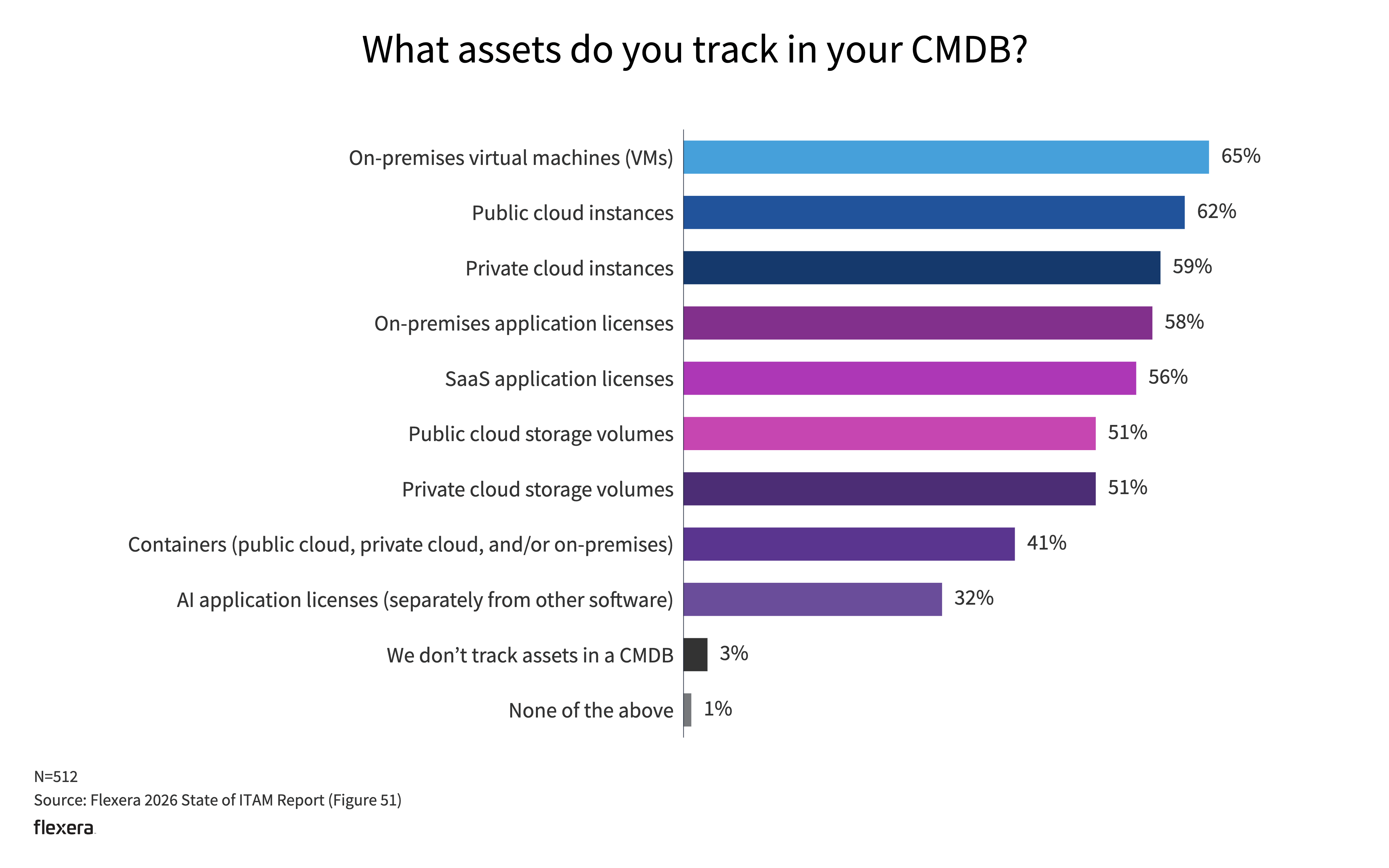
Organizations most commonly track infrastructure and application assets in their CMDB, while fewer track containers and AI licenses separately
AI governance is struggling to keep pace with adoption. As AI usage grows, governance gaps are becoming more visible.
- 45% are actively identifying unsanctioned or shadow AI usage
- 58% of SAM teams tracking AI report into cybersecurity teams, signaling a shift toward security-driven oversight
- AI tracking is now the top planned ITAM responsibility at 47%
AI governance today is largely reactive. Most organizations are trying to catch up with adoption rather than controlling it upfront. Governance models are often built after AI is already embedded across the environment.
AI cost management is emerging as a critical challenge: 59% of organizations report increased wasted AI spend
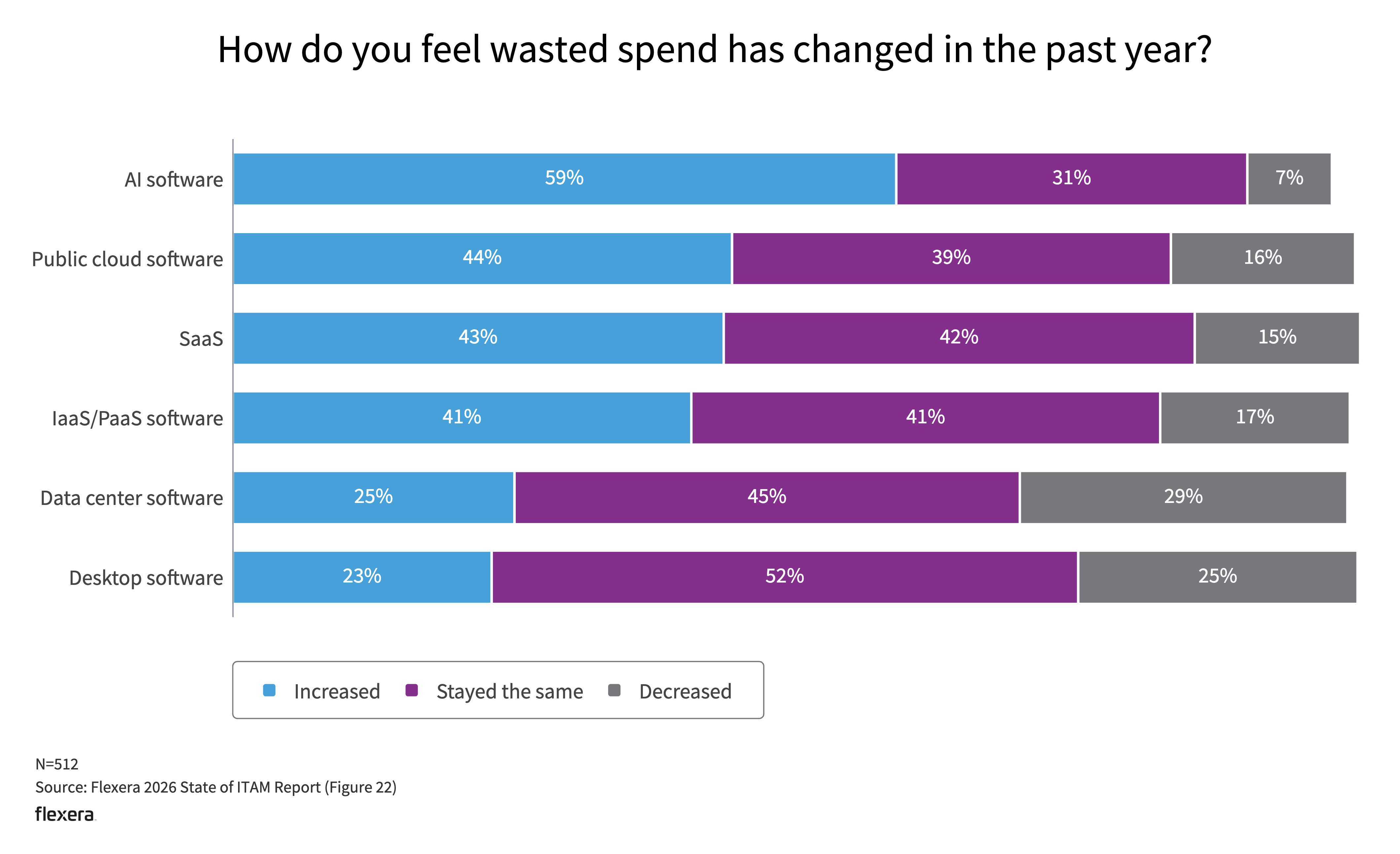
Perceived wasted spend has increased most for AI, cloud and SaaS environments
AI isn’t just a visibility and governance issue—it’s a cost problem.
- AI-related spend tracking is now bundled into broader software spend management for many organizations
- More than half of ITAM teams already support AI spend visibility responsibilities
AI cost management is still immature. Rapid experimentation and decentralized adoption are driving inefficiency before optimization frameworks are fully in place.
With only 29% of organizations measuring the value of AI software, determining ROI is still in early stages
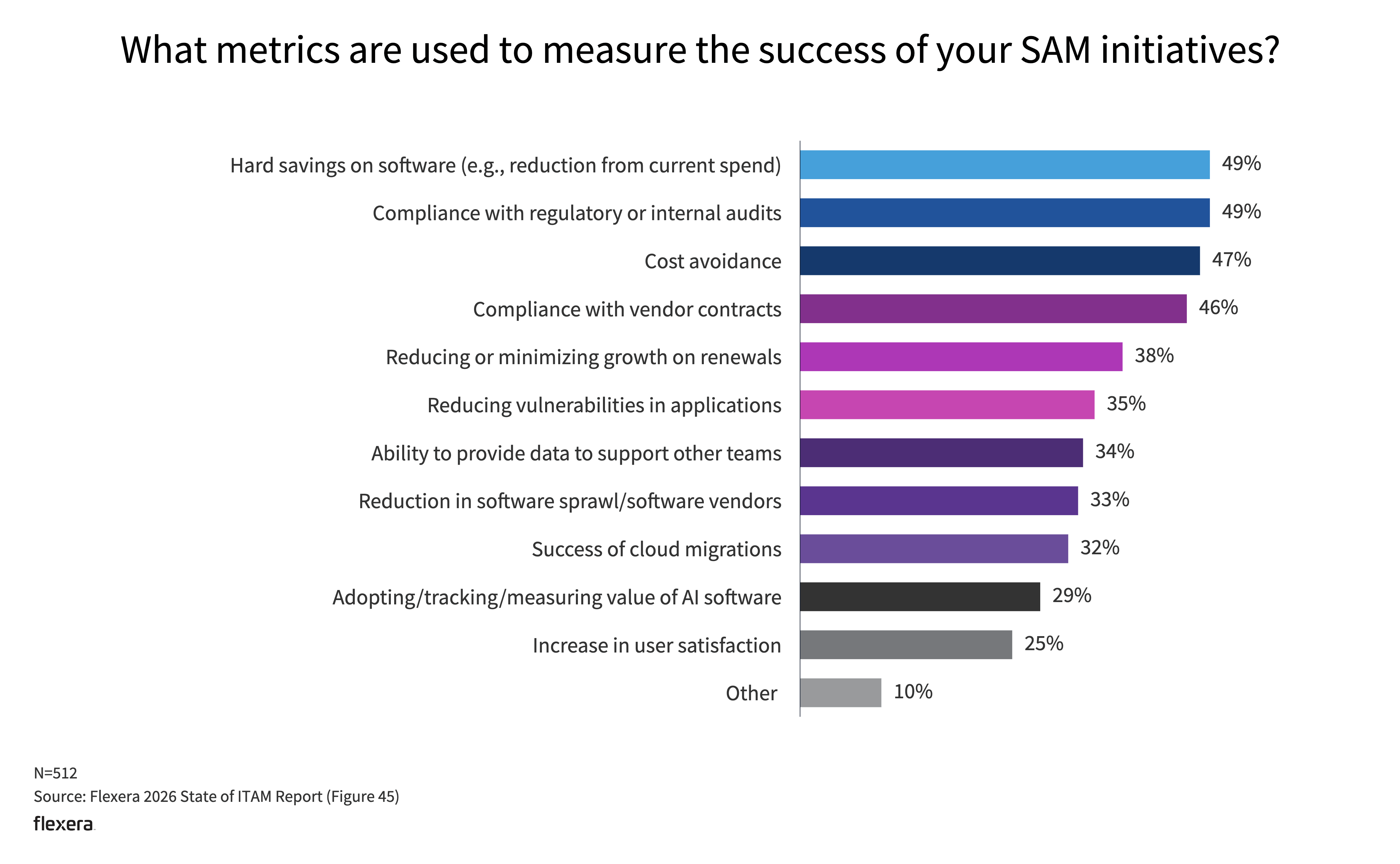
SAM success is most often measured through cost savings and compliance, with fewer organizations tracking outcomes like AI value and user satisfaction
While investment in AI continues to grow, value realization remains limited.
- According to survey respondents, AI tools aren’t yet delivering strong savings outcomes compared with SaaS or cloud optimization
- 48% of organizations are already tracking and rightsizing AI contracts
Organizations are starting to apply traditional optimization practices to AI, but ROI frameworks are still catching up. The challenge isn’t just controlling cost—it’s proving business value.
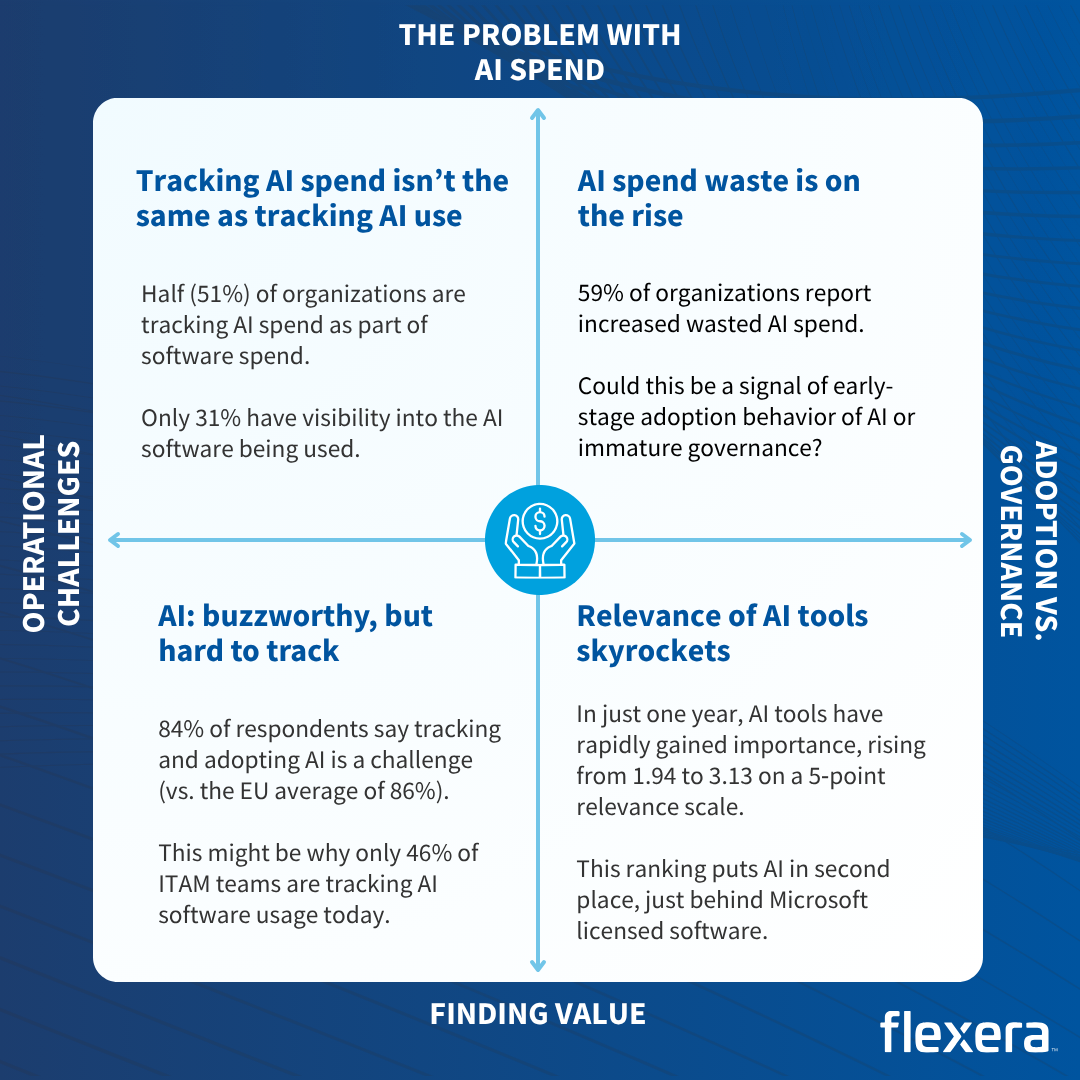
AI usage governance is becoming a shared responsibility
AI is accelerating the convergence of ITAM, FinOps and security teams.
- 51% of ITAM teams support AI spend visibility
- AI governance responsibilities now span IT, security and financial teams
- Many organizations split accountability for optimization and cost control across functions
Governing AI usage is no longer owned by a single function; it requires cross-team coordination between ITAM and FinOps. That adds complexity, but it also creates an opportunity for stronger control and clearer accountability.
The core challenge: governing AI without limiting innovation
Across all findings, one tension stands out: Organizations want and need to control AI usage—but not at the expense of innovation or speed.
- Too much governance creates friction
- Too little governance creates risk and waste
Today, many organizations lean toward fast adoption followed by delayed governance.
How leading organizations are closing the gap between increasing governance without delaying AI’s output
While the report highlights real challenges, it also shows where organizations are focusing next.
- Expanding AI visibility across tools and environments
- Integrating AI tracking into existing ITAM and CMDB systems
- Applying cost optimization practices such as rightsizing and contract management to AI
- Strengthening alignment between ITAM, FinOps and security teams
The goal isn’t to slow AI adoption. It’s to make AI measurable, governable and accountable.
Final takeaway
AI is reshaping ITAM faster than any previous technology shift. But the fundamentals haven’t changed. The organizations that succeed will treat AI not as a standalone experiment, but as a managed, measurable part of the IT estate.
Get the full picture
See how your AI governance and cost optimization stacks up against other organizations in Flexera’s 2026 State of ITAM Report.
Phil Perfetti
An accomplished IT Product Marketing Manager with experience at Device42, Lansweeper, and OVHcloud. Graduated from James Madison University - Go Dukes!