
After 5+ years of Flexera’s State of ITAM report, one thing’s clear: there’s no shortage of daily challenges faced by ITAM teams. Business units now buy applications directly. Teams experiment with unsanctioned AI tools. Free trials turn into paid subscriptions. All while overlapping apps stack up across departments. All of this rolls up under SaaS sprawl.
SaaS sprawl isn’t about having too many tools. It’s about losing control over:
- What applications are in use
- Who owns them
- How they’re being used
- What they actually cost
In this year’s edition of the report, we can see that this challenge is intensifying. Managing new environments—including SaaS—is now cited as a significant and rising challenge year over year, alongside AI adoption and software complexity.
Without centralized visibility, SaaS environments grow organically. And organic growth rarely aligns with governance, security or cost control.
Only 36% of organizations report complete visibility into their IT estate
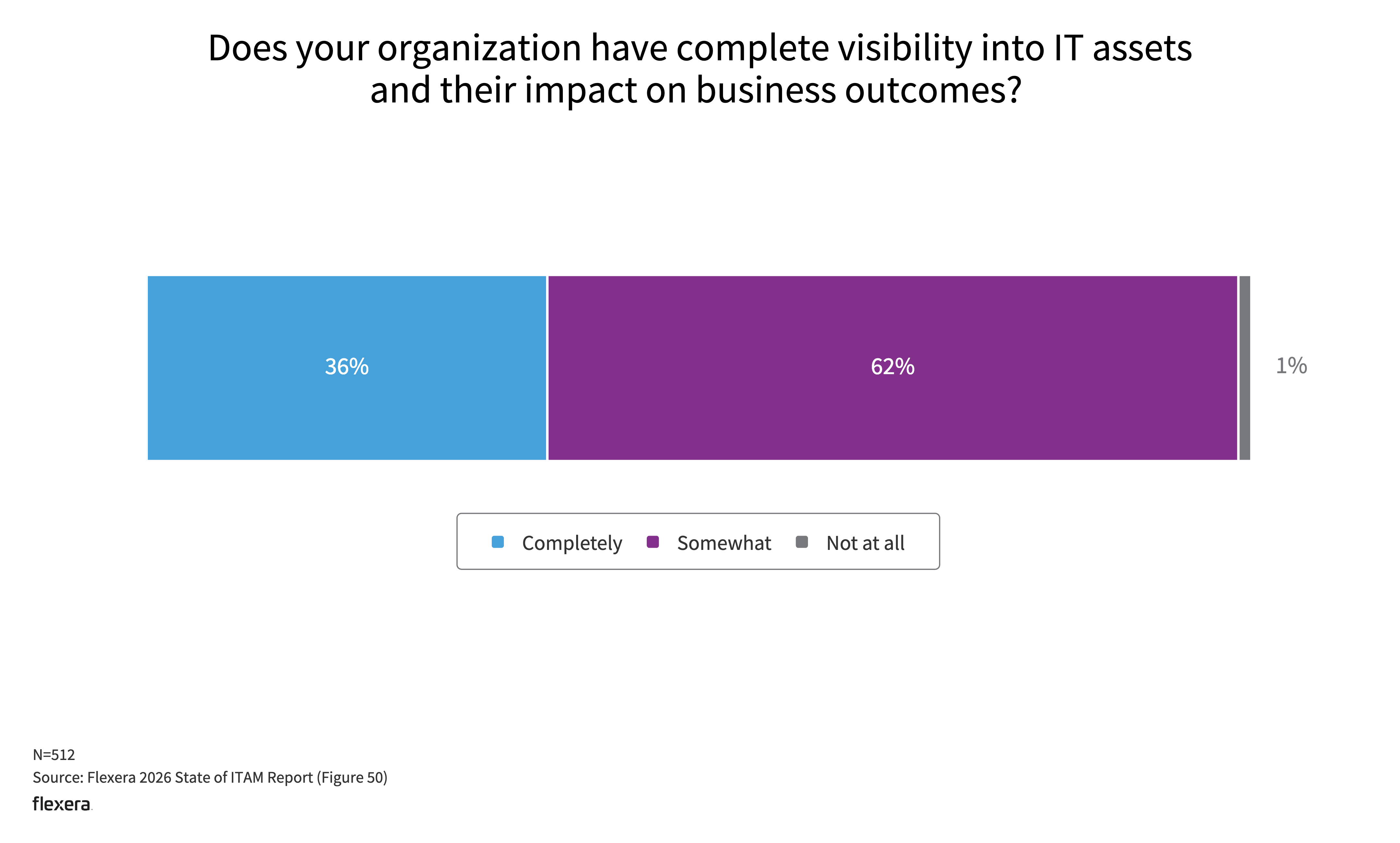
Only a third of organizations have complete visibility into IT assets and their impact on business outcomes—most still operate with partial insight
Traditional asset management models weren’t built for SaaS.
Unlike on-premises software, SaaS applications don’t sit neatly behind procurement or deployment processes. They enter the environment through expense reports, credit cards and browser logins.
That creates several visibility gaps:
- IT doesn’t see what the business buys
- Finance doesn’t see how tools are used
- Security doesn’t know where sensitive data flows
AI-driven SaaS compounds the issue. These tools often expand usage dynamically, consume credits unpredictably and introduce new data and compliance risks. While 78% of ITAM teams say maintaining accurate inventory is their top priority, SaaS sprawl can soon become a never-ending challenge.
SaaS cost management breaks down before optimization begins
SaaS cost management isn’t failing because teams aren’t trying. It’s failing because cost optimization depends on visibility—and most organizations don’t have it. According to Flexera’s State of ITAM 2026 Report, a lack of visibility has major impacts on cost:
- SaaS wasted spend increased year over year, contributing to broader software inefficiencies
- Optimizing software spend remains the #1 priority for SAM teams, leading all other initiatives by a wide margin
AI spend adds another layer of uncertainty. Consumption-based pricing and experimentation-driven usage make forecasting difficult.
Managing SaaS now requires shared ownership: why 78% of organizations have a FinOps team
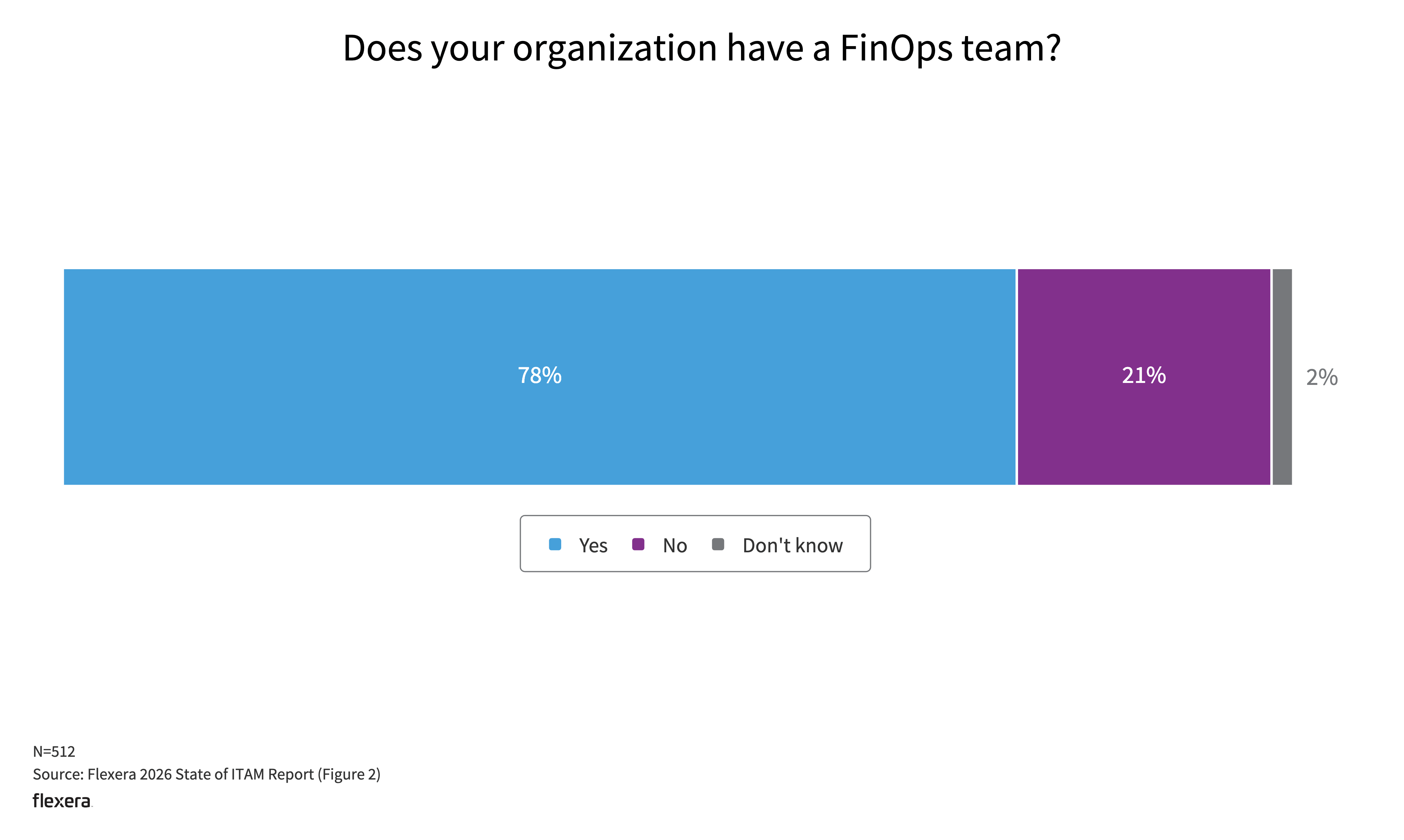
Most organizations have an established FinOps team, reflecting growing maturity in cloud cost management—but adoption is not yet universal
SaaS used to sit squarely with IT, but today managing SaaS applications requires coordination across:
- IT for application inventory and lifecycle management
- Finance for cost tracking and optimization
- Security for risk, compliance and data governance
- Business teams for usage context and value alignment
The shift is already underway:
- 78% of organizations now have a FinOps team, reflecting growing shared ownership of cost and optimization
- ITAM now works more closely with cloud, finance and security teams as responsibilities expand
AI-powered SaaS accelerates this shift. Governance decisions now affect innovation speed, employee productivity and competitive advantage.
59% report increased wasted AI spend
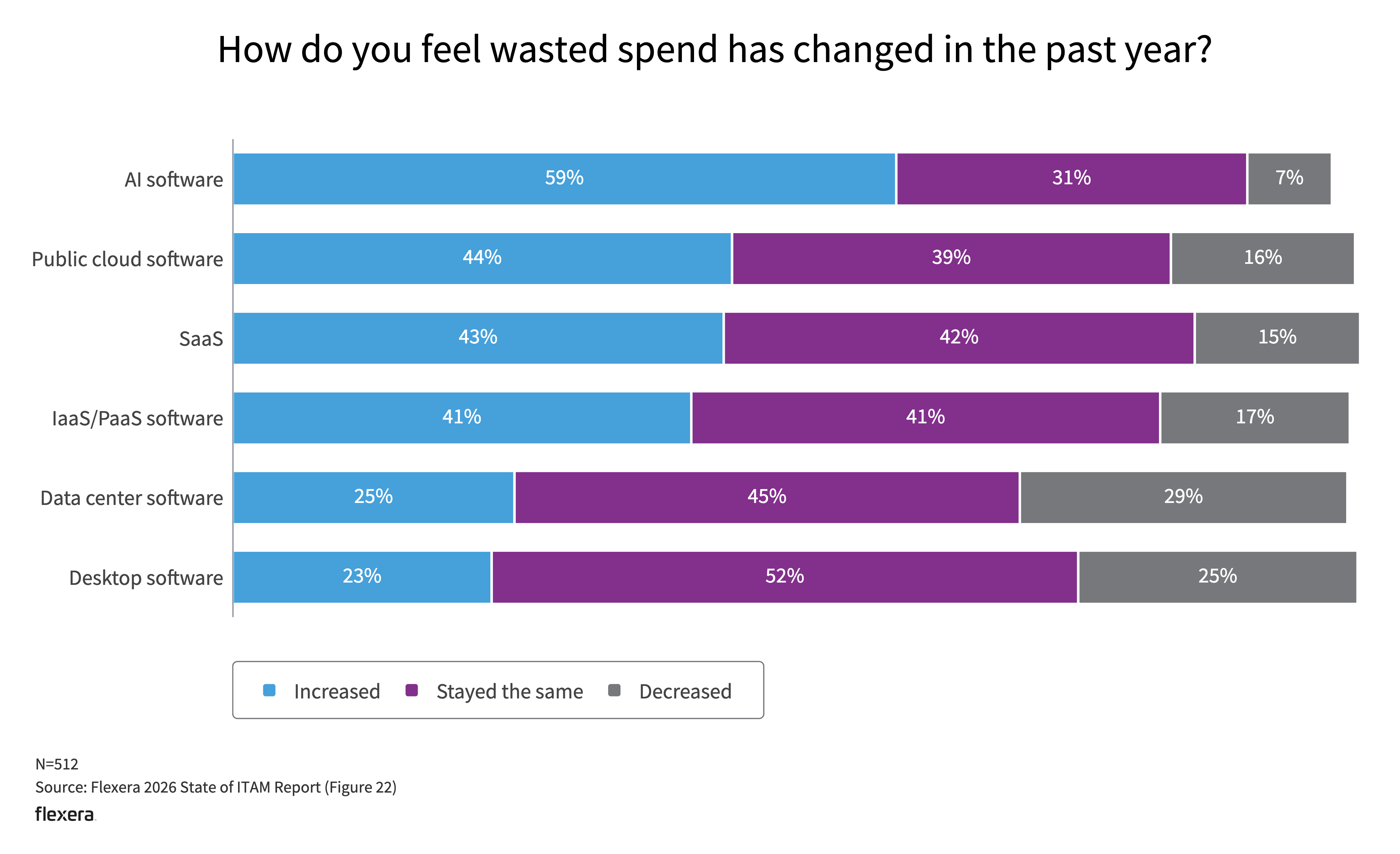
AI has the highest reported increase in wasted spend, signaling that organizations are struggling to control costs as adoption accelerates
AI doesn’t just add more tools. It changes how tools behave, and that’s why AI makes SaaS sprawl harder to control. AI-enabled SaaS often:
- Scales usage dynamically
- Introduces new pricing models
- Creates indirect data exposure risks
- Delivers value that’s harder to quantify
The data highlights just how quickly this is evolving:
- AI software importance surged from 1.94 to 3.13 on a 5-point scale
- Only 31% of organizations have visibility into AI software, compared to 66% of organizations that have visibility into their SaaS environment
That makes traditional SaaS management practices feel outdated. License counts alone no longer tell the story. Neither does spend reporting without usage context. Organizations that treat AI SaaS like any other application miss critical signals about cost, risk and ROI.
What effective SaaS management looks like today
Managing SaaS effectively means building guardrails that scale with the business. Here’s what leading organizations are focusing on:
- Improving SaaS visibility: They establish a single source of truth for SaaS applications across departments—including shadow IT and AI-driven tools
- Connecting usage to cost: They align license and consumption data with real usage patterns to identify waste early
- Governing AI-enabled SaaS intentionally: They treat AI features as first-class assets, not add-ons, with clear ownership and oversight
- Aligning teams around shared outcomes: They bring IT, finance and security together around the same data and decision-making framework
- Mitigating unmanaged growth: They don’t prioritize growth driven by speed, autonomy, and innovation unless there is visibility in how the tools are being used
The combination of decentralized buying, AI-driven tools and limited visibility has made SaaS hard to manage. The organizations that are succeeding are bringing visibility, cost, and usage together.
Wasted AI spend, SaaS sprawl, and IT visibility on your mind?
Get all the insights in Flexera’s newly-released 2026 State of ITAM report.
Phil Perfetti
An accomplished IT Product Marketing Manager with experience at Device42, Lansweeper, and OVHcloud. Graduated from James Madison University - Go Dukes!