
Snowflake Summit 2026 took place at the Moscone Center in San Francisco, California from June 1 to June 4. “Making AI Real for Business” was the theme of the conference. The central message was: enterprise AI has to be built on trusted, governed data. Sridhar Ramaswamy, the CEO of Snowflake, began by stating, “The very nature of work is changing. Day-to-day work is about partnering with and guiding intelligent agents and soon they will be operating across your business continuously, autonomously. This truly is going to be the era of the agentic enterprise”. He followed that with a point every vendor in the room felt: having a model gives you zero competitive advantage. Your competitors can buy the same ones. Your proprietary data is what actually creates leverage.
This year’s Summit was the largest in Snowflake’s history, drawing more than 20,000 in-person attendees, 500+ breakout sessions (across 12 tracks) and 200+ partners on site. Here’s everything released, announced or presented from June 1 to June 4, 2026.
Before the Summit
Snowflake made some key announcements ahead of the main Summit. Three noteworthy announcements were made prior to the start of the Snowflake Summit (on May 27).
Q1 FY2027 earnings. Snowflake product revenue came in at $1.33 billion, up 34% year over year which is an acceleration from the 30% growth rate of the prior quarter. Total revenue hit $1.39 billion, up 33% year over year. (Source: Snowflake quarterly earnings report)
AWS infrastructure commitment. Snowflake signed a five-year, $6 billion infrastructure commitment to Amazon Web Services (AWS), its largest cloud deal ever. The spend covers Amazon’s Graviton processors and AI compute infrastructure for AI and agentic workloads. (Source: Snowflake press release)
Natoma acquisition. Snowflake signed a definitive agreement to acquire Natoma, an enterprise model context protocol (MCP) platform for AI agents. Financial terms were not disclosed. (Source: Snowflake press release)
All three announcements landed on the same day. Combined, they sent Snowflake’s stock soaring on May 27 alone. By the time the Snowflake Summit even started, it was up around 60% from its April lows.
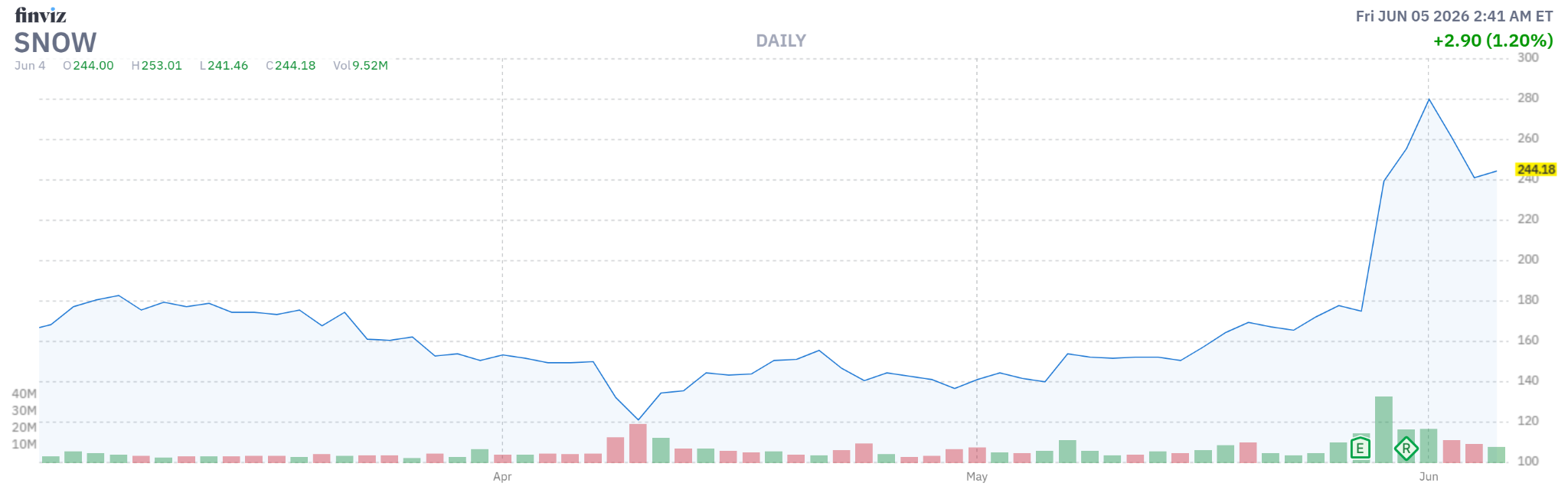
Snowflake stock chart showing a sharp surge (Source: Finviz)
Day 1: Monday, June 1, 2026 — Opening keynote and the agentic enterprise
Ramaswamy opened the Summit with two live customer examples before laying out Snowflake’s framework for the agentic enterprise.
Canva, with 265 million monthly active users, replaced lengthy manual user behavior analysis with near-real-time insights using Snowflake AI.
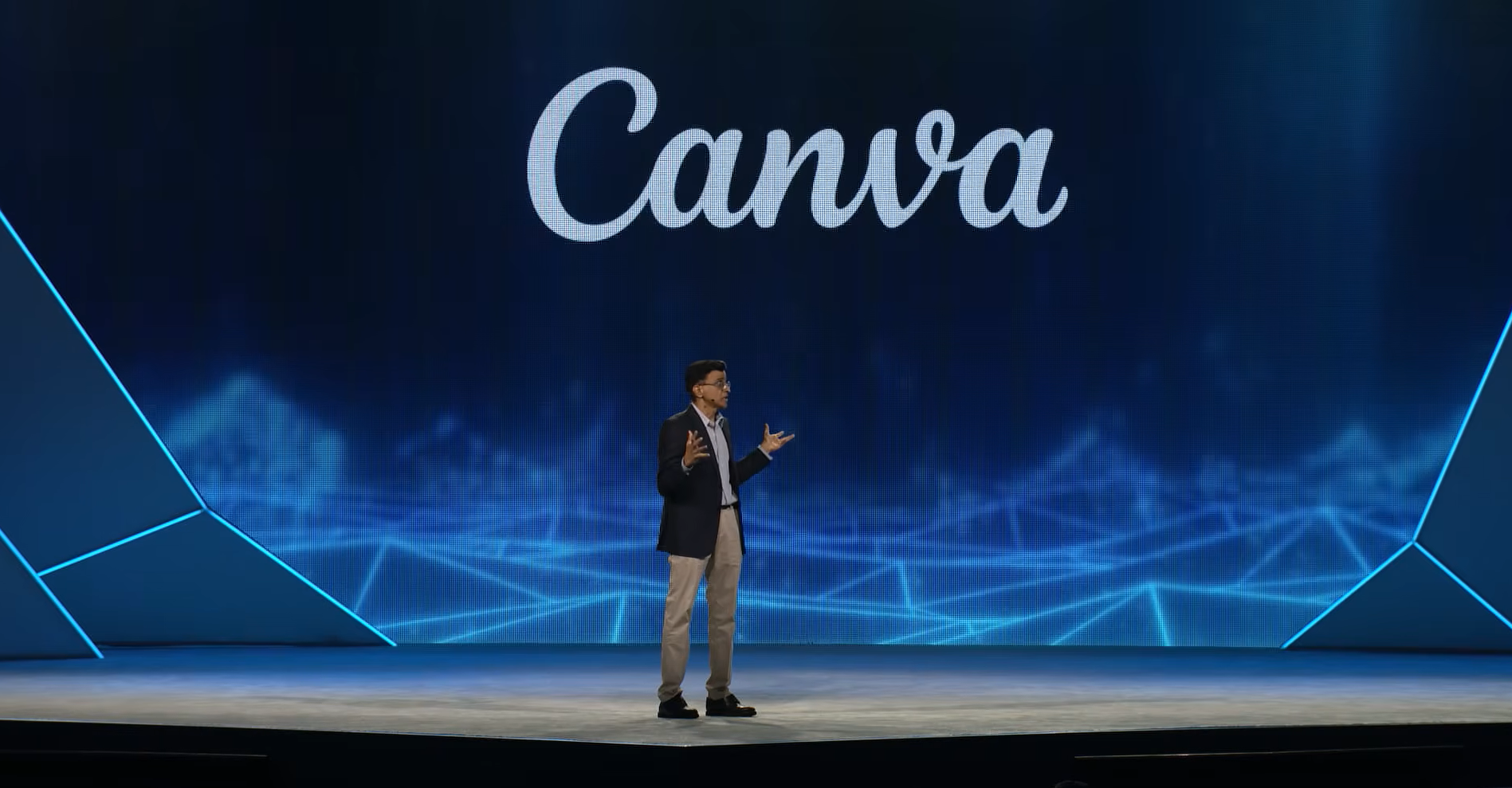
Snowflake Summit 2026 keynote slide on Canva’s use of Snowflake AI for real-time insights
Nestle, operating across more than 2,000 brands in 185 countries, deployed enterprise data products to over 50,000 users and now uses AI to anticipate supply chain disruptions rather than just report on them after the fact.
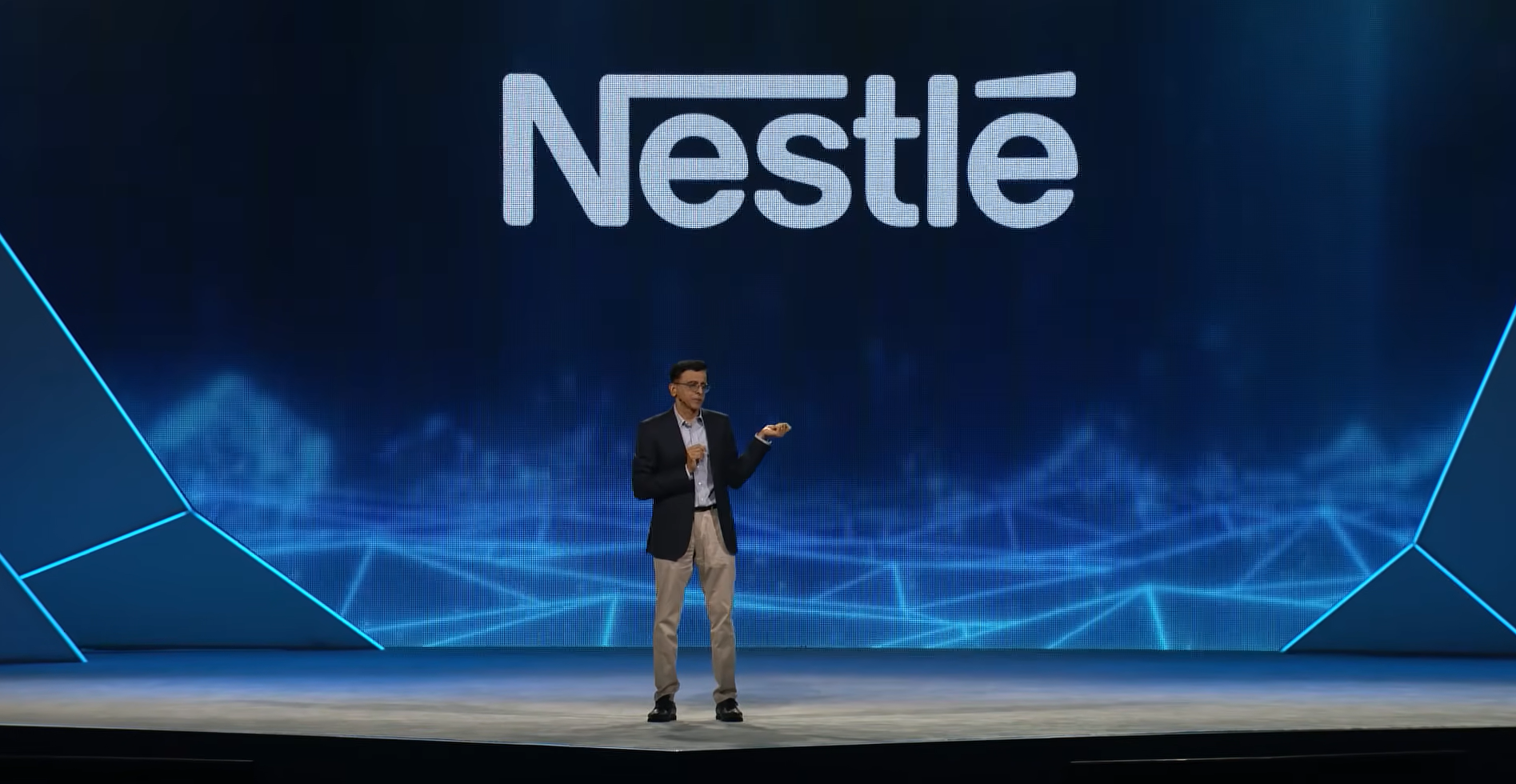
Snowflake Summit 2026 keynote slide on Nestlé’s Snowflake-powered supply chain predictions
The event then started with a big keynote on Snowflake’s vision of the “agentic enterprise“.
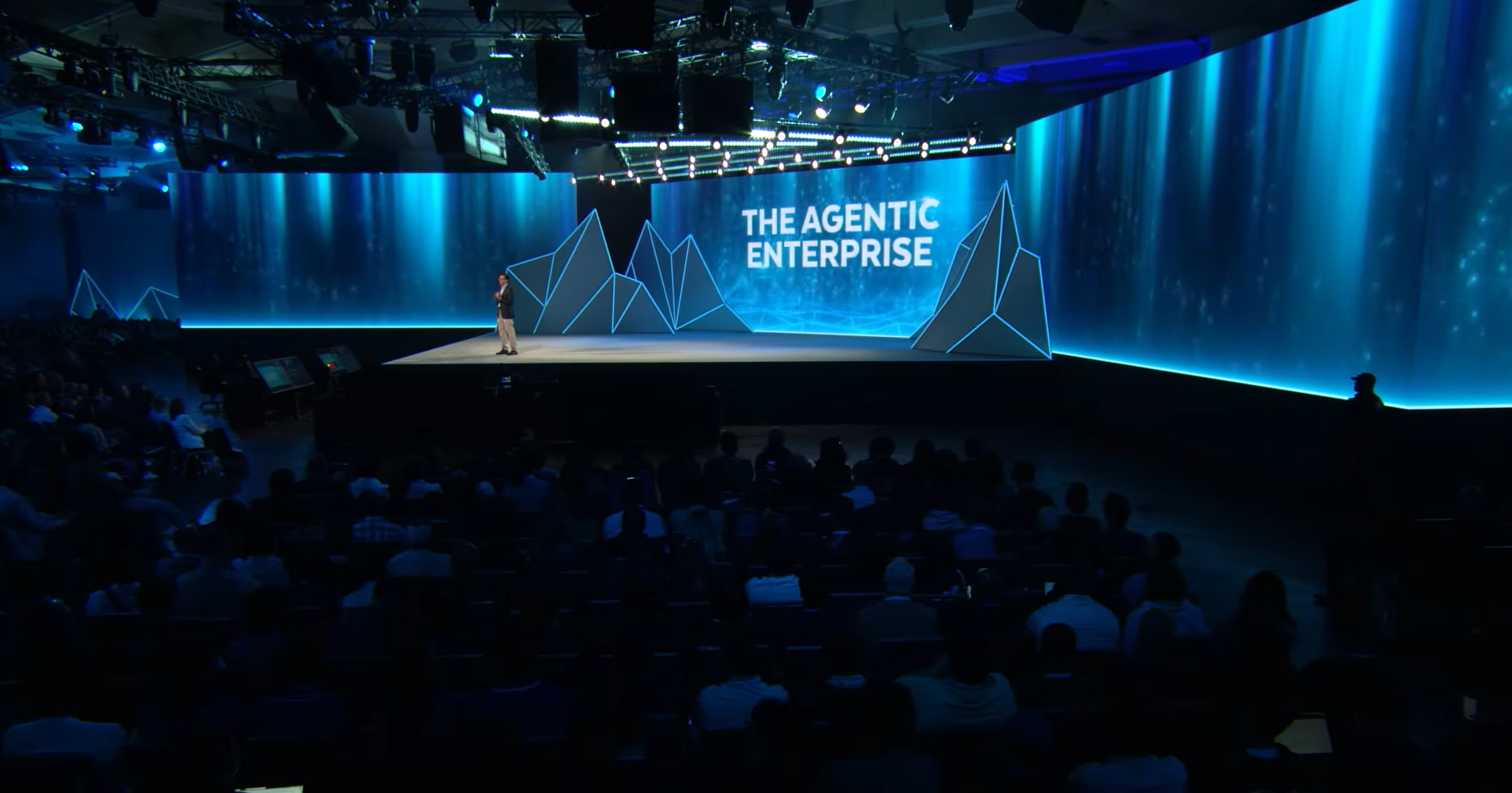
Snowflake CEO Sridhar Ramaswamy presenting the agentic enterprise keynote – Snowflake Summit 2026
Ramaswamy’s core argument: models alone give you zero competitive advantage because your competitors can buy the same ones. It’s your proprietary data that creates durable value. He then outlined four components he says every agentic enterprise needs:
- Enterprise data and context, the base layer
- AI models, both frontier and open source, with customer choice
- Applications, the systems where work actually happens
- An agentic control plane, the governance layer that ties everything together
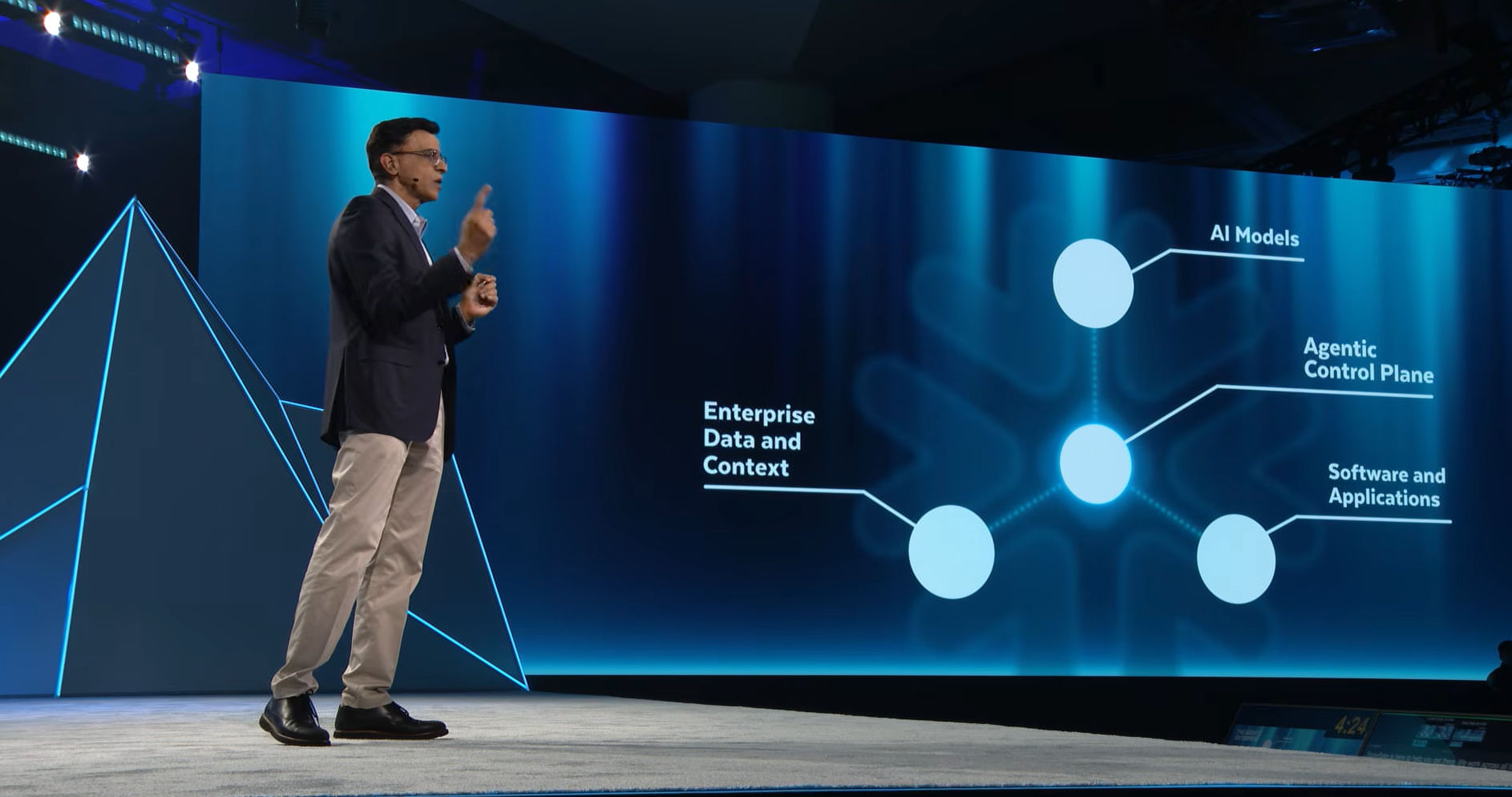
Snowflake CEO Sridhar Ramaswamy presenting the four-pillar agentic enterprise framework – Snowflake Summit 2026
Guest speakers on Day 1 of Snowflake Summit 2026
Sridhar Ramaswamy and several industry leaders took the stage for a grounded conversation. They discussed how real companies turn these concepts into hard revenue. Here are the guests and what they discussed.
Julie Sweet and Manish Sharma from Accenture
Julie Sweet, chair and CEO of Accenture, appeared via video message. She made one argument clearly: AI only creates durable value when leaders take personal responsibility for adoption. Pilots are easy. Real impact comes when AI is embedded in the profit and loss (P&L) with accountability attached.

Julie Sweet, CEO of Accenture, discussing AI adoption – Snowflake Summit 2026
Manish Sharma then joined Ramaswamy on stage for a fireside chat. Sharma shared that Accenture had recently reorganized every job across its 750,000-person workforce in 57 countries around seven key C-suite personas (CFO, CHRO, supply chain, manufacturing and others) with each role rebuilt on a data foundation running on Snowflake. Sharma said it straight out: about 85% of their clients have a data problem before they have an AI problem.

Manish Sharma in a fireside chat with Snowflake CEO Sridhar Ramaswamy
Emmanuel Frenéhard from Sanofi
Emmanuel Frenéhard, chief digital officer of Sanofi, explained why Sanofi began consolidating its fragmented data environment onto Snowflake years before generative AI arrived.Fragmented data lakes had become dead ends, he said, and continuous data availability across drug development and drug discovery is non-negotiable.
He then ran a live demo on production systems, playing the role of a pharmaceutical sales rep about to visit a physician for the first time. He called up an AI concierge agent called Concierge for Field, built on Sanofi’s Snowflake data. The agent produced a pre-call plan, shared current patient numbers for the relevant therapy, flagged one patient needing extra attention, suggested a natural icebreaker for a first meeting and emailed the full briefing on request. All in a single conversation, grounded in live operational data.
Emmanuel Frenéhard demonstrating the Sanofi AI concierge agent
Daniela Amodei, Anthropic – and the partnership expansion
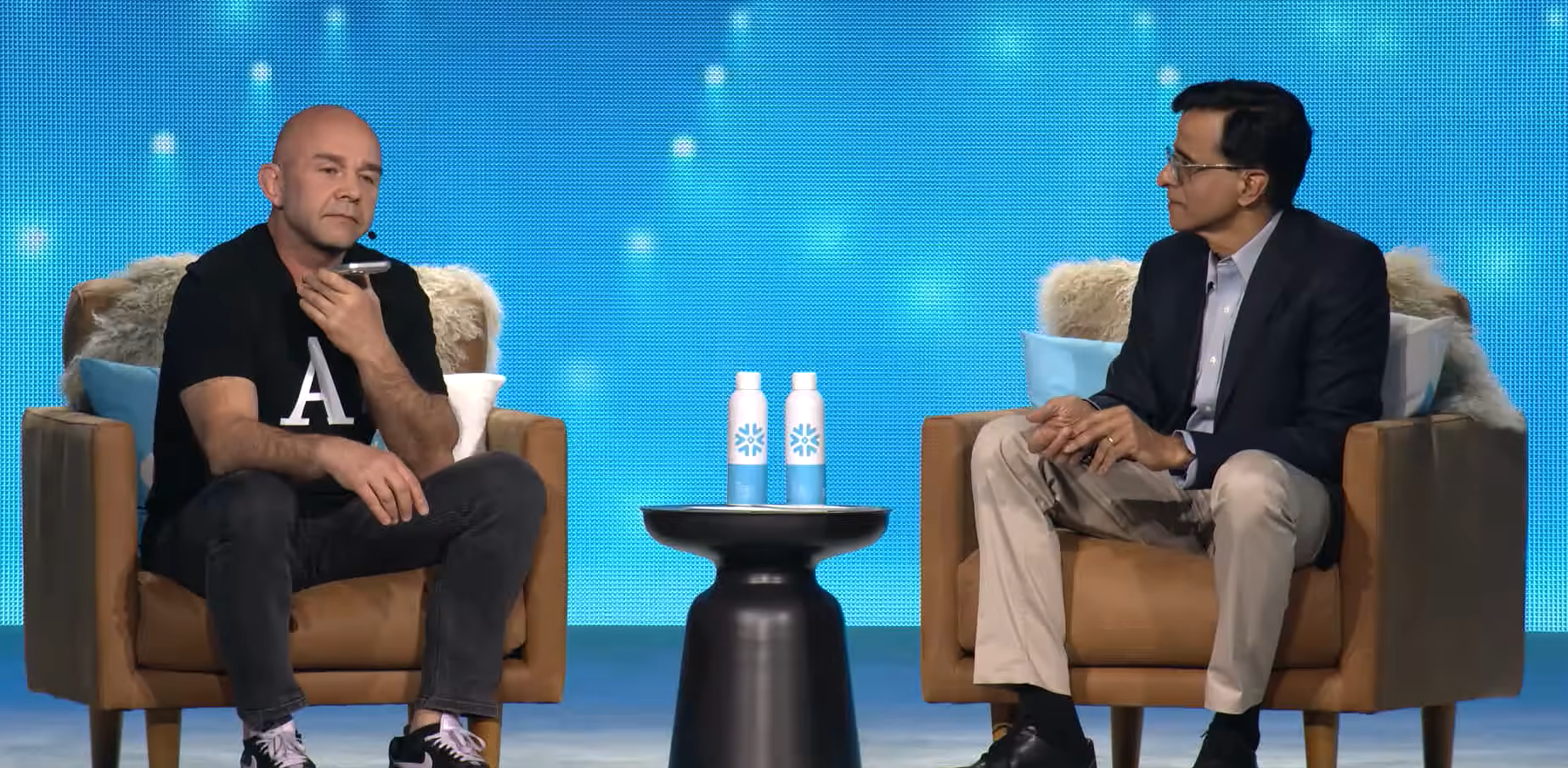
The Day 1 keynote closed with a conversation between Ramaswamy and Daniela Amodei, president and co-founder of Anthropic. Alongside the fireside chat, Snowflake and Anthropic formally announced significant momentum in their strategic partnership, building on the $200 million multi-year agreement signed in December 2025.
As part of the expanded collaboration, Snowflake is one of ten launch partners in Anthropic’s Claude Marketplace, which lets customers apply existing Anthropic commitments toward Snowflake AI capabilities. Claude models, including Claude Opus 4.8 made available on Snowflake Cortex AI the same day as the keynote, power both CoWork and CoCo inside Snowflake’s governed environment.
Amodei reflected on how quickly the enterprise AI conversation has shifted. Two years ago, no major enterprise was running large language models (LLMs) in daily workflows. Today, it’s foundational to workforce strategy across financial services, legal, healthcare and beyond. Even the teams at Anthropic who track model capabilities daily find it hard to internalize how fast things move every three to six months.
Her advice to enterprise teams: don’t plan only for today’s models. Think about the best version of what you want to build, because the models will get there faster than most planning horizons account for.
On the safety-versus-speed compromise, Amodei reframed it directly. Trust is not a brake on AI adoption. It’s an accelerant. No CEO has ever asked for more hallucinations or less predictable outputs. Organizations that invest in responsible AI move faster because their teams actually rely on the output.
Take a look at this video of key highlights from Day 1 of the Snowflake Summit 2026:
Snowflake Summit Day 1 was built around vision, live customer proof and the Anthropic partnership momentum. The detailed product announcements came on Day 2.
Day 2: Tuesday, June 2, 2026 — Platform keynote and product announcements
Day 2 was the most product-dense session. Co-founder and president of product Benoit Dageville and EVP of product Christian Kleinerman took the Platform Keynote stage at morning. What followed was the most product-intensive session of the conference, covering everything from major rebrands, a new AI security stack, a new semantic governance architecture and a full slate of infrastructure and interoperability announcements.
Dageville opened by recapping Snowflake’s evolution: from breaking data silos through global availability, data sharing, Apache Iceberg support and AI-native unstructured data handling, all building toward the agentic enterprise.
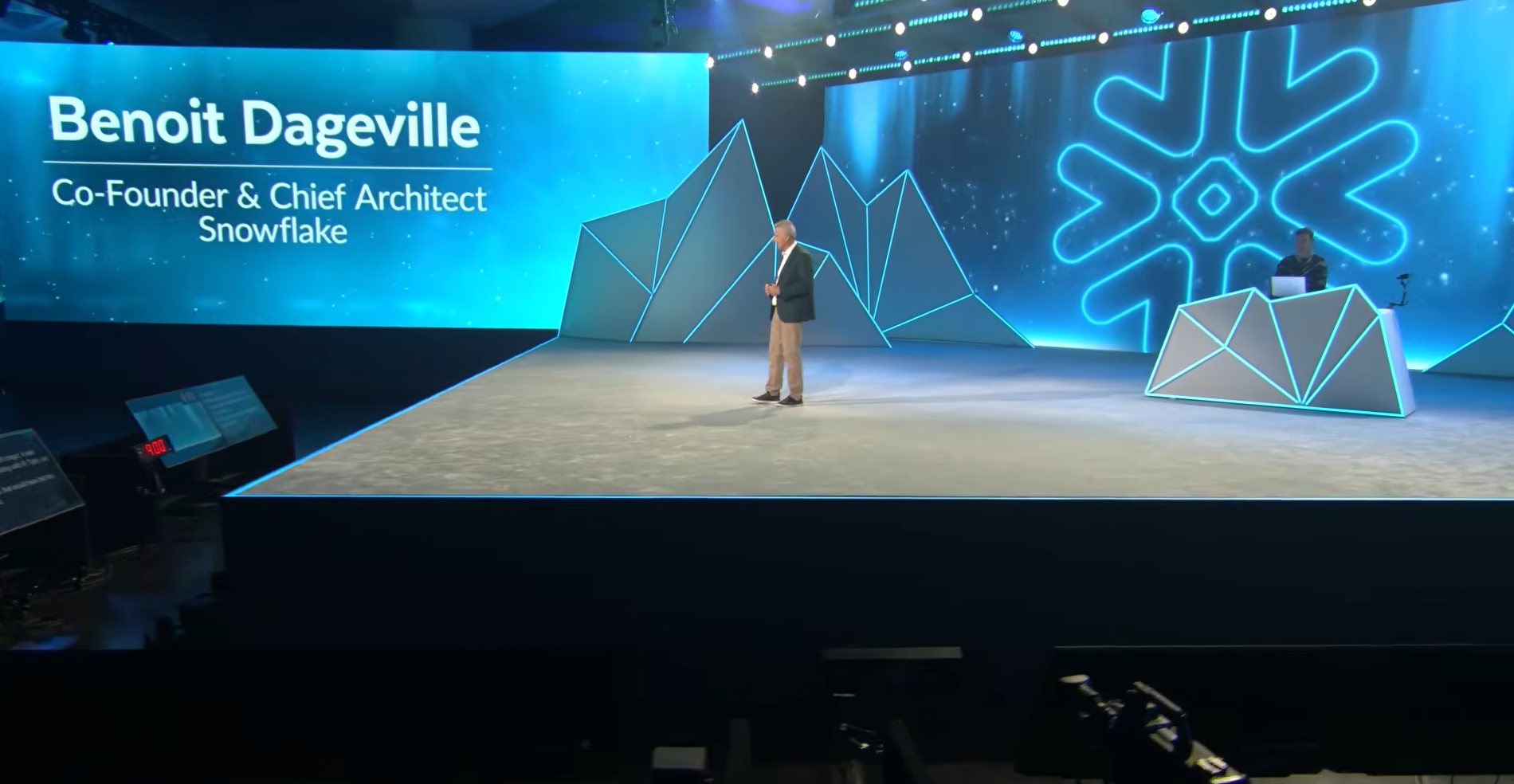
Snowflake co-founder Benoit Dageville
Kleinerman then took over for the product announcements.
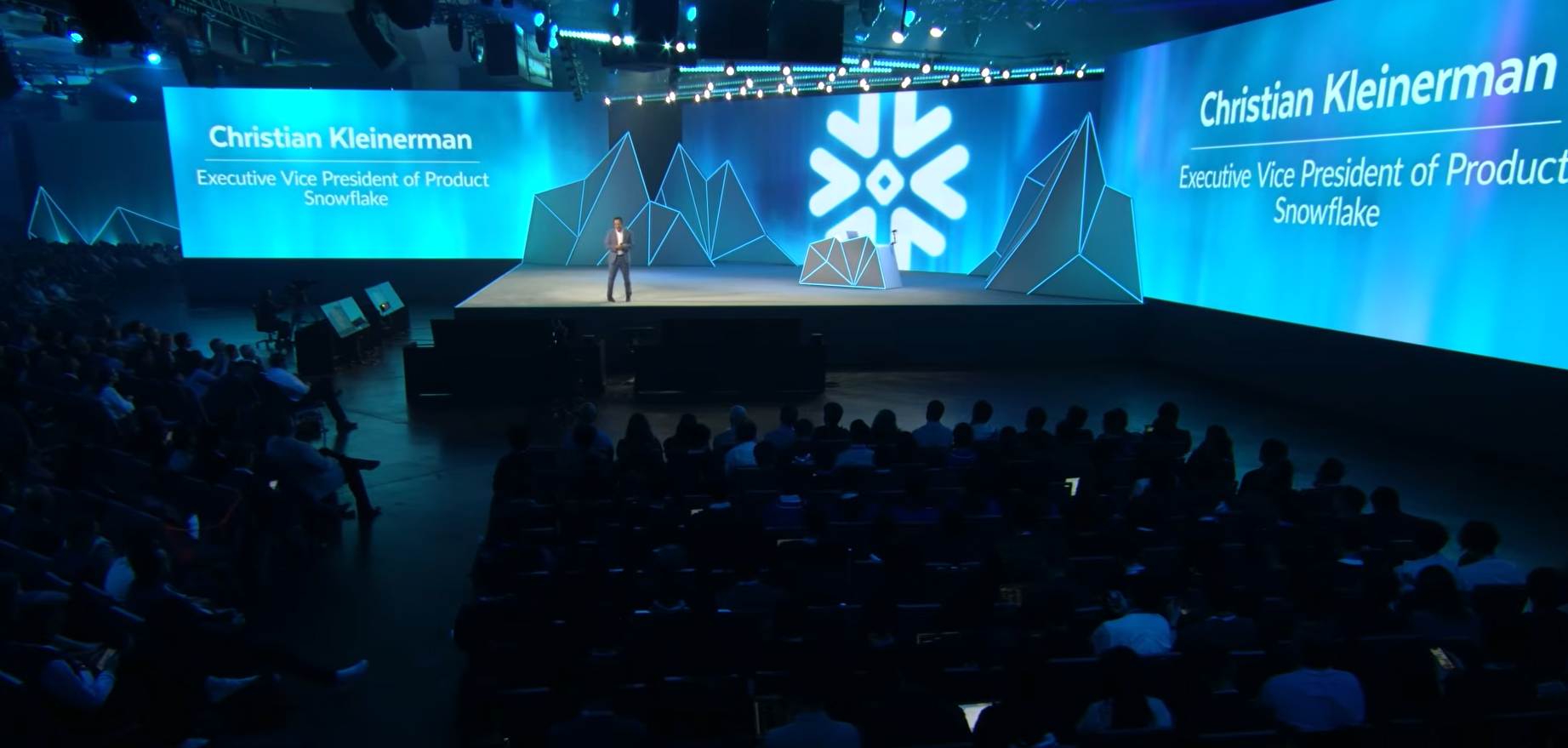
Snowflake EVP of Product Christian Kleinerman presenting new product and feature announcements
Kleinerman started his keynote by saying that enterprise data platforms don’t have to be exclusive. He said, “The idea that ‘you need to put all your data in one platform and go with just one vendor is a tale of the past. We’re giving you options”. This idea was a theme in every announcement that followed.
Here are all the products and features that were announced during Snowflake Summit 2026.
Snowflake Intelligence and Cortex Code get new names
The two biggest rebrands of the Snowflake Summit 2026:
- Snowflake Intelligence is now called Snowflake CoWork
- Snowflake Cortex Code is now called Snowflake CoCo
Both names came from how teams were already using the products internally. The rebrands came with substantial new capabilities.
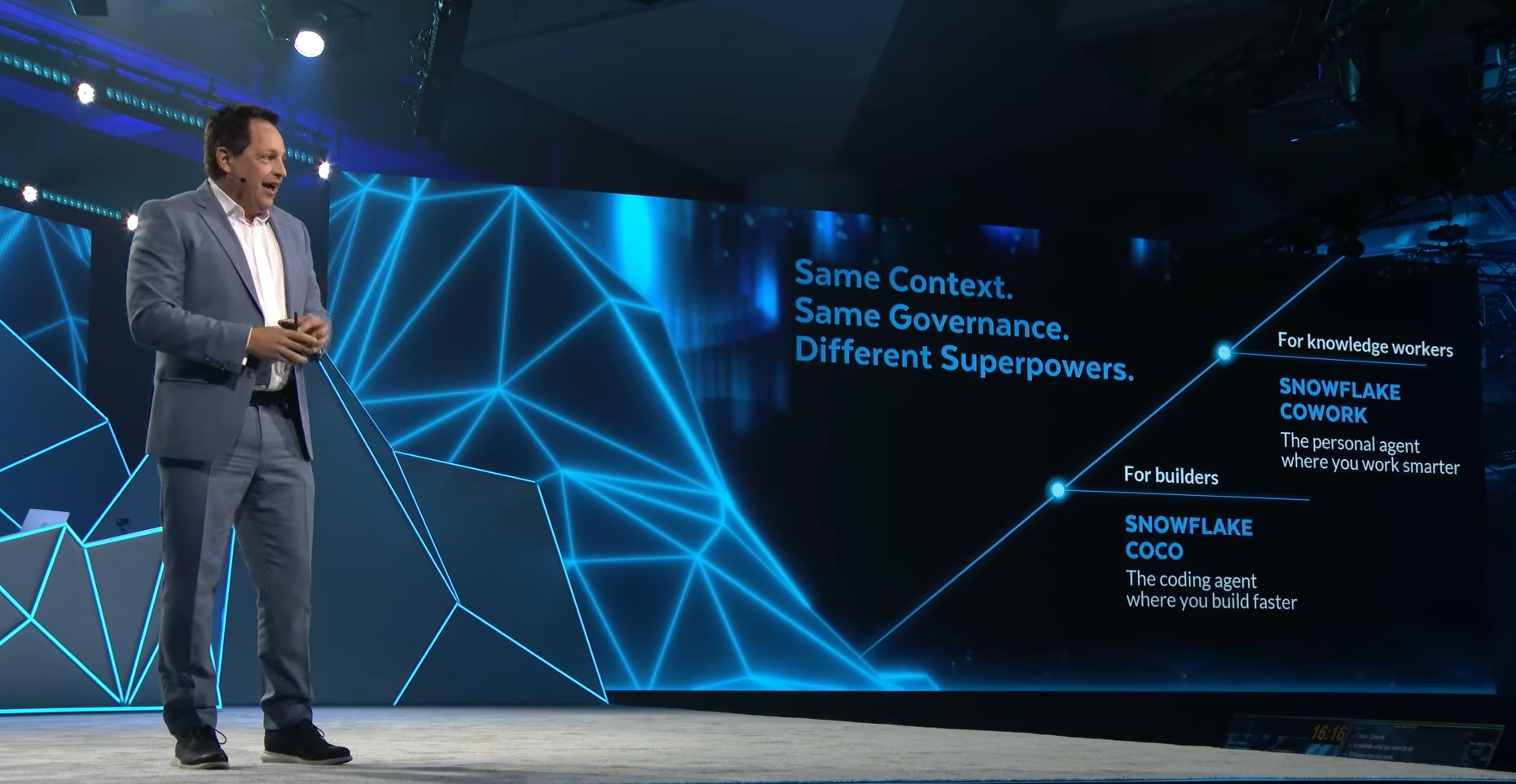
Snowflake CoWork and Snowflake CoCo rebrand announcement
Snowflake CoWork for knowledge workers
Kleinerman described CoWork as Snowflake’s answer to a persistent structural problem: enterprise data isn’t reaching the people who need it. Most employees don’t write SQL. CoWork addresses that directly by letting knowledge workers interact with governed Snowflake data through natural language.
CoWork goes well beyond what Snowflake Intelligence initially offered. New capabilities announced at the Snowflake Summit include:
- Artifacts
- Deep Research
- User Memory
- The Skill Catalog
- MCP connectors
Artifacts allows analysts to build and publish fully interactive dashboards that colleagues can explore through natural conversation, grounded in live Snowflake data rather than static PDF exports.
Deep Research runs multi-step reasoning across structured tables, documents and external context simultaneously, producing a cited report that explains what’s happening, why it’s happening and what to do about it.
User Memory maps each user’s role and behavior over time, so CoWork learns what you actually need rather than responding literally to each prompt in isolation.
The Skill Catalog allows teams to package workflows and share them across the organization.
Model Context Protocol connectors for Slack, Google Drive and Salesforce are now generally available; Gmail and Jira connectors are announced and coming soon.
Powering all of this is Cortex Sense, the new runtime context layer underneath CoWork. Cortex Sense automatically builds signals from data and activity already in Snowflake and enriches context for CoWork in real time based on user role and behavior patterns, delivering what Snowflake says is up to 3x to 4x better response accuracy compared to running without it.
Cortex Sense was announced as available in private preview.
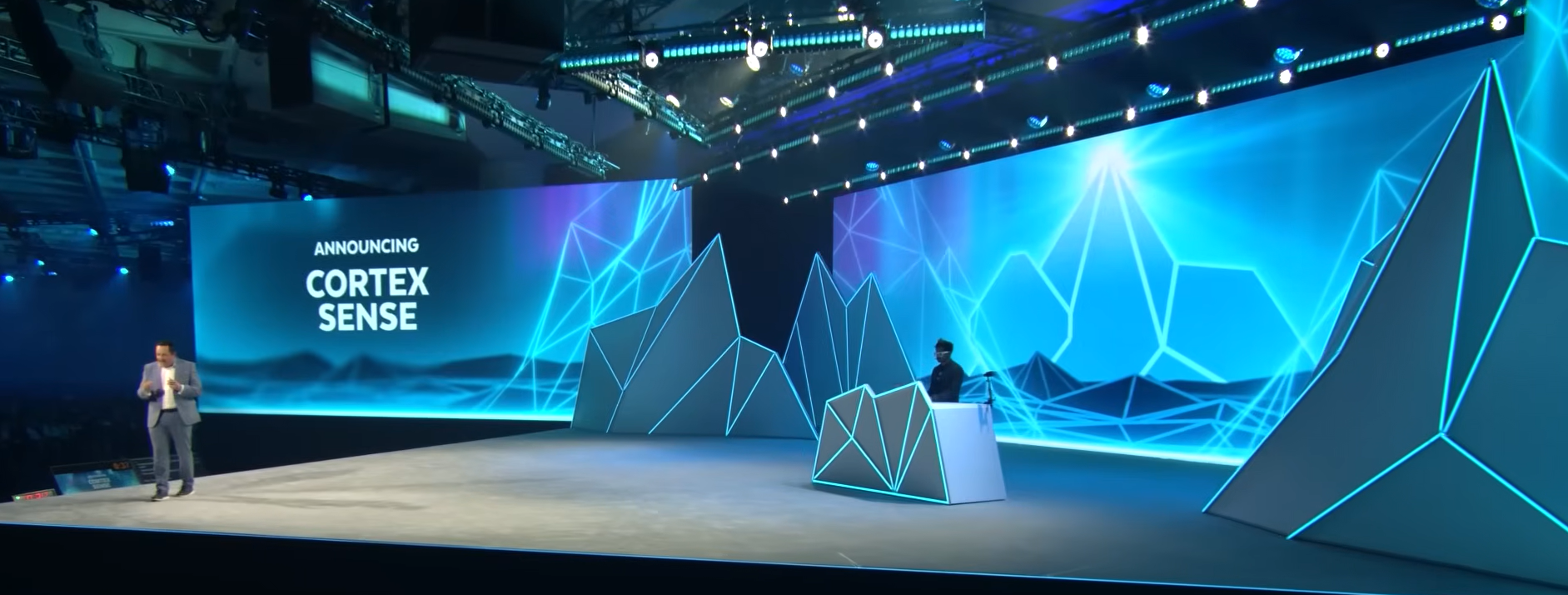
Snowflake Cortex Sense introduction slide
CoWork is also getting an iOS app (GA soon) and prebuilt plugins for finance and sales teams. These plugins combine skills, business rules and MCP connectors so teams can get production-ready agents running without building from scratch.
Kleinerman stated that CoWork accounts have more than doubled quarter over quarter. Across the Snowflake platform, over 13,600 accounts now use AI features on a weekly basis.
Snowflake CoCo for developers
Snowflake Cortex Code launched in February 2026 and grew to over 7,100 accounts by the time of the Summit, making it the fastest-growing product in Snowflake’s history. Internally, developers and data engineers were already calling it CoCo, so Snowflake made it official.
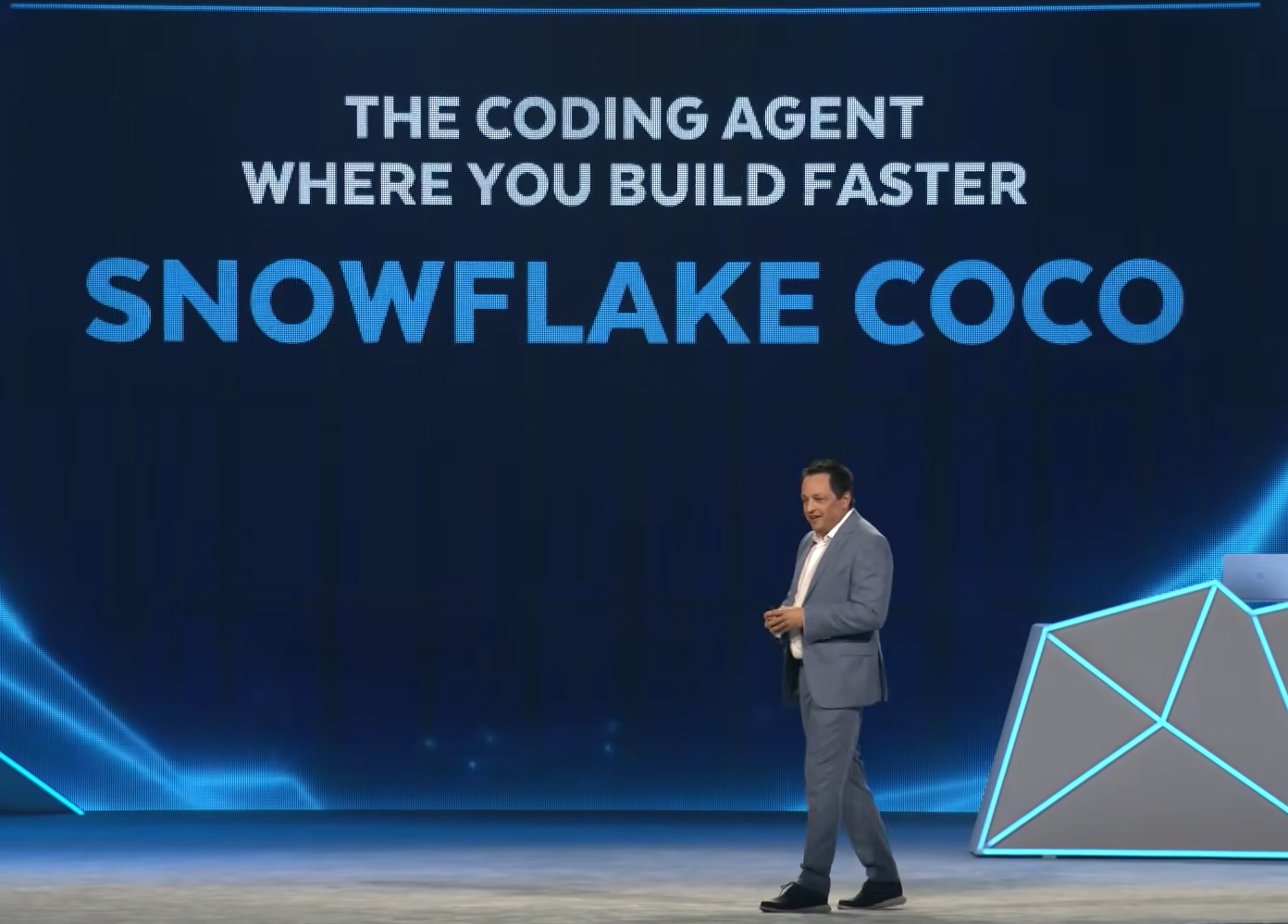
Snowflake CoCo branding and product overview
CoCo is a coding agent for data engineers, developers and anyone creating pipelines, applications or AI workflows on Snowflake.
At the Summit, CoCo expanded to every major environment where modern data teams work:
- CoCo Desktop: Now generally available; a standalone native application for working with CoCo outside the Snowflake web interface
- VS Code extension: Now generally available
- Microsoft Excel extension: Now generally available
- CoCo in Claude Code: Now generally available
- Cloud Agents: Run tasks in the background so you don’t have to wait for a long process to finish
- CoCo Mobile app and CoCo Slackbot: Both announced and coming soon
Kleinerman also shared a specific claim about migration speed: a data migration that previously took six months can now be done in six days, with CoCo handling workload assessment, code conversion, validation and deployment in a single coordinated workflow.
It’s also worth calling out a dedicated SAP Skill for CoCo, announced alongside the Zero-Copy Integrations update. It streamlines how developers connect to, explore and manage SAP data within Snowflake, cutting setup time significantly.
Snowflake Managed Agents
Also on the Agents front, Snowflake Managed Agents was rolled out. It is a framework for deploying and operating AI agents directly inside Snowflake without managing the underlying infrastructure, orchestration or lifecycle. Agents built on this framework can reason over structured warehouse data, unstructured documents and business metadata, enabling multi-step analysis and automated workflows while staying inside Snowflake’s security and governance perimeter.
Semantic governance gets an architecture: Horizon Context and OSI
On the governance front, Horizon Context was introduced as a new capability inside Snowflake Horizon Catalog. If Horizon Catalog is the governance layer for data, Horizon Context is the layer that makes that governance useful for AI.
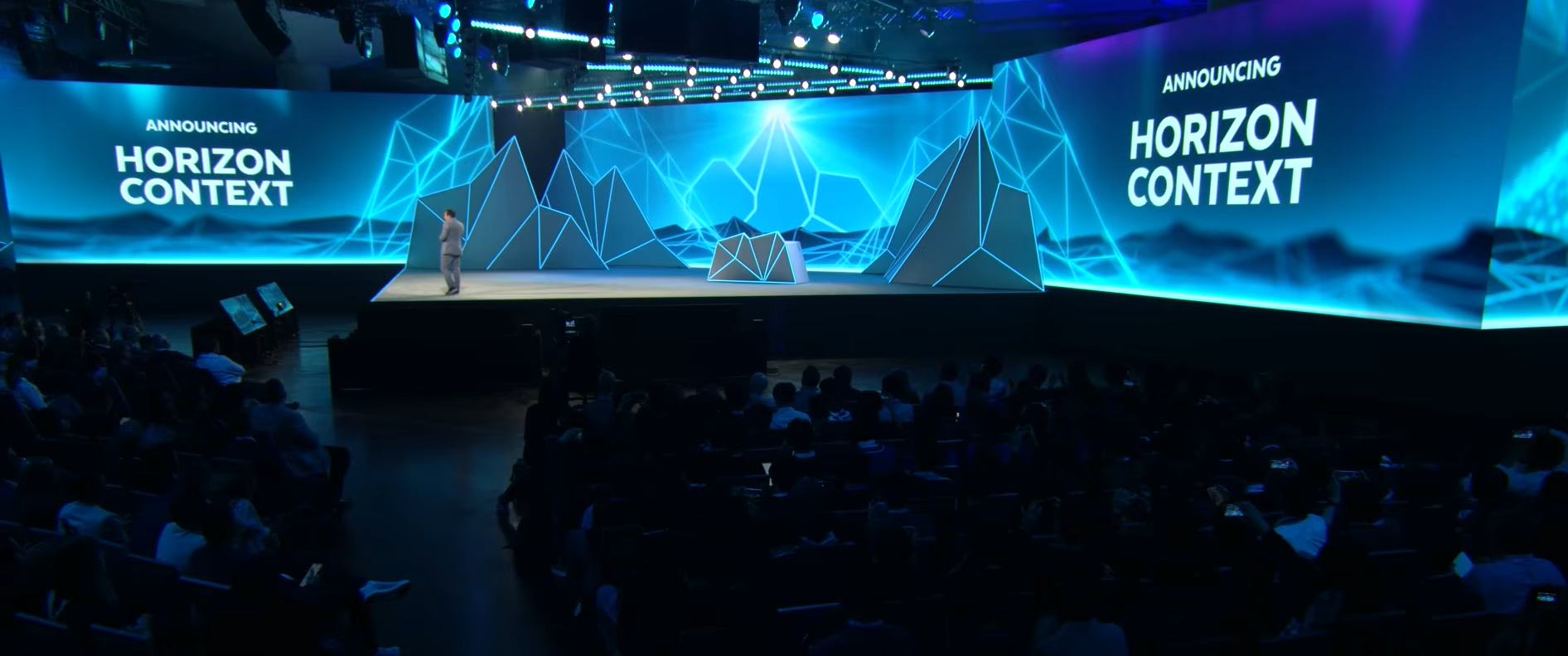
Horizon Context introduction slide
Kleinerman described the architecture across three stages:
- Collect — ingests business context from external systems including PostgreSQL, SQL Server, Tableau, Power BI and dbt, bringing it together into a single trusted foundation
- Enrich — adds column-level lineage stitching, AI-generated documentation and popularity metrics on top of that ingested metadata
- Activate — serves the result dynamically to AI agents and BI tools through hybrid semantic and keyword search, with automatic semantic view discovery
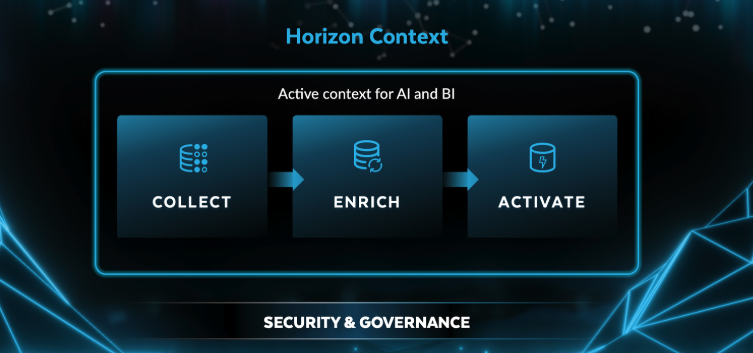
Snowflake Horizon Context architecture diagram (Source: Snowflake)
Two more things were announced alongside Horizon context:
- Semantic Studio
- Semantic View Autopilot
Semantic Studio (now in private preview) helps teams define shared business logic without SQL expertise. You specify what a metric means to your business without needing to know how it’s calculated under the hood.
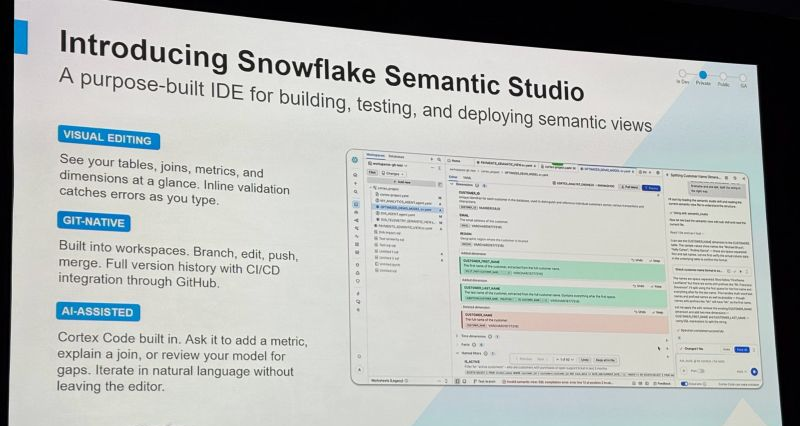
Snowflake Semantic Studio
Semantic View Autopilot (GA since February 2026) automatically generates and refines semantic view data definition language (DDL) from existing tables, cutting the manual work of building a semantic layer from scratch. Kleinerman re-highlighted it at the Summit given its relevance to the broader governance story.
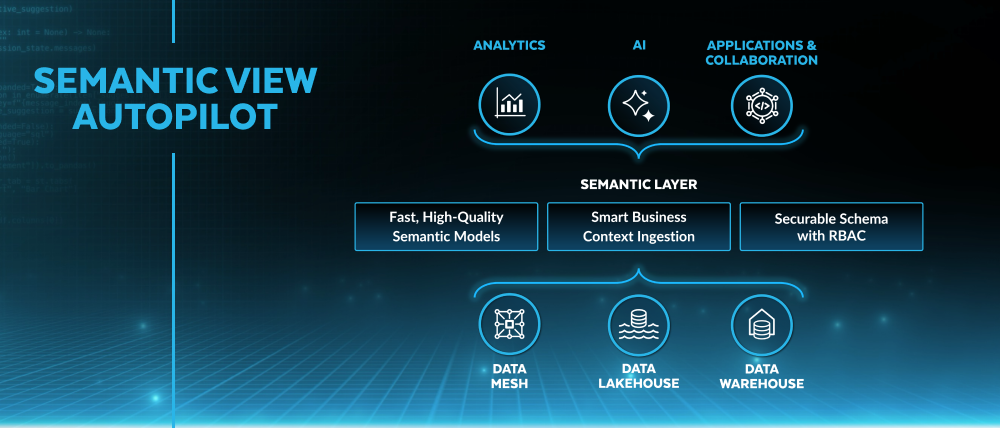
Snowflake Semantic View Autopilot (Source: Snowflake)
Kleinerman also covered a separate update to Horizon Catalog: Intent-Driven Governance, a natural-language capability that translates business rules into programmatic governance policies. You explain the goal in simple, plain English; Snowflake handles enforcement and audit documentation automatically.
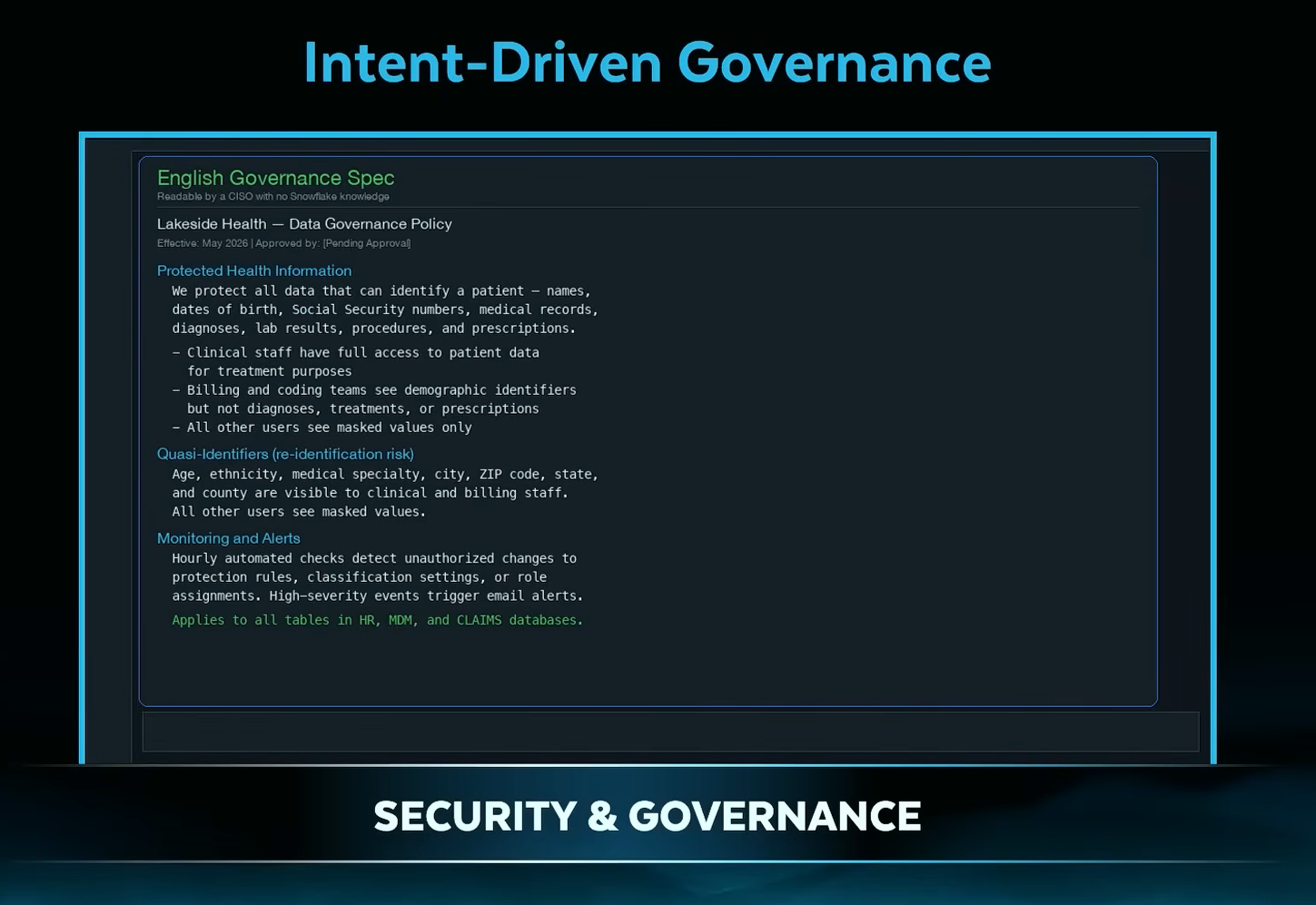
Snowflake Intent-Driven Governance (Source: Snowflake)
Kleinerman wrapped up the semantic governance segment by discussing the Open Semantic Interchange (OSI) standard. It’s an open format for sharing semantic models across data tools so context can move between platforms without being locked into any single vendor’s proprietary representation. OSI now has 50+ participating vendors, including Atlan, Collibra, dbt Labs, Databricks, ThoughtSpot, Informatica, BlackRock and more. For enterprises running mixed stacks, this is more practically valuable than most headline product releases.
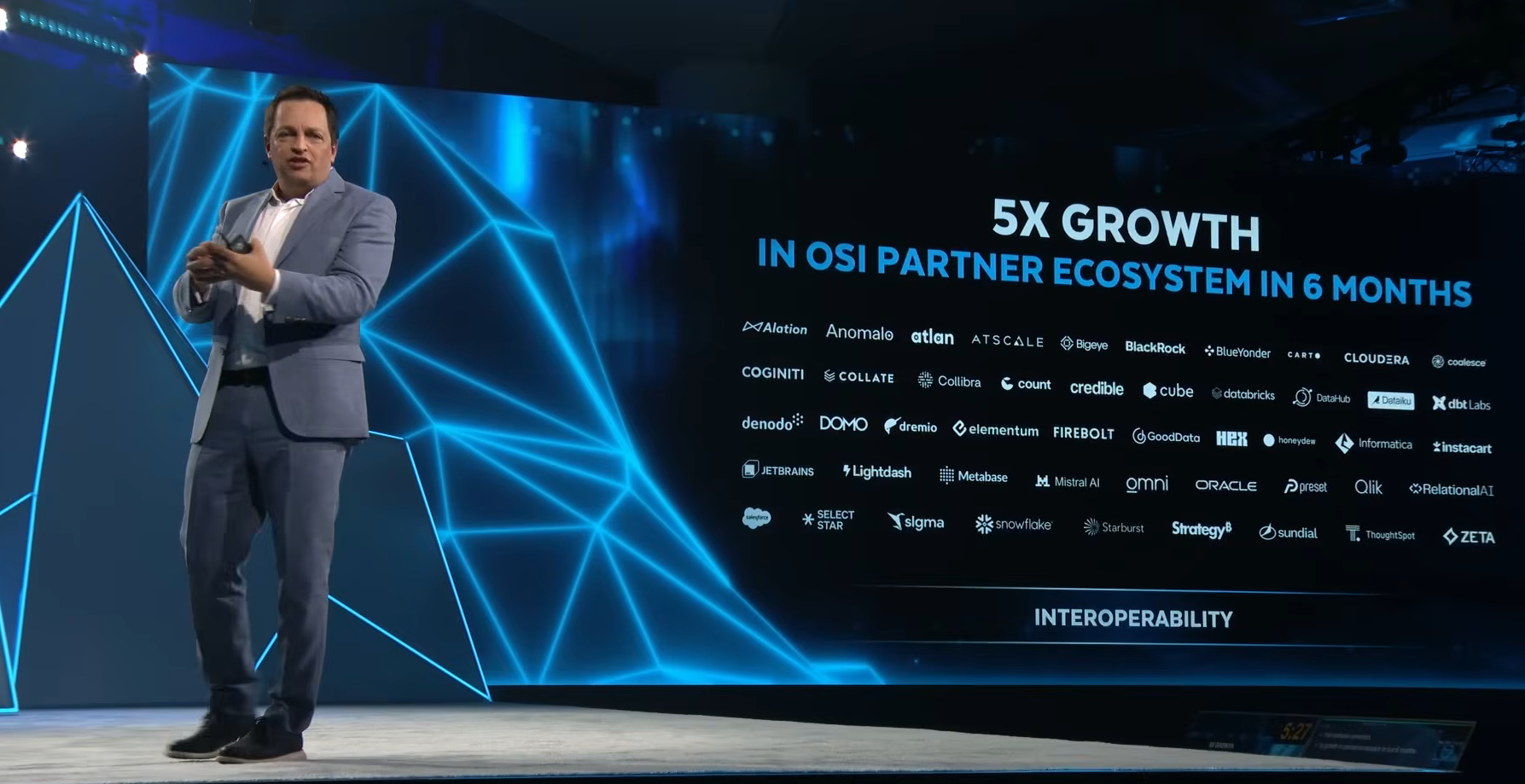
Open Semantic Interchange (OSI) participant ecosystem
Security for the age of agents
Kleinerman was direct about why current security models fail: “Traditional security models were designed for human users, not autonomous software agents”. Every security announcement was based on that basis.

Snowflake AI security framework overview (Source: Snowflake)
Here are the key announcements made around AI security.
AI Agent Identity is now generally available. Every AI agent gets a cryptographically verified identity before it can access data. Access controls are per-agent, not inherited from the user credentials that launched the agent. Dynamic data masking applies based on agent type and a complete audit trail records every agent action.
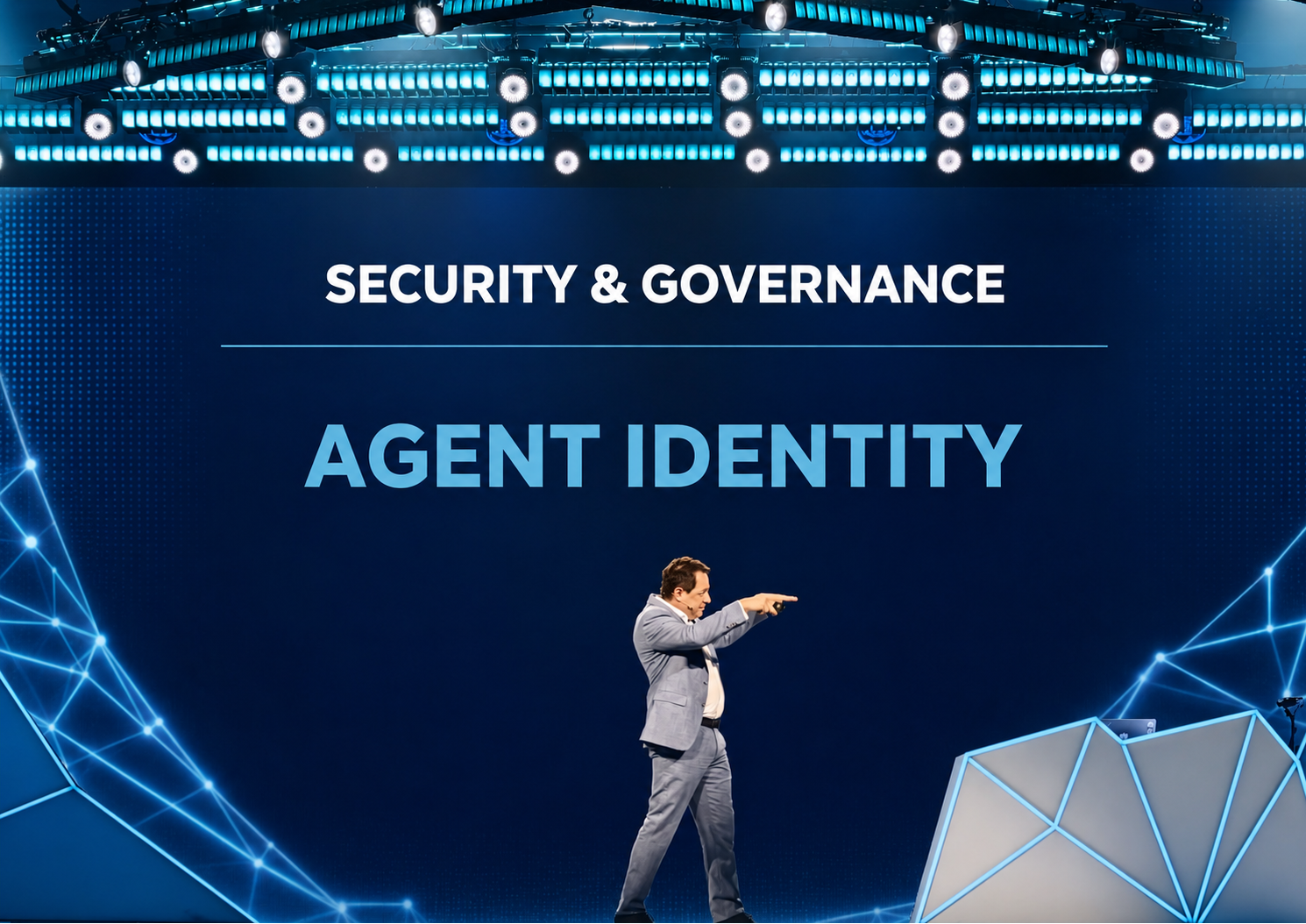
Snowflake AI Agent Identity introduction slide
AI Security Posture Management is now available in Snowflake Trust Center. It adds continuous monitoring for AI system security with machine-learning-driven threat detection covering data exfiltration, ransomware, prompt injection and jailbreak attempts. The stack also includes data exfiltration policies that define where data can and cannot move and multi-party authorization for sensitive operations.
Connected Audit Access is now in private preview. It provides unified audit visibility within Horizon Catalog for cross-system traceability, so teams can trace what happened across the full data estate.
External Engine Access Management is also in private preview. It controls what external compute engines including Apache Spark and Databricks can access within Snowflake. As Apache Iceberg opens the data layer to more compute engines, controlling that access becomes its own governance problem. This is Snowflake’s answer to it.
Infrastructure and interoperability updates
These announcements drew less stage time than CoWork and CoCo, but they carry more weight for long-term architecture decisions.
Apache Iceberg v3 reached general availability. Snowflake claims the broadest v3 feature support of any platform, covering deletion vectors, row lineage, a variant type for semi-structured data and default values. The practical implication: enterprises can now run read-and-write workloads on the same Iceberg tables from multiple compute engines. Snowflake is also actively contributing to the v4 specification.
Apache Iceberg v3 GA
Snowflake Storage for Apache Iceberg Tables also reached general availability. It enables organizations to maintain a single live, governed copy of data across Snowflake and external data lakes without moving or duplicating it. Horizon Catalog, powered by Apache Polaris, provides bidirectional read and write access across both environments.
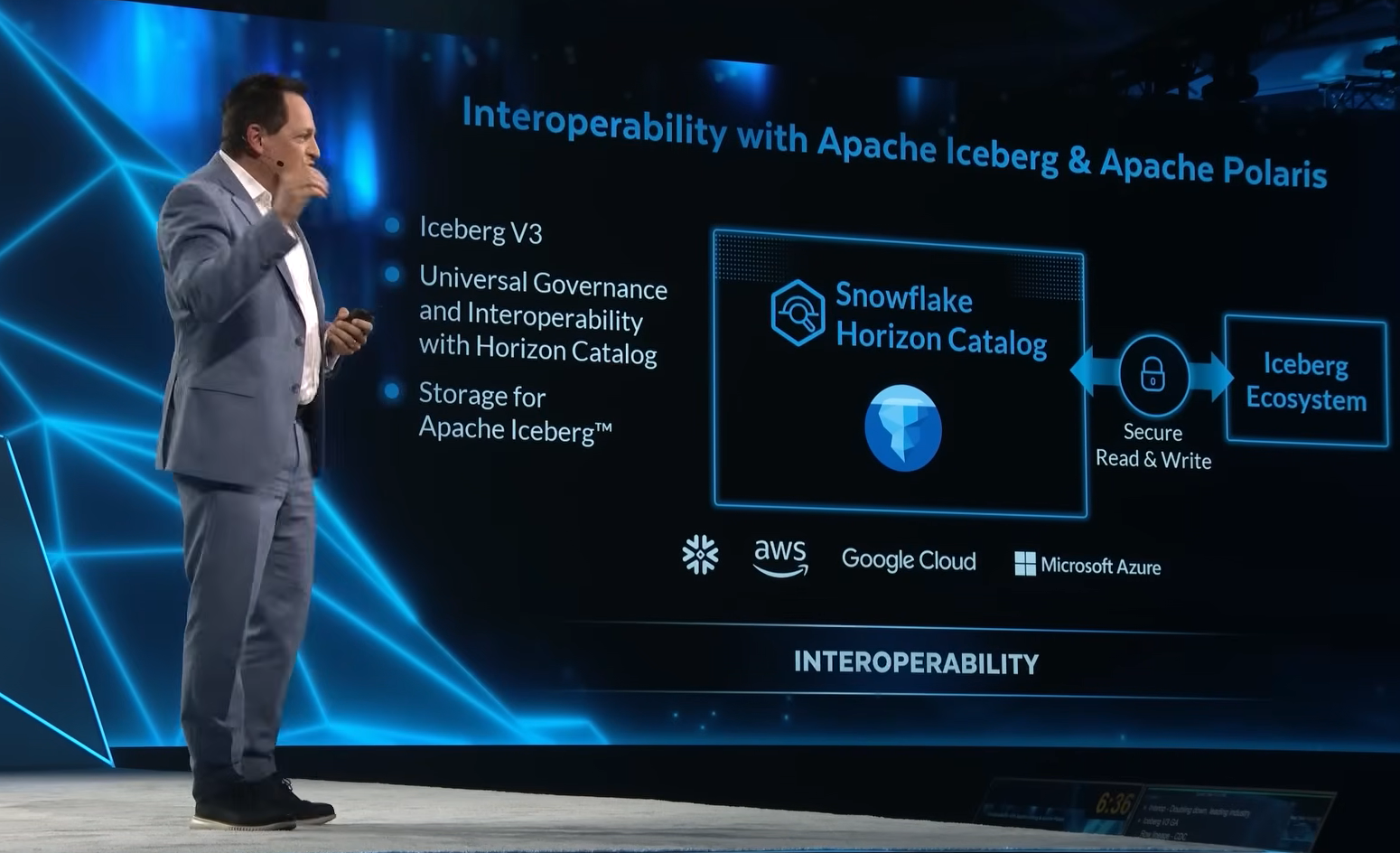
Snowflake Storage for Apache Iceberg Tables architecture
Zero-Copy Integrations is also now generally available.
Zero-Copy Integrations connect SAP, Salesforce, Workday, AVEVA and IBM directly to Snowflake without duplicating data. For enterprises running these systems, it eliminates a class of ETL pipelines entirely. SAP integration is now generally available. Salesforce integration has been GA for over two years, with a reimagined connector experience coming soon. Workday is in private preview.
Snowflake Datastream is now in preview. It is a fully managed, Apache Kafka-compatible streaming service native to Snowflake. It’s designed as a drop-in Kafka replacement. Data streamed through Datastream automatically inherits Snowflake governance and lineage, which is what distinguishes it from running your own Kafka cluster. Together with CoCo, Datastream creates a path to building real-time AI pipelines without leaving the Snowflake environment.
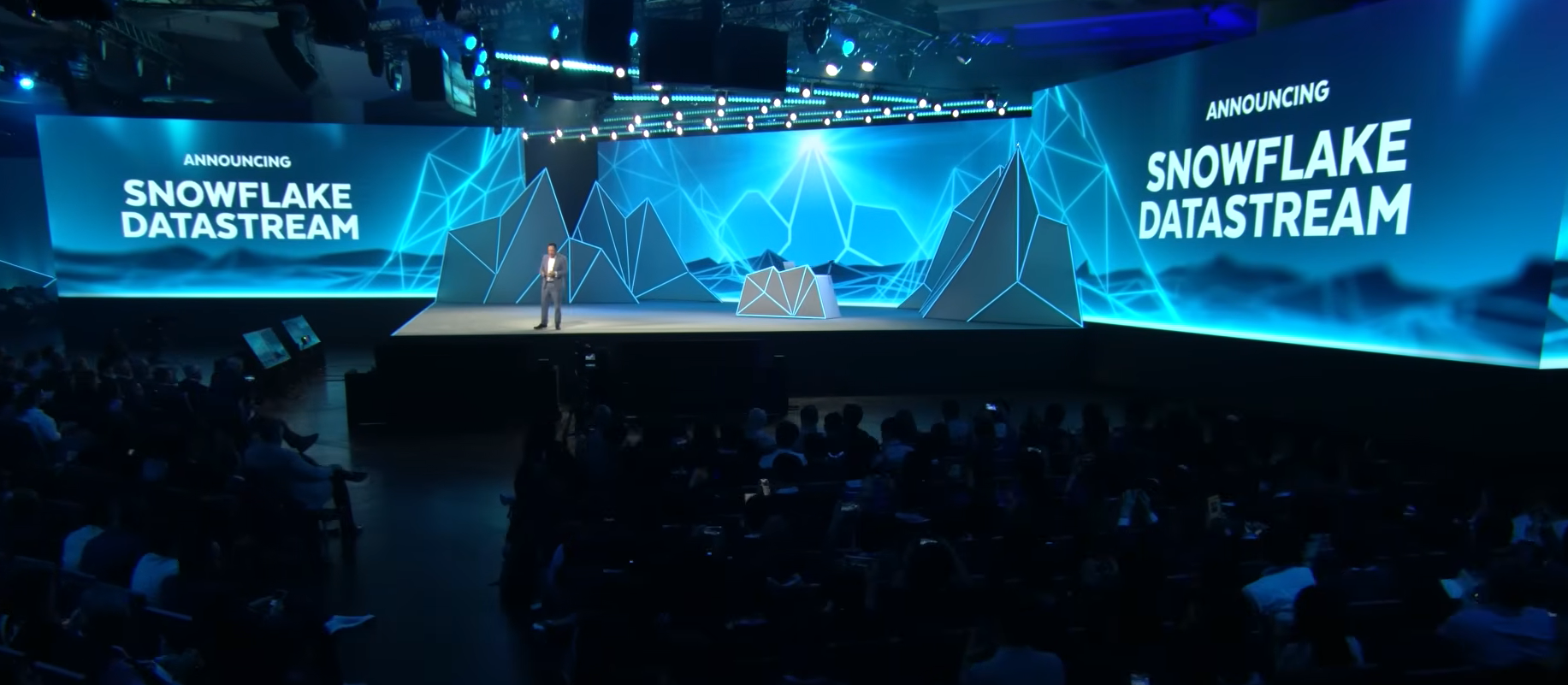
Snowflake Datastream introduction
Snowflake Openflow is now generally available on AWS, Azure and Google Cloud Platform.
Snowflake AIM, an AI-powered migration, is also now generally available.
Snowflake AIM unifies migration, modernization and virtualization for workloads moving from Teradata, Spark and other platforms. It combines capabilities from SnowConvert AI and the Snowpark Migration Accelerator and includes an AIM agent accessible via CoCo that guides users through migration by identifying dependencies and risks before any production changes.
Snowflake Cortex Training
On the custom model training front, Cortex Training was introduced. It extends Cortex AI with fully managed GPU infrastructure for fine-tuning open-weight models directly inside Snowflake. Supported model families include Qwen and Mistral. Data never leaves the Snowflake environment during training.
Snowflake claims up to 2x more training runs per equivalent GPU budget through multi-tenant GPU utilization, compared to running equivalent infrastructure externally. The feature supports reinforcement learning and domain-specific customization, which is extremely crucial for regulated industries where off-the-shelf model accuracy on specialized terminology is a real bottleneck.
Adaptive Compute coming soon to general availability
Adaptive Compute which was introduced in private preview last year at Snowflake Summit 2025, was announced as coming soon to general availability very soon.
Adaptive Compute automatically right-sizes compute resources on the customer’s behalf, removing the need to manually select warehouse sizes.
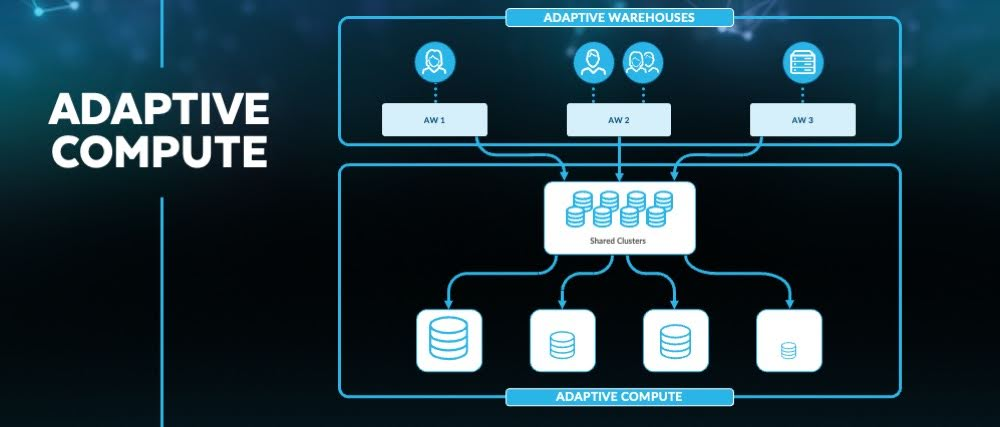
Snowflake Adaptive Compute (Source: Snowflake)
Based on TPC-DS and internal benchmarks measured against both Gen1 and Gen2 standard warehouses, Adaptive Compute delivers:
- ~ 1.6x faster for analytical workloads (exploratory analytics, data science, ad hoc queries)
- ~ 2.2x higher query throughput for highly concurrent operational analytics workloads
- ~ 3.5x faster execution for DML-heavy workloads such as data transformations, ingestion and pipelines
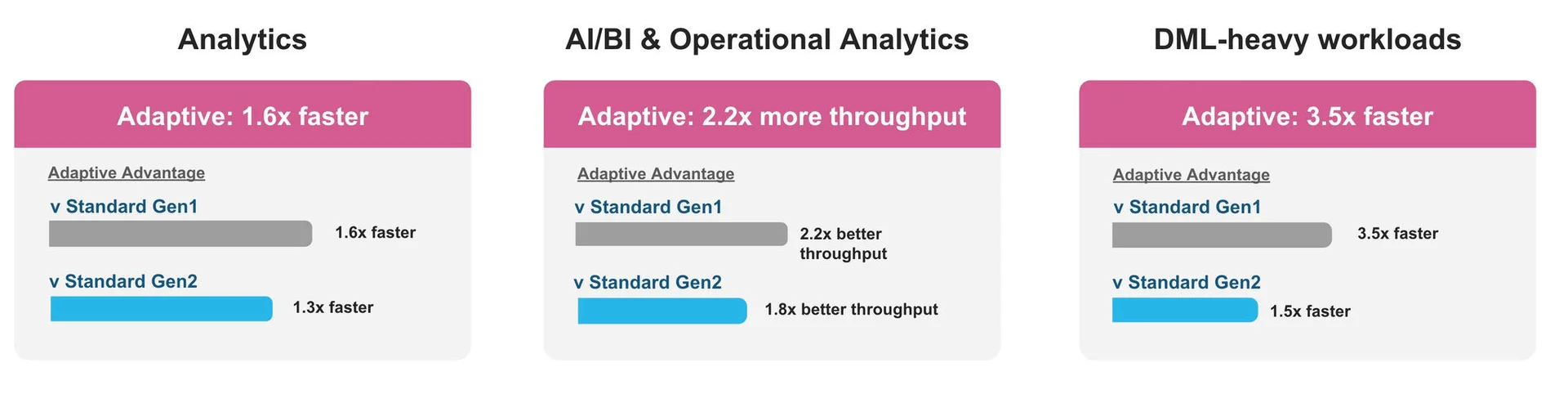
Snowflake Adaptive Compute benchmark (Source: Snowflake)
More models, more choice in Cortex AI
Snowflake’s model lineup continues to expand. Grok from xAI (SpaceX) is now generally available in Cortex AI, joining Claude, GPT, Gemini, Llama, Mistral and DeepSeek.
Snowflake also launched Cortex AI Function Studio which is in public preview. It is a powerful tool for creating, evaluating and optimizing custom AI functions inside Snowflake.
Alongside it, Snowflake also launched Automatic Data Agents for listings and shares which is in public preview. What it does is it automatically creates conversational agents for Snowflake Marketplace datasets, so data providers can add an agent interface to their listings without building one from scratch.
Customer stories: Thomson Reuters, Under Armour and Samsung
Thomson Reuters
Caitlin Halferty, Head of Data and Analytics at Thomson Reuters, joined the Platform Keynote to share how the company has turned governed data into what it calls “fiduciary-grade AI”.
For a company like Thomson Reuters, where products like CoCounsel and Westlaw serve legal and regulatory professionals, accuracy is not optional. Halferty made that loud and clear: the real value for Thomson Reuters isn’t speed alone, but the ability to innovate in a governed environment where complex regulatory data can become actionable insights without compromising trust or control.
Under Armour
Patrick Duroseau, Chief Data AI Officer at Under Armour, joined Kleinerman on stage to show what five years of committed Snowflake investment looks like in practice.
nder Armour made a deliberate shift roughly five years ago, moving from a transactional vendor relationship with Snowflake to a deep, functional data ecosystem built on a trusted, accessible foundational layer. Using Snowflake’s architecture, including hybrid and dynamic tables, the company democratized its data. Slow, traditional IT reporting was replaced with self-serve analytics across the organization.
Samsung
One of the most interesting stories came from Samsung.
Kleinerman invited Jung Suh, Head of Digital Commerce at Samsung, on stage to demonstrate how the company utilizes AI agents to track real-time customer response during big product launches. Suh put it succinctly: “By the time a traditional analytics team surfaces why conversion is down in a region, we’ve already missed the window of action. We already lost the attention of our target customer audience and we need to move with the launch, not behind it.”
Samsung’s answer is what they call the Shoppers Inside Action agent. Running on Snowflake data, the agent compares launch performance in real time across models and regions, giving the team the ability to act while the launch window is still open rather than analyzing it afterward.
That wraps up Day 2, the most product-intensive session of the conference.
Check out this platform keynote highlights from Day 2 of the Snowflake Summit 2026:
https://youtu.be/NFTdHYp9uJo?si=YpfiT6zXmm-iHSzm
Day 3: Wednesday, June 3, 2026 — Builder keynote and technical deep dives
Day 3 shifted from executive vision to hands-on building. The Builder Keynote ran in the morning with live demos, technical depth and perspectives from practitioners building and deploying AI agents on the Snowflake AI Data Cloud.
Sessions focused on data readiness for intelligent agents. Practitioners covered how they use CoWork and CoCo together with Horizon Context for governed semantics and Cortex Sense for enriched AI response quality. Adaptive Compute and Cortex Training got substantial attention, with discussions on how to right-size workloads and build domain-specific models without managing GPU infrastructure.
Security and governance remained a recurring thread. The Natoma acquisition reinforces this: Natoma adds enterprise MCP governance for agentic access, allowing agents to govern what they may read, write and act on across software as a service (SaaS) applications, databases and tools, while preserving audit trails and verified agent identities.
2026 Snowflake Partner Awards – Snowflake Summit 2026
Snowflake Summit Day 3’s highlight was the Snowflake Partner Awards.
Snowflake honored its ecosystem partners on Day 3, recognizing standout performance across services, products and industry verticals. This year marked the debut of the CoCo Catalyst Award, recognizing the first wave of partners driving enterprise adoption of Snowflake CoCo.
Here are all the noteworthy winners of the Snowflake Partner Awards announced at Snowflake Summit 2026:
Snowflake services partners
- 2026 Global Snowflake Services Partner of the Year: Deloitte
- 2026 Global Snowflake Services AI Partner of the Year: phData
- 2026 Global Snowflake Services Implementation Partner of the Year: Accenture
- 2026 AMER Snowflake Services Implementation Partner of the Year: phData
- 2026 EMEA Snowflake Services Implementation Partner of the Year: EY
- 2026 APJ Snowflake Services Implementation Partner of the Year: NTT Data
- 2026 Global Snowflake Services Innovation Partner of the Year: Slalom
- 2026 AMER Snowflake Services Innovation Partner of the Year: IBM
- 2026 EMEA Snowflake Services Innovation Partner of the Year: Capgemini
- 2026 APJ Snowflake Services Innovation Partner of the Year: Accenture
- 2026 AMER Snowflake Services Growth Partner of the Year: evolv Consulting
- 2026 EMEA Snowflake Services Growth Partner of the Year: Datalab
- 2026 APJ Snowflake Services Growth Partner of the Year: Mantel
Industry Snowflake services
- 2026 Financial Services Snowflake Services Partner of the Year: EY
- 2026 Healthcare and Life Sciences Snowflake Services Partner of the Year: Accenture
- 2026 Manufacturing and Industries Snowflake Services Partner of the Year: Deloitte
- 2026 Marketing and Advertising Snowflake Services Partner of the Year: DAS42
- 2026 Media and Entertainment Snowflake Services Partner of the Year: Spaulding Ridge
- 2026 Public Sector Snowflake Services Partner of the Year (SLED): Archetype
- 2026 Public Sector Snowflake Services Partner of the Year (FED): GDIT
- 2026 Retail and Consumer Goods Snowflake Services Partner of the Year: Tredence
- 2026 Telecom Snowflake Services Partner of the Year: kipi.ai, part of Capgemini
Snowflake resale
- 2026 AMER Snowflake Resale Partner of the Year: CDW
- 2026 EMEA Snowflake Resale Partner of the Year: Softcat
- 2026 APJ Snowflake Resale Partner of the Year: MegazoneCloud
Snowflake products
- 2026 Snowflake Product Partner of the Year (AI/ML Data Science Tooling): Posit
- 2026 Snowflake Product Partner of the Year (AI Platform): Dataiku
- 2026 Snowflake Product Partner of the Year (AI Tooling): Kumo
- 2026 Snowflake Product Partner of the Year (Agentic Transformation): Elementum
- 2026 Snowflake Product Partner of the Year (Agentic Analytics): Hex
- 2026 Data Integration Snowflake Product Partner of the Year: dbt Labs
- 2026 Business Intelligence Snowflake Product Partner of the Year: Sigma Computing
- 2026 Data Governance Snowflake Product Partner of the Year: Monte Carlo
- 2026 Startup Program Snowflake Product Partner of the Year: dltHub
- 2026 Global Snowflake Product Innovation Partner of the Year: Posit
- 2026 AMER Snowflake Product Innovation Partner of the Year: Glean
- 2026 EMEA Snowflake Product Innovation Partner of the Year: LSEG
- 2026 APJ Snowflake Product Innovation Partner of the Year: Dataiku
- 2026 AMER Snowflake Product Growth Partner of the Year: Blue Yonder
- 2026 EMEA Snowflake Product Growth Partner of the Year: Sigma Computing
- 2026 APJ Snowflake Product Growth Partner of the Year: Braze
Industry Snowflake products
- 2026 Financial Services Snowflake Product Partner of the Year: Fiserv, Inc.
- 2026 Retail and Consumer Goods Snowflake Product Partner of the Year: NielsenIQ
- 2026 Media and Entertainment Snowflake Product Partner of the Year: TransUnion
- 2026 Healthcare and Life Sciences Snowflake Product Partner of the Year: Verato
- 2026 Marketers and Advertisers Snowflake Product Partner of the Year: Hightouch
- 2026 Manufacturing and Industrials Snowflake Product Partner of the Year: Yes Energy
- 2026 Telecom Snowflake Product Partner of the Year: RelationalAI
CoCo Catalyst Award (inaugural class)
- 2026 CoCo Catalyst — Services Global Adoption: Accenture
- 2026 CoCo Catalyst — Services AMER Adoption: BlueCloud
- 2026 CoCo Catalyst — Services EMEA Adoption: INFOMOTION
- 2026 CoCo Catalyst — Services APJ Adoption: NTT Data
- 2026 CoCo Catalyst — Data Cloud Product (DCP) Adoption: dbt Labs
- 2026 CoCo Catalyst — DCP Adoption: Sigma Computing
- 2026 CoCo Catalyst — Impactful Customer Story: CitiusTech
- 2026 CoCo Catalyst — Impactful Customer Story: Cognizant
- 2026 CoCo Catalyst — Impactful Customer Story: evolv Consulting
Check out the full list available on Snowflake’s 2026 Partner Award blog post.
Day 4: Thursday, June 4, 2026 — Dev Day and the Startup Challenge finale
Finally, Day 4 of Snowflake Summit was Dev Day, Snowflake’s dedicated event for developers and data professionals. The format was hands-on throughout: live demos, technical labs, expert Q&A and practitioner-led workshops on building, deploying and scaling AI agents and applications on the Snowflake AI Data Cloud. A virtual Dev Day is planned for June 25.
Check out this Dev Day highlights from Day 4 of the Snowflake Summit 2026:
The Startup Challenge finale: LGND AI wins
The Startup Challenge finale, held at the Dev Day Builders’ Theater Stage, closed out the four days. This year’s program received entries from more than 100 different countries. The three finalists competed for a share of up to $1 million in potential investment from Snowflake Ventures, along with mentorship from NYSE-listed company executives.
The three finalists of the Snowflake Summit 2026 Startup Challenge finale were:
1) Airrived is building an agentic OS that orchestrates enterprise workflows across tools and systems
2) LGND AI is building Large Earth Models from satellite imagery
3) Twine Security is building AI-native cybersecurity agents for identity and access management
LGND AI won the 2026 Startup Challenge championship.
LGND AI’s goal is to make the entire planet queryable through imagery. Earth observation data has immense potential value, but it’s largely inaccessible to LLMs because those models are trained on language, not satellite pictures. LGND builds Large Earth Models trained on 800 petabytes (PB) of Earth imagery, allowing users to query geospatial data within Snowflake. Their platform already powers use cases in insurance, climate risk and government through Cortex AI.
Nathaniel Manning, CEO of LGND AI, stated: “We believe that in the not-too-distant future, our largest user bases won’t be just humans. It will be agents, robots and other AI models. Every AI that wants to understand the physical world is going to need what we’re building.”
As Benoit Dageville put it from the judges’ panel: “It’s such a broad theme, understanding the Earth as a whole. I like the ambition and the innovation“.
Runners-up Airrived and Twine Security also showcased agentic applications with real enterprise utility. Each will be considered for up to $250,000 in potential investment from Snowflake Ventures.
Dev Day wrapped up with additional customer spotlights showcasing how teams are extending CoWork and CoCo in production.
Here’s a quick summary of what was announced at the Snowflake Summit 2026 :
| Snowflake Summit 2026 announcement | Category | Status | Summary |
| AWS $6B commitment | Pre-summit | Announced | Five-year, $6B infrastructure deal covering Graviton processors and AI compute for agentic workloads |
| Natoma acquisition | Pre-summit | Announced | Enterprise MCP platform for AI agents; extends governance from data to agent actions across SaaS tools and databases |
| Anthropic partnership expansion | Day 1 | Announced | Building on the Dec. 2025 $200M deal; expanded Claude model access in Cortex AI, Claude Marketplace launch partner status and deepened joint go-to-market |
| Snowflake CoWork (rebrand) | Agents and productivity | GA | Snowflake Intelligence renamed CoWork; now positioned as the personal AI agent for knowledge workers across governed data |
| CoWork Artifacts | Agents and productivity | GA soon | Analysts build and publish interactive dashboards colleagues explore via natural conversation, grounded in live Snowflake data |
| CoWork Deep Research | Agents and productivity | GA soon | Multi-step reasoning across structured tables, documents and external context; outputs a cited report with what, why and what to do |
| CoWork User Memory | Agents and productivity | Public preview | Maps each user’s role and behavior over time so CoWork learns what you actually need rather than answering each prompt in isolation |
| CoWork Skill Catalog | Agents and productivity | GA soon | Teams package workflows into reusable skills and share them across the organization |
| MCP connectors (Slack, Drive, Salesforce) | Agents and productivity | GA | Model Context Protocol connectors for Slack, Google Drive and Salesforce now GA; Gmail and Jira connectors announced |
| CoWork iOS app | Agents and productivity | GA soon | Native iOS app bringing CoWork to mobile; finance and sales team plugins also coming soon |
| Snowflake CoCo (rebrand) | Agents and productivity | GA | Cortex Code renamed CoCo — fastest-growing product in Snowflake history, 7,100+ accounts within months of GA |
| CoCo Desktop | Agents and productivity | GA | Standalone native desktop app for working with CoCo outside the Snowflake web interface |
| CoCo VS Code extension | Agents and productivity | GA | CoCo available directly inside VS Code for data engineers and developers |
| CoCo Excel extension | Agents and productivity | GA | CoCo available inside Microsoft Excel for spreadsheet-based data workflows |
| CoCo in Claude Code | Agents and productivity | GA | CoCo integrates directly into Claude Code for developer teams already working in that environment |
| CoCo Cloud Agents | Agents and productivity | GA | Background task execution so long-running jobs don’t block active development |
| CoCo Mobile app + Slackbot | Agents and productivity | Announced | CoCo accessible on mobile and via Slack for async task management and workflow automation |
| Snowflake Managed Agents | Agents and productivity | Announced | Framework for deploying and operating AI agents inside Snowflake without managing underlying infrastructure or agent lifecycle |
| Cortex Sense | Context and semantics | Private preview | Runtime context layer that dynamically assembles data, business definitions and operational knowledge for AI agents at query time |
| Horizon Context | Context and semantics | Announced | New layer inside Horizon Catalog with three-stage architecture (Collect, Enrich, Activate) making semantic governance useful for AI |
| Semantic Studio | Context and semantics | Private preview | Teams define shared business logic without SQL expertise; specify what a metric means without needing to know how it’s calculated |
| Semantic View Autopilot | Context and semantics | GA | Automatically generates and refines semantic view data definition language from existing tables, cutting the manual work of building a semantic layer from scratch |
| Open Semantic Interchange (OSI) | Context and semantics | Announced | Open standard for sharing semantic models across tools; 50+ vendors including Collibra, dbt Labs, Databricks and ThoughtSpot |
| AI Agent Identity | Security and governance | GA | Cryptographically verified identity per agent before data access; per-agent role-based access control, dynamic data masking and full audit trail |
| AI Security Posture Management | Security and governance | Public preview | Continuous monitoring in Trust Center with machine-learning-driven detection for data exfiltration, ransomware, prompt injection and jailbreak attempts |
| Data Exfiltration Policies + Multi-Party Authorization | Security and governance | Public preview | Policies defining where data can move; multi-party approval requirements for sensitive agent operations |
| Connected Audit Access | Security and governance | Private preview | Unified audit visibility in Horizon Catalog for cross-system traceability across the full data estate |
| External Engine Access Management | Security and governance | Private preview | Controls what external compute engines (Apache Spark, Databricks) can access within Snowflake as Iceberg opens the data layer |
| Apache Iceberg v3 | Infrastructure | GA | Broadest v3 feature support claimed: deletion vectors, row lineage, variant type for semi-structured data and default values; read-write from multiple engines |
| Snowflake Storage for Iceberg Tables | Infrastructure | GA | Single live, governed copy of data across Snowflake and external data lakes; bidirectional read-write via Horizon Catalog and Apache Polaris |
| Zero-Copy Integrations | Infrastructure | GA (SAP); others in preview | Direct connections from SAP, Salesforce, Workday, AVEVA and IBM into Snowflake without data duplication; eliminates a class of ETL pipelines |
| Snowflake Datastream | Infrastructure | Private preview | Fully managed Kafka-compatible streaming service native to Snowflake; data inherits governance and lineage on arrival |
| Snowflake Openflow | Infrastructure | GA | Batch and streaming integration built on Apache NiFi; GA on AWS and Snowpark Container Services; Azure and GCP availability announced |
| Snowflake AIM | Infrastructure | GA | AI-powered migration for Teradata and Spark workloads; includes a CoCo-accessible migration agent for dependency and risk analysis |
| Cortex Training | AI infrastructure | Announced | Fully managed GPU fine-tuning for open-weight models (Qwen, Mistral families) inside Snowflake; supports reinforcement learning; up to 2x more training runs per GPU budget |
| Adaptive Compute | AI infrastructure | GA soon | Automatically right-sizes compute without manual warehouse sizing; up to 1.6x faster analytics and up to 3.5x faster DML vs. Gen1 warehouses |
| Grok (SpaceXAI) in Cortex AI | AI infrastructure | GA | Grok models now GA in Cortex AI, joining Claude, GPT, Gemini, Llama, Mistral and DeepSeek |
| Cortex AI Function Studio | AI infrastructure | Public preview | Create, evaluate and optimize custom AI functions inside Snowflake |
| Auto-generated agents for Marketplace listings | AI infrastructure | Public preview | Automatically generates conversational agents for Snowflake Marketplace datasets so providers can add agent interfaces without building from scratch |
Snowflake Summit 2026 concluded with a focus on what’s next for the community. Overall, the four-day session provided a fairly comprehensive overview of Snowflake’s current situation. The keynotes discussed some intriguing new features, such as a new rebrand, AI and governance, faster computing power and many other new features. The builder sessions focused on how to actually use these features. Dev Day was also a highlight, showcasing Snowflake’s expanding network of labs, partners and startups.
Conclusion
And that’s a wrap! Snowflake Summit 2026 was by far the largest and most product-dense Summit in the event’s history. The theme “Making AI Real for Business” was not just a vision; it was supported with 20+ shipping announcements, two big product rebrands, one significant acquisition, a $6 billion infrastructure commitment and a deepened partnership with Anthropic that put Claude models at the center of both Snowflake CoWork and CoCo.
The general theme across the four days was consistent: models are a commodity; governed enterprise data is not. The most significant announcements, from Horizon Context and Cortex Sense to AI Agent Identity and Adaptive Compute, were all about bridging the gap between having data and having AI that can reliably act on it at scale. The Natoma acquisition fits that same logic: governance has to extend not just to data but to every action an agent takes on your behalf.
If there’s one thing Snowflake Summit 2026 made clear, it is that the agentic enterprise is here to stay. Everyone has already started putting it into action and the tools to do it right are now readily available.
Flexera is not affiliated or endorsed by Snowflake, Inc.
Pramit Marattha
Pramit Marattha is a technical content writer and strategist with 5+ years of experience covering AI, data engineering, data cloud platforms and open source technologies. He turns complex technical concepts into clear, useful content for engineers and developers.