


AI is taking up an increasingly prominent place in corporate strategy. Major businesses are introducing AI into everyday operations and reporting on how the technology is changing the way they work. Yet their annual reports reveal surprisingly little about how much they’re spending or the financial returns they’re seeing.
A new public company reporting analysis from Flexera, examining annual filings from companies in the U.S. Dow 30 and the UK’s FTSE 100, offers a closer look at how some of the world’s largest businesses are reporting on AI investment.
US analysis finds widespread AI use, but limited financial disclosure
Flexera’s analysis of the 2025 annual filings from all 30 Dow companies found that AI is firmly embedded in corporate strategy and operations, with more than three-quarters reporting active use.
Key highlights include:
- 93% discuss AI in their latest annual filings
- 77% describe actively using AI
- 73% identify a specific AI application or use case
- 7% disclose a clearly identifiable AI-linked investment amount
- 7% provide a quantified AI-linked business result
As AI moves from experimentation into broader enterprise deployment, companies are increasingly willing to describe where the technology is being used. Their filings offer far less detail about whether those applications have achieved their intended results or what resources are needed to support them.
Flexera also found that 27 of the 30 Dow companies (90%) identify company-specific AI risks in their filings, making them more than 13 times as likely to disclose an AI-related risk than to quantify a business result linked to the technology.
While companies are finding their footing when it comes to disclosing AI risk, the economics of their deployments remain much less visible. Corporate reporting has begun to recognize AI as a company-specific source of risk, even when its contribution to business performance has yet to be quantified.
UK findings reveal similar gaps in AI financial reporting
Flexera’s separate analysis of the 2025 FTSE 100 annual reports examined whether the benefits companies attributed to AI were accompanied by financial evidence.
The analysis found that:
- 36% of FTSE 100 companies report substantive AI deployment or use.
- 32% link AI to a specific business outcome.
- 3% report a specific financial AI return or outcome.
- 2% disclose a specific AI expenditure figure.
- 0% identify AI investment as a separate budget or cost.
- 54% identify AI as a material or company-specific risk.
Although almost a third of companies link AI to a specific business outcome, very few explain what those improvements are worth financially. With none identifying AI investment as a separate budget or cost, shareholders also have limited evidence to weigh the benefits against the expenditure behind them.
Marlon Oliver, Senior Vice President, EMEA, at Flexera, explains why businesses need to go further in demonstrating what AI is contributing to company performance.
“AI investment needs to connect to business KPIs, whether that is downtime reduced, tickets resolved, claims processed or revenue generated. When shareholders are told AI is improving productivity, they should be able to see what that improvement is worth, what it cost and whether the economics are improving.”
What the findings reveal across the US and UK
Across the Dow 30 and FTSE 100, Flexera’s analysis reveals a common imbalance in how major businesses are reporting on AI. Although the studies measure some aspects of AI activity differently, both show that companies are more forthcoming about the technology’s applications and associated risks than the investment and measurable results behind them.
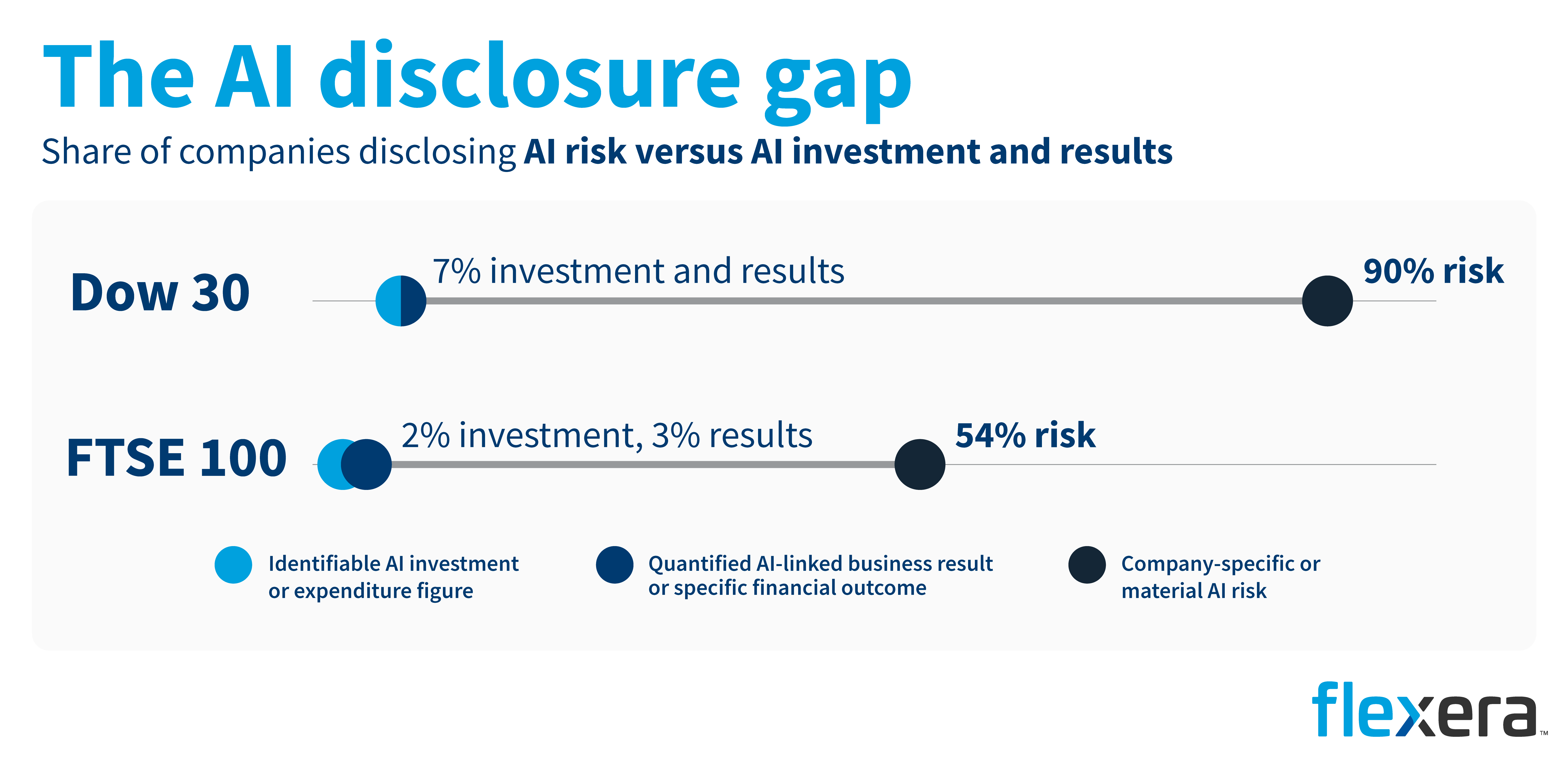
The AI disclosure gap
For enterprises moving beyond individual AI projects, establishing the full cost of deployment can be challenging. AI capabilities may arrive through existing software subscriptions or applications built on cloud infrastructure. The team benefiting from an initiative may not be the one paying for its underlying consumption, making it harder to determine whether the investment is delivering sufficient value.
While the analysis measures public disclosure rather than internal financial management, it points to a broader challenge for technology and finance teams. AI is increasingly bought and built across different parts of the business, making it harder to account for total consumption through conventional software and cloud management practices.
Managing AI consumption as agents take on more work
The growing use of autonomous AI agents introduces further complexity, as expenditure is increasingly driven by the work performed rather than the number of employees using a service.
Steve Daheb, Head of AI GTM Strategy at Flexera, explains how this changes the economics of enterprise AI.
“Every AI decision and action can mean more tokens, more data, more compute and more cost. It’s the AI cost domino effect. So, the question isn’t only, ‘What does AI cost?’ It’s, ‘What does it return?’ Organizations need to understand what they’re spending and what outcomes AI is producing.”
As Flexera explores in its analysis of AI consumption, pricing models built around tokens and credits are changing how software expenditure is measured. With consumption varying by model and workload, organizations need to understand the activity driving their AI bills rather than relying on traditional license-based measures.
Flexera’s AI Cost Management capabilities bring together information across AI applications, agents and the infrastructure supporting them, helping businesses understand the cost of AI workloads and how that expenditure relates to usage and business outcomes.
By connecting consumption with measurable outcomes, organizations can identify where spending needs to be optimized and which AI initiatives warrant further investment. That understanding will become increasingly important as businesses scale their deployments and seek to demonstrate the value of their AI ambitions.