
Table of contents
Do not edit: TOC will be auto-generated
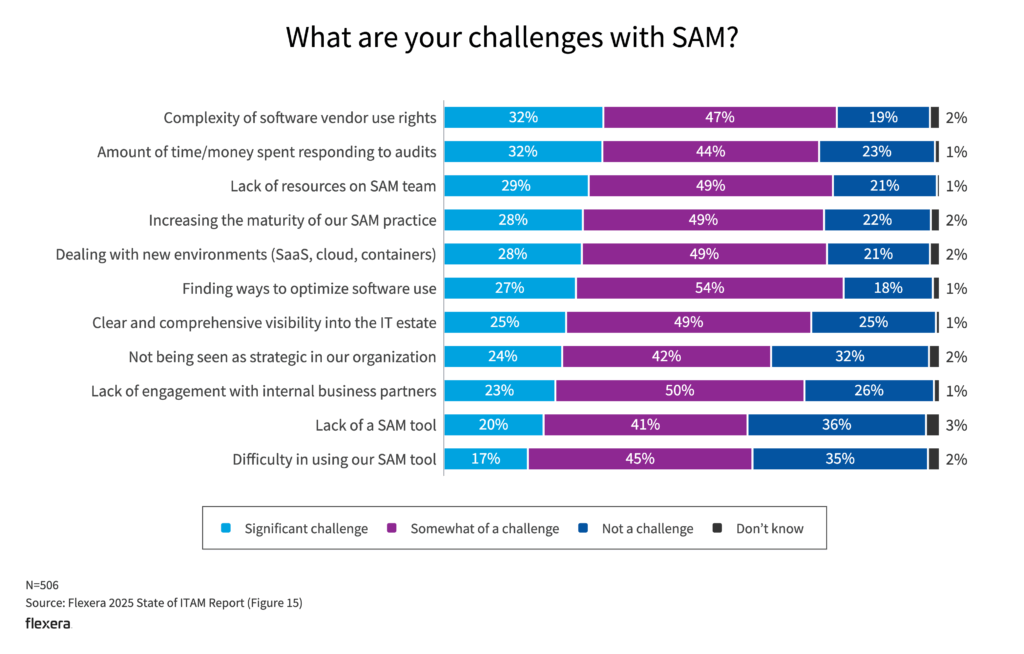
With the formation of FinOps and its convergence with ITAM, effective software license management is an increasingly critical required capability for organizations of all sizes. It impacts compliance, cost control and overall IT governance. But the complexity of software licensing agreements and the evolving nature of software distribution models make it challenging to maintain compliance while optimizing costs. According to Flexera’s 2025 State of ITAM Report, the complexity of vendor product use rights was the #1 challenge.
Product use rights (PUR) and the application of product use right templates are crucial components in software license management that enable cost savings and audit defense across your IT estate. Let’s learn how to understand them and how to get the most out of your technology investments.
Understanding product use rights
Product use rights refer to the permissions and limitations granted to the end user or organization in a software license agreement. These rights dictate how your software can be used, installed, accessed and shared—and understanding PUR is a fundamental prerequisite for effective software license management. The terms within a software license agreement can vary significantly between software vendors, so it’s essential that you understand the specifics of each agreement to ensure you’re in compliance.
The role of Product Use Rights
Compliance management
One of the primary roles of PUR is to help you maintain compliance with software license agreements. By clearly defining the terms of use, PUR ensure that software is used in accordance with the license agreement, reducing the risk of non-compliance, which can result in legal and financial consequences. These rights often specify the number of installations, users, devices or other usage parameters, helping you avoid license violations.
Cost optimization
Cost optimization is one important benefit of PUR because they act as a crucial tool that enable you to make informed decisions about software procurement and deployment. By understanding the limitations and permissions outlined in PUR, you can avoid over-licensing and unnecessary expenses. You can also leverage PUR to explore cost-effective licensing options, such as downgrade rights, which allow the use of older software versions to save on licensing costs.
Risk mitigation
PUR also serve as a crucial tool for risk mitigation because their clear and specific terms reduce the likelihood of misinterpretation and inadvertent non-compliance. This simplification of license terms ensures you can confidently use your software within the bounds of the agreement and avoid legal or financial risks associated with non-compliance.
In addition to compliance, cost optimization and risk mitigation, PUR are instrumental in streamlining software procurement and deployment processes. They provide a standardized framework for interpreting and applying PUR across your organization’s software portfolio, promoting consistency and efficiency in these critical activities.
Understanding product use case templates
Product use case templates are pre-defined, unique use right combinations that outline common usage scenarios (e.g., venue, configuration) for specific software products. These templates simplify the complex interpretation of the various combinations and permutations of available licensing scenarios, which in turn makes it easier to apply PUR consistently across your organization’s software portfolio. Some of the critical roles of use case templates include:
Standardization
Product use case templates offer standardized, pre-defined terms for common software usage scenarios. This standardization ensures that your organization can consistently interpret and apply PUR across its entire software portfolio. It helps eliminate ambiguity and confusion, making it easier to ensure compliance and avoid unnecessary misunderstandings.
Efficiency
Templates streamline the process of interpreting complex licensing terms. Rather than dissecting each license agreement from different vendors individually, you can refer to templates for common scenarios, saving you time and effort in the process. This efficiency contributes to faster decision-making and software deployment within your complex IT environment.
Consistency
Using templates ensures consistency in software license management. It guarantees that your organizations applies uniform rules and terms across its software assets. This consistency not only simplifies management but also reduces the risk of costly non-compliance and related liabilities.
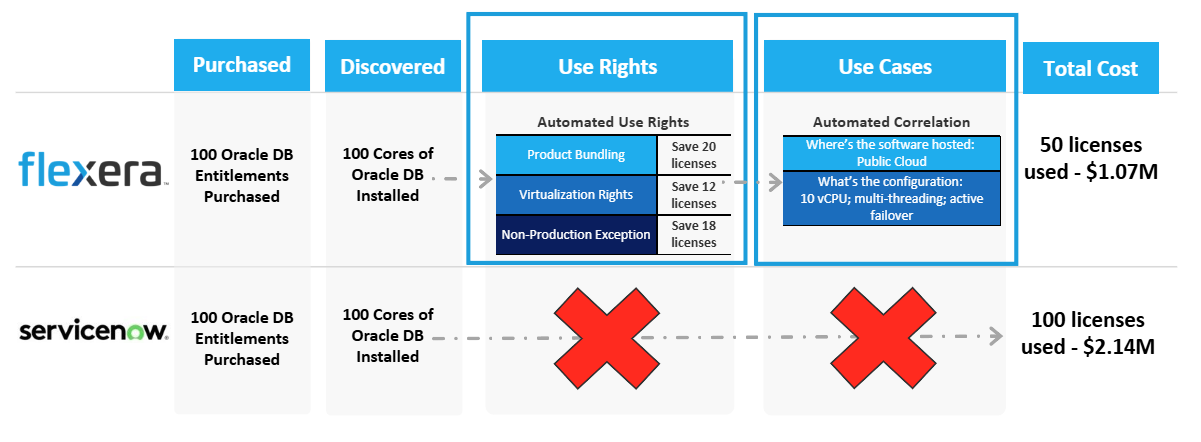
How does Flexera automate the application of product use right templates?
License intelligence
Flexera’s license intelligence is built on one of the industry’s most comprehensive and continuously updated libraries of product use rights and use right templates, spanning on-premises, SaaS, and cloud software. This intelligence extends to cloud and SaaS licensing models, helping organizations understand complex hybrid entitlements and optimize spend across traditional software, cloud licenses, and emerging AI applications.
Software recognition
Flexera uses advanced software recognition and normalization capabilities to identify software across on-premises, SaaS applications, and cloud environments. This ensures complete visibility into what’s deployed, what’s being used, and criticallywhere SaaS and AI-related applications are driving new and often untracked spend.
Template matching
Once software assets are identified, Flexera automatically maps them to the appropriate product use right templates using normalized data and licensing intelligence. This includes increasingly complex scenarios such as bring-your-own-license (BYOL), hybrid cloud deployments, and SaaS subscription models, ensuring accurate alignment between usage and entitlements.
Template application
Flexera applies the correct templates at scale across your entire technology estate, automating how usage rights, restrictions, and entitlements are enforced. This extends beyond traditional SAM to include cloud license optimization through Flexera One Cloud License Management and SaaS license optimization via Flexera One SaaS Management, helping reduce both over-licensing and unused subscriptions.
Compliance checks
Flexera continuously compares actual usage against applied templates to identify compliance risks, underutilization, and cost-saving opportunities. These insights now span on-prem software, SaaS applications, cloud licenses, and AI-related toolsproviding actionable recommendations that improve compliance while uncovering savings across all technology investments.
Continuous updates
Flexera continuously enriches Technopedia, the industry’s most trusted source of hardware, software, SaaS, and cloud intelligence. This ensures product use rights, templates, and recognition capabilities stay current with evolving licensing modelsincluding SaaS consumption, cloud marketplace purchases, and rapidly expanding AI application ecosystems.
Product use rights and use right templates are indispensable for modern software license management. Without them, organizations risk overspending and increasing compliance exposure especially as SaaS, cloud, and AI adoption accelerate.
Flexera is the only software asset management (SAM) solution that automates the application of product use rights and use right templates across hybrid IT environments, extending these capabilities to cloud license optimization, SaaS management, and emerging AI spend governance.
With over 1.1 million product use rights and nearly 7,000 templates, Flexera enables organizations to reduce spend, maintain compliance, and gain full visibility across their entire technology estate.
Phil Perfetti
An accomplished IT Product Marketing Manager with experience at Device42, Lansweeper, and OVHcloud. Graduated from James Madison University - Go Dukes!