
Open source software has become foundational to modern enterprise technology. It sits inside operating systems, databases, applications and increasingly, containers. But for many organizations, understanding exactly what open source software is running, where it is deployed and whether it introduces risk remains difficult.
That visibility gap is becoming more consequential.
Organizations are under greater pressure to understand the components they depend on, their vulnerabilities and their lifecycle status. At the same time, AI-assisted development is accelerating the pace at which developers can introduce new dependencies into applications. These trends are turning open source visibility from a specialized security or development concern into an enterprise technology governance requirement.
Flexera One IT Visibility helps organizations address that challenge by bringing open source software into the same normalized technology inventory they use to understand the rest of their estate. It can collect inventory directly, including inventory of containerized environments, or ingest evidence from other systems, including Software Bills of Materials (SBOMs). That evidence is then recognized against Technopedia to help organizations understand what open source is deployed and make the information actionable.
Why open source creates a visibility challenge
Historically, organizations have approached open source through specialized tools. Security teams might use vulnerability scanning tools while developers use software composition analysis (SCA) to evaluate dependencies during development. IT inventory, meanwhile, has traditionally focused on commercial software installed on endpoints and servers.
That separation makes it difficult to establish a consolidated view of the technology actually operating across the enterprise, particularly as more applications move into cloud-native and containerized architectures.
The consequences extend beyond simply not knowing what is installed. Incomplete visibility can make it harder to:
- Identify open source products and versions in use
- Understand lifecycle exposure
- Determine whether software aligns with organizational policies
- Investigate vulnerabilities associated with deployed technology
- Demonstrate control during audits
- Rationalize applications and vendors
- Plan modernization initiatives with a complete understanding of the estate
The goal, therefore, should not be another silo of open source information. Organizations need open source to become part of their governed enterprise technology inventory.
How to build open source visibility with four steps
A practical approach to open source visibility involves four connected capabilities: ingest evidence, recognize software, enrich it with technology intelligence and make the resulting information actionable.
- Collect evidence from across the estate
Open source can reside on desktops, on-premises servers, cloud infrastructure and containers. A comprehensive approach needs multiple evidence sources to account for these different deployment models.
Containers present a particular challenge. Software can be provisioned through container layers and organizations often do not want to deploy discovery agents inside every container. This can leave important components beyond the reach of traditional inventory approaches.
Flexera One takes a layered approach. Organizations can collect open source inventory using Flexera discovery capabilities and ingest inventory evidence from external sources. For environments where an agent is not present, SBOM ingestion provides another path to visibility.
- Use SBOM ingestion to look inside containers
A Software Bill of Materials provides a structured description of the software components packaged into an application or container.
Flexera One IT Visibility can ingest SBOM information in the CycloneDX format. SBOM files are placed on the Beacon and automatically uploaded for processing. The resulting evidence can describe software contained within different container layers, including operating systems, databases and application servers.
The important distinction is that SBOM ingestion is not simply about storing an SBOM document.
The SBOM becomes another inventory evidence source. Flexera One recognizes that evidence against Technopedia, normalizes it, cleans it and deduplicates it using the same catalog that supports the broader technology estate. The information can then flow into the inventory organizations already use for analysis and reporting.
That allows teams to move from:
“Here is an SBOM for a container.”
to:
“Here are the recognized technologies and versions deployed in this container and here is how they fit into our enterprise technology inventory.”
This is particularly useful at scale. In one customer environment, a U.S. bank runs a significant multi-cloud and container estate. Using container SBOMs as evidence, Flexera reported 98% recognition across its open source inventory while inventorying many hundreds of thousands of containers.
- Normalize open source against Technopedia
Collecting evidence is only valuable if an organization can reliably determine what that evidence represents.
Technopedia provides a common taxonomy for identifying technology products, releases and versions. At the time of this blog, the catalog recognizes more than 26,000 open source products and 300,000 releases, with a particular focus on operating systems, databases, application servers and technologies frequently found in containerized environments.
Recognition matters because risk can depend on the exact version or build of an open source component. Moving from raw evidence to a normalized product and version therefore creates a much stronger foundation for governance.
SBOM quality matters too. Manufacturer information can help distinguish among similar open source projects and distributions. For example, software such as PostgreSQL can have multiple variants that look similar at the file-system level. Richer SBOM evidence can therefore improve recognition quality.
- Turn visibility into a risk signal
Once open source components have been identified and normalized, organizations can start asking more useful questions:
- What open source products and versions are deployed?
- Where are they running?
- Which versions are obsolete or approaching end of life?
- Which components have known vulnerability signals?
- Are we using software that falls outside our open source policies?
- Which containers contain technologies that require investigation or remediation?
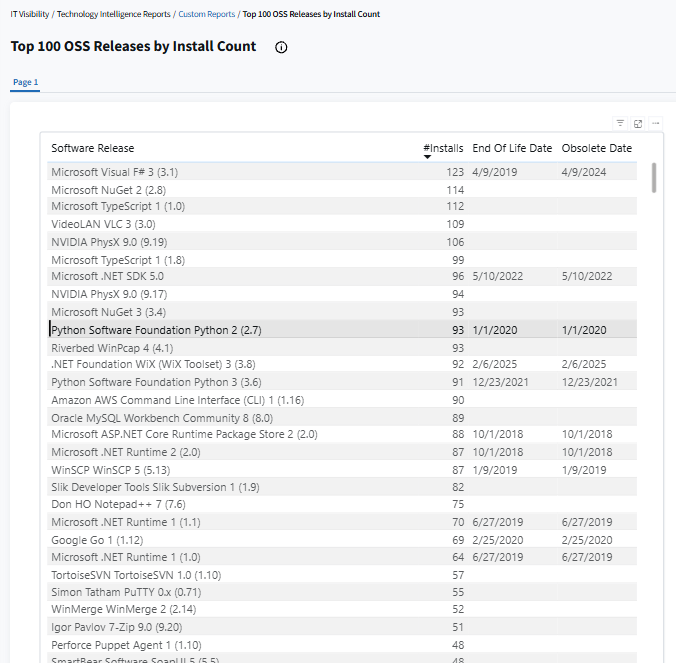
Users can explore open source information through Data Explorer and the IT Visibility data model available for Power BI and custom reporting. Within inventory reporting, the distribution model property can be filtered to open source to identify open source titles across the environment.
From fragmented evidence to a governed technology inventory
The real opportunity isn’t simply to create another list of open source software.
It is to integrate open source into the same technology intelligence model organizations use to understand commercial software, infrastructure, cloud environments and containers.
By combining multiple inventory sources with SBOM ingestion and Technopedia recognition, Flexera One IT Visibility can help organizations identify open source components that might otherwise remain hidden, understand where they are deployed and bring lifecycle and risk context into a governed inventory.
Learn more by getting a demo of Flexera One IT Visibility
Natalie Overstreet Lias
Natalie is a Principal Consultant for Flexera, focusing on Software License Optimization. Natalie specializes in working with enterprises large and small to define and implement strategies for software licensing and software purchasing beyond the basics of IT and software asset management. She has management, negotiation, and license administration experience with software ranging from Oracle and SAP to high-value engineering applications.