
Webinar
The AI Cost Crisis
Episode 2: Someone's burning through your AI budget
Related Solutions
Explore more from the AI Cost Crisis series
Overview
AI budgets are often approved once and then spread across applications, cloud services, embedded product features, AI agents, workflows and service accounts. By the time finance asks for an update, the answer typically requires multiple teams, disconnected data sources and more guesswork than certainty.
In this on-demand session, Tracie Stamm, Sr. Director of Product Marketing at Flexera, and Joe Watson, Vice President of AI Product Strategy at Flexera, explore where AI spending hides, why traditional software and cloud cost management approaches fall short and how organizations can uncover the growing sources of AI consumption across their environments.
Learn how AI spending enters the business through multiple channels, why ownership is increasingly difficult to determine and what organizations must do before governance, budgeting and optimization efforts can succeed.
Key takeaways
- AI spend is hiding in more places than most organizations realize. Costs increasingly appear through SaaS renewals, embedded AI features, cloud services, departmental purchases, pilots and unsanctioned tools across the organization
- Shadow AI is expanding visibility and governance challenges. Employees and teams can adopt AI capabilities outside traditional procurement processes, creating blind spots around spending, usage and risk
- AI billing models make spending difficult to compare. Tokens, credits, executions, bundled usage and compute hours create inconsistent measures that make total AI spend harder to understand
- Traditional cost management tools only tell part of the story. SaaS management platforms, cloud cost tools and vendor-native consoles each provide visibility into specific layers of the AI stack
- The fastest-growing AI consumers may not be people. Service accounts, automated workflows and AI agents are becoming significant drivers of AI consumption and cost
- Optimization should come after visibility and attribution. Organizations need a complete inventory of AI spending before they can make informed decisions about governance and cost control
- Successful AI cost management follows a deliberate sequence. Leading organizations first discover AI spend, then attribute ownership before introducing optimization and governance measures
- A complete inventory is the foundation for AI governance. Understanding what AI exists, where it is running and who is responsible for it enables more effective budgeting, forecasting and accountability
Speakers

Tracie Stamm
Sr. Director Product Marketing, AI Cost Management
Flexera

Joe Watson
Vice President, Product Strategy,
AI Cost Management
Flexera
From AI spending to AI visibility
Where AI spending actually hides
AI spending no longer arrives through a single procurement process or budget line. It appears in AI subscriptions, software renewals, embedded product features, cloud services, pilots and departmental purchases across the organization.
Outcome: Organizations need visibility into every source of AI consumption to understand the true scope of spending.
Why shadow AI is growing faster than governance
Teams can activate AI capabilities, purchase tools or experiment with new services long before those investments appear in formal technology inventories.
Outcome: Discovering unsanctioned AI activity helps reduce blind spots, improve governance and identify hidden costs before they escalate.
Why AI costs are difficult to compare
AI providers bill using different units, including tokens, credits, executions, bundled consumption and compute resources. Multiple billing models can exist within the same organization, and seat-based license management is no longer enough.
Outcome: Normalized cost and consumption data enables more meaningful comparisons across providers and AI workloads.
Why traditional visibility tools fall short
SaaS management platforms, cloud cost tools and vendor-native consoles each provide visibility into portions of the AI ecosystem but rarely across the full stack.
Outcome: Organizations need a broader approach that spans applications, models, agents, platforms, data services and infrastructure.
Who's actually spending the money?
Increasingly, AI consumption is driven by service accounts, workflows and agents that don’t map directly to individual users. The question is no longer simply who spent the money, but what consumed it and why.
Outcome: Effective AI cost management requires attribution across users, service accounts, workflows and agents.
The path from discovery to optimization
Many organizations attempt to optimize AI costs before they fully understand what exists in their environment. Without complete visibility and ownership data, optimization efforts are often incomplete.
Outcome: The most successful organizations follow a structured approach: discover AI spend, attribute ownership and then optimize based on value and business priorities.
Ready to uncover hidden AI spending?
AI accountability starts with visibility. Whether you're revisiting key insights from the webinar or looking to build an AI cost management practice, Flexera can help you understand consumption, assign ownership and govern AI spend across your organization.
Transcript
Tracie Stamm (0:00 – 3:50)
Hi everybody, and welcome to Part 2 of Flexera's AI Cost Crisis webinar series.
If you were with us in Part 1, you followed along as Forrester's Tracy Wu walked through why AI cost has no clear owner. Today is about finding it. Where does AI spend show up? Where does it hide, and who or what is behind it?
And a quick note before introductions on how we'll run this: please send questions in as we go. We'll leave the last few minutes to address them. And of course, the recording will be available on demand.
I'm Tracie Stamm. I run product marketing for the AI cost management category here at Flexera. I work on how we explain the art and category of AI cost management, what's changing about how AI is bought and built, and what teams should be doing about it.
And then I'm joined here by Joe Watson, VP of Product Strategy. Joe?
Joe Watson (1:04 – 1:19)
Yes. So I lead our AI product strategy, and this year we've talked to over 40 customers about how they're handling their AI cost management. And a lot of what you're hearing today will come from those conversations.
Tracie Stamm (1:19 – 3:50)
Awesome. Perfect. Well, that's the split today. Joe's going to take the mechanics, you know, how AI is built, where it hides, what customers find, and I'll take the research, the framework, and what to do about it.
This is, as I mentioned, a three-part series. It's sequenced against how we see customers tackling AI cost management with success out in the wild.
Like I mentioned, in Part 1, we presented with Tracy Wu from Forrester on why AI cost has no clear owner and what a working practice looks like. If you missed that, check out the replay. We'll share links at the end of today.
Today is Part 2, like I said, finding it. So, you know, starting with the bill, finding what it hides, and considering some of the non-human consumers behind it.
In Part 3 next month, we'll cover attribution, putting a name on every dollar, and we'll walk through the Flexera products live. But for now, let's start with that bill.
So the central challenge here is that most AI budgets are approved once and then rarely tracked. Then the months go by, consumption spreads with new providers, features embedded in products you already own, departmental pilots, and automated agents that no one formally signed off on.
This webinar is running shortly before Halloween. Totally coincidental, but this should sound pretty scary, if not relatable to you all.
By the time finance asks for a status update, the answer usually involves multiple teams, a few spreadsheets, and probably more questions than you readily have answers.
This is the situation that we want to work on today. Three things, in this order. The first one: why is AI spend so hard to pin down compared to traditional IT or cloud costs, and where does it tend to hide?
Next, what organizations find when they go looking, why ownership is so often unclear, and why the answer to who's spending the money is increasingly not a person.
And then lastly, what has to happen before any governance, budgeting, or optimization effort can even work? And we'll give you a short list of checks that you can run this quarter. Joe?
Joe Watson (3:56 – 6:15)
Yeah. So anytime you're talking about cost, you're going to be looking at the bill. And that's what our finance teams have in hand.
The challenge you're going to run through is AI bills are very different from your traditional software licenses and cloud environments.
If you look at your traditional licensing for software, that's typically brought into procurement and billed on the seats, usually annually, and you can typically associate the usage of that to named employees.
Your cloud bill is often, your purchases are done through your cloud accounts, and usage either through compute hours or storage shows up on one bill, and you often have the ability to tag your workloads so you can easily track them.
The challenge is AI. Although it has some similarities to each of these, it's very different and it has a lot more complexity.
Yes, you can purchase AI through procurement and through your traditional cloud centers. However, there are other ways that AI comes into your business through card purchases, either through a corporate card or sometimes personal cards, and shows up in apps you already have during renewals.
And it's also billed and measured very differently. The likes of Anthropic, where you might have seat-based with consumption overages through tokens. You have to deal with tokens, credits, workflow executions, GPU hours processed.
And the bigger challenge is who's using it. It can be spread not just through employees, but it's also service accounts, workflows, agents.
And one of the bigger challenges here is also how do you track it? Where do you see that bill coming from? In traditional software, you're going to see through your contracts and cloud bills. But often when you get to AI, it's spread across a lot of different consoles and vendors across your ecosystem and often across different teams.
So, Tracie, how does this show up in some of our research?
Tracie Stamm (6:19 – 8:35)
Yeah, awesome. Well, let me put some numbers to this. You know, how do we know? What indicators do we see that tell us that organizations are struggling to see their full estate and that it's hard to know where to look?
Four particular findings from Flexera research.
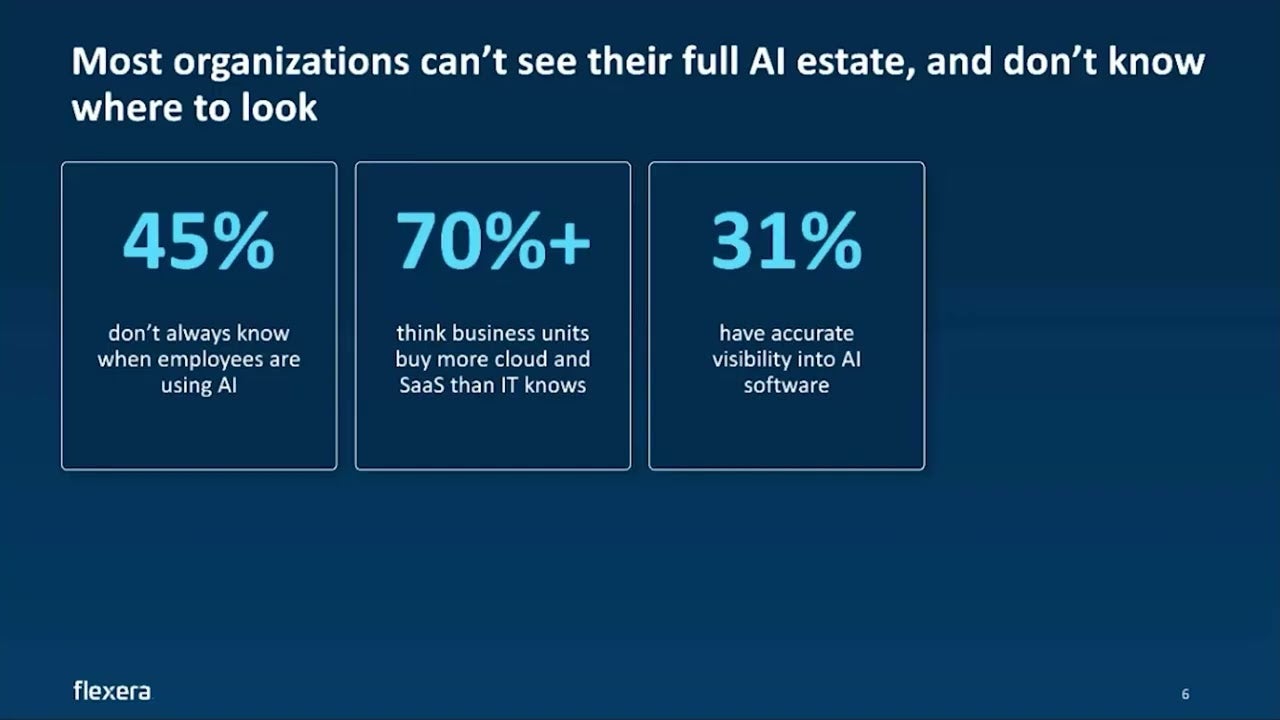
The first is that we hear from almost half of IT leaders who say they don't always know when employees are using AI.
More than 70% believe that business units are buying more cloud and SaaS applications than IT is aware of. Now, this is about cloud and SaaS in general, but important because AI is arriving through the same doors.
Just about one-third report accurate visibility into AI software, even though at least half of organizations are already tracking AI as part of software spend. And a little more than one-third here, 36%, say they are overspending on AI applications.
On top of this, and not on the page here, is that 85% say gaps in IT visibility pose a risk to their organization. I can't imagine that you would disagree with that number.
Here's how I'd answer the question about how much AI consumption sits outside of formal procurement. First, just know that nobody has a clean number for the share of AI spend, you know, outside of traditional acquisition pathways. And I'd be really careful with anybody who offers you one.
What the research tells us is that most IT leaders do believe it's happening, and most can't see it.
And here's what that usually looks like. A team has good data on one vendor, often Microsoft Copilot, because that's where the big contract is. But they can't see what other teams buy from other vendors and they don't know where that data lives.
This isn't a cost problem yet, but it does become one the first time finance asks for that total. Joe, where does the rest of it hide?
Joe Watson (8:40 – 12:23)
Yeah. So if you look at where the spending hides, it's spread across five different places.
The first area, you're starting to see AI showing up in software you already own. The CRM system that you've been using, upon renewal, now adds AI credits and usage overage costs to it. So with this, you're going to need to monitor your renewals. Look for where new AI is showing up through either a renewal or even a product upgrade.
You start to see AI showing up through your purchases, typically card purchases or expense purchases. With proliferation of AI, everyone's trying to add new capabilities to make themselves more efficient. However, those don't always go through the typical procurement process. They might be showing up on company cards or even personal cards.
The challenge here isn't just about the expenses. The risk really starts to become around who's using AI, what data are they loading into AI, and how is that data being used? This is referred to as shadow AI, and we'll talk about that in a little bit. But in order to track down these purchases, you're having to look through expense reports and invoices.
Next are those projects that were kicked off with pilots earlier in the year. That pilot project that was kicked off to respond to customer emails earlier in the year has now gone to production. And you now have thousands of systems or thousands of responses going through that.
And it's transitioned from a pilot project to a live running system responding to your customers. And it has no budget. It's not showing up on the budget. And if it is, it's showing up under a pilot project. So this you need to track down through accounts or keys that are being used throughout the organization.
Next thing, talking about keys, is a lot of applications, particularly in an engineering organization or in IT organizations, as they build out their environments, they're using shared keys, often within a common gateway or a common framework.
And what you'll find, and we actually found this talking with a lot of customers, is you'll have a single key being used, for example, through an assistant where the system was built with a single key and the bill shows one user, but that service is servicing hundreds or maybe even thousands of end users.
So the only way to really get insights into this is to start looking at the gateway logs. How is that data being consumed, or how are those tokens being consumed across those services?
And finally, the agents and workflows. These are deployed within your environment, many times will continue running all day, long after they were originally deployed and built, and often not really associated with any individual user.
They've been kicked off and they're running and being captured as agent platforms. So you have to look across all your agent platforms and continuously monitor for usage across those environments.
Tracie Stamm (12:34 – 14:39)
Nice. Awesome. Why don't we dive in a little bit to that note on shadow AI, shall we?
Number two on that list that Joe shared is what most people refer to as shadow AI. We are familiar, of course, with shadow IT through history. It used to mean someone using, like, Dropbox without approval, and we can find it by watching browser activity.
Shadow AI operates a little differently, and it's a problem for those reasons.
Number one, people adopt it directly from their browsers and their personal accounts. They switch on AI features inside software that you have already approved. And teams build agents and use developer tooling with no IT involvement at all.
This is sort of the beauty and the burn, if you will, of vibe coding. But these are three doors, and all three are open in terms of AI.
And here's why Flexera leads with cost. Ungoverned access very quickly becomes ungoverned spend, surprise bills, the same capability paid for twice, no owner for any of it. Security matters. Cost visibility and security posture move together here.
But the first place most organizations feel shadow AI is the bill. And in fact, 58% of IT leaders have told us that they've already run into issues from unsanctioned or shadow SaaS. That's SaaS, not AI specifically. And AI is arriving, as I said, through the same channels.
What we do about it: Flexera SaaS Management detects known and shadow AI apps through browser, SSO, CASB, and agent discovery. So you can see which AI apps are actually in use instead of relying on a record of what procurement has approved.
Joe Watson (14:39 – 19:24)
And as you mentioned, we can capture what AI is showing up through apps. The harder challenge really gets into seeing that consumption that doesn't look like apps.
So shared API keys, workflows that have been running out there on agents, or external systems that show up on your vendor bill and aren't associated to apps.
So let's walk through some of the types of scenarios that you're going to see.
If you look at this landscape, this landscape maps out your AI tooling or your AI stack.
If you look on the left-hand side, you'll find the types of AI that are often purchased by your line of business through the AI apps: ChatGPT, Claude, SaaS-enabled AI through Salesforce, Firefly, Canva, and down into the enterprise commercial AI agents with Copilot, Microsoft Copilot Studio, Agentforce, a whole variety of different types of AI.
On the right side, you'll start to see the AI that is introduced through IT and engineering projects, from foundation models that are deployed from your IT and engineering organization to data cloud vendors that have AI embedded within them, AI compute, and then custom frameworks such as LangChain, and also moving into the hyperscalers that bundle multiple things together, such as AWS Bedrock, Foundry, Vertex AI.
As you look at each of the dotted areas below each of these, you see the types of tools that can currently provide visibility on some of these. These AI apps from SaaS management tools that help give you visibility into the AI apps, to cloud cost tools that give you AI compute, and also those hyperscaler AI platforms where it shows up on a single line. And also the data cloud with Databricks and Snowflake.
The challenge you start to see is when you look at the AI models and the commercial agents and a lot of the custom stacks. These are provided by individual vendor consoles, and they're spread across a lot of different vendor tools.
So you run into situations where maybe one tool can cover one or two areas, but very few tools cover all of them. And the other challenge you also see is the biggest growing area is that AI model, which is the one that's covered through a bunch of vendor tools.
So we wanted to dig into this a little bit more.
Looking at this, what makes it even harder is looking at how these different tools bill differently. From your AI apps, which bill seats and consumption credits for overage, AI agents that bill by credits, AI models that bill by tokens, AI platforms that bill by bundled usage, AI data clouds also in credits, and AI compute in hours.
And what you see here is six different layers, six different ways of billing, and most of your tools out there only see a couple of these layers.
The other challenge is, as you dig into this further, if you look at the agents, apps, and models, they're the hardest ones to look at. They don't show up on your cloud bill. They're typically not counted as seats.
And for example, Anthropic and Cursor might be billed off tokens, n8n off executions, Agentforce Flex Credits. Four different invoices, four units, one budget.
And the biggest challenge with all of this is when finance comes to ask their number one question: who spent it? It's a very difficult thing to answer.
And often it might not be a single person. It can be agents. It can be other workflows. It can be shared API keys. And that's what makes a lot of this difficult.
Tracie Stamm (19:27 – 21:02)
Yeah, awesome or terrible, depending on where you are in solving the problem.
To that point, exactly why ownership is so often unclear. And the point that Tracy Wu made in Part 1. You know, each group in the org holds a piece of the picture, and oftentimes their numbers don't match.
So you have IT, who has access, but not what it costs, not what agents and service accounts are consuming.
You have finance that sees what was billed, but not who or what used it or for which project.
And you have business units that decide what gets used, but they don't see the total or what other teams are already paying for.
The org chart reflects this sort of lack of clarity in the ownership issue, and the numbers bear it out. KPMG did some research earlier this year that revealed that only 13% of organizations have a centralized AI governance and risk team, and less than a third, 29%, have named a C-level executive accountable for AI outcomes.
We've seen companies where every AI invoice lands on one director's budget because there's no other place to put it. And when the CFO asks for a number, you know, you have three teams sending three different answers.
So the next question is, you know, what organizations actually find when they go looking. Joe, do you want to take us there?
Joe Watson (21:04 – 27:32)
Yeah. So as we discussed earlier, we've talked to more than 40 organizations about what is their biggest challenge. And it really comes down to: what AI do I actually have?
And as we talked to them, there are four different areas that popped out.
First of all, it's the challenge of no single view right now. AI is spread across a lot of vendors, a lot of different billing systems. And in many cases, our customers are just pulling it together on spreadsheets, and it's very difficult to track everything.
To that next point, there's a growing trend or growing feedback out there that, you know what, hey, I can just vibe code a tool that's going to scan the bill, bring this all together into a report.
And yes, that could be done at certain scales, very small scales. The challenge we had as we talked to more and more of our customers is that it only captures a small portion.
When we talked to them, we found that in many cases it was only capturing about 40% of all the AI that was out there. And it was not able to track down the various AI that was hidden or spread across multiple different organizations.
The other challenge that you run into is what's actually being used. As we talked to customers, we found one example where a customer had purchased 30,000 seats and found that 10,000 of those 30,000 weren't even being used.
So as AI starts to sprawl across your organization, it's extremely important to get a handle on what's being used within your organization.
And finally, the other thing that we saw here is, by looking at your AI through bills, you often miss the spikes that are happening.
We ran into one customer whose AI spend spiked in a particular area 2X, and they were unable to find it until the bill came in.
And so the challenge here is that there's a lot of different ways it shows up across your organization, and also just looking at bills is a hard way to find everything that's happening in the timely fashion you need to.
And coming back to the homegrown side of it, the challenge we find with a lot of people that are trying to home-grow a solution to track this is it's a very fast-changing world. New AI sources are showing up every month. And even within those AI sources, we find that APIs are changing several times a month.
So in order to build your own or vibe code your own solution, it becomes a project in itself. And in order to get visibility across the entire organization, it's very difficult for most enterprises to keep up with that.
So as we look at where AI is growing, recent Goldman Sachs research shows that AI agents are expected to multiply 24 times by 2030. And that basically results in monthly token consumption hitting close to 120 quadrillion tokens by 2030.
That's a lot and that's a huge growth. And if you look at where that growth is happening, it's actually on the agent side. Enterprise agents become one of the largest sectors of growth by 2030.
But if you look back into today and you look at where the workload is happening today, it's non-agent workloads, those chats, those coding efforts that are tied to humans.
But the challenge you'll start to see is the area that's growing the most is the area that has the least coverage of the ability to track utilization and consumption, and is spread across so many different vendors.
And that's where the challenges of monitoring your AI consumption and usage become key. As you start to look at what you're going to deploy in your enterprise, you need to think about that biggest growing area that's the hardest to track right now.
So the other challenge here that you need to think about is who's consuming that usage. Right now, most of our cost models assume a person or a team at the end of the line. And the challenge is, although that does happen with some AI, a lot of AI is not that way.
So if you look at the first category here, users, as I mentioned, there are tools out there, Cursor or Claude and a lot of other tools that we're using, that are easily mapped to users within your business. So your allocation and your models are a little bit easier to track there.
But as you move across here, you start to find it harder and harder to track the allocation, where you have service accounts, where you have one key and an assistant that might be servicing 1,000 people.
Workflows that are running out there that nobody is monitoring. Maybe the people that built them are long gone, and they're just showing up on your bill.
And finally, agents that are going to be able to start generating their own workloads. We found in some of our conversations that we had companies that had already found 50 agents spread across multiple teams.
It becomes a very difficult thing to track across the organization. And then as you start jumping into GPUs that are constantly running in the background and how you're allocating that work.
Tracie Stamm (27:44 – 31:21)
Yeah. So when finance asks who spent the money, the honest answer is often, you know, a service account spent the money.
This is where most inventories stop, and it's the part of the bill that's growing the fastest. So if your chargeback or showback model only knows how to bill people, then it's really already out of date.
The real question, the practical question here, is what to do about it.
So Flexera definitely has a point of view, and I'll guide you through sort of that sequencing that we find to be most strategic with our most successful customers.
When AI cost projects stall, it's usually because they've kind of started at the end, unfortunately. Somebody sets a budget, they write a policy, they try to cut spend on inventory that they already had. Does this maybe sound familiar?
That inventory was missing, though, a big part of the picture. So the budget is wrong. The policy doesn't cover the tools that people actually use.
In contrast, the organizations that we see make progress do it in a very specific, intentional order.
They start by finding all of the AI spend. They pull the bills, the invoices, all of the expense data that Joe mentioned at the beginning. They inventory all the apps, the keys, the gateways, and agents. They check renewals for add-ons.
Basically, they rifle through every closet in the house, pull everything out into the hallways and put it in the light of day and figure it out.
Step two is attribution. So mapping every user, service account, and agent to the owner, rolling workflows that run across different tools up to the same project, and importantly, assigning cost centers.
And then lastly, act. So optimizing AI isn't just cutting cost. Some of your highest-spend workloads are your highest-value ones. And they shouldn't lose their funding. They should keep their funding.
The goal is always to put money where the return is and to cut costs where costs outrun value. So you can only make that call when you know what you have and who it belongs to.
If you skip either of these first two steps, every number after that becomes a guess.
So we're going to give you today six checks to follow. Most of it is pulling data that you already have and putting it into one place.
We advise to start with the bill. Like I said, that sort of cleaning-out-the-closets analogy. Pull every AI bill and invoice. Go through every expense report and card statement for AI vendors.
Pull everything out of the hallway closets, spread it out into the hallway, and look at it. This is how individual purchases surface: a team plan on a card, a tool on someone's personal account.
Pair that with SSO and browser data, which will tell you who's actually using it.
Number two: read the renewals. AI often arrives inside software that you already own, like we mentioned earlier, as add-ons or credits or a price change, maybe at renewal.
Joe, do you want to take the next two?
Joe Watson (31:23 – 31:48)
Yeah. So the next is list your keys. List your API keys, your service accounts, your gateways. Keep track of them and try to map them to who's behind each of them.
And then next is find all the agents, your agents, your automated workflows, and try to name who owns each of them.
This can often be a challenge, but it's really important to track them down and try to find out who owns each.
Tracie Stamm (31:56 – 34:32)
Check five: match seats to use. Compare what you bought with what's actually used. This should be familiar SaaS application practice already, just applied to the space of AI.
And then lastly, assign owners. Tie every item to an owner, a cost center, and a project. This is the step that turns a list into something that now finance can use.
The point of all six is to find things that you didn't expect.
Let's go back to that stack that Joe walked us through earlier. The same six layers, the same AI vendor types, this time mapped against what Flexera puts against each one.
So top left, AI apps. Flexera SaaS Management finds the AI apps that are in use, including the shadow AI that we talked about earlier, and it tracks the seats that you're paying for.
Next, we have AI models and, down in the bottom left, AI agents. These are the layers that Joe called the hardest to see, right? Token Cost Control by Flexera picks them up.
It takes the tokens, the credits, and the executions from the vendors that it supports and ties them to the user, the service account, or the agent importantly behind them.
One product that covers both layers because the problem here is the same. It's usage-based billing with no named owner.
And then over to the right, AI data clouds. Flexera's Data Cloud Optimization covers, as Joe mentioned, Databricks and Snowflake with recommendations to right-size and, importantly, cut idle compute.
And then we have AI compute, Workload Optimization, formerly known as Ocean. This is what optimizes the Kubernetes clusters that AI runs on.
And Cloud Cost Optimization by Flexera covers the cloud bill underneath.
And then, of course, across the bottom, AI platforms. These are your Bedrocks, your Foundry, and Vertex. They're billed as bundled usage. Cloud Cost Optimization also brings that spend into the same view as the rest.
So five solution areas, all six layers of your AI stack, one platform. Earlier, Joe said that most tools only see one layer, and this is really the contrast.
Joe Watson (34:32 – 35:24)
So as you start to look at how you're going to understand what's happening in your business, a lot of companies want to jump directly to optimization with autonomous agent optimization and other optimization techniques that are growing.
The challenge is, you need to understand what's in your enterprise estate and understand what you have in order to optimize it properly.
And a lot of that, the fastest-growing area, is around your agents. And that's where we recommend you start at the Token Cost Control capabilities to start looking into how those agents are spending your tokens and spending your usage.
So Part 3, we'll show you our Token Cost Control live.
Tracie Stamm (35:27 – 36:06)
Yeah, awesome. So thanks so much, Joe, for that.
If today was about finding your AI costs, then, as Joe teed up so nicely here, Part 3, what we cover next month in the last in the series, is about putting a name on every dollar.
So we'll walk through the product live, as Joe mentioned. You can register for that with the code on the screen.
And I'll also call out another tool that might be really helpful in the meantime to show you where your organization stands in the space of AI cost management and where your maturity might be in that practice.
That's linked here. Take that assessment and you'll get back a personalized scorecard, a peer benchmark to see how you are doing against industry peers cut by size and vertical, and next steps, importantly, for visibility, accountability, and all of your AI spending.
Let’s get started
Our team is standing by to discuss your requirements and deliver a demo of our industry-leading platform.