Webinar
4 ways to optimize your IT asset management
Turn IT asset management into a strategic driver of cost optimization, risk reduction and business value.
Overview
IT asset management is shaped by rising technology spend, growing SaaS and cloud adoption, and increasingly complex licensing models—from Microsoft's 5–33% price increases in 2026 to the explosion of AI-related software across the enterprise. Understanding how to optimize your ITAM programme is essential for cost control, compliance, and demonstrating measurable business value.
In this on-demand webinar, Flexera's Nathan Stevens breaks down four practical strategies to optimize your ITAM—with live demos inside the Flexera One platform showing exactly how each approach works in practice.
You'll learn how to shift ITAM from reactive control to intelligence-driven decision-making, including:
- How to automate data normalization and deduplication to eliminate manual audit overhead
- How to link hardware procurement to deployment and identify licence over/under consumption
- How to use show back and chargeback to translate ITAM data into financial accountability
- How to discover shadow IT and unapproved SaaS to strengthen governance and reduce unplanned spend
This session is designed for IT leaders, ITAM practitioners, SAM professionals, and finance teams who need a clear, practical path to optimizing their IT asset management before the next audit, renewal, or budget cycle.

Key takeaways for ITAM practitioners, IT leaders, and finance teams
- Manual data management is the biggest hidden tax on ITAM teams. Normalizing, deduplicating, and enriching asset data from multiple sources is where most time is wasted—automating this process delivers a near real-time view of recognized applications without manual intervention.
- The procurement-to-deployment gap is costing you money you can't see. If 100 machines are ordered and only 90 hit the network, that gap compounds across software licensing, where consumption over/under positions carry the largest savings opportunities—or audit risk.
- ITAM's failure to speak the language of leadership is why it stays stuck at the practitioner level. Translating ITAM data into realised savings—not potential savings—through show back and chargeback mechanisms is the bridge to executive-level influence and budget protection.
- Discovery tools like SCCM are no longer enough on their own. They won't find all SaaS applications, unapproved tools, or shadow AI. Modern ITAM requires multi-source visibility across on-premises, SaaS, cloud, and AI to govern what's actually in the environment.
- Microsoft's 2026 price increases of 5–33% make licence right-sizing urgent. Without proactive optimization before these increases take effect, organizations will absorb cost that could have been avoided through entitlement analysis and repackaging.
- Modern ITAM isn't about control—it's about intelligence. Visibility becomes insight. Compliance becomes optimization. Data becomes decisions. Organizations making this shift are achieving measurable outcomes: $3M in software cost avoidance, 60% reduction in software research, and $10M in annual cloud savings.
Why most ITAM teams spend more time managing data than managing assets
Why hidden inefficiencies drain ITAM value before optimisation begins
The biggest ITAM bottleneck isn't licensing—it's the manual effort of collating and normalizing asset data from multiple sources.
Most organizations pull data from agents, SCCM, SolarWinds, spreadsheets, and other tools—then spend weeks reconciling it. This delays decisions and increases the risk of working with incomplete data. Flexera automates this nightly—ingesting from any source, enriching with product use rights, upgrade/downgrade entitlements, end-of-life status, and categorization.
Outcome: A near real-time, normalized view of the entire software and hardware estate—freeing teams to focus on high-impact optimization rather than data wrangling.
Why hardware and software tracking gaps create the most preventable ITAM risk
If hardware is purchased but never deployed—or software is consumed beyond entitlements—you have a compliance and financial gap that's invisible without the right linkage.
The webinar demonstrates how linking procurement records to discovered inventory inside Flexera One reveals assets that never hit the network and—more critically—licence positions where consumption exceeds ownership. These over/under gaps are where the largest savings and audit risks exist.
Outcome: Clear visibility into procurement-to-deployment linkage and licence compliance positions—reducing audit exposure and identifying immediate cost avoidance.
Why ITAM optimization depends on financial alignment
ITAM teams that can't demonstrate financial value stay stuck at the practitioner level—unable to justify investment or influence strategic decisions.
The session shows how show back and chargeback reporting inside Flexera One attributes hardware and software costs to specific business units, cost centers, and corporate units. This makes the financial impact of ITAM visible and actionable—whether the goal is demonstrating savings, justifying investment, or driving accountability. For example, a single business unit's SQL Server shortfall of 16 licenses at ~$10,000 per core represents a six-figure compliance risk.
Outcome: ITAM data translates into financial accountability—enabling leadership-level conversations about cost, risk, and value.
Why governance of shadow IT and unapproved SaaS matters
Traditional discovery tools are not enough to find all the SaaS applications, unapproved tools, and shadow AI being used across the organization.
The webinar demonstrates how Flexera One identifies unmanaged on-premises applications and unapproved SaaS—including detection through browser activity and SSO integrations. In the live demo, 73 users were found on a non-approved password management tool when an approved alternative was already available. Being proactive about classifying and governing these applications reduces unplanned spend, standardizes the environment, and strengthens security posture.
Outcome: Proactive governance of shadow IT and SaaS—reducing cost, risk, and application sprawl.
Why optimizing your ITAM matters
- 45% of organizations have spent more than $1 million on software vendor audits in the past three years—often driven by incomplete or inaccurate inventory data. Getting caught underprepared doesn't just cost money; it pulls resources from multiple departments for months. (Flexera 2025 State of ITAM Report)
- Complete visibility into IT assets has declined to 43% from 47% year over year—even as pressure to optimize costs intensifies. Without a clear view of your estate, you can't eliminate waste, ensure compliance, or make cost-effective decisions. (Flexera 2025 State of ITAM Report)
- 35% of organizations report increased SaaS waste year over year—suggesting underutilized subscriptions are taking a growing toll on budgets and governance isn't keeping pace. (Flexera 2025 State of ITAM Report)
Watch our latest webinar on ITAM's defining moment: Owning the cloud, not chasing it
If your team needs to modernize ITAM and turn asset data into measurable business value, Flexera One IT Asset Management helps:
- Automated data normalization, deduplication, and enrichment—powered by Technopedia, the industry's largest technology reference library
- Optimized effective license positions for Microsoft, Oracle, IBM and more—with show back/chargeback reporting to drive financial accountability
- Shadow IT and SaaS governance across on-premises, cloud, and AI environments in a single platform
Frequently asked questions
The webinar covers:
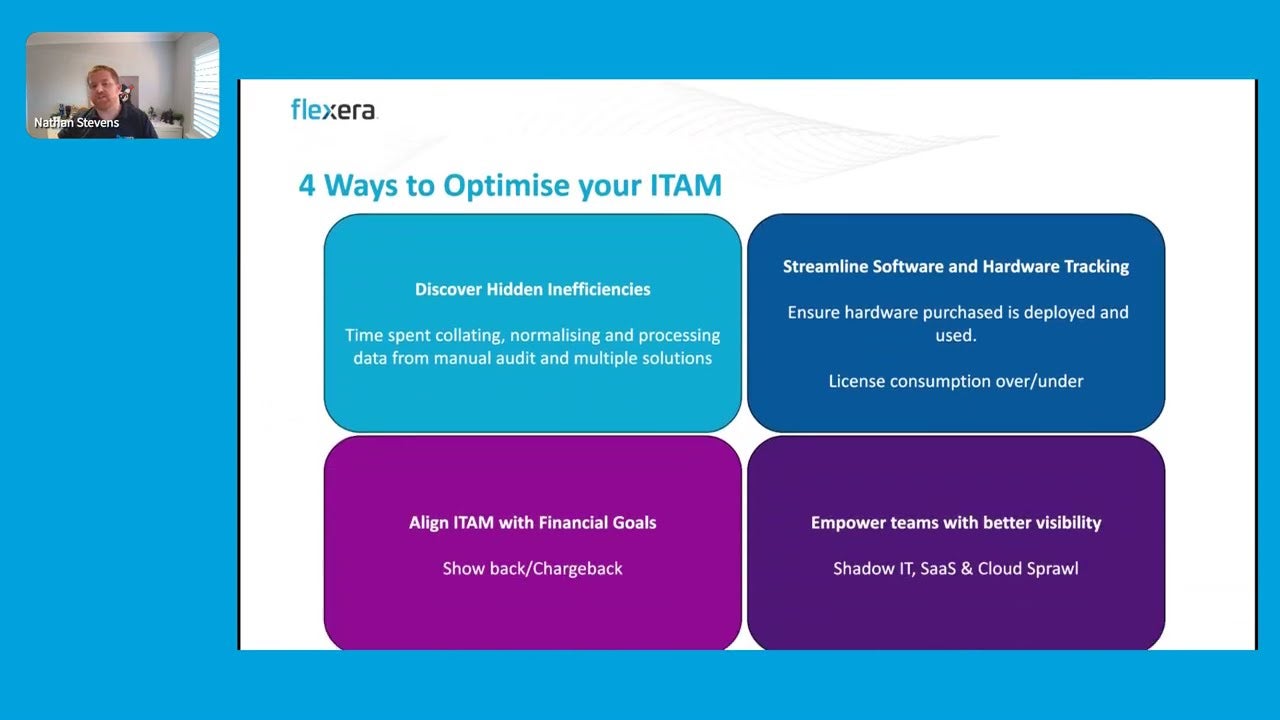
- Discovering hidden inefficiencies by automating data normalization and deduplication
- Streamlining software and hardware tracking to close procurement-to-deployment gaps and identify licence over/under consumption
- Aligning ITAM with financial goals through show back and chargeback reporting
- Empowering teams with visibility into shadow IT and unapproved SaaS
Each approach is demonstrated live inside Flexera One.
Most ITAM teams pull data from agents, SCCM, SolarWinds, and spreadsheets—then spend weeks reconciling it. Flexera automates this by ingesting data from any source, enriching it with product use rights, upgrade/downgrade entitlements, end-of-life status, and categorization. This eliminates manual overhead and delivers a near real-time, normalized view of the estate.
Software consumption that exceeds entitlements creates exposure to vendor audits—and 45% of organizations have spent more than $1 million on audits in three years. The webinar demonstrates how Flexera One calculates effective licence positions to highlight shortfalls per title, per business unit—quantifying risk before an audit letter arrives.
Flexera One identifies unmanaged applications and unapproved SaaS through multiple methods—including agent-based discovery, browser activity, and SSO integrations. The webinar shows how teams can classify, approve, or flag applications and redirect users to approved alternatives, reducing sprawl and unplanned spend.
Yes. The webinar shows how show back and chargeback reporting attributes hardware and software costs to business units, cost centres, or any organizational construct. This translates ITAM data into financial accountability—enabling leadership-level conversations about cost, risk, and value with realized savings rather than estimates.
Transcript
Nathan Stevens — 00:07 - 29:59
Hello, Hello, everyone, and welcome to the new year. Just give a couple seconds to make sure everybody can join us today.
So hopefully everyone's got into this session today, nice and easy, no computer glitches like myself trying to get into today's webinar with the Internet. So just wanted to welcome everybody to 2026 for those that are online today or even on demand watching this on catch up as well.
So as usual, we are recording this session, so you can watch this on demand. If you do have any questions, please yell them out during the chat.
We'll try to get to as many as we can today live, but most likely we'll take them offline and address them with the time that we have. So thanks everybody for joining.
Today we're going to focus a little bit more on four ways to optimise your ITAM. So this is looking at specifically at ITAM, but, you know, looking at ways that we can drive more out of your ITAM investment, and this kind of touches a couple of different areas of your business.
Just a recap, so for those that have joined us for the first time or may have missed a couple of the sessions from last year, we have these five sessions that are available on demand. Ash has kindly put those in the chat for you today.
So you can copy those. You can watch those on demand.
Each follow the same sort of format that we have today. So all of those are available to you to watch at any time that you want.
Looking ahead to this year, so we've got the first three of the year locked in. So today, the January 15, we're looking at the four ways to optimize ITAM.
Next month, we have a session around AI because AI is the hottest topic at the moment in the market. So we're going to run a session called the hidden cost of AI and really looking at the governance and risks associated with AI across your cloud and SaaS estate.
And then come March, we're going to tackle another on trend topic around data cloud optimization and looking at specifically Databricks and Snowflake. So how can Flexera help you drive a cost optimized view of those estates as well? So plenty of great stuff coming up in the near future as well.
So Ash has put those two registration pages available in the chat for the February and March sessions.
Alright, so getting stuck into the topic for today is, know, when we start to this and each one of these sessions, we're focusing on what does that look like in the grand scheme of things within the FlexeraOne platform.
Today, we're gonna touch on primarily on the middle section here in IT asset management. That's where most of the attention, but it's hard to decouple that from IT visibility and also SaaS management.
So we will touch on each of those areas as well as part of this because, you know, visibility across all your IT assets is around IT asset management. We want to make sure that we, you know, give credit where credit is due to each part of the platform for those that are interested as well.
So that's where our focus is on today.
So as we go into a number of the different areas, and there's some really good research that is coming out, specifically for last year moving into this year.
So technology spend is increasing year on year, and this is really relevant when we start to look at ways to optimize your IT asset management spend. Now if we focus in on on this, on the graph here, it's going to increase year on year.
Now the causes of that, you know, we can contribute to cloud and SaaS spend growing, you know, 50% in the last three years. AI is the big push in in that as well.
So huge spend at $644,000,000,000 global spend in 2025, and this is going to increase, and at the foundation of all of that as well is, you know, impact on your IT assets within your organisation as well.
So one call out as well as part of this is Microsoft is also implementing changes to their price structure across their Microsoft March business and government plans from July as well.
So it comes with pros and cons on all of these approaches, but when we start to look at this, know, adding of AI and security features into these hikes, but anywhere from five to 33% increase on Microsoft spend this year.
So we need to account for that.
We need to optimize spend proactively, and when we hit those marks, we're prepared for those increases.
Now the way that we look at this, and I don't if we see the first time I've used one of these slides in these sessions, but it really aptly describes the problem that we face in IT asset management.
So you as consumers of, you know, these products of, you know, IT asset management practitioners really have to think and broaden the perspective of, you know, across desktop, data center, cloud, SaaS, and now AI as its own functional vertical here.
But the answers that we're looking to address really have what is out there, you know, who's using it, how much is it costing me, Note, how do I allocate budget? What's that chargeback, showback scheme look like? So we wanna attribute costs within that.
Now where is the risk within my estate? Now risk can be from a compliance, from a regulatory compliance, from a license, from an order compliance perspective, but I really need to address my IT asset management estate like that as well.
And and and am I realizing value as part of this? So it's not good enough just to know what's out there.
It's not good enough to invest in a technology like Flexera. The goal here is to also realize that value as well.
So what am I making back? Am I actually implementing those business processes, fundamental changes to address the cost, to remove risk?
So that's where every scheme needs to remove value, increase enhance value and gain efficiencies within the business.
Now the way that we do that, and these are some of the key areas a lot of organizations are introducing those little whether it's projects or programs of work across, you know, each of the five areas, five verticals up the top.
In the horizontal, these are the areas, you know, that we need to be focused on.
How do we optimize spend? Now rightsizing spend, forecasting what we will need within the future, Or how do we remove and identify shadow IT, shadow SaaS, shadow cloud, shadow AI now even as well to remove unwanted spend or unplanned spend as part of that?
The reduction of risk is key as well.
Having access to all of this great data, this intelligence around that data, allows us to then look at compliance gaps, security vulnerabilities, and overall security posture.
So all of these remain top priorities as well.
Now when we start to look at the increasing of those efficiencies, now not everything can be attributed to the spend and risk, but we wanna make sure that we tackle the people challenge, problem, opportunity that we have as part of having access to all of this great data.
So increase of efficiency, whether that's through leveraging AI for the insights around that data, getting that outcome into the hands of people quicker, modernizing and transforming the environment.
So how do we ensure that we look for opportunities there and around different areas of the business?
Now today, what we're going to do is we're going to focus in on four ways to optimise.
Now we start with discover the hidden inefficiencies within the organisation.
Now in my experience and working with a number of organisations over the years, one of the biggest challenges is around actually getting access and collating all of that data around all the IT assets that exist out there.
Now I'll say gone is the way, but nearly gone is the way of actually doing a manual hardware audit across your environments.
Now what IT assets are out there? Are they hidden in someone's cupboard? What's out there?
So we need to improve and drive efficiencies here.
You know? Not everything has to be a manual effort here.
We need to automate as much of that as possible.
Now sometimes you can automate what's hidden and unplugged from the network and in someone's cupboard, but the goal here is to then spend time automating as much of that as possible.
The key here is about the normalization and processing of that data.
So we don't need to be determinant on having this one single source of data to, you know, work from.
Grab as much of that data as you can from a whole range of different sources and let the solution, you know, Flexera, to drive the efficiency and automation around the use of that data.
So normalise, then duplicate that data, remove the effort on trying to get to the stage where we can make decisions, and automate as much of that as possible to put that data into the hands of people who can make business and impactful decisions with the data.
Next is around streamlining software and hardware tracking.
So, you know, we want to ensure that when you purchase a piece of hardware, you know, from a vendor, from you buy you know, it's in a warehouse, you're gonna bring it back into the organization, that that is deployed and is being used.
Now we don't wanna see this sprawl of a company ordering a 100 machines for only 90 of them to hit the floor.
We wanna make sure that there's an overlap of what's deployed and linking up with the purchases that we've made.
The the license License Insider adds software consumption, So even more important than hardware.
Hardware, you know, can be sometimes even a ride off here, but the license consumption over and unders is where the biggest opportunity for savings is to be made or biggest risk as well in terms of the unexpected audits.
So where my life's consumption is over or under based on what I own.
So it's a key area to look into.
The other one around aligning ITAM with financial goals.
So really, the inability or failure to translate ITAM into business value.
So what we want to ensure that, you know, ITAM has got a bad rap, been stuck at the practitioner level for many years, and we've done a very good job as community to try to elevate the status of ITAM within businesses and really attaching to the broader technology intelligence play.
But the ability for ITAM as the custodian of that data to really drive meaningful business outcomes is the key.
So whether this is through actual realised savings, not potential savings, but putting that into practice and having a tangible impact on the financial records.
The ability as well to have that showback and chargeback.
So we'll have a look at that in a second within the platform.
But we wanna demonstrate what the cost is of that hardware and software that you own within the business and drive that as a opportunity.
And depending on your organization's appetite, by really driving that within that organization, say, this is what each business unit is costing, or this is what we need to reclaim back from those business units part of a chargeback mechanism.
Lastly, it's about empowering teams with better visibility.
So here is really about the old adage around, you cannot manage what you cannot see.
So when we have disconnected data from across, you know, SaaS, from cloud, from on prem, and all those different endpoints, it makes it very difficult to get to these outcomes.
So what we wanna do is being able to have faster decision making and stronger governance over the data.
Now what's in my shadow IT bucket? You know?
What are the unmanaged applications?
What are the, you know, SaaS applications that are not approved for use?
Where's my cloud support? You know, in terms of what's being used and what's not being used, you know, spun up, you know, for engineering personal test purposes.
So, really, what we're saying here in in all of these is that modern ITAM isn't about control anymore.
It's about intelligence.
So we've taken visibility to insight.
Now from compliance, it's become optimization now.
And from data, it becomes decisions.
So what we wanna do is spend a little bit more time today drilling into each of these within the platform, and I'll show you a couple of examples of how you can start to look to optimize your ITAM by keeping these four things in mind.
Now in every one of these sessions, I do like to bring up where other customers who are using the Flexera technologies have been able to get success using the platform.
So today, I thought it was quite apt to provide a few different examples of those.
Now there's a measurable impact in what they're doing, and this is a fantastic view of five of those organisations who have achieved those tangible results.
Now we spoke on the previous slides around the software cost avoidance, so $3,000,000 from MemorialCare.
Now the effort and increasing efficiency in how we manage the IT estate.
So 60% reduction in software research.
Now having that complete visibility, removing those disconnected silos of information.
Now so going out there and, you know, it's not SSCM and other discovery technologies are simply just not good enough today to go through and discover all of those SaaS applications.
We also can then bring this into the cloud role.
So looking at what you're spending across the public cloud, addressing the need for those annual cloud savings, and a great example here with Chegg with 10,000,000.
And lastly, around technical debt.
So in previous sessions, we covered across a lot about IT visibility and software currency, but reducing technical debt has that flow on effect of cost and efficiencies and risk within the organization.
So all of these things are great things to keep in mind.
Today, let's jump in, and I'll be going to focus in on those four key areas of the business.
So let me just swap screens for a second.
Alrighty.
So what I'll just do one second.
Up here.
So when we start to talk a little bit about discovering those hidden inefficiencies within the organisation, what we really want to do, and this is where I take this example every single time about the deduplication, the normalisation of data that we get from out there.
So as I mentioned, gone are the days of going through manually auditing everything.
In some cases, it's good trying to pick up things from hardware that unplugged in the network.
There's an asset, but usually, the software is more expensive than the asset that you're buying these days.
So it becomes a bit of a, you know, a lack of a cost benefit there in terms of doing those audits.
But the key for us is removing that manual work and headache of normalizing and duplicating all of those assets and software assets that exist out there.
Within the platform, we don't really care what data source you get that information from.
Obviously, there's a FlexError inventory agent that's out there.
There's the ability to import data, connecting to things like SCCM and other technologies.
So we'll grab all of that rich information.
We'll grab the evidence that's required to produce a recognized application as part of that.
Now so we go through this process of enriching and enhancing the data that we bring into the platform.
What are the upgrade and downgrade rights?
What what are these products SKUs associated or product use rights based on the SKUs that you've selected?
What are the categorization of that software?
What's the end of life and the support of that software?
So all of these things are enhanced as part of this process that's all automated and happens on a nightly basis.
So we can get a near real time view of exactly what's happening out there within your environment.
The same is true around the hardware side.
So you can imagine out there, I've got agents out there, I've got SSCM, I've got other data sources, which is fantastic for my data center and end user compute space.
Now as I said, we will get data from other sources.
So whether that's tapping into your, you know, SolarWinds for your network gear, storage information.
You know, we've got a spreadsheet of other detail about the information out there that, you know, fits a particular standard that we can bring in to understand what metadata exists around that hardware.
So we wanna make sure that we're driving, once again, the inefficiencies out of trying to manually compare all of this information, and let the platform do that work for you.
Get to the stage where you have a number of recognized products that you can work with, make decisions on, and have a real impact on the business, not go through the headache of getting and managing this estate.
Now next is around streamlining software and hardware.
So we're going to improve compliance and reduce waste.
So I want to go here and look at my hardware side and my device assets.
So back to what we spoke about in terms of that linkage.
So coming from a background in the IT asset management space as well, what I can see here is looking at hardware that's been procured.
So I can add my assets here.
I can build a spreadsheet and consume that with the adapters that we have to bring that information into the platform.
I can then see as well, and back to that example or or analogy of a 100 different assets that go out there, 90 of those hit the floor, and I can see when those have linked inventory.
So I can see what assets actually hit the network and, you know, combined with information that's available as part of procurement.
I can then also see information here against those assets.
So if I go in to create an asset, I can go through, and this would be done on a programmatic approach.
It wouldn't necessarily have to be something that you do one by one, which would be tremendous overhead.
But I can then tag these details, you know, serial number, manufacturers.
I can do that from a procurement perspective.
When it hits the warehouse, integrate the processes within the platform to be able to drive, you know, that end to end life cycle of asset information.
I can then update those statuses.
So if it hits the network, you know, whether it's now deployed into the environment.
Now if I'm going to dispose or something in storage, integrate your processes back into your IT asset management discipline.
The other side as well, if you start to look at software and, you know, licensing.
Now what I want to do here is look at my licenses at risk.
Now I've just taken one example.
There's many different angles that you could come in on and review this data.
And, for example, where I've got shelfware sitting there and not being consumed, where I need to right size or repackage particular licenses.
This example here looks at that risk in terms of what I've bought and versus what's being consumed.
So through the various configurations that I have, through the various normalization, I get to a point here where I can confidently say that I'm actually in a negative.
So my consumption here is, you know, consumption is 39, my shortfall is negative 24.
So I know there's a risk associated with this particular title.
So whereas where I'm streamlining that software process, I'm entering in all my procurement information, you know, adding in, you know, we have the procurement, the contracts, you know, the the purchases, add that information into the platform, and that's where the hard work goes in to making a business decision and getting business outcome with the data, and then I can actually address my risk.
And this is how we do that with software.
Next, where we start to look at the alignment of ITAM with financial goals.
Now one of the good use cases that I always like to talk about is showback and chargeback.
Now some organisations may not have the appetite for chargeback.
It's not how the business works.
IT is a central bucket that, you know, profit and loss, that's how it is.
Others, you know, wanna actually just show back to the business as well exactly what's being used and consumed within the business.
So we can have these showback or chargeback reports, you can tailor these according to, you know, the views, the columns, the looks, and how you want to consume that data.
I can get this information out, push it into, you know, a BI solution to get a more granular view of the data again, and then, you know, graph this up and chart that, whatever I need to do.
But the goal here is that I'm have financial accountability or even just visibility when I'm talking showback in terms of what assets exist within the environment, what in this case here, what corporate units, I can do a cost center view of this, whatever view that I really want using the organizational construct within Flexera One iTem to get that view of the data that exists out there within the environment.
Now in this case here, we're focusing on those licenses.
And then when this loads, and this is a big report, so it does take a little bit longer to load, but I can actually then go and see what business units are out there and it can see in what, where my bigger overages are, or where my biggest risk is.
So if I start to look here and just use this one because it's top of the list and it's easy to expand, but we're starting to look at, you know, where my overages are.
And and in this case here, a lot of these have a shortfall within this business unit.
So I can start to see exactly within this particular report where my biggest risks are within that business unit.
Now if the way that I'm implementing and operating means that within this business unit, we can actually go through and identify that under Microsoft, maybe SQL Server here, I'm negative 16, you know, put a cost in associated with that.
I mean, these are thousands of dollars enterprise, probably up to nearly $10,000 per core, what the risk of that is.
You know? And this could be, you know, a 160 plus, and my math is terrible, but, you know, you get the point there.
Well, I start to look at one, and I'll pick one that has some data in here now, but go down a little bit for a good example, but Visual Studio.
So this covers a lot of different products here.
You can use the Flexera platform to work out what the preference is of how those applications are covered, but I'm negative three in terms of my licensing.
So my costs here, my compliance costs, my risk costs within this particular corporate unit now is close to $17.
So if I'm using this showback mechanism, I can go back to that unit and say, do you really need to use those three licenses, drill into the detail that sits behind this, and say, can we remove three licenses, or we need to increase the cost of your business unit by by $17?
And finally, where we want to empower teams with better visibility.
So this is where we start to look at, you know, showing applications in particular, and a couple of examples here, but showing unmanaged applications.
So if I want to make sure that I'm proactively managing my estate.
Now if I take the example, know, this year I've focused in on a little bit here, but I can see that this is a list of everything, and I've done a quick search here on Visio, but everything that's classified as unmanaged within the environment today.
So I'm being proactive.
I wanna actually classify these applications.
And whether they're managed, unmanaged, what's the status of this within and working with the enterprise architecture group or application architecture in some organizations to understand is if this is a current, you know, if this is authorized for the environment, unauthorized, what that looks like for this environment, you know, for you as the customer.
So in your organization, being proactive and managing what comes in, if I'm up to date with this detail, the next time, you know, a new application comes in, it hits this unmanaged list, and then I can proactively manage that piece of software.
The same is true when I start to look at my SaaS based applications.
And so, for example, I go into here and within the FlexeraOne platform, look at my SaaS based applications.
I can see my total applications, applications that are approved or not approved within the environment.
And I wanna focus here on there's a number of not approved applications and a very similar process that we just saw with on premise software.
But I can actually go through and classify these as approved or not.
I can put an owner against that and also notes against that particular product.
The goal here as well is I wanna go through and even add my subcategory.
I can see here, it's showing me everything that's, you know, a password management type SaaS based application.
I can see that I have three of those.
I can see that one of those was picked up through the web browser, which is my password.
I've also got two here that are picked up through a single sign on.
But as I go through here, I can see these two have approved and this one's not.
So we can actually go through and then go through and pick out these 73 users and get them to use the approved standard.
So both of these capabilities then should give us a way, whether it's on premise or whether it's a SaaS based application, to help empower, you know, the ITEM team, you know, the SaaS team with understanding what's out there, having the visibility to make real world decisions and optimize that ITEM state.
We don't wanna unapprove the unmanaged software within the environment.
It adds cost.
It adds risk.
We standardize and streamline how we're using software.
Alright.
So I just wanna cut back just to the session here.
So if there's a couple questions that have come through, I think I've answered them as I've been talking, just keeping an eye on those.
So what we've done today is we've covered each of these different areas.
Please go back, relook at what we've covered, but if there are any questions about that, please do let me know.
And I'll just end with this.
It's just a link to my LinkedIn.
Please, if you do have any other questions about how we can help improve how your IT asset management is being run today, please do reach out, whether that's to myself or to our fantastic partner community that can help drive real outcomes and help you start optimising beyond those four ways that we've just showed you today.
I appreciate everyone's time, and thank you.
We'll see you again next month in February to start looking at the the hitting cost of AI.
Thank you.
Let’s get started
Our team is standing by to discuss your requirements and deliver a demo of our industry-leading platform.