Webinar
How to improve cloud cost visibility and allocation with effective FinOps strategies
Overview
This webinar shows how organizations can make cloud cost data usable by applying metadata, tagging and cost allocation as part of a practical FinOps practice. It’s designed for teams struggling with unclear cloud spend, limited accountability or slow FinOps maturity.
Viewers learn how different personas use cost data, how tagging and allocation work together and how to build a scalable metadata strategy that supports visibility, accountability and savings.
Key takeaways for FinOps practitioners, cloud teams, finance teams and IT leaders
- How metadata turns raw cloud billing data into actionable cost insights teams can trust
- When tagging is required for accurate cost allocation and when account structure alone is sufficient
- Why different FinOps personas need different cost and usage context to make decisions
- How to design a simple, scalable tagging strategy that supports visibility and accountability
- How automation and validation improve tag accuracy and reduce ongoing operational effort
Speakers

Parker Nancollas
FinOps Certified Professional
SoftwareOne

Brian Adler
Sr. Director, Cloud Market Strategy
Flexera
Cloud cost visibility and allocation challenges, outcomes and business impact
1. Why cloud cost data is hard to use in real environments
Most organizations rely on raw cloud billing files, provider invoices or native dashboards that include millions or billions of rows but very little usable context. Teams can see total spend, but they struggle to understand what resources exist, who owns them or why costs change over time. Without added context, cloud cost data creates more questions than answers.
Outcome: Teams lack confidence in cloud cost data and struggle to make timely, data-driven decisions.
2. Why inconsistent tagging limits FinOps maturity
Tagging is often applied inconsistently across cloud environments or owned by a single technical team without input from finance, engineering or IT asset management. As tagging requirements grow without clear governance, different teams interpret the same cloud spend differently, making alignment harder instead of easier.
Outcome: FinOps programs take longer to deliver value and fail to align stakeholders around a shared view of cloud spend.
3. Why tagging alone can’t support long-term cost allocation
As cloud environments scale, tagging becomes harder to maintain and less reliable over time. Tags can’t always account for shared services, untaggable resources or historical costs. To preserve allocation accuracy, teams often need account structure, naming conventions and business logic that go beyond tags alone.
Outcome: Allocation accuracy declines, forcing teams into manual reconciliation and repeated reporting effort.
4. Why ownership and accountability depend on metadata
Effective FinOps depends on clearly knowing who owns each portion of cloud spend. Without metadata that ties resources to accountable owners, teams can’t quickly investigate cost spikes or support showback and chargeback models. The result is slower response times and limited accountability across the organization.
Outcome: Cloud spend remains reactive rather than controlled, reducing the impact of optimization efforts.
5. Why effective metadata accelerates FinOps outcomes
When metadata, tagging and cost allocation are designed around real stakeholder needs, cloud cost data becomes actionable. Automation and validation reduce errors, while stable identifiers help preserve accuracy as cloud environments evolve. This foundation enables teams to move from basic visibility to meaningful FinOps results faster.
Outcome: Organizations accelerate FinOps maturity and improve the business value of their cloud investments.
Why effective FinOps strategies matter
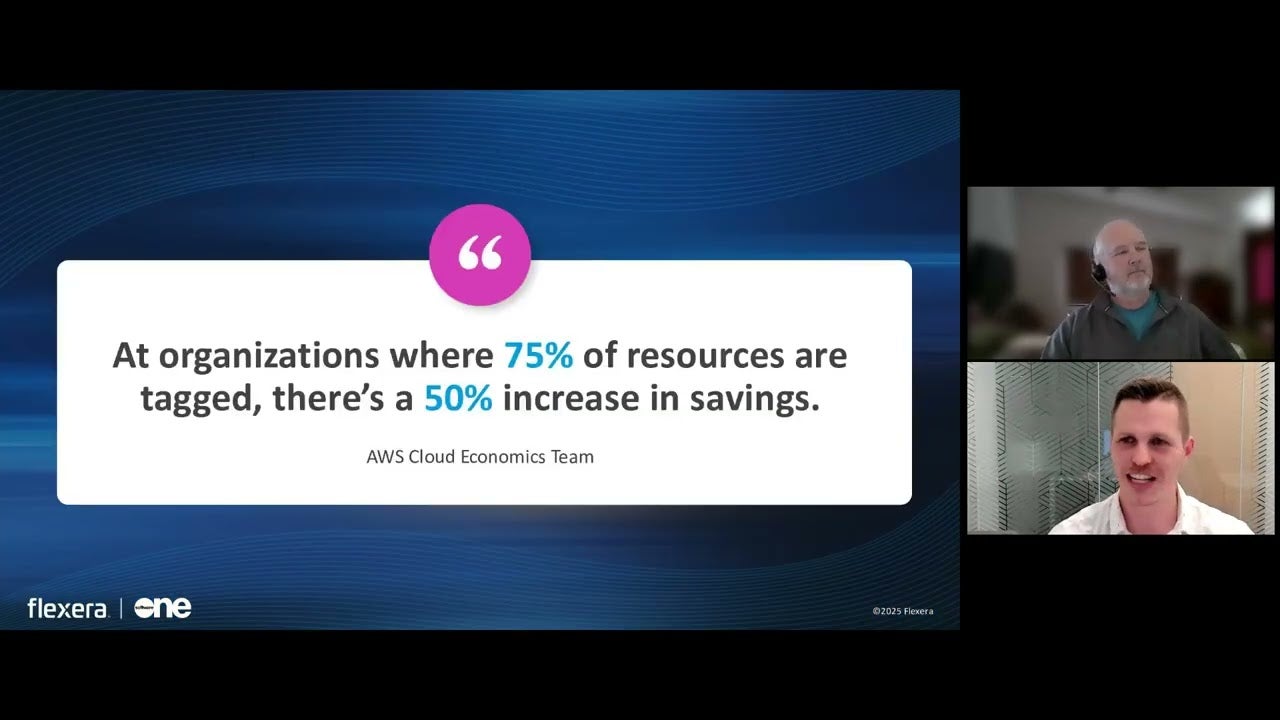
- Organizations with high tagging coverage often see significantly better cloud savings because teams can make more informed decisions
- Large cloud bills often contain millions or billions of usage records, making cost decisions impossible without added context
If your team needs clearer cloud cost visibility, stronger allocation and faster FinOps outcomes, Flexera One FinOps helps operationalize the strategies discussed in this webinar. See how automated metadata, allocation and optimization work together across complex cloud environments.
Contact us to see Flexera One FinOps in action.
Frequently asked questions
Start with a small set of required metadata that supports your most important outcomes, then enrich it using business logic and external systems like a CMDB. This improves visibility while keeping tagging effort manageable.
Use a combination of account structure and tagging based on your organization’s needs. Some costs can be allocated through hierarchy alone while others require tags to assign ownership accurately.
Accurate tags enable accountability by clearly showing who owns spend. This makes it easier to investigate cost spikes, enable chargeback or showback and drive responsible cloud usage.
There is no fixed number. Most organizations start with just enough required tags to meet reporting needs, often around eight to ten, and evolve over time as priorities change.
Resource owners are typically the best owners of tags because they understand the workload and are accountable for its cost, which improves long‑term tag quality and FinOps outcomes.
Transcript
[00:03] Introduction: Why metadata and tagging matter in FinOps
[01:24] Caroline Knowles:
Welcome to this session on mastering cloud cost management through metadata, tagging, and cost allocation.
Organizations today generate vast volumes of cloud cost data, but turning that data into actionable insight requires context. This session explores how metadata and tagging enable organizations to understand, allocate, and optimize cloud spend effectively.
[02:38] Speaker expertise and FinOps context
[02:38] Parker Nancollas:
This discussion draws on real-world FinOps experience, including building and scaling FinOps practices across organizations.
[03:10] Brian Adler:
Cloud cost optimization consistently depends on the ability to understand and structure data. Metadata and tagging are foundational to achieving that.
[04:07] Agenda: From data complexity to actionable cost insights
[04:07] Parker Nancollas:
This session covers:
- The role of metadata and tagging in cloud cost management
- How different FinOps personas use cloud data
- The relationship between tagging and cost allocation
- Best practices for implementing scalable FinOps strategies
[05:03] The role of metadata in cloud cost management
[05:03] Parker Nancollas:
Raw cloud data is extremely complex.
Cloud cost and usage reports can contain:
- Hundreds of columns
- Millions or billions of rows
- Data that is difficult to interpret directly
At the same time, invoices provide limited insight.
Metadata provides the missing layer of context, transforming raw data into something that can support decision-making and cost optimization.
[07:04] Brian Adler:
Modern cloud environments produce data at a scale that cannot be managed manually. Metadata and tagging are essential to making this data usable.
[08:32] How metadata drives better cloud cost outcomes
[08:32] Parker Nancollas:
Organizations that improve metadata and tagging quality tend to achieve better outcomes.
For example:
- Higher tag coverage correlates with improved cost visibility
- Better visibility leads to better decisions
- Better decisions lead to greater cost savings
Metadata does not directly create savings—it enables informed decision-making, which drives optimization.
[09:59] Why FinOps requires cross-functional alignment
[09:59] Parker Nancollas:
Effective FinOps requires collaboration across multiple personas, including:
- Finance teams (cost allocation and reporting)
- Engineering teams (technical context)
- ITAM teams (licensing and usage)
A common challenge is lack of alignment between these groups, which slows FinOps maturity and reduces effectiveness.
Tagging strategies must reflect the data needs of all stakeholders.
[16:23] Tagging vs cost allocation: understanding the difference
[16:23] Brian Adler:
Tagging and cost allocation are closely related but not identical.
- Tagging adds context to resources
- Cost allocation uses that context to assign responsibility for spend
In some cases, organizations can rely on account structure alone for cost allocation. In most environments, tagging provides the necessary granularity to:
- Assign costs to teams or departments
- Enable chargeback and showback
- Improve accountability
[25:59] Types of metadata beyond resource tags
[25:59] Brian Adler:
Metadata extends beyond simple tags and includes:
- Resource-level metadata (e.g., environment, cost center)
- Account or group-level context
- External enrichment via business systems (e.g., CMDB)
A best practice is to use stable identifiers (e.g., application ID) and enrich them through external systems, rather than using dynamic values such as individual names.
[30:46] Key metadata categories for operations and governance
[30:46] Brian Adler:
Metadata supports multiple use cases:
- Cost allocation: cost center, business unit
- Ownership: team or application owner
- Automation: scheduling, backup policies
- Operational context: environment (prod, dev, test)
- Security and compliance: regulatory or classification tags
- Technical context: software version and configuration
This enables organizations to align data with business, operational, and compliance requirements.
[34:12] Best practice: Keep tagging simple
[34:12] Parker Nancollas:
Overly complex tagging strategies reduce adoption and compliance.
A key principle is simplicity:
- Minimize required tags
- Avoid redundant or rarely used tags
- Use business logic to enrich data externally
Requiring fewer, more meaningful tags improves consistency and usability.
[37:45] Best practice: Automate and validate tagging
[37:45] Brian Adler:
Manual tagging introduces errors and inconsistency.
Best practices include:
- Automating tag assignment during provisioning
- Using dropdowns and predefined values
- Validating tags continuously
- Maintaining a central tag dictionary
Automation ensures consistency at scale and reduces operational effort.
[44:44] Best practice: Iterate and evolve tagging strategy
[44:44] Brian Adler:
Tagging strategies should evolve over time.
Organizations should:
- Start with high-priority use cases
- Implement an 80/20 approach
- Continuously review and refine metadata
Attempting to design a perfect tagging model upfront often leads to delays and unnecessary complexity.
[45:55] Parker Nancollas:
FinOps maturity follows a crawl, walk, run model. Iteration and continuous improvement are essential.
[48:44] Key takeaways: Combining simplicity, automation, and alignment
[47:38] Brian Adler:
To succeed with cloud cost management:
- Align stakeholders across finance, engineering, and ITAM
- Keep tagging simple and practical
- Automate wherever possible
- Use metadata to drive visibility and accountability
Different organizations may use different approaches, but the goal remains the same: turn cloud data into actionable insight.
[1:01:00] Closing remarks
[1:01:00] Caroline Knowles:
Thank you for joining this session on cloud cost management. We hope this has provided practical guidance on how to use metadata and tagging to improve FinOps outcomes.
Let’s get started
Our team is standing by to discuss your requirements and deliver a demo of our industry-leading platform.