Webinar
Turn AI and cloud cost chaos into your next managed service
Watch this on-demand webinar to learn how MSPs can apply AI Cost Management, Tokenomics and proven FinOps practices to build scalable services around visibility, governance, forecasting, accountability and optimization.
Related Solutions
Overview
Build a profitable AI cost management practice
AI adoption is accelerating across the enterprise, but many organizations are moving faster than their ability to govern, forecast and optimize the cost of AI usage. As teams deploy AI applications, copilots, agents, models, data platforms, compute and cloud services, spend becomes fragmented, difficult to explain and harder to control.
For MSPs, this complexity creates a new growth opportunity. Customers need help establishing the visibility, governance, accountability, forecasting and optimization practices required to bring AI and cloud costs under control.
In this on-demand webinar, Jeremy Chaplin, Senior Director of Solutions Architecture & Advisory, FinOps at Flexera, explains the emerging world of AI Cost Management and tokenomics. He shows how these capabilities extend proven FinOps and cloud cost management practices, and how partners can convert them into repeatable, scalable managed service offerings.
You’ll learn how to:
- Explain why AI costs are becoming a barrier to enterprise AI success.
- Understand AI tokenomics and why token-based consumption matters to MSPs.
- Build AI-focused managed services around governance, visibility, optimization, forecasting and accountability.
- Help customers gain visibility across AI apps, agents, models, data, compute and cloud consumption.
- Extend established FinOps and cloud cost management practices to AI workloads.
- Use Flexera to deliver AI and cloud cost governance, financial accountability and optimization at scale.
Key takeaways for MSP leaders
- AI cost complexity can become a repeatable service opportunity. Customers need ongoing help with visibility, governance, forecasting, accountability and optimization. MSPs can package these recurring needs into structured services rather than one-off projects.
- Tokenomics changes the economics of AI. Token-based and consumption-based models introduce new cost drivers. MSPs that can explain, allocate, forecast and optimize this usage can provide immediate strategic value.
- FinOps provides a practical foundation. AI Cost Management does not require MSPs to start from zero. Existing FinOps and cloud cost management skills can be extended to AI applications, agents, models, data, compute and cloud services.
- A scalable offer needs more than dashboards. Successful services combine visibility with governance, accountability, forecasting and continuous optimization, creating a stronger path to recurring revenue and deeper customer relationships.
- Flexera helps partners operationalize the opportunity. Flexera enables partners to deliver AI and cloud cost governance, financial accountability and optimization at scale.

From cost chaos to a scalable managed service
Why AI cost management is now an MSP growth priority
Enterprise AI adoption is creating a wider, more fragmented cost base across applications, copilots, agents, models, data platforms, compute and cloud services. Customers often struggle to connect this consumption to business ownership, budgets and outcomes.
Outcome: MSP opportunity: Establish an ongoing service that brings together cost visibility, governance, forecasting and optimization across the full AI and cloud consumption landscape.
Why tokenomics matters to every MSP
Token-based consumption introduces a different way to measure and manage value. Usage can vary by workload, model and business team, making allocation and forecasting more complex than traditional software licensing.
Outcome: MSP opportunity: Help customers interpret token consumption, create accountability, improve forecasts and identify optimization opportunities before spend becomes difficult to control.
How FinOps skills extend into AI
AI Cost Management builds on proven FinOps disciplines, including visibility, allocation, budgeting, forecasting, anomaly awareness, optimization and financial accountability. The difference is the expanding range of AI services and consumption signals that must be managed together.
Outcome: MSP opportunity: Evolve existing cloud and FinOps practices into a differentiated AI-focused service without rebuilding the operating model from scratch.
What a repeatable AI cost management service includes
A scalable offer should connect discovery and visibility with governance, ownership, forecasting, optimization and ongoing reporting. This allows MSPs to move from reactive cost reviews to a continuous service that supports customer decision-making.
Outcome: MSP opportunity: Package the work into assessment, implementation and recurring optimization stages that can be delivered consistently across customers.
How Flexera supports service delivery at scale
Flexera helps partners bring AI and cloud cost governance, financial accountability and optimization together, supporting a consistent approach across complex technology estates.
Outcome: MSP opportunity: Use Flexera capabilities and expertise to strengthen service differentiation, customer value and recurring revenue potential.
Why this opportunity matters now
AI adoption is expanding the scope of technology consumption customers must manage. The challenge is no longer limited to public cloud infrastructure: it now spans AI applications, copilots, agents, models, data, compute and cloud services. This broader landscape increases the need for integrated visibility, governance, accountability, forecasting and optimization.
For MSPs, the commercial opportunity is to turn that need into a repeatable service. By combining established FinOps practices with AI Cost Management and tokenomics expertise, partners can help customers control complexity while creating differentiated offers and new recurring revenue streams.
Frequently asked questions
AI Cost Management is the practice of bringing visibility, governance, accountability, forecasting and optimization to spend generated by AI applications, copilots, agents, models, data platforms, compute and cloud services.
Tokenomics describes the consumption and cost dynamics associated with token-based AI services. For MSPs, it creates a need to help customers understand usage, allocate costs, forecast demand and optimize consumption.
MSPs can combine assessment, visibility, governance, forecasting, accountability and ongoing optimization into a repeatable service. This creates a structured way to help customers control AI and cloud costs over time.
Not necessarily. The webinar explains how AI Cost Management extends proven FinOps and cloud cost management practices, giving MSPs a practical foundation for developing AI-focused services.
The session is designed for MSP executives, practice and service delivery leaders, alliance and business development teams, and technical leaders responsible for cloud optimization, FinOps, AI governance or technology intelligence services.
Flexera enables partners to deliver AI and cloud cost governance, financial accountability and optimization at scale, supporting the development of scalable managed service offerings.
Transcript
Jeremy Chaplin 0:22-39:35
Good day everyone and welcome to AI powered MSP growth. We're going to have a great conversation today talking about Tokenomics and how as partners of Flexera you can take uh a solution and services to market to support what is the buzzword and the conversation that I am having repeatedly um with customers and prospects and partners alike uh here at Flexera. Um so I'm your presenter today.
0:49
I’m very excited to be here. I'm Jeremy Chaplin and I lead our solutions architecture and advisory function for FinOps. Um I've been at Flexera for five years leading the team and have industry experience across a range of vendors but also in the partner space. So been in your shoes and know the challenges uh in taking these services to market.
1:10
Now what we're going to look at today is a range of topics. I'm going to introduce for you uh the Flexera platform and how that can power as either existing or as a new partner a growth for you in taking services into the market specifically of course today around FinOps and of course AI cost management and Tokenomics but we'll also see that the platform is very broad in covering other areas in terms of IT asset management uh and SaaS management as well and those are ultimately important parts of the AI story.
1:44
We’ll understand a little bit about the AI crisis as well once we've seen the platform. And we'll then talk about Tokenomics and how we might take a service to market in order to help our customers address this kind of, you know, visibility gap that we have with AI spend. Nobody being able to kind of track it or understand the value that it is bringing to their business. And then with a little bit of time we'll have a look at the platform just to show you a couple of areas where uh we can provide value for you um you know providing services to your customers with our platform which covers a broad range of capabilities as we'll see and then some Q&A from you as well.
2:22
Uh so hopefully that works for you. Let's dig in and have a look at the platform and how that can power growth. So, as I said uh in the introduction here, if we take a look at the Flexera One platform, uh it's a portfolio of capabilities that span all of the scopes of technology spend within your organization. And for any of you tracking the FinOps Foundation, you'll have seen, of course, that their mission statement has been changed from cloud to technology. That's really important because we're recognizing this is not just a public cloud problem anymore, but wherever your technology investments are, this is where your customers are looking for help. And particularly, of course, when we think of AI, you know, the spend exists in all sorts of domains, not just in public cloud. So the breadth of the platform here from all the way on the left hand side, our IT visibility, IT asset management solutions, the things that we own on premises, desktops, servers, switches, but also expanding into licensing uh and the agreements and commitments and entitlements that you have that are super complex. And then as we head towards the right side, well, now we're getting into software as a service.
3:34
How do we manage that on a per seat per user basis? But that's being made massively complex by AI. No longer do you just procure, you know, a number of Microsoft 365 licenses. It will come with, you know, an option to buy tokens for, you know, uh, workflow solutions, AI based solutions, as will pretty much any AI service uh, that you're buying as SaaS. And then of course, as we head to the right, well, this is purely the FinOps play.
4:05
Uh, how do we manage commitments? How do we manage cloud uh, and an aggregate of cost? and then looking at things like workload optimization getting into the depths of ultimately how do we save you more money so that you can make those investments uh you know in other parts of the solution. If we double click here we've got the FinOps portfolio. So here you can see a smaller segment of um you know the capabilities here and you can see other detail like our sustainability uh you know solution which is part of cloud cost optimization.
4:30
But what I want to draw to your attention here really is the uh managed service layer. Okay, this is enabling you as a partner of ours to deploy these services very easy to customers and we'll take a look at that as we go through hopefully into the demo. Um because you want to make it easy to test and try out these capabilities to be able to deploy with a single click to avoid having to go through complex on boarding or crediting for these things where you already have access to that data. And so if we drill in a little bit further, what we're talking about here is ability really for your customers to see everything and ultimately control everything. And that would be from the ecosystem at the bottom lay here where they have spend from a variety of different logos of course that we'll all recognize here. But then doing discovery, right?
5:21
Understanding what's SaaS, what's software, what's cloud and containers and data center. And now looking at all of the apps and agents and the tokens and models uh and data platforms that your customers are consuming. And there we bring the magic source at the knowledge layer, right?
5:34
Being able to normalize, categorize and enrich that data so that the you can understand the value that that spend on that diverse range of technology brings and ultimately then making some inference right at the insights layer using things like natural language queries to drill in and analyze that data and ultimately then also taking action on those things. And we have a broad range of the portfolio that is autonomous that will take actions that will deliver immediate ROI to your customers.
6:08
And so here's a simplified view, right? to get that inventory, get that data, enrich it, normalize it, then take AI into the uh into the into use here for AI for FinOps ultimately to get some insight into the data and then use AI also to take action on that driving value for your customers. Now, if I drill in one level further, this is what we kind of looking in terms of capabilities, visibility of course, right? If we think of the FinOps framework and how we tackle this problem most generally for you know any problem it's to get visibility the inform stages here and we do that as I said across all of the areas of technology spend software licensing will give you sustainability insight you can do budget forecast and allocation of cost but ultimately what customers are looking for is that optimization how can I drive out savings well using things like our discount management solution or our spot instance solution for Kubernetes or uh you know using right sizing and bin packing technical terms for effectively making the most of the infrastructure that you're buying and of course autoscaling and then data cloud optimization as well.
7:21
But the point here really is you start to add these solutions on for your customers not only does the breadth of visibility and the breadth of insight increase for them but the savings that they're making are stacking up as well. And ultimately your customers getting to a point where maybe they're paying 80% less than the public cloud rate. And that of course is great for their competitive uh you know improving margins and ultimately driving theirs and of course your growth.
7:52
So, if you're not a partner already and you're not kind of, you know, in the loop with our partner program, it's a three- tiered structure here that ultimately rewards, you know, your investment uh and commercial success as you move up through the member select and strategic um, you know, tiers here. Now, if you need more information, you can obviously read the content on the slide. I'm not going to spend too long here, but do contact the partner desk, partners.flexera.com. they can provide you all of the detail that you need.
8:22
But as you can see, you know, extensive range of benefits uh and support from us in terms of going to market and ultimately growing uh your business and your customer base. All right, so let's dig in on what is you know the topic to jour at the moment, the AI cost crisis.
8:40
We'll just explain a little bit about the challenge in the market, but also give you some positioning as how Flexera can uniquely help. And ultimately if you haven't kind of grasped already you've seen the breadth of you know visibility that we have and really that's part of the solution for customers that AI spend is sitting everywhere and therefore having that broad view is really fundamental to solving the problem.
9:00
Now we've all seen the news of course and you know a lot of talk about AI and impact on jobs and you know lots of big organizations letting people go and saying AI is going to solve that problem for us. You know we don't need the headcount. we're going to invest in in the technology. Um, but that that quickly shifted, I think, and you know, days [laughter] if not weeks maybe for my LinkedIn feeds to kind of blow up as well as yours, I'm sure. But actually, it shifted to really this is a cost problem that we have here. Yeah, maybe we've let some folks go, but do we know actually the cost of replacing them? Even if we can replace them, are the outcomes them the same at the end of the day?
9:45
Uh and so controlling costs, running AI at production scale has ultimately resulted in you know the AI cost crisis and this is real. I you know just come back from FinOps X in San Diego at the start of June and quite honestly every conversation that I've had with partners and customers um is digging into the challenges that they have with AI. uh you know customers saying hey we've got you know a token limit for GitHub co-pilot uh we're only a third of the way through the month and we've blown through that budget um you know and we've got engineers sat there now hopefully they still remember how to code with AI support but those productivity gains that we expected to see uh you know disappear once that the kind of uh you know the quot is used up for the tokens for the services that you're using and you're kind of being held to ransom for renewing of that, right? Or you're saying to your teams, you can't use those services anymore.
10:40
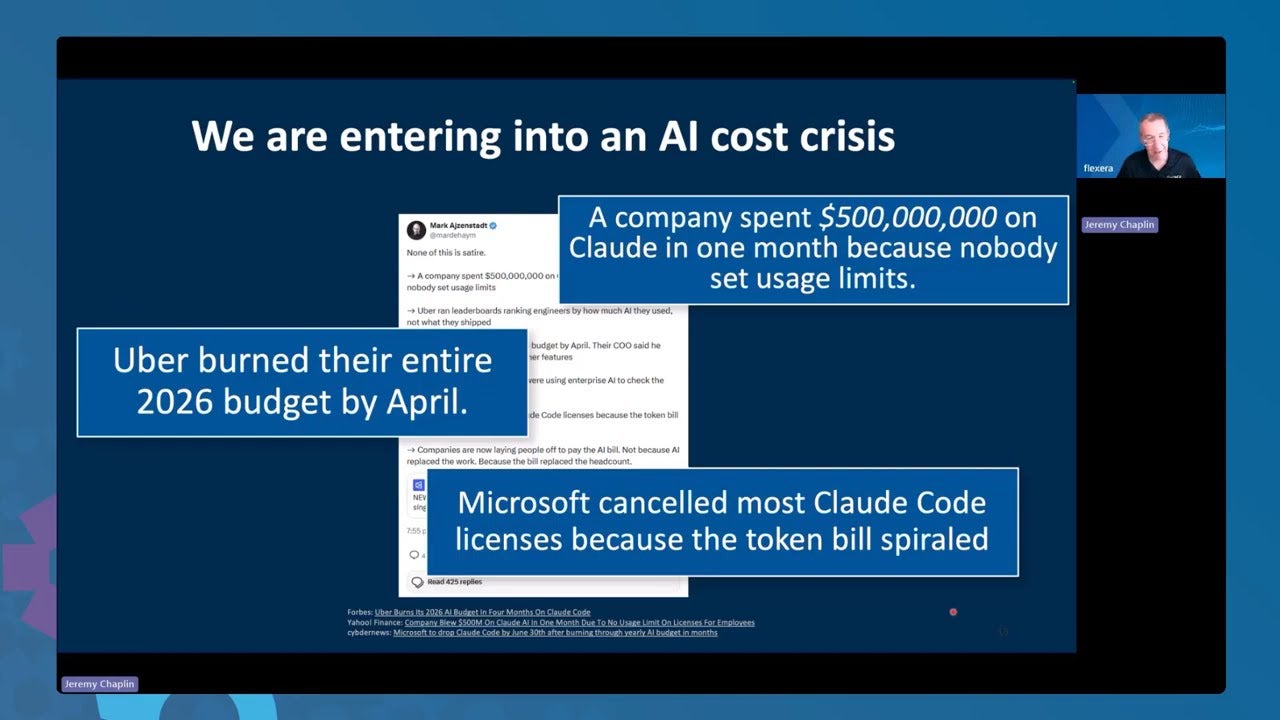
Um, so we we've lost visibility, right? It's almost like we've gone back to the cloud days or the data center days when we were doing virtualization or Kubernetes and suddenly you've got this opaque view of spend and how it relates to driving value and underpinning applications and other, you know, business context that you need to make informed decisions. Now I'm hearing that. I'm sure you're hearing that. But you're not alone in terms of very big organizations, the Ubers, the Microsofts of the world, and you know, spending 500 million on Claude in a month, right?
11:14
Uh crazy uh crazy kind of stories in the market. But these are real these are real problems and it might not be the same order of magnitude for you and your customers. Um but I'm sure that you're hearing the same the same stories. We need to get this in check. Uh and it's an interesting challenge as well because actually AI is not necessarily getting cheaper. Um it's supply constrained and it's the first time certainly in my life you know working in IT that we you know have to reset our expectations that these things get cheaper over time.
11:52
For sure, the cost of a token has fallen, but when you compare that to how token consumption has increased exponentially, it's not getting cheaper. And ultimately, we can't expect that uh token cost to continue to decline when there are supply constraints of both, you know, silicon and the raw materials and electricity and water and other things.
12:17
So you know a bit of a a kind of mind shift for me was also to think about this problem of value and about optimization of tokens in the production in the consumption you know side of things. How do I turn the raw materials, you know, that power my data center into tokens that I can consume and do that in the most uh efficient way so that I get more tokens, you know, for the money I'm investing and really this is an important part of the sustainability aspect that we've talked about and what's going on in your data center and licensing and hardware and everything else, right? Am I using the right GPUs? are being efficient even at the production and infrastructure level let alone at the software levels with models and different uh you know options to uh drive value.
12:57
So you know every decision uh every AI decision and action has a price tag. Um you know it it's again [snorts] it's about this opacity. We write a query into whatever kind of AI model that you might be using but do you know what it's going to cost? Do you know at the end of the day what the price will be? No.
13:17
There's complete uh you know completely no information telling you what it might be and that query might go off. It might trigger other models, might trigger other agents and things to take action. It's reasoning it's with itself. It's double-checking, you know, because you've asked it to validate the responses and other things. And so, you know, just to complete one task, you could have millions, if not tens of millions of tokens being consumed. And so the problem that we're facing and the problem that we really want to help you as partners solve here is what we're you know referring to as the AI economy or of course as you've heard from JR Stormman and others at the FinOps Foundation and now the Tokenomics foundation you know a AI Tokenomics [snorts] and we've kind of moved now away from the training and the changes there that hasn't gone away because the data layer is still important and I'll touch on things like data bricks and snowflake you know as we go through the demo.
14:21
Um, but we're into the kind of uh inferencing side of things where the compute is driving substantial usage, burning through tokens in real time and again, we've lost that view. Um, we need to get visibility here, of course, to start to be able to budget, start be able to forecast what my consumption is, but really more important, you know, to take this new unit of measure, the token if you will, and be able to attribute value to that, right? investment decisions that your customers are making have to be driven by understanding the value that that investment is making because if it's not driving value and not you know resulting in growth for an organization then you stop that investment or you change that investment and make different uh decisions.
14:58
So we'd love for you to you know leveraging the Flexera platform go to market with a you know Tokenomics as a service if you want to [laughter] you know call it that but you get the idea right how do we deliver managed services to our customers uh you know to help them with this new problem and again I'd love to hear from you but I'm sure they're knocking on your door in the same way that they are ours saying help us solve this problem and it's as I said it's a visibility problem but it's a new visibility problem not only just in the order of magnitude that we have here, right?
15:29
Gartner with their prediction and it was changing month by month. So, it very quickly went from 2 to 2.5 trillion. [clears throat] Uh, you know, and I hate to think what the projection is at this point, halfway through the year, but $2.5 trillion on AI spend. Um, lots of organizations reporting that actually their spend on technology surpasses the spend on human capital, right? which is a uh quite an inflection point for us to be in and really highlights the importance. But before we can do all these things at the side here that we're used to doing for cloud spend and we're still learning how to do it efficiently to be to be banded, we have to have the visibility, right?
16:08
We can't do those things without the context and the understanding of what we're spending. And as we've said, any organization, you know, using AI right now, it's not just a public cloud problem. It exists in all of the SAS applications. We've got hugely complex new license and consumption based models you know for charging you and ultimately it's a problem that exists in the data center in the data cloud as well. Um you know because of that uh you know supply constraint and the consumption that you might be running within data centers and of course the underlying data that powers the training and efficiency of the models we're running. Now I can tell you this of course um but you know we also hear it of course from practitioners.
16:51
This is the FinOps Foundation and their own survey state of FinOps for this year and you can see their strap line now you know where cloud has been replaced for technology as I was alluding to earlier but importantly 98% of FinOps practitioners people on the ground not vendors you know not analysts but people doing this are being tasked with um managing AI spend an increase over the year of 35% 90% looking at SaaS 64 4 licensing and then you know around the 50s mark for private cloud and data center. This is telling us that people are being tasked with solving this problem.
17:34
But it's pretty you know obvious to me given the conversations we've been having that we don't have the tooling necessary to support that. And of course this is where Flex era comes to help. you know what we're trying to do and what we've been doing of course with unit economics in cloud and more broadly across other technology domains or scopes if you want to use the FinOps foundation terminology is to get a total cost of ownership because if I'm powering you know my AI you know whatever it is chatbot or uh you know web checkout whatever it might be uh and I'm using cloud resources I might also have SaaS applications or data clouds powering at uh you know Kubernetes clusters licensing on premise I if we don't look at the total cost we can't you know by reasoning get to a point where we can understand the value and so not only is Flex era giving you this entire visibility of the technology stack but we recognize there's more okay so we're looking of course at the data platforms the snowflake data bricks as I alluded to earlier we have the insight for your infrastructure and cloud compute We have intelligence about what you're consuming on premise and we're building in visibility of those AI agents, the platforms, the models and the Tokenomics and ultimately the AI applications that maybe you're consuming directly from those vendors, right?
18:57
Not everything of course is being consumed from the cloud bill and more importantly we don't always get all of the information that we would need in order to attribute value um you know to the spend that we're ingesting and so what we want to do is of course get to this view of understanding the economics of the AI you're consuming who is consuming it and as we can see you know from the screenshots here not always a person could be a service account really important again to understand you the change in licensing now where you know an agent itself or AI itself can be deemed as a licensable user and a consumer of tokens and again a level of opacity that we need to solve. Um giving some sort of business context but also understanding what they're using is really important.
19:56
We know different models can be many orders of magnitude more expensive you know depending on the outcome and so understanding what's being used what the relative cost is and I say relative because again the licensing models are going to be very different across these services ultimately is what we need to be able to do to understand the value that they bring and this of course will be taken further in terms of model optimization and other things but ultimately we can't optimize what we can't See, and so we want to get a view of trends, right? What are we using? Again, which tools, where do they sit? Maybe it's within the SaaS space, maybe it's within the public cloud space, maybe it's direct to those vendors.
20:28
What are we spending over time? What is our forecast? You know, what is the trend of consumption here? And ultimately, we taking that further using our ML engine already that we have that predicts C cloud spend to give you that prediction and spend forecast. really really important because again we're seeing those customers burning through tokens at such a rate not sustainable they don't know that they're going to kind of run out you know halfway through the month or whatever it might be that these organizations are doing. So real problem here that we need to solve. Uh and then you know ultimately alerting on that right cost spikes, things running out of control, retries and other things that we've talked about here ultimately resulting in unwanted spend but also spend that you don't know about right and so we're kind of back again to the challenge that we're trying to solve um you know in the public cloud space in the early days about anomaly detection and uh just getting some sort of prediction of spend.
21:26
All right. So, that's it from a slide point of view. Although, we'll circle back and we'll have a little bit of time on some Q&A here. I'm just going to drop out of the PowerPoint deck uh and we'll take a look at the uh platform, have a look at that uh so that we can um show you a little bit about what I'm talking about here in terms of the platform capabilities. And what we're going to start with is understanding actually how the Flexera platform can help you um deliver the kind of capabilities that I've talked about to your customers. Super super easy for you to come into Flexera One.
21:58
Here we've got some white labeling. So you can brand these things in line with whatever you need as a partner or your customers need. But it's really easy to then come in and provision an organization. Provision a tenant would be the word that we would use for your customer to try or to have access to whatever capabilities that you've licensed. So I can go in and add a new customer. We'll add a new entry. Of course, you would give it a name and a description. But here is where you can then say, oh, you know, we're going to give them cloud cost optimization. Um, you know, and actually they're interested in the commitment management side of things and the sustainability module really important here. And so it's super easy to come in and manage your customers, provision a new organization, and that gets created in near real time, right?
22:49
That will be available in a few minutes for you, uh, and get them access to the capabilities that they need in order for you to deliver the services that ultimately drive value for those customers. And we can see here a great uh, you know, example, right? So we've got a customer created um, we can see, you know, creation date. We can see that we have delegated access. Our support teams can log in and get access to these customers. But importantly, we can then see the capabilities and remember that market slide, you know, the capabilities that we've exposed to them and of course then importantly any expiration dates, right? So provisioning a customer, getting them access to the platform, super super easy. And of course, you know, from a support point of view, you need to log in and access as that customer. you can do it.
23:41
Now, if you're a cloud service provider, a reseller of cloud, you're also going to want to delegate cloud spend from your own reseller, you know, structure through to that customer. And here we can see on a dashboard a really easy, really easy way, um, you know, to see that spend. Um, but as well as delegating the spend down to the customer, again, if you're in the kind of cloud resell business, many customers are, you want to be able to manipulate that spend. And there are lots of options here in terms of how we would do that.
24:12
Let's just add a new rule here as an example. Find the right one. Add a rule. So we can do anything with the spend right from the top level where we ingest it for you as a cloud reseller. manipulating our eyes and savings plans to ensure that the customer is seeing that in a way that they want and not necessarily how the cloud providers um you know spread the those discount mechanisms across bills you can start to rerate the services. So if you're providing your own support tiers, well let's take Amazon's AWS support, put our own tiers, right? Where we get discounts based on spend uh and ultimately rewriting pricing for other things, not just support, including you know volume discounts that they provide.
24:58
But you can also do this with credits, adding in custom credits, manipulating credits that come into the bill, deciding whether customers can see them or not, you know, and deciding whether tax is exposed or adding your own charges into the platform. So very very easy again to kind of you know manipulate the data so that ultimately you can manage margins and we have then a tool billing explorer that ultimately lets you do that. Right? Can I see the spend that is delegated down to my customers um you know and understand the margins that we are making there um on those customers right and so digging into that seeing the customer list bringing in metrics like the effective cost the list prices uh you know margins that you're making so simple reporting to say hey yes we've got these customers we've added these billing plans and structures to them these are the ones that are most effective ive for us and of course we can move customers around um you know within that structure as well. So super super powerful. You can also do things with billing history.
26:08
So as you ingest bills, of course, those bills change over time. You might not want to um you know expose those changes to customers. Or you might do, right? Again, right, credits might drop in, but you've invoiced your customer. Well, you don't want to reprocess that bill um for that customer unless you changes to billing rules, right? So you could just reprocess it uh or you could unlock it and reingest it for yourself so that you can see them see the new bills. So lots of opportunity then again to manage customers, manage the margins for those of you that might be resellers. But ultimately it's about the simplicity of giving your customers access [clears throat] to the broad set of capabilities that exist within Flexera here.
26:50
So what I'm going to do now is just switch gears a little bit and we'll have a quick look at our demo here um for the end customer and we'll talk a little bit about of course the AI spend management side of things that we've talked about in the second part of the webinar here. So here as an end user I'm seeing you know the spend that has been ingested into the platform. I have all of the kind of capabilities that I'm familiar with as a FinOps persona, but of course I can go in and I can start to dashboard and report on things. And of course, AI spend is part of that. Now, here we've got a view of AI and ML spend for this particular customer. It's bringing out all of the services that the customer is consuming um from their public cloud bill, right? And so pulling that data in, I can see that I can start to of course attribute it uh to different business uh you know services and things if I need to. I [snorts] can do anomaly detection. I can do budget and forecast and other things and if we have time we can have a look at that.
27:50
Um but as we said the problem doesn't just start uh you know with the kind of AI and ML that I'm ingesting um from the cloud bill. It starts at the data layer and so services like data bricks and snowflake are becoming immensely popular with customers but every customer that I speak to and you know Flexera themselves no exception in terms of being customers of these vendors you know has a cost problem it's a new cloud it's a new level you know of spend that I need to embrace and ingest and allocate accordingly and ultimately be able to optimize right how do I drive value out of it again of course it starts at the visibility layer
28:32
What am I spending? What services are we consuming here? Um, you know, from the uh cloud vendors, uh, you know, do I have other data bricks spend in the cloud bill? Uh, do we use data bricks AI services? Can we see, you know, the workspaces and bring in business context to that spend? What services and SKUs am I using from data bricks? Uh and then of course the compute types and other things which are really really important for optimization and of course optimization is going to be front of mind right engaging uh your customers engaging with you are going to be asking well so what of course visibility really helps me but can I do things to drive out cost and Flexera has a massively powerful set of optimization capabilities we saw of course commitment management which is powered by uh prosper And that that gives you uh automated commitment management capabilities resulting in up to you know 70% uh savings and a super super industry leading effective savings rate.
29:35
Those kind of things that you can deliver to your customers are really exciting because the return on investment is a predictable. So we can tell customers what they would save in a very short period of time but also the ROI the return uh start immediately as soon as you deploy that service you start saving money and so that means that you can deploy those things as you know a leading a land and expand opportunity where the returns then are invested in other parts of the platform. So that's on the kind of rate reduction side. But on the usage reduction of course recommendations for data bricks as well as all of the services that you're seeing you know paz and IAZ services that we see customers consuming in the public cloud space drill into that as an example.
30:20
Let's have a look at what's happening for data bricks. Right? So lot of right sizing of compute here. Okay, giving you ideas here about what we could downsize uh you know and ultimately switch nodes to different uh instance types to be more efficient with that spend. Um right sizing of clusters uh and the worker nodes that are running under those clusters if they're not being used effectively. Um you know and ultimately doing that for all purpose job clusters and other things both for the worker nodes and uh you know the controller nodes as well.
30:57
Um as we look ahead uh into the second half of the year, we'll be delivering similar recommendations of course for snowflake consumers uh and then looking at other areas where data cloud consumption the big queries and others of the world you know we can provide similar capabilities but again where we're going to similar to the prosper kind of uh you know uh capability delivering automatic outcomes and if you look at our uh you know solution for Kubernetes our ution platform. Again, it does exactly the same. It takes action for the customer delivering autonomous optimization and therefore the savings are banked immediately and of course uh reinvestable and so using the platform using the breadth of the capabilities of the portfolio uh helping your customers solve that problem. Let's have another look at some of the AI metrics again. You know, for those customers, digging into their cloud bills, seeing the different types of AI service that they're consuming here, digging into the kind of workload type or looking at the usage units here.
32:03
I've filtered it just to see how many tokens we're consuming of various services over time. And again, if you think about the capabilities that your customers are asking, you know, for budget, for forecast, for anomaly detection, well, I can do all of that again against the data that we're ingesting and surfacing um around AI consumption as well as bringing in spend from other areas, whether it's your SAS spend, um you know, maybe it's the AI spend, maybe it's the cloud spend, or even costs from the data center. So being able to get alerts and things where that spend goes out of control but also applying the business context and ultimately you know getting to the nana the Tokenomics understanding the value that those AI investments are uh you know making to your particular business here. Um so lots of capabilities here.
32:53
There's one more thing that I'm going to show you and I talked of course about ingesting a broad more broader set of capabilities. This is a mockup. This is not a product yet. will be delivered at the end of this month for our customers in early access here. But directionally this is where we will be going for a managing AI getting a sense of my c you know my spend where is that spend sitting is it SaaS is it the foundational models is it paz that's running within the cloud space um so that you can get a view of that right um being able to see the spend over the period of time tracking it understanding renewals that might exist in in the SaaS space um and ultimately being able to attribute that consumption understanding the trends and patterns you know to different parts of your business right the business context super super important here so you know can we do chargeback of AI the answer is probably not for uh many many customers here can we get you know some sort of view of what teams are doing what cost centers are consuming uh and ultimately the individuals and as we said the service accounts where AI is effectively consuming tokens itself all super important outcomes that we need to get to and ultimately then you know alerts forecasting projection of that spend being notified you know when things go wrong and are outside of your kind of budget threshold really really important to do that but also making sure you've got good coverage of AI as it is consumed within your organization.
34:28
So little sneak peek there of the capabilities that we have there. What I'm going to do now is just toggle back here uh and we'll just have a quick Q&A.
34:33
Hopefully that was really useful for you. Certainly um you know enjoyed the conversation here. Um we've had a few questions now from the audience. So I'm going to just take those as we go. But again if you have any further questions about Flexera about the platform program um you know or anything that we've shared here today again please do reach out partners at flexera.com here uh to learn more about the partner program to learn more about the solutions that we've shared here uh with you today.
35:04
So question one I've got here um what AI services do you support now and plan to support in the future?
35:10
Uh what a great question because there are many many of them right we have I think on our list 150 different services you know on top of the things that we already support in the SaaS and cloud domains not all of those are mature right we we're definitely on a journey here and nobody's completely solved the problem and many of these you know native connections and to the providers the foundational models and things maybe they don't have the APIs maybe they're not exposing the uh you know attribution data and metadata that lets us know who or what part of the business is consuming the tokens. Right? So yes, we've got a lot of 150. We're working through those rapidly. Um many of course we need the vendor to start making changes and start adopting things. And of course, you know, the Tokenomics foundation, the FinOps Foundation are working on standards there. The focus format, you know, will be extended to support all things Tokenomics. And again hoping that we can drive adoption from the vendors because again solving that problem and normalizing some of these data sources is part of the problem here. So good list it you know of course keen to hear from you about any uh particular services that you want supporting. Um but based on the conversations we've had with existing customers and partners uh we think we've got a pretty good understanding of where the demand sits. But again love to hear from you.
36:32
Uh all right we have another question. Providing visibility is a first step, but we're already being asked how do I save the money on AI?
36:38
Uh, you know, do you have plans to help customers ultimately optimize prompts and models and things? And of course, the answer is yes, right? As we've said, visibility is really key here. We have to solve that problem first uh before we can start to optimize. And there are some challenges in the optimization, right? You start to think about prompt optimization. Well, that requires us to be able to read the prompts and make some inference about whether they're efficiently written and so on. So, that's quite intrusive. Um, some customers, they may not want that level of intrusion and you kind of reading uh the specifics of what the customer is, you know, typing. So, there's a PII element, uh, you know, and a kind of sovereignty element, I'm sure, in those conversations. But we will do what we can and of course you will have options I guess uh you know based on the data that you allow us to gather in terms of how we can optimize those things for prompts and models and model routters and other things that that we can do to drive out cost. But remember as I said at the start it also starts at the point of production. So where you are running your own infrastructure uh and using GPU in the data center you can think about that layer as a first step to driving value and optimization.
37:48
Um third question here, can we access the data to produce our own views uh or applications? Do you support MCP server or API for example?
37:59
And yes, uh MCP server as well as our own natural language. Flexera assistant are available uh and will expose any of the data that Flexera has again MCP server across the platform. I think is in early access um you know coming GA uh later in the year here. So that absolutely supports customers accessing the data that we've gathered but maybe using their own models. Um the testing that I've seen from that has been super super effective just to sit clawed across that MCP server and ask questions like about workload placement and where might I host an application based on sustainability and cost and latency and you know those kind of big data problems where all of that data that Flexera stores is important in terms of reaching the right decisions. Um, so yeah, coming to coming soon. Uh, capabilities there.
38:43
Uh, do you have plans for enriching AI data with sustainability?
38:50
Well, absolutely. Uh, again, reach out to us if you'd like to see, but we do have an AI sustainability dashboard again being released. If it hasn't already, I think it's coming this quarter, uh, which will give you that insight, right, carbon emission against the AI that you're consuming. you know, nobody can't have seen the news as it relates to the kind of sustainability impact that the massive amounts of compute that AI needs uh you know is driving. So a particular concern here and of course something that we can do given the context that we have. Uh I've got time for one more I think here.
39:23
So who do we speak to? How do we get in touch for next steps?
39:29
Okay. Uh if I hadn't re already articulated it, please do reach out uh you know partners at flexera.com. uh and we'll be able to support you whether it's about the partner program or anything else you've seen here today. All right. Appreciate the time.
Let’s get started
Our team is standing by to discuss your requirements and deliver a demo of our industry-leading platform.